This site is supported by our readers. We may earn a commission, at no cost to you, if you purchase through links.
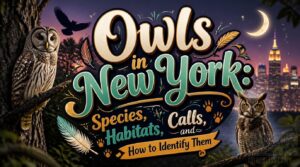
A Great Horned Owl can snap the neck of a skunk without catching a whiff of trouble, and Central Park hosts screech-owls roosting thirty feet from joggers who never look up. That’s the strange truth about owls in New York: they’re everywhere, from Adirondack forests to barn rafters in Dutchess County, yet most people walk past them daily without noticing.
Five species call this state home year-round or during migration, each wearing different camouflage and hunting on its own schedule. Learning their calls, sizes, and eye colors turns an ordinary walk into something closer to detective work.
Table Of Contents
- Key Takeaways
- Owl Species Found in New York
- How to Identify New York Owls
- New York Owl Habitats
- Owl Calls and Hunting Behavior
- Top 4 New York Owl Guides
- Frequently Asked Questions (FAQs)
- Are there wild owls in NYC?
- Can an owl pick up a 10 lb dog?
- What is the biggest owl in New York?
- What kind of owls are in Central Park?
- What is the most common owl in NY?
- Are owls good to have in your yard?
- What time of day do owls come out?
- What kind of owls hoot at night?
- How to attract owls to my backyard?
- What is the lifespan of New Yorks owls?
- Conclusion
Key Takeaways
- New York hosts five main owl species—Great Horned, Barred, Eastern Screech, Barn, and Northern Saw-whet—each identifiable by size, eye color, facial disc shape, and call, even in city parks like Central Park.
- Key identification traits include wingspan and weight (from the Great Horned Owl’s 5-foot span down to the Saw-whet’s palm-sized frame), facial disc condition, and eye color, which stays fixed and reveals genetic and health clues.
- Owls occupy diverse New York habitats—forests, grasslands, farmland, and urban parks—with each environment shaping how they hunt, nest, and face risks like rodenticide poisoning and habitat loss.
- You can support owls and enjoy natural pest control by skipping rodenticides, installing nest boxes 10–20 feet up, leaving dead trees and brush piles, and dimming outdoor lights at night.
Owl Species Found in New York
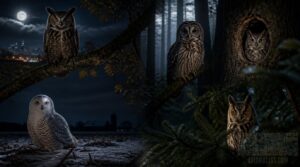
New York’s night skies host a surprising mix of owl species, each with its own size, sound, and hunting style. Some you’ll spot in city parks, while others stick to quiet farmland or deep woods. Here are five you’re most likely to encounter across the state.
For a broader look at raptors sharing these habitats, check out this guide to Illinois birds of prey, which highlights species beyond just owls.
Great Horned Owls
Great Horned Owls are the tigers of New York’s night skies, standing 18–25 inches tall with nearly a 5-foot wingspan. Females outsize males, a trait called sexual size dimorphism. Their talons grip with 28 pounds of force, enough to overpower skunks and geese.
You’ll hear their deep hoots at dusk, often defending territory fiercely against rival raptors. These predators use specialized fringed feathers to achieve silent flight.
Barred Owls
If Great Horned Owls are the tigers, Barred Owls are the neighborhood watch—round-headed, dark-eyed, no ear tufts, wrapped in brown barring that hides them against bark. Listen for "who cooks for you."
Round-headed and tuftless, the Barred Owl hides in bark-brown barring while asking who cooks for you
They’ve expanded their range across New York’s mature woods, hunting rabbits and squirrels from a perch. Their rodenticide exposure makes them a real nature health indicator.
Eastern Screech-Owls
Barely bigger than a soda can, Eastern Screech-Owls stand under 10 inches tall but pack serious personality into that bark-like body. You’ll spot gray or rufous color morphs, tiny ear tufts, and a teddy-bear face with yellow eyes.
Listen for a soft trill, not a hoot. They’ve mastered urban nesting, tucking into tree cavities from Central Park to your backyard maple.
Barn Owls
Trade that tiny trill for a ghostly hiss, and you’ve found the American Barn Owl. That heart-shaped facial disc funnels sound to asymmetrically placed ears, letting them pinpoint a vole rustling in tall grass, even in total darkness.
Watch for a low, hovering hunting flight over farmland. Nesting in barns and cavities, these silent rodent-hunters offer New York farmers free, natural pest control.
Northern Saw-whet Owls
Six inches shorter than a robin’s cousin, the Northern Saw-whet Owl proves size isn’t everything. Yellow eyes and a white facial disk give it away instantly.
Females outweigh males by roughly 25%. They’re cavity nesters, tucking into old woodpecker holes.
Listen for a "too-too-too" song at dusk. Three traits to remember:
- Yellow eyes
- Compact, stocky build
- Rufous-brown streaking
How to Identify New York Owls
Spotting an owl in the wild is one thing, but knowing which owl you’re looking at is a different skill entirely. Once you know what to look for, the clues are actually right there in front of you. Here are five key traits that’ll help you tell one species from another.
Size and Wingspan
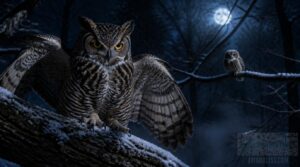
Size is your fastest clue in low light. A Great Horned Owl’s 39–57 inch wingspan dwarfs a Saw-whet’s 13–17 inch span, while weight tells you even more, from 2.6 kilograms down to a mere 40 grams.
Beyond size and weight, each species’ hoots and calls carry their own signature, much like the varied vocalizations detailed in this guide to Colorado’s heron species and habitats.
Watch for sexual dimorphism, too, since females are usually larger than males across most raptor species you’ll spot.
Facial Discs
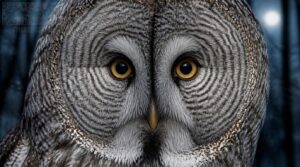
That flat, disc-shaped face isn’t just for looks, it’s a satellite dish for sound. Stiff feathers funnel noise straight to the ears, letting owls pinpoint prey through acoustic funneling and precise sound localization.
- Concave shape
- Camouflage patterns matching bark
- Feather symmetry
- Adjustable tension
- Health indicators like tattered edges
A ragged disc often signals stress, while a crisp one points to a sharp hunter.
Ear Tufts
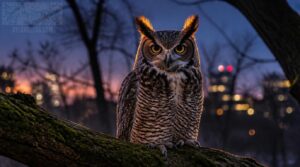
Those feathery "horns" atop a Great Horned Owl’s head aren’t ears at all—they’re pure theater. Ear tufts create larger silhouettes to deter rivals and predators, while doubling as camouflage that breaks up the head’s outline against bark and branches.
A common myth: tufts don’t boost hearing. That job belongs entirely to facial discs and actual ear openings hidden beneath the feathers.
Plumage Patterns
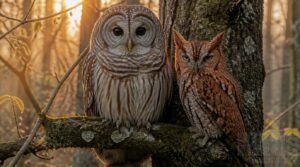
Feathers tell their own story. Barred Owls wear Barred Camouflage across their bellies, alternating dark and light lines that vanish among vertical branches. Eastern Screech-Owls rely on Mottled Texture, bark-like speckling in red or gray morphs.
Some species show Scaled Edges or Spotting Functions for signaling, while others flash Structural Coloration—light-refracted sheens rather than pigment—adding another layer to owl identification.
Eye Color
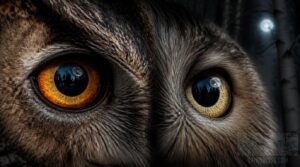
Look an owl straight in the eye, and you’ll spot a genetic fingerprint. Melanin concentration decides everything—Great Horned Owls carry dark amber eyes, while Saw-whets show pale yellow. Chicks hatch lighter, darkening with age.
This pigment also affects light sensitivity, helping raptor identification in dim woods. Eye color rarely changes, making it a trustworthy tool for wildlife identification across New York’s owl species.
New York Owl Habitats
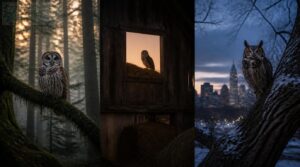
Where you find an owl often says as much about it as its call does. Across New York, owls have staked out everything from deep forests to old barns to city parks, each spot shaping how that species hunts, nests, and survives. Here’s a look at the habitats you’re most likely to find them calling home.
Forests and Woodlands
Deep woods hold New York’s owl secrets, layer by layer. Canopy layer diversity shelters Barred Owls in tree cavities, while emergent trees and understory brush create hunting perches.
Beneath it all, forest soil health thrives on decomposing leaf litter, fed by mycorrhizal network roles connecting oaks and maples. This nutrient cycling sustains prey populations, proof that healthy woodlands mean healthy raptors.
Grasslands and Fields
Step out of the trees and the sky opens up, wide fields where Short-eared Owls hunt by day. Their nests sit right on the ground, a bold move that leaves them vulnerable when open habitat vanishes—one reason they’re now endangered in New York.
Meanwhile, Snowy Owl migration patterns bring these arctic hunters into similar grassy stretches, supported by native plant diversity and healthy soil carbon storage.
Barns and Farmland
Old barns aren’t just farm relics, they’re prime real estate for the American Barn Owl, easily spotted by its heart-shaped white face. These structures offer sheltered nesting spots and habitat that mimic hollow trees.
Farmers often welcome them for free wildlife pest control. Nesting boxes near farmland support rural habitat corridors, while good farm drainage management keeps roosting sites dry and appealing.
Parks and Urban Areas
Farmland isn’t the only unexpected refuge — Central Park hosts Eastern Screech-Owls right in the Ramble and North Woods, proving urban wildlife adapts remarkably well.
Still, city life brings risks: vehicle collisions, building strikes, and rodenticide poisoning from contaminated prey all threaten these birds. Add habitat loss and human disturbance (photographers flushing roosting owls), and you’ll understand why birdwatchers should observe quietly, respecting these avian species’ fragile urban foothold.
Tree Cavities and Nests
Real estate matters even for owls. Woodpecker excavation carves out the first hollows, but natural decay often finishes the job as trees age. Barred Owls and saw-whets rely on these tree cavities for stable breeding grounds.
Nest box benefits include supplementing scarce spots, though cavity microclimates in old wood stay more temperature-stable. Habitat management preserving hollow trees keeps nesting habits diverse across New York.
Owl Calls and Hunting Behavior
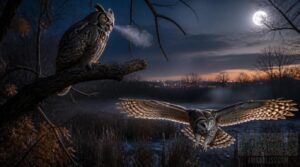
Once you know where to look for owls, the next step is learning how to find them by ear. Every species in New York has its own voice, and its own rhythm for hunting, whether that’s under cover of darkness or right in broad daylight. Here’s what to listen and watch for.
Barred Owl Hoots
Who cooks for you?" That familiar phrase captures the Barred Owl’s classic hoot pattern in New York’s woodlands.
- Rising, rhythmic hoots that echo through misty forests
- Territorial calls warning off rival owls after dark
- Duets between mates syncing before nesting season
- Weather and dialect shifting each bird’s unique voice
Wind and rain dampen these calls, while moonlit nights bring louder, more frequent hooting bouts.
Screech-Owl Trills
Eastern Screech-Owls trade hoots for a bouncing trill, 8-12 notes per second, like a small ball skittering across a forest floor.
| Trait | Detail | Why It Matters |
|---|---|---|
| Rate | 8-12 notes/sec | ID clue |
| Timing | Dusk, breeding season | Mate coordination |
| Texture | Raspier in cities | Urban acoustic adaptation |
Pitch shifts with temperature, age, and location—your local soundtrack, uniquely tuned.
Barn Owl Screeches
Forget the trill—Barn Owls skip music altogether and go straight for a raspy, high-pitched screech, lasting 1-4 seconds.
It’s a Swiss Army call: territorial warnings, courtship crescendos, prey-locating beacons, and sharp alarm bursts, all shaped by pitch and rhythm.
Each bird carries its own vocal signature. In New York’s nocturnal darkness, that screech might sound eerie—but it’s simply an owl saying, "I’m here.
Nocturnal Hunting
Picture pitch-black woods where a mouse’s rustle gives it away instantly—that’s an owl’s world.
**Silent flight comes from fringed wing feathers muffling airflow, while asymmetrical ear placement and acoustic facial discs pinpoint prey under leaves or snow. Night vision adaptations gather what little light exists.
Barred and Great Horned Owls perch, listen, then drop like stones onto small mammals, talons first.
Daytime Owl Activity
Not every owl waits for dark. Short-eared Owls are true diurnal hunters, coursing over grasslands at midday for voles.
Their eyes pack extra cone cells for sharp daylight vision, while pupils constrict against glare. You’ll catch them sun-basking on fence posts, preening feathers, or delivering territorial calls near nest sites—breeding season turns these New York fields lively well before sunset.
Top 4 New York Owl Guides
Once you’ve spent time listening for hoots and scanning tree cavities, you’ll probably want a solid reference to keep learning at home.
Field guides and posters can turn a lucky sighting into real identification skills, especially when New York’s owls overlap in size and coloring.
Here are four guides worth having in your bag or on your wall.
1. Owls of North America Reference Book
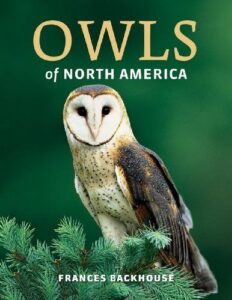
If your shelf has room for one heavyweight owl book, this is it. Firefly’s Owls of North America runs 216 pages packed with 70 color photos and profiles on 19 species, complete with range maps and population status.
You’ll find real depth here, breeding behavior, hunting strategy, nesting habits, not just field-guide basics. It’s sold used and in good condition, which keeps the price friendly. For New York birders wanting the full story behind a hoot in the dark, this reference earns its weight (nearly 2 pounds!) on your shelf.
| Best For | This book is best for birders, naturalists, and ornithology enthusiasts who want an in-depth reference on North American owl species. |
|---|---|
| Format | Book |
| Species Coverage | 23 species |
| Region Focus | North America |
| Visual Content | 70 color photographs |
| Educational Use | Birding reference |
| Made In | Not specified |
| Additional Features |
|
- Covers 23 species with detailed profiles and range maps
- Features 70 color photos showing real behavioral detail
- Goes beyond basics into anatomy, mating, feeding, and nocturnal adaptations
- Only covers North American species, so it’s not a global reference
- Sold used, so it won’t have that brand-new book feel
- Listed in good rather than new condition
2. Peterson guide to north american owls
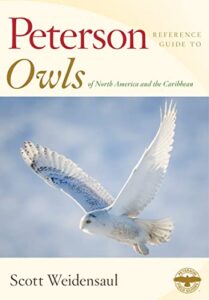
Want something even broader in scope? The Peterson Reference Guide to Owls of North America and the Caribbean covers 39 species across the region, with hundreds of color photos and range maps showing breeding and wintering grounds.
At 352 pages, it leans heavily on vocalization identification, useful since you’ll often hear a Barred Owl’s "who cooks for you?" before spotting one. Published in 2015, it’s a solid field companion, though its 2.36-pound heft means it’s better suited for the car than a long trail hike.
| Best For | Serious birders, ornithologists, and dedicated hobbyists who want a thorough reference for identifying owl species across North America, Mexico, and the Caribbean. |
|---|---|
| Format | Book |
| Species Coverage | North American, Mexican, Caribbean species |
| Region Focus | North America, Mexico, Caribbean |
| Visual Content | Hundreds of color photographs |
| Educational Use | Field identification guide |
| Made In | Not specified |
| Additional Features |
|
- Covers 39 species with detailed range maps and hundreds of color photographs for accurate visual ID
- Includes access to owl vocalization recordings, making it easier to identify species by sound alone
- Offers in-depth info on habitat, nesting behavior, and conservation status for a well-rounded understanding of each species
- At 2.36 lbs, it’s on the heavier side, making it less practical for long hikes or lightweight packing
- Published in 2015, so some species data or conservation statuses may be outdated
- Requires a separate device or digital access to use the audio recordings, which adds an extra step in the field
3. Sibley Eastern North America Owls Poster
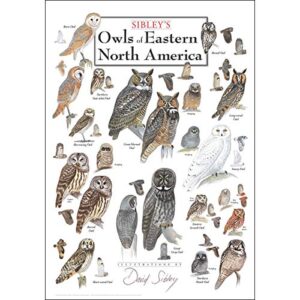
If a field guide feels like homework, this poster feels like art. David Allen Sibley illustrates 13 eastern species at near-to-scale size, so you see at a glance how a Great Horned Owl’s bulk dwarfs a Saw-whet’s palm-sized frame.
Printed on heavy coated stock with fade-resistant inks, it’s built for framing, not filing away. At 19×27 inches, it’s a classroom or study wall focal point, arriving in a protective tube with endcaps so shipping damage isn’t a worry.
| Best For | Bird enthusiasts, naturalists, and educators who want a museum-quality, near-to-scale reference for identifying Eastern North American owl species. |
|---|---|
| Format | Poster |
| Species Coverage | 13 regional species |
| Region Focus | Eastern North America |
| Visual Content | Illustrations by David Allen Sibley |
| Educational Use | Classroom bird ID resource |
| Made In | USA |
| Additional Features |
|
- Near-to-scale illustrations from David Allen Sibley make size comparisons between species immediately clear
- Fade-resistant inks and heavy coated stock give it lasting, museum-quality durability
- Ships securely in a protective tube with endcaps, minimizing risk of damage in transit
- Only covers Eastern North American species, so it won’t help with regional identification elsewhere
- Requires separate framing to achieve its full wall-art potential
- Packaging includes plastic components, which may not appeal to those avoiding plastic materials
4. Sibley western North America owl poster
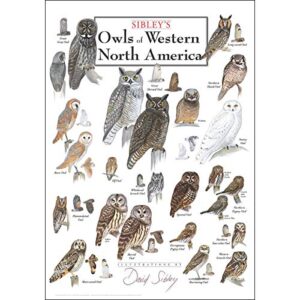
Sibley made an eastern edition, but he didn’t stop there. The western counterpart covers species you won’t spot in Central Park, yet it pairs beautifully with its eastern sibling for anyone building a complete reference wall.
Same 19×27 format, same fade-resistant printing, same protective tube shipping. If you’re already collecting field guides, having both regions side by side gives you a genuine coast-to-coast owl education, even if your backyard sightings stay firmly New York.
| Best For | Bird enthusiasts, ornithology students, and Western North America nature lovers who want a museum-quality reference piece for identifying local owl species. |
|---|---|
| Format | Poster |
| Species Coverage | 17 species |
| Region Focus | Western North America |
| Visual Content | Illustrations by David Allen Sibley |
| Educational Use | Bird watching reference |
| Made In | USA |
| Additional Features |
|
- Features detailed, scientifically accurate illustrations of 17 owl species by renowned ornithologist David Allen Sibley
- Museum-quality construction with fade-resistant inks makes it suitable for long-term display and framing
- Ships in a heavy-walled protective tube, ensuring it arrives in pristine condition
- Requires separate framing to achieve its full decorative and educational impact
- Large 19 x 27 inch size demands dedicated wall space, which may not suit smaller rooms
- Focused specifically on Western species, so it offers limited value if you’re primarily interested in Eastern owls
Frequently Asked Questions (FAQs)
Are there wild owls in NYC?
Perched in tree cavities, tucked in park woodlands, hidden along coastal edges—yes, New York City hosts wild owls year-round.
Great Horned Owls nest in all five boroughs, while Screech-Owls, Barred Owls, and even Saw-whets turn up in parks like Central and Prospect.
Can an owl pick up a 10 lb dog?
Realistically, no. Even a great horned owl, our strongest lifter, tops out around 8 to 9 pounds under ideal conditions. A 10 lb dog exceeds that limit, so attacks usually cause injury rather than an actual carry-off.
What is the biggest owl in New York?
That title goes to the Great Horned Owl, stretching 18–25 inches with a 4–5 foot wingspan and weighing up to 5 kg. Its ear tufts and bulky frame make it an unmistakable, powerful presence across New York’s woodlands.
What kind of owls are in Central Park?
Manhattan’s most exclusive residents don’t need reservations. Great Horned and Eastern Screech-Owls claim the Ramble as prime real estate, while Barred Owls favor dense trees near water—proof that even a concrete jungle offers surprisingly wild penthouse views.
What is the most common owl in NY?
Your best bet for a common sighting is the Great Horned Owl, found statewide from suburban edges to deep woods. Standing up to 25 inches tall with a 5-foot wingspan, its low hoots and ear tufts make it easy to spot.
Are owls good to have in your yard?
Yes—owls offer natural rodent control, hunting mice and voles right in your yard. A single Barn Owl can eat hundreds of rodents yearly, so leaving dead trees standing and skipping rodenticides keeps them safe and welcome.
What time of day do owls come out?
Dusk is your best bet. Most owls are nocturnal hunters, becoming active as light fades and hunting into the night, though some, like Great Horned Owls, occasionally forage during cold winter days when prey grows scarce.
What kind of owls hoot at night?
Great Horned Owls hoot in 1–2 second deep notes, Barred Owls chant "who cooks for you," while Screech-Owls trill instead.
Saw-whets whistle rapidly, and Barn Owls skip hoots entirely, favoring eerie screeches for nighttime communication and territory calls.
How to attract owls to my backyard?
Skip poison, keep it dark, and let nature do the rest. Install a nest box 10–20 feet up, leave brush piles for prey, add a shallow water source, and dim outdoor lights—owls need quiet, cover, and hunting habitat to settle in.
What is the lifespan of New Yorks owls?
Lifespans vary widely by species: Great Horned Owls can live 5–10 years (sometimes 15+), Barred Owls 7–10 years, Screech-Owls 4–7 years, Barn Owls 4–9 years, and tiny Saw-whets usually 5–7 years in the wild.
Conclusion
Next time dusk settles over your neighborhood, something with silent wings might already be watching you. That’s the real gift of studying owls in New York: once you learn a call or a silhouette, you can’t unsee them.
Screech-owls in the maple, a barn owl ghosting over a hayfield, a saw-whet tucked in cedar. Grab binoculars, step outside at twilight, and let your backyard reveal its quiet hunters. You’ll never walk past a tree the same way again.