This site is supported by our readers. We may earn a commission, at no cost to you, if you purchase through links.
Stand beneath a tree at dawn, and you’re eavesdropping on one of nature’s most intricate communication networks. That sharp ‘chip’ from the robin isn’t random noise—it’s a contact call keeping the flock connected. The cardinal’s rising whistle? A territorial anthem warning rivals to keep their distance.
Understanding the types of bird songs and calls transforms what sounds like morning chaos into a readable language, where every chirp, trill, and screech carries specific meaning. Birds don’t waste energy on meaningless vocalizations; each sound fulfills a distinct purpose, from announcing danger to wooing a mate.
Once you crack the code, you’ll realize the airwaves are alive with conversations you’ve been missing your entire life.
Table Of Contents
- Key Takeaways
- Bird Calls Explained
- Bird Song Characteristics
- Types of Bird Calls
- Non-Vocal Bird Sounds
- Bird Sound Identification
- Species Specific Sounds
- Bird Communication Methods
- Frequently Asked Questions (FAQs)
- What are the four types of bird calls?
- What are the five voices of birds?
- What is the most common song bird?
- How do birds learn their first songs?
- Why do some birds sing at night?
- Do female birds ever sing or call?
- How far can bird calls travel?
- What affects bird vocal sound quality?
- How do birds learn their songs from parents?
- Can birds recognize individual voices of other birds?
- Conclusion
Key Takeaways
- Bird calls serve as functional, year-round communication for daily survival tasks (contact, flight coordination, alarm warnings, begging), while songs are complex, learned performances reserved primarily for mate attraction and territorial defense during breeding season.
- Each vocalization carries specific meaning through measurable acoustic features—chickadees add more “dee” notes to alarm calls based on predator proximity, and urban birds adjust call frequency and duration to cut through traffic noise, demonstrating sophisticated adaptability.
- Birds produce sounds beyond vocalizations through mechanical means like wingbeats, feather stridulation, beak smacking, and even echolocation in cave-dwelling species, expanding their communication toolkit beyond the syrinx.
- Modern technology has democratized bird sound identification through spectrogram analysis achieving 88-90% accuracy, massive digital archives containing millions of recordings, and systematic active listening techniques that train your ear to recognize species-specific acoustic signatures and regional dialects.
Bird Calls Explained
Bird calls serve as the everyday language of avian communication, distinct from the elaborate songs you hear during breeding season. While songs are complex melodies reserved for courtship and territorial defense, calls are short, functional sounds that birds use throughout the year to navigate their daily lives.
Understanding the main types of calls will help you decode what birds are saying to each other in your backyard or out in the field.
Contact Calls
Contact calls crack open the hidden world of how birds stay connected. These short, simple vocalizations—often just milliseconds long—are your first clue to understanding bird communication strategies.
You’ll hear them most when flocks forage through dense cover, with each species broadcasting unique vocal signatures that prevent mix-ups. Call structure varies by social context: birds ramp up their rate in larger groups and when bonding with mates.
Through acoustic analysis, researchers confirm these sounds encode individual identity and group membership. When visual contact fails, contact calls become acoustic beacons, pulling separated birds back together and strengthening social bonds that hold flocks intact.
The study of group living dynamics provides valuable insights into the complex relationships between birds and their environments.
Flight Calls
While contact calls keep foraging flocks connected on the ground, flight calls serve as nature’s in-flight navigation system—especially powerful during nocturnal migration when most North American migrants take wing under cover of darkness. These brief vocalizations help coordinate bird navigation across vast distances, with acoustic monitoring revealing staggering vocal activity: one study captured nearly 2.9 million nocturnal flight calls over three fall seasons. You’ll detect these sounds most intensely during peak migration windows, when calling rates surge as birds pass over urban areas or fly through overcast conditions at lower altitudes.
Flight calls enable:
- Group cohesion during long-distance journeys when visual contact fails
- Species recognition in mixed-flock encounters aloft
- Collision avoidance in dense flocks, particularly around illuminated structures
- Real-time flight patterns tracking for conservation through automated acoustic monitoring systems
This vocal learning adaptation proves essential for survival across migration routes. Researchers study artificial light effects to better understand bird migration patterns.
Alarm Calls
When predators appear, birds emit sharp, urgent warnings that cut through any landscape—nature’s emergency broadcast system kicking into high gear. These alarm calls showcase advanced threat detection you won’t find in simpler vocalizations. Chickadees famously adjust their “chick-a-dee-dee-dee” calls based on danger level, adding more “dee” notes when hawks perch closer. That’s predator warning with striking precision.
When predators appear, birds emit sharp, urgent alarm calls—nature’s emergency broadcast system that showcases advanced threat detection with striking precision
Acoustic adaptation shapes these sounds for survival. White-browed scrubwrens produce distinct “buzz” calls for ground threats and “trill” calls for aerial predators, demonstrating vocal learning that saves lives. Urban tree sparrows even modify alarm response patterns in noisy environments, stretching call duration to punch through traffic din.
| Call Type | Target Threat |
|---|---|
| Buzz calls | Ground predators nearby |
| Trill calls | Flying predators overhead |
| Mobbing calls | Perched owls or hawks |
| Parasitism alarms | Brood parasites approaching |
Interspecies communication runs deep here—over 50 bird species respond to chickadee mobbing calls, proving avian communication transcends species boundaries.
Begging Calls
While alarm calls warn of danger, nestling begging calls function as acoustic hunger signals that drive parental response. These high-intensity vocalizations reveal intricate nestling behavior—hungry chicks increase call rate and shift frequency structure to honestly signal need. Energy expenditure during begging runs roughly 28% higher than resting, proving these aren’t cheap signals.
You’ll recognize begging call structure by its:
- Wide frequency range with abrupt onsets
- Condition-dependent amplitude shifts
- Quantifiable relationship between call rate and hunger level
- Developmental changes as nestlings mature
Parents adjust provisioning accordingly.
Bird Song Characteristics

Bird songs stand apart from calls through their unmistakable complexity and purpose. While calls serve immediate practical needs, songs are elaborate performances that birds perfect through practice and repetition.
You’ll recognize three defining features that set these vocalizations apart from simpler communication sounds.
Melodious Sounds
You’ll recognize melodious sounds by their intricate song patterns and harmonic analysis. Bird vocalizations unfold across frequency ranges of 1,000 to 8,000 Hz, with some species reaching even higher pitches. These avian vocalization types showcase spectral complexity through frequency variation—think of the Song Sparrow’s 2-3 second performances featuring multiple song types, or the Wood Thrush’s flute-like phrases lasting 4-6 seconds.
Bird sound identification becomes easier when you understand melodic structure: listen for how notes connect in harmonic intervals, creating patterns that echo musical scales. Young males polish their bird songs through practice, developing the intricate tunes that define dawn’s layered chorus.
Mate Attraction
Precision matters when a male songbird stakes his claim to a mate. Song complexity directly predicts reproductive success—in about 60% of studied species, females choose males with elaborate courtship songs featuring higher rates and longer durations.
Vocal learning facilitates this mate attraction technique: young males perfect their bird vocalizations through practice, transforming courtship displays into powerful avian communication that wins over discerning females and outcompetes rivals.
Territorial Defense
Dominance in the avian world demands more than beautiful melodies—territorial songs function as acoustic fences that mark spatial ranging boundaries and repel intruders. You’ll observe these territorial defense strategies in action:
- Deterrent broadcasts reduce territory intrusions by roughly 50% compared to silence
- Aggression signals through song structure convey threat levels to rivals
- Energetic costs reach 3.1 times basal metabolic rate during intense singing
- Territorial marking strategies combine alarm calls with bird vocalizations to establish territorial boundaries
Types of Bird Calls
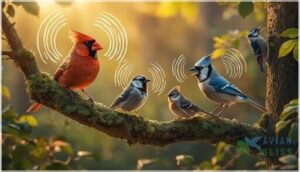
Beyond the basic categories you’ve learned, bird calls branch into even more specialized sounds that reveal what’s happening in a bird’s world right now. Each type fulfills a distinct purpose, from asserting dominance to signaling contentment.
Let’s break down four key call types you’ll encounter in the field.
Repetitive Trills
When you hear a rapid-fire burst of identical notes—a trill—you’re catching a bird’s most technically demanding vocal stunt. These acoustic properties reveal serious vocal learning: birds face a biomechanical trade-off between trill speed and frequency range, making high-performance trills honest signals of fitness.
Dark-eyed Juncos showcase this with metallic trills, while species like White-crowned Sparrows adjust trill patterns to cut through urban noise.
In mate attraction and territorial showdowns, trill complexity broadcasts quality.
Scolding Calls
When birds mob a perched hawk or cat, you’re witnessing one of nature’s boldest anti-predator strategies. Scolding calls—harsh, broadband alarm calls—serve dual functions: they harass stationary predators while recruiting backup from nearby birds. Species like jays, chickadees, and wrens use this threat signaling to coordinate mobbing behavior across mixed flocks.
Call rate reveals danger level—faster scolding means higher risk—and these predator alert vocalizations can hit 100 decibels at close range. Through bird sound identification, you’ll recognize contact calls versus true alarm calls by their urgent, repetitive rhythm during active confrontations.
Distress Calls
When a bird unleashes a piercing scream during capture or attack, you’re hearing one of nature’s most primal acoustic alerts—distress signals that differ sharply from routine alarm calls. These high-frequency bird vocalizations (peaking between 4,000–8,000 Hz) serve critical functions:
- Attract parents and flock members to intervene
- Startle predators into momentary hesitation
- Warn nearby birds of immediate predator threats
- Coordinate group mobbing responses
- Mark high-risk locations for the community
Through bird sound identification, you’ll recognize these urgent acoustic alerts by their rapid, desperate quality during life-threatening encounters.
Pleasure Calls
While distress signals broadcast urgent danger, you’ll encounter an entirely different acoustic dimension when birds express contentment through soft purring, gentle chattering, and undirected song. These Pleasure Call Types reveal Avian Emotions tied to intrinsically rewarding experiences rather than survival imperatives.
Neurobiological research shows that undirected singing—melodious vocalizations produced without an immediate social audience—correlates strongly with opioid peptide density in reward centers of songbird brains, suggesting genuine Vocal Rewards from the act itself. This Brain Chemistry explains why starlings sing elaborate sequences during solitary moments, reinforcing positive states through natural dopamine and enkephalin release.
You’ll also observe affiliative “purr calls” during foraging, where Social Bonding vocalizations recruit flock members to feeding sites and strengthen group cohesion, distinguishing these rewarding Bird Vocalizations from utilitarian Contact Calls or Alarm Calls.
Non-Vocal Bird Sounds

Not all bird sounds come from the syrinx. Beyond their vocal repertoire, birds produce a fascinating array of mechanical sounds using wings, beaks, and other body parts to communicate with their surroundings.
Here’s what you’ll encounter when listening beyond the traditional song.
Wingbeats
Wingbeat patterns generate powerful nonvocal sounds that reveal bird identity even when you can’t see the species. Flight mechanics drive these acoustic signatures—hummingbirds whir at high frequencies while geese produce deep whooshes. Wing structure determines aerodynamic noise intensity, with broader wings creating lower tones. You’ll notice turbulence effects heighten wingbeat sounds, particularly at lower altitudes.
These bird sounds provide essential identification clues:
- Small species flap faster, producing higher-pitched wing noise
- Downstrokes generate louder aerodynamic noise than upstrokes
- Wing surface area correlates directly with sound pressure levels
- Courtship displays feature specialized percussive wingbeats
- Turbulence increases both frequency and amplitude variations
Understanding bird behavior patterns through auditory perception in birds transforms how you identify species in dense habitats.
Scraping Sounds
You’ll hear mechanical noises when feathers rub together or feet scrape against substrates—nonvocal sounds that carry surprising weight in avian communication. Club-winged manakins strum specialized wing feathers at 1500 Hz during courtship displays, creating continuous tones without any bird vocalizations. Penguins produce substrate scraping through pebble manipulation at nest sites, generating acoustic signatures that mark territory.
These bird sounds complement traditional bird calls in bioacoustic monitoring, revealing species presence even when visual identification fails. Feather stridulation and ground contact create distinct patterns you can learn to recognize.
Beak Smacking
When rapid mandible strikes produce sharp mechanical sounds, you’re witnessing percussive behavior that rivals any bird vocalizations in communicative power. These nonvocal signals appear most often in species with limited vocal repertoires, where beak smacking fills the ecological role that elaborate bird calls occupy elsewhere.
Bill clattering in white storks functions as their primary acoustic signal—greeting mates, defending nests, and coordinating breeding colonies without complex bird songs. Context matters: storks clatter slowly during copulation but deliver brief, intense bursts as alarm signals.
Beak snapping in barn owls forms graded threat displays, while woodpeckers drum on hollow branches for territorial defense and mate attraction over hundreds of meters.
Echolocation
Deep in tropical caves, you’ll find nature’s acoustic rebels breaking all the rules. Oilbirds and swiftlets navigate pitch-black roosts using echolocation basics—clicking sounds between 1 and 10 kHz that bounce off walls as bird sonar.
These auditory perception systems evolved independently from bats, proving that cave navigation through echo location works brilliantly even without ultrasound. It’s acoustic ecology at its most ingenious.
Bird Sound Identification

You don’t need a PhD to start identifying birds by their sounds—you just need the right approach and a bit of patience. Whether you’re working with apps, recordings, or your own ears, the tools available today make sound identification more accessible than ever.
Here’s how to turn those mysterious chirps and trills into recognizable species.
Visual Tools
Spectrogram analysis has revolutionized bird identification, letting you see what you hear. These visual tools convert bird songs into color-coded frequency maps that reveal patterns your ears might miss. Modern acoustic monitoring platforms combine this visual classification with field guides, transforming bird watching from educated guessing into systematic discovery.
You’ll gain confidence when you understand that:
- Audio visualization displays time-frequency relationships in real-time
- Automated systems achieve 88–90% accuracy on reference datasets
- Wildlife conservation teams now rely on 24/7 visual monitoring for population tracking
Break free from uncertainty—spectrograms make the invisible audible.
Audio Clips
Digital archives have shattered the barriers to understanding bird vocalizations. You now have access to over 835,000 bird sound recordings spanning more than 10,300 species—a rebellion against ignorance. The Cornell Lab’s Macaulay Library alone holds over 10 million audio clips for acoustic monitoring and sound pattern analysis.
These bird recordings let you decode intricate bird songs and calls through audio analysis, whether you’re tracking regional dialects or comparing frequency shifts. Modern bird sound analysis tools achieve 86% precision on real-world bird vocalizations, turning your smartphone into a field laboratory for digital discovery.
| Archive Platform | Key Features |
|---|---|
| Xeno-canto | 835,000+ community-contributed clips worldwide |
| Macaulay Library | 10 million+ curated audio assets with spectrograms |
| BirdNET Database | Automated identification across 984 species |
Field Guides
You can’t break free from guesswork in bird identification without the right tools in hand. Field Guides—both printed and digital—remain essential Conservation Tools that transform casual observers into skilled practitioners of Bird Species Identification.
Digital Guides now dominate the market, projected to reach 3,500 million USD by 2035, integrating Audio Resources with detailed species profiles for thorough Bird Sound Analysis.
Whether you’re conducting Field Research or simply engaged in Bird Watching and Birding, these Ornithology references provide the systematic framework you need for confident Bird Identification across diverse habitats and regional populations.
Active Listening
Your ear becomes a precision instrument when you commit to Active Listening—the cornerstone of mastering Bird Songs and Bird Calls. Research on birdsong perception shows you’ll most accurately judge tempo when focusing on 200- to 300-millisecond intervals, matching natural syllable durations in Bird Vocalizations. This Focused Attention trains your Auditory Perception through measurable Cognitive Adaptation: studies reveal recognition accuracy climbs markedly across successive sessions as your brain fine-tunes to specific motifs.
Start your Auditory Training with familiar backyard species during quiet mornings, dedicating 10–15 minutes daily to recordings without visual aids. Sound Awareness develops through structured practice—participants in “woods ears” exercises documented improved recall of species-specific vocal features compared with baseline attempts, proving intentional engagement unlocks identification breakthroughs.
Species Specific Sounds
Every bird species has evolved its own acoustic signature—a unique set of sounds that sets it apart from the rest. Think of it as each bird’s personal calling card, shaped by millions of years of evolution and fine-tuned by its environment.
Let’s explore the four key ways these species-specific sounds reveal themselves in the field.
Unique Calls

Each bird species broadcasts its own acoustic signature—individual signatures so distinct that researchers can identify single birds from recordings. Contact calls maintain flock cohesion, while alarm calls warn of specific threats with striking precision. African penguins achieve 61% correct caller identification through unique vocal features, and monk parakeets show classification accuracies 36 percentage points above chance.
These acoustic variations power conservation monitoring efforts, letting scientists track populations without capture. Duet patterns in over 400 species create joint signals for territorial defense, while begging calls and flight calls round out each species’ vocal toolkit for survival.
Regional Dialects
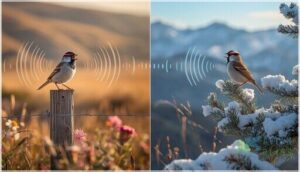
You’ve seen how each species has its own voice—now here’s where it gets wild: birds in different regions speak with accents. Geographic variation in bird songs runs deeper than you’d think. Just as young songbirds learn from adult tutors during sensitive periods, regional dialects form through cultural transmission across generations. In White-crowned Sparrows, these boundaries can shift over distances of just tens of kilometers, with neighboring populations singing entirely different tunes.
Ruby-crowned Kinglets showcase this dialect formation beautifully—researchers have mapped eight distinct regional song dialect regions across their breeding range, each tied to specific ecoregions. Within these zones, two or three dominant phrase types account for over 70% of recorded bird vocalizations, proving strong local conformity.
Urban environments push dialect evolution further, as city birds raise their pitch to cut through low-frequency noise. This song learning creates living maps of sound, where bird calls mark invisible territories as clearly as any border.
Mimicry

Regional dialects show how birds inherit local sounds—but vocal imitation takes this learning to radical new heights. About 11–15% of songbird species practice avian deception, copying heterospecific bird vocalizations with stunning cognitive adaptation. Here’s what sound learning achieves across mimicry types:
- Lyrebirds mimic 11–27 species in sequences lasting nearly 40 seconds
- Mockingbirds blend dozens of bird calls into territorial defense songs
- Parrots reorganize learned words into new contextual phrases
- Urban catbirds adjust mimicry based on local noise levels
- Starlings weave mechanical sounds with natural bird songs
This vocal imitation isn’t random—it fulfills mate attraction, territorial marking, and social integration through intricate mimicry.
Song Complexity

Vocal imitation stretches acoustic boundaries, but song complexity measures how deeply evolution sculpts bird vocalizations. You’re witnessing performance artistry when males deliver repertoires ranging from modest catalogs to virtuosic displays exceeding 300 syllables—skylarks push those limits relentlessly.
Repertoire size varies dramatically: about 80% of songbirds maintain 1–25 song types, while rare specialists stack hundreds of variations. Acoustic features like frequency modulation and syllable patterns determine versatility, with machine learning now achieving 93% accuracy in bird song identification using just six spectral measurements.
| Complexity Metric | Typical Range | Champion Examples |
|---|---|---|
| Song Types per Bird | 5–25 varieties | Rock Wrens: 108+ types |
| Syllable Repertoire | 20–100 elements | Skylarks: 300+ syllables |
| Structural Diversity | Shannon entropy 2–4 | Weaverbirds: colony-driven variety |
Evolutionary traits link complexity to mating success—females often choose elaborate singers in competitive breeding colonies, driving song versatility upward across generations.
Bird Communication Methods

Birds don’t rely on sound alone to get their message across. They’ve developed a whole toolkit of communication strategies that work together—vocalizations, physical movements, visual displays, and territorial signals.
Understanding these methods will help you see the bigger picture of how birds interact with their world and each other.
Vocalizations
You’re witnessing millions of years of evolution every time you hear a chickadee’s alarm call spike at 9 kilohertz or catch a thrush practicing his territorial song. Vocal Learning drives this acoustic mastery—your backyard birds craft intricate Syllable Structure and sharpen Frequency Analysis through Song Development that rivals human language acquisition.
These complex Acoustic Signals form intricate Avian Communication Systems where Bird Songs advertise territory while Bird Calls coordinate flocks, creating Vocalizations that transform survival into an art form worth decoding.
Body Movements
When you’re tuning into bird life, don’t let acoustic signals monopolize your attention—body movements create their own grammar of survival. These Visual Cues and Aggressive Signals transform feathers, wings, and posture into Communication Methods that complement or even replace vocalizations entirely.
Research on Bird Behavior reveals that physical displays carry precise messages:
- Wing Displays dominate territorial disputes – In aggressive encounters, 57% of birds spread their wings to enlarge apparent body size, while species-specific tactics emerge: hummingbirds hover upright with fanned Tail Feathers angled downward, and raptors highlight talons mid-air to broadcast lethal capability.
- Courtship Postures encode stimulus quality – Female zebra finches adjust tail-motion timing and display duration in direct response to male song potency, linking body configuration to mate assessment.
- Proximity shifts communication modes – American dippers reduce song amplitude when neighbors approach, compensating with increased blinking and bobbing—a strategic pivot in Bird Social Interaction that prioritizes visual over Auditory Perception.
Understanding these Wildlife Biology principles lets you decode the silent language shaping avian communities.
Courtship Displays
Courtship rituals reveal how birds weaponize beauty and sound to win mates. Multimodal displays fuse visual signals with acoustic traits. Lekking species achieve up to 83% of copulations at cooperative dance zones, while passerines dramatically increase song-and-dance sequences when audiences appear. These mate attraction techniques expose bird social structure: males investing in display over fighting optimize success, and courtship songs paired with movement target high-value partners within communication network complexity.
| Display Type | Sensory Channel | Mate Attraction Impact |
|---|---|---|
| Aerial dances | Visual dominance | Open-habitat specialists transmit signals farther |
| Synchronized duets | Acoustic coordination | Pair bonds strengthen through vocal precision |
| Plumage flashing | Color brightness | Sexual dichromatism correlates with polygyny rates |
Territorial Marking
Territory functions as an acoustic battleground where you’ll hear birds draw invisible property lines through song. Males broadcast territorial songs from elevated perches near borders, reducing physical patrols while advertising ownership across hundreds of meters. Dawn chorus performances peak when sound travels farthest, re-establishing territorial boundaries after nocturnal silence.
Song overlapping and matching signal escalation during border defense, while aggressive signals like rapid trills warn rivals of competitive ability. Woodpeckers drum dozens of bouts hourly, and alarm calls plus contact calls reinforce acoustic cues that proclaim “this space is occupied.
Frequently Asked Questions (FAQs)
What are the four types of bird calls?
When you listen closely to the chorus around you, four distinct bird calls emerge: contact calls keep flocks together, alarm calls signal danger, begging calls plead for food, and flight calls coordinate group movement.
What are the five voices of birds?
Bird Language reveals five distinct voices: baseline song for territory and mate attraction, companion calls maintaining flock contact, territorial aggression vocalizations, juvenile begging calls from hungry young, and alarm calls signaling immediate danger.
What is the most common song bird?
Across continents, from bustling city streets to quiet suburban gardens, the American Robin dominates with roughly 370 million individuals—North America’s most abundant landbird.
Celebrated in global bird counts, it is known for its cheerful, territorial songs and widespread urban birdlife.
How do birds learn their first songs?
Young zebra finches absorb tutor melodies during sensitive periods around 20–50 days post-hatch.
They then practice thousands of song renditions through auditory feedback and neural development, refining their vocalizations into crystallized adult bird songs.
Why do some birds sing at night?
Ever wonder why darkness doesn’t silence bird songs? Nocturnal singing occurs when urban noise and light pollution disrupt circadian rhythms.
Some birds shift their dawn chorus earlier or use night’s acoustic clarity to avoid daytime acoustic masking.
Do female birds ever sing or call?
Yes—females vocalize extensively across songbird species, using songs for territorial defense and calls for coordinating with mates and fledglings.
Research shows female song appears in roughly 59-71% of species surveyed globally, challenging outdated assumptions about sex-specific calls.
How far can bird calls travel?
Bird calls can reach 100–500 meters depending on species size and habitat. Low-frequency vocalizations from larger birds propagate farther in open areas, while forest acoustics and sound propagation limit high-frequency contact calls to shorter vocal ranges.
What affects bird vocal sound quality?
Syrinx function and morphology effects determine your frequency modulation range, while habitat structure shapes acoustic ecology through sound transmission.
Song complexity reflects brain function and auditory perception in birds, influencing how bird songs and calls convey information across environments.
How do birds learn their songs from parents?
Young songbirds develop vocal abilities through vocal learning, relying on parental influence during sensitive periods.
Neural development allows song imitation as juveniles memorize and practice tutor patterns, refining auditory perception to match their father’s complex melodies with striking fidelity.
Can birds recognize individual voices of other birds?
Absolutely—research shows over 70% of bird species tested demonstrate individual vocal recognition.
You’ll find zebra finches distinguish their mate’s calls from strangers’, while territorial songbirds respond differently to neighbors versus unfamiliar individuals, using acoustic cues embedded in vocalizations.
Conclusion
Picture yourself standing in that same dawn light, but this time the chaos has vanished. You recognize the robin’s check-in, decode the cardinal’s boundary line, distinguish alarm from invitation.
The types of bird songs and calls you’ve studied aren’t background noise anymore—they’re conversations you’re finally equipped to follow. You’ve cracked nature’s acoustic code.
The airwaves were always this rich; you just needed the key to decipher what’s been broadcasting all along.
- https://royalsocietypublishing.org/doi/10.1098/rspb.2024.1908
- https://www.nature.com/articles/s41598-023-33825-5
- https://onlinelibrary.wiley.com/doi/full/10.1002/ece3.5418
- https://pmc.ncbi.nlm.nih.gov/articles/PMC8848481/
- https://www.frontiersin.org/journals/ecology-and-evolution/articles/10.3389/fevo.2021.757972/full