This site is supported by our readers. We may earn a commission, at no cost to you, if you purchase through links.
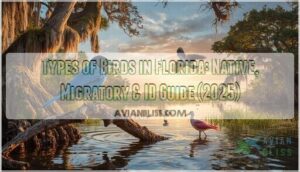
Florida’s skies host more avian diversity than most birders realize—over 525 documented species spanning mangrove-tangled coastlines, pine flatwoods, and freshwater marshes. Some, like the Florida Scrub-Jay, evolved here and exist nowhere else on Earth. Others, including millions of migratory warblers and raptors, use the peninsula as a seasonal highway between hemispheres.
This collision of resident and transient populations creates identification challenges that frustrate beginners and reward patience. Understanding the types of birds in Florida means recognizing how geography shapes distribution—what thrives in the Panhandle’s longleaf savannas won’t appear in the Everglades’ sawgrass prairies.
You’ll find the clearest path to recognition lies in breaking species down by origin, behavior, and the specific habitats they can’t survive without.
Table Of Contents
- Key Takeaways
- Florida Native Birds
- Migratory Birds in Florida
- Bird Species by Region
- Attracting Birds to Your Yard
- Identifying Florida Bird Species
- Frequently Asked Questions (FAQs)
- How do I identify a bird I found?
- What is the most aggressive bird in Florida?
- How many types of birds are there in Florida?
- When is the best time for birdwatching?
- What threats face Floridas endangered bird species?
- How do hurricanes affect Florida bird populations?
- Which Florida birds are best for photography?
- What permits are needed for bird research?
- What are the rarest birds in Florida?
- When is the best birding season in Florida?
- Conclusion
Key Takeaways
- Florida hosts over 525 documented bird species shaped by geography—resident endemics like the Florida Scrub-Jay survive only in xeric oak scrub, while millions of migratory warblers and raptors funnel through the peninsula as a seasonal highway between continents
- Native species thrive in habitat-specific niches that won’t tolerate displacement—Wood Storks hunt by tactile feeding in shallow wetlands, Anhingas spear fish in freshwater colonies, and Black-bellied Whistling-Ducks nest exclusively in tree cavities near emergent vegetation
- Successful bird identification hinges on recognizing physical markers and behavioral patterns rather than memorizing checklists—males and females often display distinct plumage differences, flight patterns reveal species instantly, and territorial calls announce presence before visual confirmation
- Attracting birds to your yard requires rebuilding what development destroyed through native plant layering, pesticide elimination, and strategic water placement—feeders stocked with black-oil sunflower seeds work universally, but natural nectar sources and insect populations sustain long-term populations better than artificial supplements
Florida Native Birds
Florida’s native birds have carved out their niches in the state’s diverse ecosystems, from coastal wetlands to scrublands. Species here exist nowhere else in the world, shaped by millions of years of adaptation to this unique environment.
Let’s look at four standout natives that define Florida’s avian landscape.
Black-bellied Whistling-Duck Habitat
You’ll find Black-bellied Whistling-Ducks thriving in Florida’s shallow freshwater habitats—ponds, marshes, and agricultural wetlands bordered by woody vegetation. These wetland ecology specialists favor emergent vegetation like cattails and water lilies, often roosting on low branches above water before commuting to feeding sites at sunset.
They’re cavity nesters, selecting tree hollows 4–20 feet up in oaks or willows, though they’ll readily use nest boxes when natural sites are scarce. Freshwater habitats within about a quarter-mile of nesting sites support their gregarious flocks.
Habitat conservation efforts protect these bird species from wetland drainage threats, ensuring stable populations across central Florida’s wildlife-rich landscapes. The Black-bellied Whistling-Duck population is supported by freshwater wetlands that provide essential breeding and feeding grounds.
Florida Scrub Jay Characteristics
You’ll spot the Florida Scrub Jay by its striking cobalt-blue head, wings, and tail contrasting with gray underparts—measuring just 23 to 28 cm with a 33 to 36 cm wingspan.
This threatened species requires sand pine and xeric oak scrub habitats, where family groups defend 10 to 45-acre territories. Their Scrub Jay Diet centers on acorns and arthropods year-round, while cooperative breeding with helpers from previous seasons defines their Bird Social Structure, making Birdwatching in Florida especially rewarding.
The Florida Scrub Jay’s survival is heavily impacted by habitat destruction issues, which have led to a significant decline in their population.
Wood Stork Feeding Habits
While the Florida Scrub Jay relies on keen vision, the Wood Stork hunts by Tactile Feeding—sweeping its partially open bill through shallow water until Prey Capture triggers a lightning-fast snap, often within 25 to 40 milliseconds.
Unlike the vision-dependent Florida Scrub Jay, the Wood Stork hunts by touch, snapping its bill shut in under 40 milliseconds when prey brushes against it
You’ll witness this specialized Feeding Behavior in freshwater marshes and managed wetlands where Wetland Ecology concentrates fish during dry-season drawdowns. Their Foraging Strategies include foot stirring to flush hidden prey, making Birdwatching in Florida’s shallow Habitat particularly rewarding for observing this federally threatened species’ striking adaptations during Bird Identification outings.
Anhinga Nesting Patterns
While Wood Storks rely on tactile hunting, you’ll find Anhingas use their dagger-like bills for spearing fish—a striking contrast that extends to their Nesting Behavior. These waterbirds nest colonially in Florida’s rookeries alongside herons and ibises, building stick platforms 10–20 feet above water from February through June.
Both parents share incubation duties for 25–30 days, then feed hatchlings until fledging at six weeks. Nesting Success hinges on minimal human disturbance during Breeding Seasons, making respectful Bird Identification practices essential for Bird Conservation and protecting Wildlife in Florida’s fragile Colony Structure.
Migratory Birds in Florida
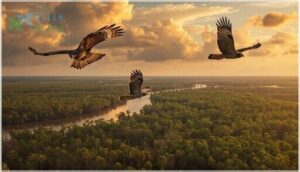
Florida’s skies transform with the seasons as migratory raptors sweep through the state on their journeys between breeding and wintering grounds. These birds of prey time their movements with precision, following ancient flyways that have shaped their survival for millennia.
You’ll encounter three outstanding hawk species that showcase different migration strategies and ecological niches across Florida’s diverse landscapes.
Swallow-tailed Kite Migration Patterns
When you track Swallow-tailed Kites in Florida, you’re witnessing one of nature’s boldest migrations. These raptors arrive from Brazil between February and March, gathering at massive pre-migratory roosts—sometimes over 1,000 birds at a single site.
Their flight patterns cross the Caribbean rather than hugging coastlines, with some individuals making 28-hour nonstop flights.
Habitat conservation of these staging areas matters deeply, since nearly half the U.S. population funnels through South Florida before their 5,000-mile journey south.
Short-tailed Hawk Prey Preferences
When you observe Short-tailed Hawks in Florida’s skies, you’re watching specialists at work—these raptors overwhelmingly favor small birds over all other prey. Hawk Diet Analysis reveals they strike perched songbirds from heights up to 800 feet, diving steep and fast to snatch warblers, blackbirds, and even birds as large as meadowlarks. Their Prey Selection shifts slightly across seasons, with occasional rodents, lizards, or tree frogs supplementing the menu, but Bird Predation remains central. Their Hunting Strategies exploit forest edges and prairies where avian prey concentrates.
What drives their fierce focus on feathered targets:
- Tropical populations embrace broader diets—frogs, lizards, insects—but Florida birds stay loyal to songbirds
- They hunt from soaring flight, not perches, scanning open country for movement below
- Migration Patterns bring them south where marsh-edge birds fuel their winter survival
Red-shouldered Hawk Habitat Selection
You’ll find Red-shouldered Hawks where wetlands meet woodland—they select nest sites 40–60 feet up in mature forests adjacent to marshes and streams. Wetland Conservation directly shapes their survival; Florida populations occupy surprisingly open landscapes with under 10% forest cover, provided wetlands remain intact.
Forest Fragmentation threatens nesting success, yet these adaptable raptors persist in suburban mosaics. Habitat Restoration and protecting riparian corridors support stable Migration Patterns and healthy Nesting Habits across Florida’s changing birdwatcher destinations.
Bird Species by Region
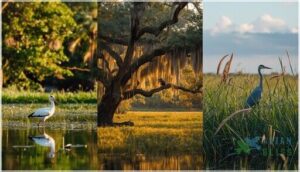
Florida’s geography creates distinct birding regions, each with its own mix of species shaped by climate, habitat, and coastline access. Whether you’re scanning the Everglades, exploring oak hammocks, or watching coastal marshes, the birds you’ll encounter change as you move across the state.
Let’s break down what you can expect to see in each region.
Southeast Florida Bird Species
Southeast Florida is a birdwatcher’s jackpot—home to close to 400 naturally occurring species. You’ll encounter exotic urban parrots like Monk Parakeets in Miami, Everglades birds including wood storks and herons in coastal habitats, and Caribbean vagrants drifting north. Wading birds concentrate in mangrove corridors, while non-native species thrive alongside native Florida birds in this ecologically unique gateway.
Top Southeast Florida Birding Experiences:
- Florida Bay flamingos – American Flamingos winter in shallow coastal habitats
- Jupiter Ridge scrub-jays – Endemic Florida Scrub-Jays inhabit protected uplands
- Miami’s parrot flocks – Over 20 breeding parrot species established in urban areas
- Everglades wading colonies – Thousands of nests during peak breeding seasons
- Mangrove migrants – Prairie warblers and tropical kingbirds use coastal stopover sites
Central Florida Bird Species
Central Florida sits at a crossroads where temperate and subtropical bird communities collide—you’re looking at over 130 priority species documented across the region’s uplands, wetlands, and coastal systems. You’ll spot the endemic Florida Scrub-Jay in xeric scrub habitats, Wood Storks stalking fish in wetland mosaics, and Purple Gallinules moving through emergent marsh vegetation.
Migration patterns bring billions of birds through Florida each autumn, making Central Florida a critical stopover hub. Despite intense urbanization pressure—bird diversity is declining in metropolitan areas—conservation efforts target species that have lost 50% or more of their populations since the 1970s.
Central Florida Habitats and Signature Species:
| Habitat Type | Notable Species |
|---|---|
| Scrub & Sandhill | Florida Scrub-Jay, Florida Sandhill Crane |
| Wetland Ecosystems | Wood Stork, Purple Gallinule, Limpkin |
| Pine Forests | Bachman’s Sparrow, Pine Warbler |
Panhandle Bird Species
The Panhandle’s 300+ bird species span coastal marshes, longleaf pine forests, and riverine corridors—you’ll encounter specialized communities nowhere else in Florida. Red-cockaded Woodpeckers mark cavity trees in Apalachicola National Forest, while barrier islands concentrate Neotropical migrants during Gulf crossings.
Panhandle birding hotspots reveal distinct wetland birds and coastal species:
- Migratory patterns funnel billions through September-October bottlenecks
- Conservation efforts protect Bachman’s Sparrows in fire-maintained pinewoods
- Shorebird concentrations include wintering Piping Plovers on barrier beaches
- Riverine assemblages host Prothonotary Warblers in floodplain forests
Attracting Birds to Your Yard
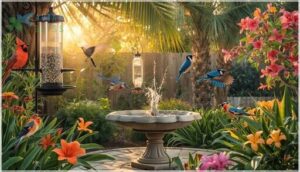
You don’t need a fancy setup to turn your yard into a Florida bird haven. The right feeders, native plants, and water sources can attract everyone from cardinals to hummingbirds without breaking your budget.
Here’s what works best for bringing these feathered visitors to your doorstep.
Bird Feeder Selection
You’ll attract more species by matching feeder types to your target birds. Tube and hopper feeders are your workhorses for backyard birding—cardinals and finches flock to them readily. Black-oil sunflower seeds work best across the board because their thin shells and high energy draw the widest variety. Skip cheap mixes with red millet; most Florida birds toss it aside, creating moldy waste.
Weight-activated squirrel deterrents protect your investment while cage-style designs favor smaller songbirds.
Clean feeders every two weeks with dilute disinfectant to prevent disease, and skip suet in Florida’s heat—it melts fast and spoils.
Creating a Bird-Friendly Habitat
Feeders alone won’t cut it—your yard becomes real bird habitat when you rebuild what development stripped away. Native plant selection transforms sterile lawns into wildlife preservation zones that mirror Florida’s original ecosystems.
Start with these fundamentals for sustainable gardening and backyard birding success:
- Layer vegetation from ground to canopy—stack native shrubs like Simpson’s stopper and American beautyberry beneath established oaks to create the structural complexity that forest specialists need for nesting and foraging.
- Install shallow water features positioned near protective cover but visible from windows for your viewing pleasure.
- Eliminate pesticides completely—they obliterate the insects that fuel bird-friendly, eco-friendly landscaping and conservation efforts.
Tips for Attracting Hummingbirds
Ruby-throated hummingbirds need feeders positioned 10–15 feet from protective cover, stocked with four-parts-water to one-part-sugar nectar—no red dyes. Change solutions every two days when temperatures climb past 70°F to prevent fermentation.
Plant coral honeysuckle and firebush for natural nectar sources that extend beyond artificial feeding stations.
Skip pesticides entirely; hummingbirds require insects for protein during breeding season.
Add misters near bird-friendly plants—these territorial sprites can’t resist bathing opportunities that mimic rainforest edges.
Identifying Florida Bird Species
You’ll spot dozens of bird species across Florida’s varied landscapes, but knowing which ones you’re actually looking at takes a bit of practice.
Learning to identify birds starts with recognizing key physical features, behaviors, and habitat preferences that set each species apart.
Here’s what to watch for when identifying some of Florida’s most common and distinctive birds.
Characteristics of The American Goldfinch
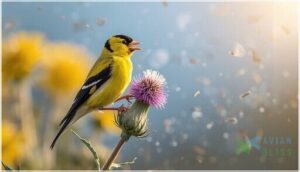
You’ll recognize the American Goldfinch by its striking transformation—males flash vivid yellow body plumage with jet-black wings during summer breeding months, while females maintain subtler yellow-green tones year-round. These seed specialists are masters of adaptation, their conical bills perfectly designed for cracking open thistle and sunflower seeds.
Key identification markers for bird watching in Florida include:
- Breeding plumage: Males show intense yellow contrast with black forehead cap and tail; sexual dimorphism is pronounced
- Flight pattern: Distinctive undulating, wavelike motion with repeated “per-chick-o-ree” calls that announce their presence
- Flocking behavior: Large nomadic groups form outside breeding season, tracking ripening seed crops across landscapes
- Seed preferences: Strong association with composite plants—thistles, dandelions, sunflowers—dominates finch diet throughout their range
Their twice-yearly molt sets them apart from most Florida bird species you’ll encounter.
Northern Cardinal Identification
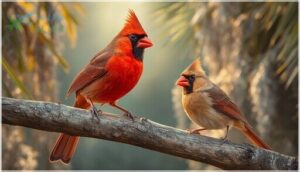
You’ll spot the Northern Cardinal instantly—males wear that unmistakable crimson coat with a sharp black mask framing their bright orange beak. Females trade the red for warm tan-brown, but both sexes share the signature pointed crest.
Among Bird Species in Florida, this songbird’s clear whistled phrases echo through your yard year-round. Watch for Feather Molting in juveniles, which shift from mottled brown to adult Plumage Patterns by their first winter—a key Bird Identification Techniques marker for Types of Birds in Florida.
Red-winged Blackbird Distinctive Features
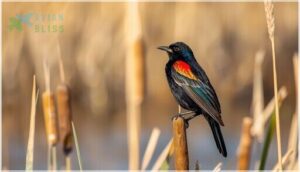
Watch for the hump-backed Bird Silhouettes perched on cattails—that’s your first clue to identifying the Redwinged Blackbird, one of the most distinctive Birds of Florida. Males flaunt glossy black Plumage Patterns with vivid red-and-yellow shoulder patches called epaulets, which they’ll puff up or hide depending on their confidence level. Females wear streaked brown feathers with a pale eyebrow stripe, often mistaken for oversized sparrows.
You’ll notice their sharply pointed, conical Beak Shapes and medium-length, rounded Tail Features during flight. These Types of Birds in Florida demonstrate fascinating Epaulet Displays during territorial disputes—males flash those crimson shoulders like warning flags. This behavior exemplifies key Bird Identification Techniques in Ornithology in Florida.
For beginners learning bird recognition, start here. Males perch prominently while singing their distinctive “konk-la-ree” call, while brown-streaked females stay concealed in marsh vegetation, building cup-shaped nests among the reeds.
Purple Gallinule Habitat and Behavior
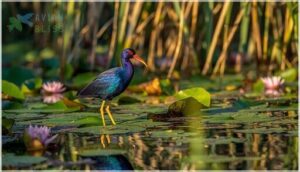
You’ll spot Purple Gallinules treading lily pads in Florida’s freshwater marshes, where wetland ecology sustains their foraging strategies—picking insects, seeds, and small fish from floating vegetation. Their nesting habits involve building cup-shaped platforms in dense reeds during May through July.
While southern populations stay year-round, migration patterns show northern breeders heading south in winter. Conservation status remains stable, though habitat loss threatens these colorful wildlife gems across their ornithology-documented range.
Frequently Asked Questions (FAQs)
How do I identify a bird I found?
Start with the bird’s overall shape and beak profile—these clues narrow your search fast.
Snap photos, record calls, then use apps like Merlin Bird ID to match feather identification and wing pattern recognition against local species.
What is the most aggressive bird in Florida?
You’ll meet Florida’s most aggressive defender: the Northern Mockingbird. These gray dive-bombers fearlessly attack anyone near their nests—humans, pets, even hawks—showcasing textbook nest defense strategies and reminding us why wildlife management respects territorial boundaries.
How many types of birds are there in Florida?
Florida’s avifauna comprises 545 extant bird species, according to current ornithological records. You’ll find remarkable species diversity here, from endemic natives to established exotics, reflecting the state’s distinctive position in North American bird taxonomy and migration patterns.
When is the best time for birdwatching?
You’ll catch the most action at dawn and during spring migration—late March through mid-May—when millions of warblers and shorebirds pass through Florida, creating peak viewing windows that’ll transform your morning outings.
What threats face Floridas endangered bird species?
You’ll confront habitat loss—over 90% of native scrub vanished—plus climate change altering breeding patterns, sea-level rise drowning coastal nests, pollution disorienting migrants, and human disturbance crushing shorebird survival across Florida’s fragmented landscapes.
How do hurricanes affect Florida bird populations?
Storm surges destroy nesting sites and alter wetland water levels, displacing wading birds like herons and ibises.
You’ll notice habitat erosion changes migration patterns, while coastal flooding reduces food availability across Florida’s ecosystems.
Which Florida birds are best for photography?
You’ll capture stunning wildlife photography of Roseate Spoonbills, Wood Storks, and Painted Buntings across Florida’s wetlands.
Master camera settings for flight shots and bird behavior capture—Anhingas drying wings create perfect portrait compositions for nature photography enthusiasts.
What permits are needed for bird research?
Think of research permits as your passport into Florida’s avian world. You’ll need federal permits from U.S. Fish and Wildlife Service and state licenses from FWC—especially for bird banding endangered bird species or handling threatened populations.
What are the rarest birds in Florida?
Florida’s rarest endangered bird species include the ivory-billed woodpecker (possibly extinct), snail kite (declining population trends), Florida grasshopper sparrow (fewer than 80 wild individuals in 2019), and Kirtland’s warbler—vagrant songbirds documented only five times.
When is the best birding season in Florida?
You’d think birds follow our vacation calendar, but they don’t—November through April delivers Florida’s peak birding season, when winter migrants, dry season dynamics, and coastal birdwatching converge for remarkable viewing.
Conclusion
Your field guide won’t decode every wing flash or call note—that takes what Victorian naturalists called “the educated eye,” earned through hours watching light shift across a heron’s plumage. But now you’ve got the framework: habitat dictates presence, behavior reveals identity, and the types of birds in Florida shift with seasons and latitude.
Choose your patch—coastal, urban, wild—then return until the unfamiliar becomes unmistakable. Recognition comes from repetition, not checklists.
- https://fosbirds.org/fos-bird-checklist/
- https://floridabirdingtrail.com/wp-content/uploads/2022/07/FL-Bird-Checklist-_2021.pdf
- https://lib.usf.edu/breeding-bird-atlas/methods/results/
- https://www.everglades.org/the-everglades-handbook/section-3-flora-and-fauna/birds/
- https://a-z-animals.com/articles/birds-that-spend-their-winters-in-florida/