This site is supported by our readers. We may earn a commission, at no cost to you, if you purchase through links.

You step outside at dawn and hear what sounds like a robin, but something’s off—the notes are shorter, sharper, almost frantic. That’s because you’re not hearing a song at all. You’re hearing an alarm call, and it means there’s a hawk nearby.
Understanding different bird calls isn’t just about naming species; it’s about decoding an entire language happening right above your head. Birds use distinct vocalizations for everything from claiming territory to warning their neighbors about danger. Once you learn the difference between a song and a call, the world around you becomes remarkably more detailed.
The good news? You don’t need perfect pitch or years of training to start recognizing these patterns and what they mean.
Table Of Contents
- Key Takeaways
- Distinguishing Songs and Calls
- Types of Bird Calls and Their Purposes
- Describing and Recognizing Bird Sounds
- Techniques for Bird Call Identification
- Advanced Bird Song Analysis
- Frequently Asked Questions (FAQs)
- What is the difference between a bird song and a call?
- What is a bird call?
- How do bird calls work?
- Why should you learn about bird calls?
- How do you know if a bird is a song or call?
- Why do birds make sounds and calls?
- Do birds understand each other’s calls?
- How do you know what your bird is saying?
- How do I know if a bird has a call?
- What is the difference between a bird song and a bird call?
- Conclusion
Key Takeaways
- Bird songs are complex, learned vocalizations lasting over one second that males use to claim territory and attract mates, while calls are shorter, simpler sounds both sexes use year-round for immediate needs like danger warnings and flock coordination.
- Alarm calls encode specific predator information through acoustic details—faster elements signal agile threats—and birds across different species can recognize and respond to each other’s warning signals through shared acoustic patterns.
- You can build reliable identification skills by starting with 10-20 local species you hear daily, using mnemonics to anchor songs to memorable phrases, and practicing recognition through repeated exposure in the same locations.
- Urban environments force birds to adapt their vocalizations by shifting to higher frequencies that cut through traffic noise, while regional dialects and habitat structure create distinct sound variations across different geographic areas.
Distinguishing Songs and Calls
When you first start listening to birds, all those chirps and whistles can sound like one big noisy chorus. But here’s the thing: not all bird sounds are created equal.
Let’s break down what separates a song from a call, why birds use each one, and clear up a few things that trip up beginners.
Key Differences Between Songs and Calls
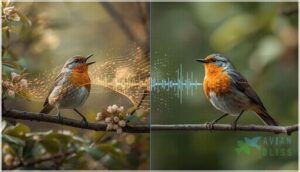
When you tune into bird sounds, songs and calls represent two distinct acoustic structures. Songs generally stretch beyond one second with multiple syllables spanning over 3 kHz in frequency, while calls stay shorter—often under half a second—and narrower in bandwidth.
This song vs call distinction matters because songs demand learning development in many species, whereas calls emerge nearly complete shortly after fledging. Bird calls, unlike songs, often serve as practical warning sounds.
Functions of Songs Vs. Calls

Understanding the song vs call distinction unlocks what birds are actually saying. Songs handle territorial defense and mate attraction—think of a male cardinal declaring “this yard is mine” while also wooing a partner.
Bird songs claim territory and attract mates, while calls handle immediate survival needs like danger warnings and flock coordination
Bird calls tackle immediate needs: alarm calls warn of danger, contact calls keep flocks together during flight. Paired birds even use softer calls for pair communication, coordinating nest duties without broadcasting to rivals.
Intriguingly, female bird song is more common than previously thought.
Common Misconceptions
Even experienced birdwatchers stumble when identifying bird calls. Let’s clear up what trips people up most:
- Labeling everything as “song” — UK surveys show 64% of birdwatchers mix up songs and calls, treating all vocalizations the same way.
- Thinking songs only attract mates — Males keep singing after pairing to defend territory, yet 61% believe singing stops once birds couple up.
- Underestimating simple calls — Brief alarm chirps pack detailed information; fairy-wrens distinguish aerial threats from ground predators using subtle acoustic shifts.
- Misidentifying species at night — About 10% of nightingale recordings submitted by citizens were actually other melodious species singing after dark.
- Judging by human aesthetics — Birds prioritize note order and timing over what sounds “pretty” to us; Japanese great tits respond to specific call sequences but ignore the same notes rearranged.
Understanding bird calls means recognizing that what seems simple to your ear carries complex meaning in bird song identification.
Types of Bird Calls and Their Purposes

Birds don’t just make noise for the fun of it. Each call has a specific purpose, whether it’s warning the flock about danger, keeping in touch during flight, or wooing a potential mate.
Let’s break down the main types of calls you’ll hear in the field and what they’re actually saying.
Alarm Calls and Predator Warnings
When danger strikes, alarm calls serve as a bird’s emergency broadcast system for predator detection. Great tits encode predator-specific details—faster elements per second for agile threats, while nestlings freeze in response to warnings even before fledging.
Urban adaptation has pushed species to shift frequencies upward, cutting through traffic noise.
Mobbing dynamics reveal coordinated group defense, though fork-tailed drongos prove call deception works, stealing food with fake alerts.
Contact Calls for Flock Coordination
While birds forage or fly together, contact calls act as their real-time GPS for flock cohesion. These short, repeated vocalizations maintain spatial dynamics even through dense vegetation:
- Zebra finches adjust amplitude over distance for individual recognition
- Willow tits coordinate mixed-species foraging contexts through strategic calling
- Group size influences call rates—larger flocks mean more vocal output
- Affiliated partners call more frequently, strengthening social bonds
You’ll hear contact calls as soft chips during routine movement, escalating when coordination demands spike.
Mating Songs and Courtship Displays
When breeding season arrives, male songbirds pull out all the stops to attract mates. Song complexity matters—females prefer longer, faster songs signaling male quality. Mating songs demand energetic costs, so males balance performance with stamina.
Many species add multimodal displays, combining vocals with dances or wing snaps. Dialect variation also plays a role, as females often choose males whose songs match their home region.
Begging Calls in Juveniles
As nestlings grow, their begging calls evolve from soft, low-pitched tones to louder, more complex signals. Acoustic development happens fast—within two weeks, dramatic changes in pitch and intensity become noticeable.
These calls serve multiple functions:
- Honest signaling of hunger and body condition to parents
- Individual recognition so adults identify their own chicks
- Noise effects can force louder calls in urban areas
- Vocal learning foundations that shape future adult songs
Offspring communication is surprisingly intricate, even in the nest.
Describing and Recognizing Bird Sounds

Learning to describe what you’re hearing is the first step toward identifying birds by sound. You’ll need a simple vocabulary to capture pitch, tempo, and tone, along with an understanding of patterns like trills and buzzes.
Once you can put words to the sounds, you’ll start recognizing songs faster and building memory tricks that stick.
Pitch, Tempo, and Tone Explained
You can think of pitch as how high or low a bird sounds—most songbirds produce frequency ranges between 2,000 and 8,000 Hz. Tempo describes the rhythm perception, or speed, with many species singing 5 to 20 notes per second. Tone refers to timbre recognition—the quality that makes each bird sound unique.
Understanding these parameter interactions through measurement analysis helps you decode different types of bird calls in the field.
Trills, Buzzes, and Harsh Sounds
When you hear rapid notes blurring together, that’s a trill—white-crowned sparrows deliver 20 to 40 notes per second. Buzzes sound even faster, almost like an insect’s hum. Harsh sounds are rough and grating, often signaling alarm or aggression.
Urban noise effects push many species to adjust these calls, shifting frequencies higher to cut through traffic rumble and maintain clear communication with their flock.
Using Mnemonics for Bird Song Memory
Your brain can anchor bird songs to short phrases or vivid mental pictures—mnemonics turn fleeting sounds into lasting memories. Phrase-based verbal mnemonics map syllables to note counts, while image mnemonics pair a species’ rhythm with a visual story. Neural encoding research shows that song memory strengthens through structured training protocols: repeat each phrase daily, pair it with recordings, and practice in short sessions to build reliable recognition.
- Match syllables to notes—three-syllable phrases for three-note songs create instant recall.
- Build mental pictures—link a hurried trill to a bird dashing through branches.
- Practice in short bursts—daily five-minute sessions cement learning bird song categories.
- Customize your list—adapt standard mnemonics to fit your local dialects and speech rhythm.
Identifying Melody Patterns
Once you’ve anchored songs with mnemonics, motif recognition sharpens your ear for repeated melodic chunks—those two-to-ten-note phrases birds cycle through their repertoire. Identifying bird songs means catching interval structure: most species favor small pitch jumps of two or three semitones rather than wild leaps.
Temporal patterning reveals steady rhythms; spectral shape adds timbral fingerprints. Together, these sound characteristics and syntactic rules decode bird song patterns into reliable field IDs.
Techniques for Bird Call Identification

You’ve learned to recognize the basic building blocks of bird sounds—now it’s time to put that knowledge to work in the field. Identifying birds by ear takes more than just good listening skills; it requires the right tools, smart observation habits, and a solid foundation built on the species you encounter most often.
Here are four practical techniques that will help you go from hearing birds to actually knowing who’s singing.
Field Guide and App Usage
Apps like Merlin Bird ID and BirdNET make identification easier, especially for beginners. Merlin’s visual identification reaches about 98% accuracy, while BirdNET covers over 3,000 species. Both offer offline access through downloadable regional packs—necessary for remote locations.
Field guides still provide context on range and habitat, helping you confirm app suggestions. Best practices? Cross-check automated results and log sightings in eBird for citizen science.
Smartphone Recording and Playback
Once you’ve got a bird ID app running, your phone becomes a field recorder too. Capture calls by holding your device steady and aiming the microphone toward the bird—this boosts audio quality more than any other field technique. Disable automatic gain control to prevent distortion.
For acoustic analysis and citizen science projects, keep recordings short, avoid playback near nests, and always follow recording ethics to minimize playback effects on breeding birds.
Visual Cues and Behavior Observation
Recording calls is just step one—watching what the bird does unlocks the full story. Courtship displays pair dance moves with song structure, so you’ll miss mating context if you only listen.
Alarm calls trigger specific postures: crouching for aerial threats, scanning horizontally for ground predators. Movement concordance between wings and vocalizations reveals whether a starling’s really advertising or just warming up.
Visual identification cuts error rates and confirms the caller behind every sound.
Building a Local Bird Sound Foundation
Start your journey with the ten to twenty species you’ll hear every morning—this local species focus builds reliable bird calls identification faster than tackling continental lists. Studies show beginners who concentrate on common backyard birds jump from 20% to 60% accuracy within weeks. Region-specific recordings and regular field practice skills cement recognition, especially when you learn local dialect variation. Here’s your foundation:
- Visit the same park weekly to encounter familiar songs repeatedly
- Download digital tool integration apps like Merlin with your regional bird pack
- Record unfamiliar calls, then cross-check them against local sound libraries
Distinguishing bird sounds becomes automatic when you master your neighborhood first.
Advanced Bird Song Analysis

Once you’re comfortable identifying common bird songs in the field, you can take your skills to the next level with some specialized tools and deeper knowledge.
Sophisticated techniques like reading spectrograms, understanding how location affects bird sounds, and recognizing seasonal patterns will sharpen your ear even further.
Let’s explore these more technical approaches that serious birders use to decode what they’re hearing.
Spectrograms and Sound Visualization
Spectrograms turn sound into pictures, showing time on one axis and frequency on the other. This Spectrogram Analysis reveals patterns you can’t hear—like how a warbler’s trill sweeps up in pitch or a finch’s call sits at 2 kHz.
Time-Frequency Domain tools and Automated Identification apps now let you see avian vocalizations analysis, making Acoustic Monitoring and interpreting spectrograms accessible for anyone curious about Visualizing Birdsong.
Habitat and Regional Variations
Where you listen matters. Urban song shifts push many bird species toward higher frequencies to cut through traffic noise, while Geographic dialects mark regional boundaries—White-crowned Sparrows in California sound different from their northern cousins.
Climate acoustics and Vegetation structure also shape sound transmission; dense forests favor low, slow songs, whereas open grasslands boost higher pitches.
Habitat differences create stunning avian diversity you’ll notice once you start comparing recordings across regions.
Seasonal Changes in Vocalizations
Spring doesn’t just bring leaves—it brings a symphony. Vocal seasonality transforms bird vocalizations dramatically as breeding cycles kick in. You’ll notice three major shifts:
- Song rate peaks in spring when testosterone surges and males defend territories
- Reduced output after pairing as nesting demands attention
- Climate effects alter timing with warming pushing migration and song earlier each year
Seasonal variation means May recordings capture far more species than June surveys.
Research Insights Into Bird Communication
Recent avian communication studies reveal intricate signaling systems you can observe yourself. Song syntax carries 20–30% of predictive information in sequences, while risk signaling encodes threat levels in call structure—receivers react within 100 milliseconds.
Social learning shapes vocal development, and honest signaling links repertoire size to mate choice. Understanding acoustic niches and these decoding bird communication patterns deepens your appreciation of functions of bird calls in the wild.
Frequently Asked Questions (FAQs)
What is the difference between a bird song and a call?
Bird songs are complex, learned vocalizations males use for territory and courtship, while calls are shorter, simpler sounds both sexes produce year-round for alarms, contact, and coordination—though this human classification oversimplifies nature’s complexity.
What is a bird call?
You hear a sharp chirp from the bushes—that’s a call. Calls are short, simple vocalizations birds use for practical communication like alerting to danger, keeping flocks together, or coordinating daily activities.
How do bird calls work?
When you hear a bird call, you’re listening to air pushed from lungs through a specialized organ called the syrinx. Neural signals control muscles that shape pitch, tempo, and tone—creating distinct vocal patterns for communication.
Why should you learn about bird calls?
Learning bird sounds reveals opportunities you didn’t know existed—tracking ecosystem health, boosting mental well-being, joining citizen science projects, and gaining education benefits while supporting scientific research through birding by ear and identifying bird species.
How do you know if a bird is a song or call?
Songs are generally longer than one second with multiple syllable types, while calls stay under 300 milliseconds.
Songs show broader frequency ranges and complex patterns; calls remain shorter, simpler, and more stereotyped acoustically.
Why do birds make sounds and calls?
Think of bird language as nature’s Wi-Fi—constant signals streaming across territories.
Birds make sounds for mate attraction, territory defense, predator avoidance, and social coordination, turning simple vocalizations into intricate avian communication methods that keep their world connected.
Do birds understand each other’s calls?
Yes, birds can interpret other species’ alarm calls through acoustic similarity and social learning. Interspecies communication forms community networks where birds recognize predator warnings across species, though anthropogenic noise disrupts this cross-species understanding.
How do you know what your bird is saying?
You’d think bird communication cues would be obvious, but interpreting call context requires careful observation.
Watch for species-specific calls paired with behavior—alarm calls trigger freezing, contact calls prompt movement, and mating songs accompany displays.
How do I know if a bird has a call?
Every bird species produces calls—short, simple avian vocalizations for alarm, contact, or coordination. Most calls are innate rather than learned, ensuring reliable bird communication across populations. Species variation means call presence and call function differ among birds.
What is the difference between a bird song and a bird call?
You’d think bird songs and calls would be the same thing, but they’re surprisingly different in their song complexity, neural control, and syrinx musculature.
Songs are longer, learned avian vocalizations for mating, while calls are simpler, innate signals.
Conclusion
Think of bird calls as the soundtrack to a hidden world—one that’s been playing all along, just waiting for you to tune in. Understanding different bird calls transforms every walk into a richer experience, where each chirp and trill tells a story about what’s happening around you.
Start with one species in your backyard, learn its voice, and watch how quickly the rest of the chorus begins making sense. The conversation has always been there.