This site is supported by our readers. We may earn a commission, at no cost to you, if you purchase through links.

Walk through any mature Kentucky forest and something will eventually give itself away—a rapid-fire drumming echoing off a dead oak, or a flash of red disappearing into the canopy.
Seven woodpecker species call this state home, and each one has carved out a distinct niche, from the crow-sized Pileated, splitting logs apart to the sparrow-sized Downy, working a backyard suet cage.
One species, the Red-headed Woodpecker, has lost more than 70% of its population over the last fifty years—a quiet crisis most people never notice.
Knowing who’s out there, what they need, and how to read their field marks changes the way you see Kentucky’s woods entirely.
Table Of Contents
- Key Takeaways
- Kentucky Woodpecker Species to Know
- How to Identify Kentucky Woodpeckers
- Size, Wingspan, and Weight Comparison
- Bill Shape and Head Proportions
- Red Crest, Nape, and Facial Markings
- Black-and-white Pattern Differences
- Downy Vs. Hairy Woodpecker Field Marks
- Northern Flicker Markings and Ground Behavior
- Pileated Woodpecker Silhouette and Flight Profile
- Calls, Drumming, and Vocal Clues
- Where Kentucky Woodpeckers Live
- Mature Forests and Large Dead Trees
- Open Woodlands, Savannas, and Forest Edges
- Backyard, Park, and Suburban Habitats
- Snags, Dead Branches, and Nesting Cavities
- Tree Species Used for Feeding and Nesting
- Ground-foraging Areas for Northern Flickers
- Sap Wells in Birch and Maple Trees
- Best Kentucky Habitats for Each Species
- What Kentucky Woodpeckers Eat
- Conservation of Kentucky Woodpeckers
- Red-headed Woodpecker Population Decline
- Habitat Loss and Forest Fragmentation
- Importance of Mature Trees and Snags
- Nest Cavity Competition and Breeding Success
- Red-cockaded Woodpecker Extirpation in Kentucky
- How Native Trees Support Woodpecker Populations
- Bird-friendly Yard Practices for Homeowners
- Why Woodpeckers Matter in Kentucky Ecosystems
- Frequently Asked Questions (FAQs)
- Are Kentucky woodpeckers protected by local or federal laws?
- What is the average lifespan of a woodpecker in Kentucky?
- Can Kentucky woodpeckers be kept as pets or in captivity?
- How do woodpeckers in Kentucky adapt to winter conditions?
- What are some natural predators of Kentucky woodpeckers species?
- Do woodpeckers mate for life in Kentucky?
- How long do Kentucky woodpeckers typically live?
- When do Kentucky woodpeckers begin nesting?
- Can woodpeckers cause serious damage to homes?
- Are Kentucky woodpeckers protected under federal law?
- Conclusion
Key Takeaways
- Kentucky’s seven woodpecker species each claim a distinct niche — from the crow-sized Pileated splitting open rotting logs in deep forests to the sparrow-sized Downy working at your backyard suet feeder.
- Red-headed Woodpecker has quietly lost over 70% of its population in the last 50 years, driven by habitat loss, fire suppression, and shifting land use — making it one of the most at-risk birds you’ll rarely hear about.
- Dead trees and standing snags aren’t eyesores — they’re the backbone of woodpecker survival, providing nesting cavities, beetle larvae, and shelter that dozens of other species depend on as well.
- You can make your yard a real woodpecker draw with a few simple moves: put up a suet feeder near tree cover, skip the pesticides, and leave any safe dead wood standing.
Kentucky Woodpecker Species to Know

Kentucky is home to seven woodpecker species, and each one has its own personality once you know what to look for. Some are backyard regulars, while others prefer deep forest and rarely show up at feeders.
If you want a closer look at behavior and habitat clues, this guide to Tennessee woodpecker species and identification covers the same birds you’ll likely spot just across the border.
Here’s a closer look at each one.
Downy Woodpecker
Downy Woodpecker (Dryobates pubescens) is your most likely backyard visitor — and the smallest woodpecker in North America. At just 5.5 inches, it punches above its weight.
Banding studies show they adapt well to suburban life, making urban adaptation a real strength.
Winter food like suet keeps them coming back, and their lively courtship displays make late winter surprisingly entertaining to watch.
Its distinctive red nape patch helps bird it from similar species.
Hairy Woodpecker
Think of the Hairy Woodpecker (Dryobates villosus) as the Downy’s bigger, bolder cousin. At 9–11 inches, it’s noticeably larger, with a bill nearly as long as its head — your clearest woodpecker identification clue.
Its winter range covers all of Kentucky, so you’ll spot it year‑round.
Territorial drumming rings loud through mature woods, and suet feeders work well for backyard feeding strategies.
Red-bellied Woodpecker
Meet the Red‑bellied Woodpecker (Melanerpes carolinianus) — a reliable year‑round presence in Kentucky. Males wear red from bill to nape; females show red only at the back. That bold black‑and‑white barred back makes this redbellied woodpecker easy to spot in your identification guide for Kentucky woodpeckers.
Suet feeders draw them in reliably, and territorial aggression often keeps smaller birds at a distance.
Red-headed Woodpecker
If the Red-bellied is subtle, the Red-headed Woodpecker (Melanerpes erythrocephalus) is anything but. That fully crimson head, jet-black back, and bright white belly make Woodpecker identification practically easy.
Habitat preferences of Kentucky woodpecker species vary, but this one favors open woods with dead snags.
Territory Drumming and Mating Displays are loud and bold — you won’t miss it.
Northern Flicker
Unlike most woodpeckers, the Northern Flicker spends a surprising amount of time on the ground. It hunts ants and beetles by probing lawns and leaf litter with its curved bill — a habit that catches many birders off guard.
Here’s what makes this species stand out:
- Seasonal Plumage shifts subtly between seasons, but that bold black bib stays consistent
- Courtship Songs include a loud, ringing "wicka-wicka" call you’ll hear well before you spot the bird
- Nest Site Selection relies on dead trees and tree cavity nesting in rotting snags
- Winter Roosting draws flickers into mixed woodlands and suburban yards — check your suet feeders
- Predator Avoidance benefits from that striking white rump patch, flashing as a distraction during flight
Pileated Woodpecker
If you spot what looks like a crow wearing a red beret hammering through a log, you’ve found the Pileated Woodpecker (Dryocopus pileatus). At up to 19 inches, it’s Kentucky’s largest woodpecker.
Its cavity excavation reshapes dead trees, creating shelter for dozens of other species — a cornerstone of its forest ecosystem role.
Territory drumming echoes loudly and quickly through mature woods.
Yellow-bellied Sapsucker
The Yellow-bellied Sapsucker is a fascinating winter visitor — it breeds up north, then follows its Winter Migration Patterns south into Kentucky. Woodpecker identification is straightforward here: look for bold black-and-white striping and a pale yellow belly.
Its tongue morphology — a brush-tipped tool — makes sap feeding possible by lapping wells drilled into maples and birches. Those wells leave lasting Tree Health Impact marks on the bark.
Which Species Are Year-round Residents
Six of Kentucky’s seven woodpecker species are true year-round residents — their Habitat Fidelity runs deep. Winter Territory Size stays consistent, and Seasonal Vocalizations keep drumming even in January snow.
- Downy Woodpecker — smallest, feeder-friendly, stable Population Trends
- Hairy Woodpecker — forest edges, year-round presence
- Red-bellied Woodpecker — mixed woodlands, dependable resident
- Northern Flicker — ground-forager, Breeding Site Consistency noted
- Pileated Woodpecker — mature forest anchor
Seasonal Status of The Yellow-bellied Sapsucker
The Yellow-bellied Sapsucker is Kentucky’s only seasonal visitor among woodpeckers.
Spring Arrival Timing peaks late March through April, when small Migration Flock Dynamics bring birds into deciduous forests to tap maple and birch. Sap Feeding Shifts drive their whole calendar.
Wintering Habitat Use keeps some birds in southern Kentucky year-round. Breeding Success Factors depend on mature cavity trees farther north, so they eventually move on.
How to Identify Kentucky Woodpeckers
Once you know woodpeckers live in Kentucky, the next step is learning to tell them apart in the field. Seven species sound manageable, but some look surprisingly similar at a glance.
Here are the key features to check when one lands in front of you.
Size, Wingspan, and Weight Comparison
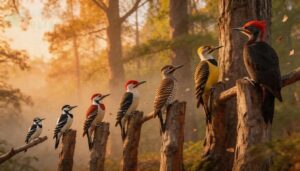
Size tells you a lot, fast. Kentucky’s woodpeckers span a wide body mass range — from the featherweight Downy at under an ounce to the crow-sized Pileated pushing 12 ounces.
Length ratios stretch from 5.5 inches to nearly 19 inches. Weight overlap exists between mid-sized species, so don’t rely on size alone.
Wing loading differences also show in flight — the Pileated’s 29-inch wingspan is unmistakable.
Bill Shape and Head Proportions
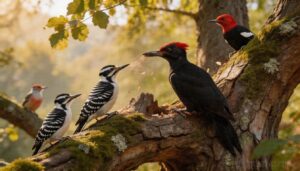
Bill shape is your next best clue after size. The bill length variation across Kentucky species is striking — and useful.
- Downy: short bill, roughly half the head width ratio
- Hairy: longer bill, nearly matching head width
- Pileated: stout, heavy bill for serious excavation
- Red-headed: sharp, pointed bill tip shape for precise foraging
Cranial compactness and mandible proportion help too — bigger species carry broader, more powerful heads built for impact.
Red Crest, Nape, and Facial Markings
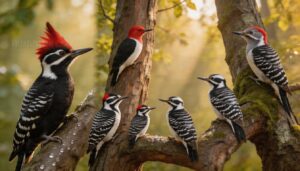
Once you’ve clocked the bill, look up — the head tells the rest of the story.
Crest Color Variation and Nape Pattern Significance set species apart quickly. The Pileated sports a large triangle red crest you can’t miss. The Red-Headed Woodpecker wears a fully red head, from hood to chin. Red-Bellied and Hairy males show a red spot on the back of their head. Facial Mask Contrast, Marking Age Variation, and Seasonal Crest Display sharpen those distinctions further.
| Species | Head/Crest Mark | Nape/Facial Note |
|---|---|---|
| Pileated | Large triangle red crest | White facial stripes, red cheek (male) |
| Red-Headed | Full red head | Clean black-and-white body |
| Red-Bellied | Red cap to nape | Barred black-and-white back |
| Hairy | Red nape spot (male) | White cheek, bold facial contrast |
| Downy | Red nape spot (male) | Similar to Hairy, smaller scale |
Black-and-white Pattern Differences
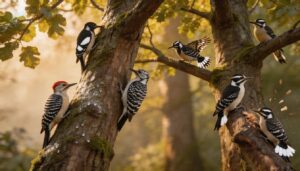
After the head markings, the body’s black-and-white pattern becomes your next identifier.
Crown Stripe Contrast runs bold on the Pileated, while Wing Bar Geometry and Back Mosaic Texture differ sharply between species.
Edge Jaggedness on feather margins isn’t random — it’s diagnostic.
The Tail Patch Pattern flashes in flight.
A black and white barred pattern nails Red-bellied instantly.
Downy Vs. Hairy Woodpecker Field Marks
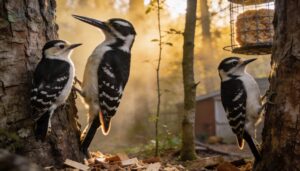
Once you’ve clocked the black-and-white barred pattern, the Downy and Hairy Woodpecker become your trickiest woodpecker species identification challenge in Kentucky. Both look nearly identical — until you check the bill.
The Downy’s is stubby; the Hairy’s nearly matches its head length.
Tail feather edges, wing bar spacing, foraging height, habitat preference, and nesting site choice all differ too, once you know what to look for.
Northern Flicker Markings and Ground Behavior
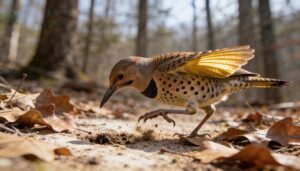
The Northern Flicker breaks the woodpecker mold entirely — you’ll spot it hopping across bare ground, not clinging to bark. Its spotted breast camouflage blends perfectly into leaf litter while it scratches soil with strong legs, using a foraging foot scratch motion to uncover ant colonies.
Watch for that underwing color flash of bright yellow during takeoff.
Seasonal ant peaks drive most of this ground behavior.
Pileated Woodpecker Silhouette and Flight Profile
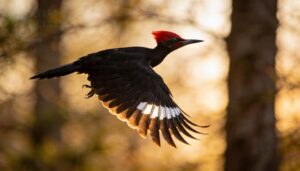
Once you spot a Pileated Woodpecker in flight, you won’t mistake it again. That bold Silhouette Contrast — jet-black body, flashing White Wing Patches, and a blazing red crest — makes Woodpecker species identification in Kentucky almost instantaneous.
Its Direct Flight and steady Wingbeat Rhythm feel powerful, almost crow-like. The stiff Tail Support keeps every stroke controlled and purposeful.
Calls, Drumming, and Vocal Clues

Sound is one of the sharpest tools for Woodpecker species identification in Kentucky. Woodpecker vocalizations and drumming patterns shift with season, habitat, and age — making your ears just as valuable as your eyes.
Seasonal Drumming Patterns peak during breeding, while Juvenile Vocal Development means young birds sound subtler than adults. Acoustic Habitat Effects and Drum Echo Distance vary too:
- Downy’s high-pitched whinnying carries fast through open edges
- Pileated’s booming territorial drumming rolls through mature forest
- Red-bellied’s nasal "churr" signals Territorial Call Variations at dawn
- Flicker’s "wicka-wicka" rings clear across open ground
Where Kentucky Woodpeckers Live
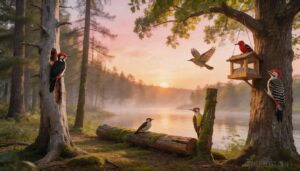
Woodpeckers don’t just show up anywhere — each species has its own idea of a perfect address. From dense old-growth forest to your backyard oak, Kentucky’s seven woodpeckers are surprisingly selective about where they set up shop.
Here’s a look at the key habitats that keep them fed, sheltered, and nesting successfully.
Mature Forests and Large Dead Trees
Mature forests are ground zero for most of Kentucky’s woodpeckers. Large tree decay creates the cavity formation dynamics, these birds depend on — snags aren’t eyesores, they’re prime real estate.
Standing dead trees add vertical heterogeneity to the forest, stacking foraging layers from ground to canopy. habitat complexity facilitates cavity nesting, carbon storage benefits, and a food web built on beetles, ants, and termites.
Open Woodlands, Savannas, and Forest Edges
Not every woodpecker calls the deep woods home. Open woodlands, savannas, and forest edges offer something different — sunlit ground forage, exposed snags, and edge insect abundance that draws species like Red-headed Woodpeckers and Northern Flickers.
Edge microclimate dynamics keep these zones warmer and drier, concentrating food sources.
Fire-managed habitat and native grass restoration keep these open systems productive and worth exploring.
Backyard, Park, and Suburban Habitats
Your backyard can be surprisingly productive woodpecker territory. Dense living fence shrubs offer cover, while a well-placed bird bath draws birds in daily.
Add mulch insect habitats near native trees to boost ground-level foraging.
Park trail canopies work the same way — dead limbs, mixed plantings, and pollinator garden benefits all combine to create reliable woodpecker habitat right outside your door.
Snags, Dead Branches, and Nesting Cavities
Dead branches and snags are the backbone of woodpecker habitat. Snag size importance really can’t be overstated — larger standing dead trees give Pileated Woodpeckers room to excavate deep nest cavities, while smaller snags suit Downies perfectly.
Decay Stage Influence shapes everything:
- Early decay attracts beetle larvae for Dead Limb Foraging
- Soft heartwood allows cavity excavation
- Abandoned holes become Cavity Reuse Species opportunities for bluebirds and chickadees
- Habitat Structural Complexity increases as fungi and insects colonize the wood
Tree Species Used for Feeding and Nesting
The trees you have on your property — or nearby — make a real difference.
Oaks support Oak Acorn Forage and host wood‑boring beetles in dead branches. Hickory Nut Supply carries woodpeckers through winter.
Pileated woodpeckers favor Populus Riparian Habitat along streams, while Beech Mast Production and Pine Bark Beetles draw additional species. Native trees with snags, tree cavities, and standing dead trees are the real draw.
Ground-foraging Areas for Northern Flickers
Unlike most woodpeckers, the Northern Flicker spends a surprising amount of time on the ground. While trees matter, so does what’s beneath them.
Look for flickers in spots:
- Open ground patches and bare soil strips where ants tunnel freely
- Leaf litter zones hiding insect larvae just below the surface
- Masonry gravel edges near old trees
- Moisture-rich soil after rain
- Mixed seed scattered near forest edges
Simple habitat management goes a long way.
Sap Wells in Birch and Maple Trees
The Yellow-bellied Sapsucker takes a different approach to food — it farms tree sap. Watch for neat rows of small holes drilled into birch and maple bark. That’s intentional well placement at work.
| Feature | Detail |
|---|---|
| Tree Preference | Birch and maple |
| Seasonal Timing | Late February–April |
| Sap Quality | Sweet, mineral-rich |
Healthy trees recover naturally once the season ends.
Best Kentucky Habitats for Each Species
Each species has its sweet spot.
Downy and Hairy Woodpeckers thrive in Mature Hickory Stands and Riverine Snag Corridors, where dead wood is plentiful. Flickers prefer open edges and Cedar Swamp Edges for ground foraging. Red-headed Woodpeckers favor Lowland Floodplain Forests, while Pileated Woodpeckers claim Rocky Ridge Outcrops with large snags.
Knowing these habitat preferences and distribution patterns makes spotting each species much easier.
What Kentucky Woodpeckers Eat
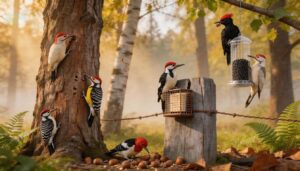
What a woodpecker eats tells you a lot about where to find one and how to bring it closer to your yard. Each species has its own food preferences — some drilling for insects, others sipping sap or cracking open seeds.
Here’s a closer look at what fuels Kentucky’s seven woodpecker species.
Insects, Beetle Larvae, Ants, and Termites
Most of what Kentucky woodpeckers eat is alive — and wriggling. Beetle larvae boring through dead wood, ant colonies tunneling under bark, termites quietly chewing through rotting logs — these are the real targets.
As insectivorous birds, woodpeckers fill a natural pest-control role you can’t overlook.
Each species has slightly different feeding habits, but insects drive the menu year-round.
Sap, Berries, Nuts, and Seeds
Insects aren’t the whole story. Woodpecker species in Kentucky round out their diet with sap, berries, nuts, and seeds depending on the season.
Early spring sap from drilled sap wells in birch and maple trees gives quick energy. Summer berry bloom adds soft fruits.
Fall nut consumption ramps up. Winter seed storage — including sunflower seeds cached in bark — keeps them fueled when sap-feeding insects disappear.
Species Most Likely to Visit Feeders
Not every woodpecker will show up at your feeder — but a few reliably do. Understanding bird feeder preferences of woodpeckers helps you set realistic expectations.
- Downy Woodpecker — your most frequent visitor, year-round
- Hairy Woodpecker — regular, especially at suet
- Red-bellied Woodpecker — steady seasonal visitor patterns, loves peanuts
- Red-headed Woodpecker — occasional; watch for behavioral cues like quick caching visits
Pileated woodpeckers rarely commit.
Best Suet for Kentucky Woodpeckers
Suet is the single best thing you can put out for woodpeckers. But not all suet is equal. Suet Consistency matters — soft blends work better in cold snaps for smaller birds like Downy, while nut-packed blends suit Red‑bellied woodpeckers. Blend Rotation to keep things fresh.
| Suet Type | Best For |
|---|---|
| Soft rendered suet | Downy & Hairy Woodpeckers |
| Hard nut blend | Red‑bellied Woodpecker |
| No-melt suet | Warm Kentucky months |
| Omega-3 Enrichment blend | Migration & breeding season |
Squirrel-Resistant Suet cages help protect your investment. Some blends include Calcium Additives, which support breeding females during spring. Feeding woodpeckers with suet and seeds covers most of your bases and keeps your Woodpecker feeder busy all year.
Peanuts, Sunflower, and Mixed-seed Options
Beyond suet, peanuts, and black sunflower seeds punch well above their weight for woodpecker feeding habits and diet. Their energy density comparison is hard to beat — high fat, high protein, especially useful in winter.
Shelled peanuts keep shell management strategies simple and feeders cleaner.
For seasonal seed rotation, swap in quality mixed-seed blends summer through fall.
Always practice basic feeder hygiene tips and check seed nutrient profiles before buying.
Why Pileated Woodpeckers Rarely Use Feeders
Pileated Woodpeckers are the wild cards of woodpecker feeder behavior — they almost never show up. Feeder Avoidance runs deep with this species. Their Wood Substrate Preference drives everything; they need real rotting logs, not plastic or metal. Territorial Range is vast; Human Disturbance spooks them easily, and Feeder Design Limitations mean nothing mimics their natural foraging substrate.
- They excavate carpenter ants from dead wood — no feeder replicates that
- Open yard settings conflict with their deep-forest habitat preferences
- Brief, cautious visits are the norm when they do appear
- Yard trees with rotten wood attract them far better than any seed offering
Feeding Differences by Season
Woodpeckers don’t eat the same things year-round. Their diet shifts with the seasons in pretty predictable ways.
| Season | Primary Food Source |
|---|---|
| Spring | Spring insect surge — beetle larvae under bark |
| Summer | Summer sap abundance from drilled wells |
| Autumn | Autumn nut storage and berry fattening |
| Winter | Winter cache reliance on stored food and suet |
Cold weather feeding pushes them toward your suet feeders more than any other time.
How to Attract Woodpeckers to Your Yard
Cold weather sends woodpeckers straight to your yard — if you’ve set it up right. few simple moves make a real difference:
- woodpecker feeder with suet near tree cover for easy feeder placement.
- seasonal food — peanuts in fall, fresh suet blends in winter.
- water feature installation like a shallow birdbath.
- Skip pesticides to support native insect plantings, woodpeckers actually forage on.
Conservation of Kentucky Woodpeckers
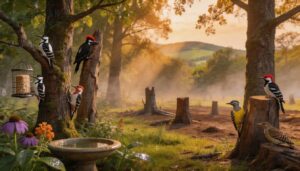
Kentucky’s woodpeckers are doing well in some spots, but a few species are quietly struggling. Habitat loss, dead tree removal, and forest fragmentation are taking a real toll.
Here’s what’s shaping their survival — and what you can actually do about it.
Red-headed Woodpecker Population Decline
The Red-Headed Woodpecker is one of the most striking Woodpecker species in Kentucky — and one of the most at risk. Populations have dropped over 70% in the past 50 years.
Land Use Change, Fire Regime Alteration, Food Resource Decline, and shifting Predator Dynamics all play a role.
Climate Change Effects are making recovery even harder, pushing this species toward a troubling conservation status.
Habitat Loss and Forest Fragmentation
Habitat loss hits Kentucky woodpeckers hard, and forest fragmentation makes it worse. Smaller patches mean fewer large dead trees, less deadwood loss buffering, and shrinking prey populations.
Fragment size effects push species like the Pileated to the edge, while genetic isolation quietly erodes long-term survival.
Microclimate shifts dry out edges faster, reducing nesting options.
Patch connectivity isn’t optional — it’s survival.
Importance of Mature Trees and Snags
Snags aren’t just dead trees — they’re working infrastructure. Standing dead trees support insect habitat, carbon sequestration, and nutrient enrichment all at once.
The habitat preferences of Kentucky woodpeckers lean heavily on dead tree snags for both food and nesting. Without them, biodiversity support collapses and microclimate regulation suffers too.
If you want woodpeckers, protect your mature trees and leave safe snags standing.
Nest Cavity Competition and Breeding Success
Getting a good cavity is everything for a woodpecker. Cavity size preference matters — smaller species lose prime holes to bigger ones every season.
Microclimate effects inside the cavity influence hatching success, especially during cool Kentucky springs.
Predator proximity tanks nest survival fast. Artificial nest boxes help ease the pressure.
Temporal nesting shifts mean earlier nesters simply win better sites.
Red-cockaded Woodpecker Extirpation in Kentucky
One of the saddest chapters in Kentucky’s woodpecker story is the loss of the Red-cockaded Woodpecker. Once part of the historical range across the state’s pine forests, it’s now extirpated — gone as a breeding species.
The Red-cockaded Woodpecker once roamed Kentucky’s pine forests — today, it’s gone as a breeding species entirely
Logging, fire suppression, and habitat loss erased the open pine ecosystems it needs.
Translocation programs, cavity enhancement, and landowner collaboration helped elsewhere, but Kentucky’s populations didn’t recover.
How Native Trees Support Woodpecker Populations
Native tree diversity is the backbone of woodpecker survival in Kentucky. Oaks and maples act as a bark beetle reservoir, feeding species like Downy and Pileated year‑round.
Dead native trees create deadwood insect pools and drive cavity creation timing that aligns with breeding season.
Sap feeding habitat in birch and maple keeps sapsuckers returning each winter. Protect native trees, and woodpeckers follow.
Bird-friendly Yard Practices for Homeowners
Your yard can quietly become a woodpecker refuge with a few smart choices. Skip Low-Impact Pesticides when possible — insects are the main course for most species.
Backyard feeding strategies for woodpeckers work best when layered with habitat:
- Add Native Shrub Layers and fruit-bearing plants for Seasonal Food Rotation
- Try Nest Box Installation near existing trees
- Mind Bird Bath Placement — shaded, shallow, and close to cover
Why Woodpeckers Matter in Kentucky Ecosystems
Woodpeckers do more than peck. Each species plays a quiet but measurable ecological role that keeps Kentucky forests running.
| Function | Woodpecker Contribution |
|---|---|
| Cavity Creation | Shelter for bluebirds, owls, and small mammals |
| Pest Regulation | Controls bark beetles and wood-boring larvae |
| Nutrient Cycling | Accelerates decay in dead wood |
| Biodiversity Support | Boosts species richness across woodland edges |
| Forest Health Indicator | Signals mature habitat quality for forest management |
Protecting woodpecker species diversity in Kentucky means investing in habitat restoration before it’s too late.
Frequently Asked Questions (FAQs)
Are Kentucky woodpeckers protected by local or federal laws?
Here’s a coincidence worth knowing — every woodpecker you spot in Kentucky falls under the MBTA, meaning federal law already has their back before your state even steps in.
What is the average lifespan of a woodpecker in Kentucky?
Lifespan varies quite a bit by species. Downy Woodpeckers generally live 4–6 years, while Red-bellied Woodpeckers can reach 12– Habitat quality, predation pressure, and seasonal mortality all play a role.
Can Kentucky woodpeckers be kept as pets or in captivity?
No, you can’t keep them as pets. Legal restrictions and permit requirements make it nearly impossible.
Ethical alternatives, like attracting them naturally, are far better for their conservation status and your peace of mind.
How do woodpeckers in Kentucky adapt to winter conditions?
They don’t migrate — they adapt. Kentucky woodpeckers rely on feather insulation, food caching, and sheltered roosting sites to survive winter.
Reduced drumming and high‑fat feeders keep them fueled when winter food sources run thin.
What are some natural predators of Kentucky woodpeckers species?
Hawks strike from above, Great Horned Owls ambush cavities at night, and snakes raid nests silently.
Raccoons, cats, and even competing cavity nesters all pressure woodpeckers across Kentucky’s forests and human-modified landscapes.
Do woodpeckers mate for life in Kentucky?
Most Kentucky woodpeckers form monogamous pair bonds and often reunite with the same mate each breeding season.
Courtship drumming, territorial calls, and cooperative nesting reinforce that seasonal mate fidelity year after year.
How long do Kentucky woodpeckers typically live?
Lifespans vary quite a bit by species. Downy woodpeckers generally live 2–7 years, while Red-bellied and Pileated woodpeckers often reach 10– Predation, window strikes, and habitat loss are the main mortality causes.
When do Kentucky woodpeckers begin nesting?
Most species kick off Early Spring Nesting in March, with Mid‑Spring Egg Laying peaking through May.
Temperature Influence shapes exact timing, but nesting behavior generally follows insect emergence and leaf-out across Kentucky woodlands.
Can woodpeckers cause serious damage to homes?
Yes, they can—like a slow leak you ignore too long, woodpecker damage compounds fast.
Siding infiltration, nesting cavities, and structural weakening are real risks worth addressing before small holes become big repairs.
Are Kentucky woodpeckers protected under federal law?
All seven species are shielded by the Migratory Bird Treaty Act. That means no harming, capturing, or disturbing nests without a Legal Permit. Enforcement Penalties include fines and jail time.
Conclusion
As I recall my first encounter with a Red-headed Woodpecker, its vibrant red plumage flashing in a Kentucky forest, I realized how much I’d been missing. These birds are more than just a splash of color; they’re indicators of forest health.
By learning about the woodpeckers of Kentucky, you can better appreciate the intricate balance of ecosystems. So, take a moment to listen for their drumming and look for their flashes of red—your woods will come alive.
- https://www.youtube.com/watch?v=UTVWIloVPeU&t=2s
- https://camstreamer.com/embed/5tlcVPQgIrfngJT2Z2ABuvHDiog2eqLVTcfgtGyG
- https://www.sctimes.com/story/sports/2021/07/15/red-headed-woodpecker-numbers-decline-due-habitat-loss/7889837002/
- https://bwdmagazine.com/backyard-birding-time/bird-feeding/top-four-foods-to-attract-and-feed-woodpeckers/
- https://www.audubonpark.com/audubon-park-classic/p/woodpecker-suet