
This site is supported by our readers. We may earn a commission, at no cost to you, if you purchase through links.
 That mystery chirping outside your window isn’t random noise—it’s bird communication with purpose.
When wondering what bird is making noise, listen for patterns: sharp "cheer-cheer-cheer" whistles signal Northern Cardinals claiming territory, while repetitive "fee-bee" calls indicate Eastern Phoebes.
Black-capped Chickadees produce their signature "chickadee-dee-dee" chatter, and Northern Flickers drum loudly during breeding season.
The timing matters too—dawn choruses feature territorial songs, while alarm calls happen when predators appear.
Most backyard sounds come from males defending territory or birds maintaining contact with their flocks, which is a form of meaningful bird conversations happening right outside your door, and understanding these vocal signatures transforms confusing noise into something more understandable.
Table Of Contents
- Key Takeaways
- Bird Noise Identification
- What Bird is Making Noise
- Bird Sound Variations
- Bird Species Sound Recognition
- Bird Call Analysis Tools
- Identifying Birds by Sound
- Advanced Bird Sound Analysis
- Frequently Asked Questions (FAQs)
- Why do birds make different sounds?
- Are all bird sounds vocalizations?
- What do bird sounds sound like in a marching band?
- How to find out what bird is making noise?
- Why is this bird making so much noise?
- Why do birds make noise at night?
- When is peak bird vocal activity time?
- How weather affects bird sound patterns?
- Do injured birds make different sounds?
- Can urban noise change bird calls?
- Conclusion
Key Takeaways
- Learn the basic sound types – You’ll hear songs (complex melodies for territory and mating), calls (short communication sounds), alarm calls (sharp danger warnings), and contact calls (gentle flock coordination chirps)
- Start with common backyard birds – You can easily recognize Northern Cardinals’ "cheer-cheer-cheer" whistles, Eastern Phoebes’ "fee-bee" calls, Black-capped Chickadees’ signature chatter, and Northern Flickers’ loud drumming
- Use smartphone apps for instant identification – Apps like Merlin Bird ID and BirdNET can analyze recordings in real-time, giving you immediate species identification with confidence scores
- Pay attention to timing and context – Dawn choruses feature territorial songs, while sharp calls during the day usually signal predators or threats, and understanding when birds vocalize helps narrow down what you’re hearing
Bird Noise Identification
You’ll often hear mysterious bird sounds outside but can’t identify the culprit behind the noise.
Learning to recognize common bird vocalizations helps you quickly determine which species is calling, singing, or making alarm sounds in your yard or neighborhood, and understand the mysterious bird sounds.
Types of Bird Sounds
When you’re trying to identify that mystery bird making noise outside your window, understanding the basic types of bird sounds helps narrow down your search.
Birds produce distinct vocalizations for different purposes, and recognizing these patterns makes identification much easier.
Here are the main types of bird sounds you’ll encounter:
- Songs – Complex, musical patterns used primarily by males during breeding season for territory defense and mate attraction
- Calls – Simple, short vocalizations (usually one syllable) made by both sexes year-round for basic communication
- Alarm calls – Sharp, insistent sounds that warn other birds of predators or threats nearby
- Contact calls – Gentle chirps or peeps that help birds stay connected within flocks or family groups
- Flight calls – Distinct vocalizations given during movement, especially common in migrating species
These avian communication patterns involve sound mimicry and vocal learning, with some species developing regional dialects.
Bird calls and bird songs differ substantially in complexity, while imitative birdsongs showcase remarkable abilities in certain species.
Bird Vocalizations
You’ll discover bird vocalizations serve specific purposes beyond simple noise-making.
Songs showcase complex melodies for territory defense and mate attraction, while calls deliver quick messages like danger alerts.
Different call types include contact chirps, alarm shrieks, and begging sounds.
Bird species develop regional dialects, making sound development fascinating.
Understanding these bird sounds helps with accurate bird species identification through distinct vocalization patterns and regional dialects, and by recognizing complex melodies.
Unique Bird Calls
Why do some birds sound like chainsaws while others mimic your ringtone?
Unique bird calls showcase fascinating Call Functions beyond basic communication.
Mimicry Calls let mockingbirds copy dozens of species, while Regional Dialects mean cardinals sound different across states.
Hybrid Sounds occur when species interbreed, creating puzzling vocalizations.
Even Silent Calls exist—owls use infrasonic frequencies you can’t hear.
These quirks make bird sound identification challenging but rewarding for bird species identification enthusiasts.
What Bird is Making Noise
When you hear mysterious sounds outside your window, bird sound identification becomes your detective tool for solving the feathered mystery. Each bird species creates distinct vocalizations that serve as their personal calling cards. Understanding Sound vs. Species differences helps you match specific calls to their makers – a crow’s harsh "caw" differs dramatically from a cardinal’s sweet whistle.
Habitat Sounds provide essential context clues. Forest birds like wood thrushes produce flute-like trills, while urban sparrows chirp sharply above city noise. Birdsong Meanings reveal whether you’re hearing territorial claims, mating calls, or alarm signals.
Regional Variations add complexity – the same species might sound slightly different across geographic areas. Crows, for example, exhibit complex communication methods using varied calls.
Noise Pollution increasingly affects bird call recognition in urban environments, forcing birds to adjust their pitch and volume. Modern technology like smartphone apps can analyze recordings instantly, making bird species identification accessible to beginners. Start with common local birds, then expand your auditory library as your ear develops for these natural soundscapes.
Bird Sound Variations

You’ll notice that birds don’t just make one type of sound—they’ve got a whole repertoire of calls for different situations.
Whether they’re staying in touch with their flock, sounding the alarm about a nearby cat, or begging for food, each vocalization serves a specific purpose that can help you identify both the species and what’s happening in their world, which is crucial for understanding their complete concepts.
Contact Calls
You’ll often hear soft, gentle chirps that keep family groups connected throughout the day.
These contact calls maintain flock cohesion and strengthen social bonds through consistent avian communication.
- Short peep sounds – Quick notes that say "I’m here"
- Gentle chirps – Soft calls between mates and offspring
- Location signals – Help scattered birds regroup safely
- Comfort sounds – Reassuring notes during rest periods
- Bonding calls – Strengthen relationships within the flock
Flight Calls
When migrating birds travel together, they use flight calls to stay connected during their journey.
These distinct vocalizations differ from regular songs and help with flock coordination and species recognition, especially during nocturnal flights when visual contact isn’t possible.
| Flight Call Purpose | Example Species |
|---|---|
| Flock Coordination | Geese, Sandhill Cranes |
| Altitude Communication | Warblers, Thrushes |
| Species Recognition | Blackbirds, Finches |
Flight calls serve as aerial GPS systems, helping birds maintain formation and avoid collisions.
You’ll often hear these migration vocalizations overhead during spring and fall, particularly at night when most bird species travel.
These specialized bird sounds enable successful long-distance journeys through precise bird sound identification among flockmates.
Alarm Calls
Something’s wrong when birds suddenly erupt in sharp, urgent cries. You’ll recognize these Predator Detection signals by their distinct Acoustic Features and immediate Threat Response patterns. Call Variation differs between Species Differences, but all alarm calls share intensity.
Bird behavior during threats includes:
- Sharp, repetitive notes that pierce through background noise
- Aggressive posturing with fluffed feathers and alert stance
- Mobbing behavior where multiple species join the warning chorus
- Distinctive pitch changes that signal different threat levels
- Persistent calling until danger passes or birds retreat
Bird communication through alarm calls protects entire neighborhoods of wildlife.
Begging Calls
The desperation in fledgling distress calls cuts through any woodland quiet like a dinner bell for parents.
You’ll recognize these repetitive, urgent bird sounds as young birds beg for food—think of a toddler’s persistent "please, please, please!"
Call intensity varies dramatically between species, with some chicks producing surprisingly loud bird noises.
These acoustic features help with bird identification, as parental response patterns differ across species.
Understanding different bird calls is key to interpreting these behaviors.
This bird behavior continues until fledglings become independent.
Bird Species Sound Recognition
You can identify many birds just by learning their signature sounds and watching their behavior patterns.
Start with these four common species that have distinctive calls you’ll hear year-round in most backyards, which can help you learn to recognize birds by their signature sounds.
Northern Cardinal Sounds

You’ll recognize the Northern Cardinal by its loud, whistled songs that sound like "cheer, cheer, cheer" or "birdie, birdie, birdie."
Both male and female cardinals sing, though males perform year-round while females sing mainly during nesting season.
Their sharp metallic "chip" call serves as an alarm.
Cardinal vocalizations show regional dialects and song complexity, with individuals mastering over a dozen variations.
The female Cardinal typically lays 3-4 speckled eggs in each nest, demonstrating a unique aspect of their breeding behavior.
Eastern Phoebe Sounds
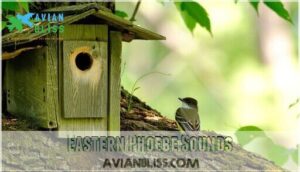
The Eastern Phoebe’s signature "fee-bee" song makes bird identification straightforward among North America’s flycatchers.
You’ll hear males singing this raspy, two-part call persistently during spring territory establishment. Listen for the alternative "fee-britit" pattern with its sputtery ending, plus sharp "chip" calls near nesting sounds in phoebe habitats.
Unlike many bird species, regional variations remain minimal across their range. These birds are known to frequently nest near human structures, adapting to urban environments with their ability to nest in a variety of locations, including near human structures.
Black-capped Chickadee Sounds

You’ll recognize a Black-capped Chickadee by its signature "chickadee-dee-dee" call and clear whistled "fee-bee" song.
These social birds show fascinating chickadee call variations across dialect regions, with chickadee alarm calls becoming faster when danger approaches.
Their chickadee vocal mimicry abilities help with bird sound identification, making them excellent starter birds for learning bird species identification through consistent, friendly vocalizations year-round.
The similar-sounding Eastern Phoebe says "fee-bee," giving the bird its name.
Northern Flicker Sounds
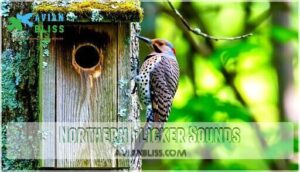
You’ll recognize Northern Flickers by their distinctive "wick-a-wick-a-wick" territorial song and sharp "kleer" alarm calls.
These woodpeckers also produce loud drumming on metal surfaces during spring breeding season.
| Sound Type | Description | When You’ll Hear It |
|---|---|---|
| Territorial Song | "wick-a-wick-a-wick" lasting 7-8 seconds | Spring mornings, breeding season |
| Alarm Call | Sharp "kleer" or "klee-yer" | When threatened or disturbed |
| Drumming | Rapid pecking on metal/wood | Territory defense, courtship displays |
Bird Call Analysis Tools
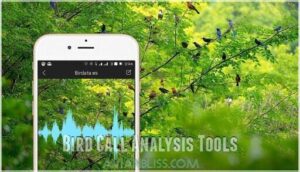
You don’t have to guess anymore when you hear mysterious bird sounds in your yard.
Modern technology puts powerful identification tools right in your smartphone, turning you into an instant bird detective with apps that can recognize calls in real-time.
BirdNET Platform
Over six million people worldwide rely on BirdNET’s cutting-edge acoustic monitoring technology for bird sound identification.
This citizen science powerhouse uses deep learning algorithms trained on hundreds of thousands of recordings to recognize over 6,500 species globally.
You’ll get instant sound classification results with confidence scores, making data analysis simple for conservation applications and research projects tracking avian populations.
Users can also find BirdNET platform products online.
Merlin Bird ID App
You’ll love Merlin Bird ID App’s user-friendly approach to bird sounds identification.
This free app from Cornell Lab offers impressive species coverage across six continents, supporting over 6,000 birds worldwide.
Its Sound ID feature analyzes real-time audio with solid app accuracy for common species.
The intuitive user interface makes bird sound recognition accessible to beginners, while future updates continuously expand global coverage and improve identification capabilities.
Many users find its offline access helpful when identifying birds in remote areas.
AI-powered Bird Recognition
Modern AI transforms how you identify bird song through sophisticated machine learning.
These birdsong identifier apps use deep neural networks for avian sound detection, achieving remarkable AI accuracy rates up to 95%.
Here’s what makes them revolutionary:
- Real-time recognition – Apps like BirdNET instantly process your recordings
- Global expansion – Coverage spans 3,000+ species across continents
- Future potential – Synthetic calls now help train models for rare birds
While app limitations exist for uncommon species and accessibility issues remain, bird sound identification apps continue evolving rapidly.
Identifying Birds by Sound
You can identify mystery bird sounds by focusing on three key techniques that turn confusing noise into clear species identification.
Measuring the rhythm of woodpecker drumming, watching how birds move while they vocalize, and using visual sound patterns in apps will help you match what you’re hearing to the right feathered culprit.
These techniques, including rhythm, are essential for identifying bird sounds.
Measuring Woodpecker Knocks

Counting knock tempo reveals vital species clues in bird sound identification apps.
Pileated woodpeckers deliver slow, deliberate strikes—about one per second—while smaller species like downy woodpeckers produce rapid-fire bursts.
This acoustic bird monitoring technique helps distinguish between similar-looking species.
Woodpecker rhythms create unique sound signatures that bird sound analysis tools recognize, making behavioral context essential for accurate bird noise identification when visual confirmation isn’t possible.
To further refine identification, consider using a woodpecker sound identifier.
Observing Bird Behavior

While listening for bird sounds recognition, watch how birds move—their Bird Posture reveals species clues.
A woodpecker’s vertical stance differs from a warbler’s horizontal perch. Movement Patterns matter too: chickadees dart between branches while cardinals hop deliberately.
Note Feeding Habits, Social Interactions, and Time of Day for complete bird behavior understanding that enhances bird sounds interpretation.
Observing their vocalizations and songs can further help identify the species.
Using Visual Spectrograms
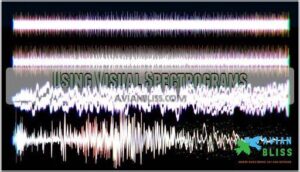
Visual spectrograms transform bird sound analysis into something you can actually see.
Seeing sound patterns makes identifying bird calls as clear as reading sheet music
These frequency analysis charts show pitch changes over time, making birdsong learning much easier than relying on ears alone.
- High-frequency whistles appear as thin horizontal lines at the top
- Low hoots and coos show as thick bands near the bottom
- Trills and warbles create wavy, oscillating patterns
- Sharp calls display as vertical spikes or dots
Bird identification apps like Merlin and BirdNET use spectrogram patterns for visual identification, helping you match what you hear to distinctive sound visualization signatures for accurate bird sound classification.
Specialized software can also help with detailed sound analysis.
Advanced Bird Sound Analysis

When you’re ready to take bird identification beyond casual listening, advanced sound analysis opens up powerful research capabilities.
Tools like BirdNET’s downloadable repository let you process large datasets of recordings, while expanding global species coverage means you can identify birds from virtually anywhere on Earth.
Downloading BirdNET Repository
To access BirdNET’s open-source repository, you’ll need Python 3.7+ and TensorFlow 2.5+ installed on your system.
The AI-powered tool from Chemnitz University of Technology uses machine learning for bird recognition. Repository Access requires GitHub knowledge, while Installation Guide details vary by operating system.
Check System Requirements before downloading.
| Component | Requirement |
|---|---|
| Python Version | 3.7 or higher |
| TensorFlow | 2.5+ required |
| Operating System | Windows/Mac/Linux |
| Storage Space | 2GB minimum |
| Internet Connection | Required for setup |
Data Usage follows specific Contribution Guidelines, so you’ll want to review the documentation thoroughly.
The repository includes pre-trained models and sample audio files to get you started with bird sound analysis right away.
Large Data Collection Analysis
BirdNET processes massive bird sound databases containing millions of recordings from global sources.
When analyzing large datasets, you’ll encounter Dataset Bias from regional recording differences and varying equipment quality.
Algorithm Accuracy improves with more training data, but Computational Cost increases exponentially.
Feature Extraction methods must handle diverse audio formats while maintaining consistent bird sound recognition performance.
Predictive Modeling techniques classify bird sounds across different environments and recording conditions, making animal sound recognition systems more robust for real-world applications.
Global Bird Species Coverage
Scientific advancement in bird sound recognition has expanded dramatically, yet coverage gaps persist across the planet’s 11,000+ species.
Current databases document vocalizations from primarily common species, leaving rare birds understudied.
- Species Distribution varies by continent, with South America holding 40% of global diversity
- Habitat Variation affects vocal complexity, especially in dense tropical forests
- Conservation Status influences research priority, favoring threatened species
- Regional Endemism creates identification challenges in remote areas
Modern animal sound recognition technology continues bridging these gaps through AI-powered nature sounds identifier systems.
Frequently Asked Questions (FAQs)
Why do birds make different sounds?
Over 7,500 bird species exist worldwide, each using distinct sounds for survival.
You’ll hear birds make different sounds because they’re communicating territory boundaries, attracting mates, warning of danger, and coordinating with their flock for essential daily activities, which includes warning of danger.
Are all bird sounds vocalizations?
No, you’ll encounter both vocal sounds and non-vocal mechanical sounds from birds.
While songs and calls are true vocalizations from their syrinx, birds also create sounds through wing beats, bill clicking, and drumming behaviors.
What do bird sounds sound like in a marching band?
Imagine brass instruments mimicking nature’s symphony! You’ll hear trumpet "hoots" like owls, tuba "croaks" resembling ravens, and flute "trills" echoing wood thrushes, creating a whimsical orchestral interpretation of birdsong.
How to find out what bird is making noise?
Listen carefully to identify the bird’s location, then use apps like Merlin Bird ID or BirdNET to record and analyze the sound.
These AI-powered tools can identify species from calls in real time.
Why is this bird making so much noise?
Persistent, passionate performances point to birds broadcasting territorial boundaries or attracting mates.
You’re hearing nature’s dating app in action—males especially vocalize loudly during breeding season to claim space and court females, showcasing their ability to secure a mate through vocalize.
Why do birds make noise at night?
You’ll hear nighttime bird calls from owls hunting, mockingbirds defending territory, or nocturnal migrants communicating during flight. Some species are naturally active after dark, using darkness for protection.
When is peak bird vocal activity time?
Like nature’s alarm clock striking at dawn, you’ll hear peak bird vocal activity during the first two hours after sunrise.
That’s when males belt out territorial songs and mating calls most enthusiastically.
How weather affects bird sound patterns?
Weather substantially impacts bird vocalizations.
Rain and wind reduce singing activity since birds conserve energy and sounds don’t carry well.
Cold weather decreases dawn chorus intensity, while warm, calm mornings amplify bird sounds beautifully, and this is heavily influenced by the weather.
Do injured birds make different sounds?
A robin with a broken wing might produce distressed, repetitive chirps instead of its usual melodic song.
Injured birds typically vocalize more frantically, using sharper alarm calls or weak, labored sounds that differ markedly from their normal repertoire, and this can be seen as a distressed sign.
Can urban noise change bird calls?
Yes, urban noise forces birds to adapt their calls.
You’ll notice they sing louder, at higher pitches, or during quieter times like dawn.
Cities literally reshape how birds communicate to cut through traffic and construction sounds, making them sing louder and at higher pitches.
Conclusion
Picture yourself stepping outside on a crisp morning, coffee in hand, when that familiar symphony begins around you.
Now you’re equipped to decode what bird is making noise in your backyard orchestra, whether it’s a cardinal’s territorial whistle or a chickadee’s cheerful chatter.
With practice and patience, you’ll transform mysterious sounds into meaningful conversations, turning every outdoor moment into an opportunity for discovery and connection with nature’s daily performers, allowing you to appreciate the daily performers.
- https://merlin.allaboutbirds.org/sound-id/
- https://pmc.ncbi.nlm.nih.gov/articles/PMC10575132/
- https://www.birdnote.org/podcasts/birdnote-daily/identify-bird-sounds-your-phone
- https://apps.apple.com/us/app/merlin-bird-id-by-cornell-lab/id773457673
- https://www.massaudubon.org/news/latest/10-common-bird-sounds



John
November 3, 2025 at 04:59 PM
what kind of bird has a call that sounds like "orick" ?
Mutasim Sweileh
November 5, 2025 at 12:59 PM
The "orick" sound you're hearing might be one of the oriole's distinctive whistle notes. These birds are common in eastern North America during spring and summer, and they're quite vocal, especially during breeding season. They're striking birds with bright orange and black plumage, so if you can spot the bird making the sound, that would help confirm the identification!