This site is supported by our readers. We may earn a commission, at no cost to you, if you purchase through links.
 You’ll spot some truly impressive large birds in Arizona that’ll make your jaw drop.
The California Condor (Gymnogyps californianus) rules the skies with a massive 10-foot wingspan, while Bald Eagles (Haliaeetus leucocephalus) soar majestically over lakes and rivers.
Wild Turkeys (Meleagris gallopavo) can tip the scales at 25 pounds, making them Arizona’s heaviest birds.
Great Blue Herons (Ardea herodias) stand nearly four feet tall, looking like feathered statues in wetlands.
You can’t miss the Golden Eagles (Aquila chrysaetos) or Turkey Vultures (Cathartes aura) riding thermals above desert landscapes.
These desert giants have some surprising secrets about where they nest and hunt.
Table Of Contents
- Key Takeaways
- Largest Birds in Arizona by Wingspan
- Heaviest Birds Found in Arizona
- Tallest Birds in Arizona’s Landscape
- Impressive Raptors of Arizona
- Majestic Water Birds in Arizona
- Arizona’s Largest Game Birds
- Scavengers and Vultures of Arizona
- Unique Large Birds in Arizona’s Deserts
- Where to Spot Large Birds in Arizona
- Conservation Efforts for Arizona’s Large Birds
- Frequently Asked Questions (FAQs)
- Are there birds in Arizona?
- What is the biggest bird in Arizona?
- Where to see birds in Arizona?
- How do I find birds in Arizona?
- Is Arizona a good place to bird?
- What are the smartest birds in Arizona?
- What is the largest bird of prey in Arizona?
- What is the difference between a falcon and a hawk in Arizona?
- What are the top 5 biggest birds?
- What are the most common birds in Arizona?
- Conclusion
Key Takeaways
- You’ll find Arizona’s most impressive bird is the California Condor with its massive 9.5-foot wingspan, followed by the Bald Eagle at 8 feet and American White Pelican at 10 feet across.
- You can spot these giants in three main locations: state parks like Dead Horse Ranch, wildlife refuges such as Bosque del Apache, and surprisingly in urban areas where Great Blue Herons hunt city ponds.
- You’ll discover Arizona hosts both powerful raptors like Golden Eagles and Red-tailed Hawks, plus heavyweight game birds including Wild Turkeys that can weigh up to 25 pounds.
- You’re witnessing remarkable conservation success stories, especially with California Condors pulled back from extinction and Bald Eagles thriving again thanks to dedicated habitat protection and breeding programs.
Largest Birds in Arizona by Wingspan

When you’re looking up at Arizona’s skies, you’ll spot some truly massive birds that’ll make you stop and stare.
The state’s biggest winged giants include the California Condor with its incredible 9.5-foot wingspan, the majestic Bald Eagle stretching up to 7.5 feet across, and the elegant Tundra Swan that can reach over 6 feet from tip to tip.
California Condor
You’ll witness California Condor (Gymnogyps californianus), Arizona’s most magnificent bird with a stunning 9.5-foot wingspan.
These critically endangered scavengers represent one of conservation’s greatest success stories through dedicated Condor Conservation and Reintroduction Challenges. They thrive by soaring on thermal updraft currents to reach high altitudes.
California Condors soar on thermals with 9.5-foot wings—Arizona’s most magnificent conservation success story taking flight.
Picture these massive arizona birds:
- Soaring effortlessly over Grand Canyon’s rim
- Weighing up to 25 pounds with jet-black plumage
- Living 60 years in their natural Habitat Range
Despite Lead Poisoning threats, Breeding Success continues improving these remarkable arizona wildlife ambassadors.
Bald Eagle
The Bald Eagle (Haliaeetus leucocephalus) dominates Arizona’s skies with wingspans reaching 8 feet.
You’ll spot these Arizona eagles near the Verde and Salt Rivers, where their nesting habits center around tall cottonwoods.
Their diet specifics include fish, waterfowl, and small mammals.
Once endangered, conservation status improved dramatically through eagle rehabilitation programs, making these magnificent birds of prey a comeback story.
These eagles, with a typical lifespan of 20-30 years, require old-growth trees for nesting.
Tundra Swan
You’ll spot these graceful waterfowl during winter months as they pass through Arizona’s lakes and rivers.
Tundra Swans boast an impressive 66-83 inch wingspan, making them true giants among Arizona bird species.
Their migration patterns bring flocks from Arctic breeding grounds to warmer climates.
Listen for their distinctive trumpeting vocalizations echoing across wetlands—a sound you won’t forget.
Heaviest Birds Found in Arizona

When you’re looking for Arizona’s heaviest feathered residents, you’ll find some surprisingly hefty birds that might make you wonder how they ever get off the ground.
These weighty champions include the Wild Turkey, Sandhill Crane, and Canada Goose—birds that can tip the scales at over 20 pounds and still manage to soar through Arizona’s skies with grace.
They are able to do this despite their size, and it is a testament to their ability to fly efficiently.
Wild Turkey
You’ll discover wild turkeys strutting through Arizona’s diverse landscapes, from pine forests to grasslands.
These heavy-bodied birds tip the scales at 15-25 pounds, making them true giants among Arizona’s feathered residents.
Watch for their iridescent bronze plumage and distinctive gobbling calls echoing through mountain canyons.
Three subspecies call Arizona home: Merriam’s, Gould’s, and Rio Grande turkeys, each perfectly adapted to their unique Wild Turkey Habitat across the state’s varied terrain.
They’re known to supplement their diet with insects and small animals.
Sandhill Crane
Standing four feet tall and weighing up to 15 pounds, the Sandhill Crane (Antigone canadensis) ranks among Arizona’s heaviest birds.
These magnificent creatures showcase their famous mating rituals through elaborate dances during crane migration seasons. You’ll hear their distinctive crane sounds – trumpeting calls that carry for miles across wetlands and agricultural fields.
Here’s what makes these large birds fascinating:
- Crane diet includes everything from insects to small mammals
- Arizona bird habitats like the Verde Valley attract thousands annually
- Crane conservation efforts help protect their migration routes
Arizona birding enthusiasts flock to witness these graceful giants during peak bird migration periods.
Canada Goose
Canada Geese (Branta canadensis) pack serious weight at up to 14 pounds, making them Arizona’s heaviest waterfowl.
You’ll hear their signature honking before spotting their distinctive black heads and white chin straps.
These adaptable giants have mastered both migration patterns and year-round residency.
| Feature | Details |
|---|---|
| Goose Behavior | Forms lifelong pairs, aggressive during nesting |
| Goose Migration | Follows ancient flyways, some stay year-round |
| Goose Diet | Grazes on grass, aquatic plants, grains |
Their success story proves effective goose management works.
Tallest Birds in Arizona’s Landscape

You’ll spot Arizona’s tallest birds standing like nature’s skyscrapers along rivers and wetlands, where Great Blue Herons (Ardea herodias) can tower up to 4.5 feet tall with their impressive 6-foot wingspan.
These long-legged waders share the spotlight with Great Egrets (Ardea alba), whose snowy white feathers and 3-foot height make them look like elegant statues until they strike at fish with lightning speed.
Great Blue Heron
Picture a feathered giant wading through Arizona’s wetlands—that’s the Great Blue Heron.
Standing 4.5 feet tall with blue-gray plumage, this majestic bird dominates shallow waters.
Heron Diet includes fish, frogs, and small mammals they spear with lightning-fast strikes.
Heron Habitat spans rivers, ponds, and marshes statewide.
Their Heron Adaptations make them Arizona’s most impressive wading birds.
Great Egret
Among Arizona’s most striking large birds, you’ll spot the Great Egret’s snowy-white plumage gleaming against wetland backdrops.
This tall wader reaches 41 inches, displaying spectacular breeding plumage with delicate aigrettes that once fueled the devastating feather trade.
Along the Colorado River and desert oases, watch its patient foraging behavior as it stalks fish with dagger-like precision.
Thanks to protection efforts, this species’ conservation status has improved dramatically, making it a true success story in arizona bird identification.
Impressive Raptors of Arizona
You’ll spot Arizona’s most powerful hunters soaring overhead or perched on desert posts, scanning for their next meal.
These raptors include the mighty Golden Eagle with its 8-foot wingspan, the common Red-tailed Hawk that’s basically the neighborhood watch of the bird world, and the Great Horned Owl that hunts silently in complete darkness.
Golden Eagle

Why does the Golden Eagle (Aquila chrysaetos) reign supreme among Arizona’s raptors? This circumglobal species dominates montane habitat with its golden plumage gleaming in desert sunlight.
You’ll spot juvenile markings on younger birds—white patches on wings and tail.
These large birds showcase impressive hunting techniques:
- Soaring at 200+ feet to spot prey
- Diving at 80+ mph speeds
- Grasping mammals with powerful talons
Arizona wildlife enthusiasts consider these birds of prey absolutely magnificent.
Red-tailed Hawk
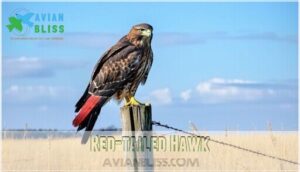
Red-tailed Hawks soar through Arizona’s skies with unmatched grace.
These large birds showcase remarkable hunting techniques, diving from perches to snatch rodents below.
Urban hawks adapt brilliantly to city life, while desert populations display stunning color variations.
Their habitat adaptations make them Arizona’s most successful raptors.
| Feature | Description |
|---|---|
| Wingspan | Up to 52 inches wide |
| Hunting Style | Perch-and-pounce method |
| Conservation Status | Stable populations statewide |
Great Horned Owl
Meet Arizona’s most adaptable predator – the Great Horned Owl. This master of nocturnal hunting weighs up to 4 pounds and sports intimidating ear tufts with piercing yellow eyes.
You’ll find these arizona owls thriving across diverse habitat range from deserts to mountains. Their varied owl diet includes rabbits, skunks, and even other birds of prey.
With flexible nesting habits using abandoned hawk nests, they’re true survivors among raptors arizona offers in your arizona bird guide. They often aggressively displace other nest occupants.
Majestic Water Birds in Arizona

Arizona’s waters host some truly impressive feathered giants that’ll make you stop and stare.
You’ll find massive American White Pelicans with 10-foot wingspans working together like a synchronized swimming team, plus sleek Double-crested Cormorants that spread their wings to dry after fishing trips.
American White Pelican
You’ll spot the American White Pelican‘s impressive nine-foot wingspan soaring over Arizona’s wetlands during winter months.
These massive birds showcase remarkable cooperative fishing techniques, working together to herd fish into shallow waters before using their signature pouch feeding method.
They’re known to forage at night, and during breeding season, rely on touch to catch fish.
Their fascinating social behavior includes:
- Migration patterns from northern breeding colonies to Arizona’s warmer waters
- Conservation status improvements through protected nesting site initiatives
- Coordinated group hunting that makes bird watching Arizona unforgettable
Double-crested Cormorant
These sleek master fishers patrol Arizona’s waterways with impressive skill.
You’ll watch double-crested cormorants plunge underwater, using hooked bills to catch fish.
After diving, they perch with wings spread wide for feather drying since their plumage isn’t waterproof.
Large colonies nest together in trees, though their droppings sometimes kill vegetation.
Conservation efforts help maintain stable populations across Arizona’s diverse aquatic habitats.
Arizona’s Largest Game Birds

When you think about Arizona’s largest game birds, the Wild Turkey (Meleagris gallopavo) takes center stage as the heavyweight champion. These impressive birds can tip the scales at 24 pounds, with their iridescent bronze feathers catching sunlight as they strut through ponderosa pine forests and oak woodlands.
The Gambel’s Quail (Callipepla gambelii) might be smaller, but it’s Arizona’s desert icon. You’ll spot these plump, football-shaped birds scurrying between mesquite and palo verde trees.
Game bird habitats face mounting pressure from development, making population management essential. Hunting regulations help maintain healthy numbers while generating significant economic impact through license sales and tourism. Conservation challenges include habitat fragmentation and climate change effects.
Here’s what makes these Arizona birds special:
- Wild Turkeys can fly up to 55 mph despite their hefty size
- Gambel’s Quail travel in coveys of 10-40 birds for protection
- Both species play pivotal roles in large birds in Arizona ecosystems through seed dispersal
Scavengers and Vultures of Arizona

You’ll spot these impressive scavengers soaring through Arizona’s skies, where they play nature’s cleanup crew with surprising grace.
These large birds mightn’t win beauty contests, but they’re essential helpers that keep the desert ecosystem healthy while showing off wingspans that’ll make you stop and stare.
Turkey Vulture
You’ll recognize Turkey Vultures soaring overhead with their distinctive red heads and massive six-foot wingspans.
These incredible scavengers are nature’s cleanup crew, keeping Arizona’s landscapes healthy by consuming carrion. Their keen sense of smell helps them locate food from miles away. Their large diagonal nostrils support this exceptional olfactory acuity.
Turkey Vulture Identification and behavior features:
- Red, featherless head that prevents bacteria buildup
- Wings held in a distinctive V-shape while soaring
- Wobbly flight pattern that rocks side to side
- Strong stomach acid that kills harmful bacteria
- Found in open areas, farmlands, and desert regions
Vulture Diet consists mainly of roadkill and deceased animals.
Black Vulture
Arizona’s skies occasionally host the striking Black Vulture (Coragyps atratus), one of the most social scavengers among Large birds in Arizona.
You’ll recognize these arizona avian species by their jet-black plumage and distinctive white wingtips that flash like stars during flight.
Unlike their red-headed cousins, Black Vultures sport featherless black heads and demonstrate remarkable Vulture Social Behavior—they’re family-oriented birds that mate for life and hunt in groups up to 100 strong.
Their Vulture Habitat Range extends into southern Arizona’s open deserts.
The Black Vulture Diet consists entirely of carrion, making these vulture species nature’s essential cleanup crew.
Feature Black Vulture Turkey Vulture
Plumage
Head
Wingtips
Social Behavior
Sense of Smell
Crested Caracara
Unlike typical birds of prey, the Crested Caracara (Caracara plancus) acts more like nature’s cleanup crew than a hunter.
This fascinating falcon breaks all the rules with its unique scavenging habits and ground-foraging behavior:
- Bold black-and-white plumage with bright orange-red facial skin
- Long, powerful legs perfect for walking and ground hunting
- Social nature – often feeds in groups unlike solitary raptors
Their caracara diet includes carrion, insects, and small animals, making them essential to Arizona’s ecosystem balance.
Unique Large Birds in Arizona’s Deserts

Arizona’s deserts host some truly special large birds that you won’t find anywhere else in quite the same way.
You’ll spot the famous Greater Roadrunner (Geococcyx californianus) sprinting across open ground at speeds up to 20 mph.
While the cooperative Harris’s Hawk (Parabuteo unicinctus) hunts in family groups like a feathered wolf pack.
Greater Roadrunner
You’ll spot the Greater Roadrunner sprinting through Arizona’s desert landscapes at impressive speeds up to 20 mph.
This large bird prefers running over flying, using its powerful legs to chase lizards, snakes, and insects across open scrubland.
Roadrunner behavior includes territorial displays and monogamous pairing.
Their specialized roadrunner habitat encompasses Sonoran Desert regions where these iconic arizona bird species thrive year-round.
Harris’s Hawk
With dark reddish-brown plumage and bright yellow legs, Harris’s Hawks stand out among Arizona’s raptors.
These social hunters work in coordinated groups—a rare behavior that makes them fascinating to watch. You’ll spot them in desert brush country, where their cooperative hunting tactics help them take down prey much larger than themselves.
- Cooperative Hunting: Harris’s Hawks hunt in packs of 2-6 birds, surrounding prey like ground squirrels
- Social Behavior: They form complex family groups with strict dominance hierarchies and shared nesting duties
- Habitat Adaptation: Perfectly suited for Arizona’s thorn-forest and desert scrub environments
- Juvenile Plumage: Young birds show streaked brown coloring before developing adult’s distinctive reddish shoulders
- Birdwatching in Arizona: These large birds offer some of the best raptor viewing experiences in the Southwest
Where to Spot Large Birds in Arizona

You’ll find Arizona’s largest birds in three main places: state parks like Dead Horse Ranch offer excellent wildlife viewing, while Bosque del Apache and other refuges attract migrating giants.
Urban areas surprise many birders too, as Great Blue Herons often hunt in city ponds and Red-tailed Hawks perch on streetlights right downtown.
State Parks
Park Birding enthusiasts will discover Arizona’s state parks are treasure troves for spotting large birds in Arizona. These Accessible Parks feature diverse habitats perfect for birdwatching adventures.
Red Rock State Park’s riparian corridors and Patagonia Lake’s wetlands shine during Seasonal Migrations. Your Arizona bird checklist grows quickly here, with majestic raptors soaring overhead and waterfowl cruising peaceful waters.
Consider purchasing an Arizona field guide for easy identification. These Conservation Areas protect critical habitat while offering excellent viewing opportunities for Arizona bird species list additions.
Wildlife Refuges
Arizona’s wildlife refuges serve as premier bird sanctuaries where you’ll discover incredible large birds in Arizona.
These refuge habitats support diverse arizona bird species list through specialized refuge management and species protection programs.
Bill Williams River National Wildlife Refuge hosts over 340 bird species, while Buenos Aires National Wildlife Refuge offers prime birdwatching locations.
You can even find Arizona bird refuge merchandise online.
These protected areas balance ecotourism impact with arizona bird conservation, creating perfect spots for observing majestic raptors and waterbirds.
Urban Areas
You don’t need to venture into wilderness areas to witness Arizona’s impressive large birds. Cities offer surprising birdwatching opportunities right outside your door. Urban adaptations have helped many species thrive alongside humans, creating unique city birdwatching experiences.
Here are prime spots to discover Arizona’s majestic birds in urban areas:
- City parks with water features – Great Blue Herons and cormorants frequent artificial lakes
- Golf courses and green spaces – Red-tailed Hawks hunt rodents on manicured lawns
- Residential neighborhoods with bird feeders – Attract various species while reducing human impact through thoughtful feeding
Light pollution doesn’t deter these resilient giants. Consider investing in urban birding supplies to enhance your viewing experience.
Conservation Efforts for Arizona’s Large Birds

You’ll be amazed by the dedicated work that’s helping Arizona’s giant birds make a comeback from near extinction.
These conservation programs have turned some of our state’s most endangered species into success stories that’ll make you want to grab your binoculars and celebrate Arizona’s conservation efforts.
California Condor Recovery Program
You’ll witness one of conservation’s greatest success stories through the California Condor Recovery Program.
One of nature’s most incredible comeback stories unfolds before your eyes in Arizona’s skies.
This groundbreaking initiative pulled these magnificent birds back from extinction’s edge through:
- Captive Breeding programs that boosted population numbers
- Lead Poisoning prevention by removing toxic ammunition sources
- Habitat Expansion creating protected nesting areas
- Genetic Diversity maintenance for healthy future generations
The program’s multifaceted approach has been instrumental in the species’ recovery, addressing various threats to ensure the long-term survival of the California Condor.
Bald Eagle Protection
Bald Eagle protection in Arizona showcases remarkable conservation success.
Legal protections under federal law safeguard these majestic birds, while habitat conservation along rivers maintains essential nesting sites.
Population monitoring tracks steady growth, with nesting success rates improving annually.
Public awareness campaigns educate visitors about respecting eagle territories.
These large birds in Arizona now thrive thanks to dedicated bird conservation efforts, with a notable improvement in their overall nesting sites.
Habitat Preservation Initiatives
You can’t protect large birds in Arizona without safeguarding their homes first.
Habitat preservation initiatives tackle threats through land acquisition, nest protection, and water management projects.
The Arizona Quail Initiative restores 30,000 acres by removing invasive species like buffelgrass.
Road decommissioning creates wildlife corridors, while pollinator gardens support endangered monarchs.
Public awareness campaigns engage communities in wetland restoration and native vegetation planting.
These bird conservation efforts guarantee Arizona’s majestic species thrive across diverse Arizona bird habitats for future generations.
Frequently Asked Questions (FAQs)
Are there birds in Arizona?
Arizona hosts over 550 bird species, making it a birder’s paradise.
You’ll spot magnificent raptors like Golden Eagles and Red-tailed Hawks soaring overhead, plus waterbirds like Great Blue Herons fishing in rivers throughout the state, which makes Arizona a great place for birding.
What is the biggest bird in Arizona?
You’ll find the American White Pelican takes the crown as Arizona’s largest bird, boasting an impressive 10-foot wingspan.
These massive waterfowl cruise along rivers and lakes, scooping up fish with their enormous orange beaks.
Where to see birds in Arizona?
Picture yourself scanning endless blue skies where majestic wings soar overhead.
You’ll spot Arizona’s impressive birds at Bosque del Apache, Salt River, Lake Pleasant, and Saguenot National Park.
Desert riparian areas offer the best wildlife viewing opportunities year-round.
How do I find birds in Arizona?
Start early morning or late afternoon when birds are most active.
Grab binoculars and head to water sources like rivers, lakes, or ponds.
Listen for calls, watch for movement, and check riparian areas where food’s abundant.
Is Arizona a good place to bird?
Like a treasure chest overflowing with jewels, the Grand Canyon State offers you incredible birding adventures.
You’ll spot majestic raptors, colorful desert species, and rare migrants across diverse habitats from Sonoran deserts to alpine forests.
What are the smartest birds in Arizona?
Ravens and crows top Arizona’s intelligence charts, with Common Ravens solving complex puzzles and using tools.
Great Horned Owls demonstrate remarkable problem-solving skills, while Cooper’s Hawks show strategic hunting intelligence that’ll impress you.
What is the largest bird of prey in Arizona?
You’ll encounter nature’s most formidable aerial hunter when you spot the Golden Eagle (Aquila chrysaetos).
This magnificent raptor spans up to 91 inches and weighs 16 pounds, making it Arizona’s largest bird of prey.
What is the difference between a falcon and a hawk in Arizona?
Hawks have broader wings and soar while hunting, whereas falcons possess pointed wings for swift dives.
You’ll spot hawks like Red-tails perching on posts, while Peregrine Falcons dive at incredible speeds to catch prey.
What are the top 5 biggest birds?
Magnificent massive birds dominate Arizona’s skies.
You’ll spot American White Pelicans with 10-foot wingspans, towering Sandhill Cranes, graceful Tundra Swans, hefty Canada Geese, and powerful Golden Eagles soaring overhead in desert thermals.
What are the most common birds in Arizona?
You’ll spot Red-tailed Hawks everywhere in Arizona – they’re the most common raptor.
Great-tailed Grackles, House Finches, and Mourning Doves also dominate the landscape, while Gambel’s Quail scurry through desert scrub statewide.
Conclusion
Birds of a feather flock together, and Arizona’s skies showcase nature’s most magnificent aviators.
You’ve discovered twelve incredible large birds in Arizona, from the mighty California Condor to the clever Greater Roadrunner.
Each species plays a pivotal role in the desert ecosystem.
Grab your binoculars and head to local wildlife refuges or state parks.
These feathered giants are waiting to amaze you with their impressive size and unique behaviors throughout the Grand Canyon State.
- https://youtube.com/live/QhxCVRJrVHs
- https://www.bbc.com/future/article/20191211-crows-could-be-the-smartest-animal-other-than-primates
- https://www.audubon.org/
- https://www.nps.gov/grca/learn/nature/california-condors.htm
- https://peregrinefund.org/news-release/california-condors-be-released-northern-arizona