This site is supported by our readers. We may earn a commission, at no cost to you, if you purchase through links.

Your bird’s slight fluff of feathers or reluctance to perch might seem like a minor mood shift, but these subtle changes can signal a bacterial infection brewing beneath the surface. Birds are masters at hiding illness—a survival instinct that once protected them from predators now makes detecting health problems challenging for even attentive owners.
By the time most birds show obvious distress, the infection has often progressed considerably. Recognizing bird bacterial infection signs early can mean the difference between a straightforward treatment and a life-threatening crisis. Understanding what to watch for in your bird’s behavior, appearance, and physical condition gives you the knowledge to act quickly when something’s wrong.
Table Of Contents
Key Takeaways
- Birds instinctively hide illness until infections advance significantly, so watch for subtle early signs like fluffed feathers, reduced activity, appetite loss, and abnormal droppings before obvious distress appears.
- Respiratory symptoms including labored breathing, nasal discharge, and wheezing combined with digestive issues like vomiting and diarrhea indicate bacterial infections requiring immediate veterinary culture testing and antibiotic therapy.
- Physical changes such as feather loss, skin lesions, eye swelling, and foot pad inflammation (bumblefoot) reveal bacterial infections that progress from mild redness to bone involvement without prompt treatment.
- Prevention through daily cage cleaning, 30-45 day quarantine for new birds, stress reduction, balanced nutrition, and annual veterinary exams catches infections early when survival rates exceed 80-90% with proper intervention.
Key Signs of Bacterial Infection in Birds
Bacterial infections in birds don’t always announce themselves with dramatic symptoms—instead, they often creep in quietly through changes you might easily miss if you’re not paying attention.
The early signs can range from subtle behavioral shifts to physical discomfort, and catching them matters because the difference between a treatable infection and a serious one often comes down to how quickly you notice something’s off.
Early detection transforms bacterial infections from serious threats into treatable conditions—watch for subtle changes before symptoms escalate
Here are the key indicators that your bird might be dealing with a bacterial infection.
Lethargy and Weakness
When bacterial infection takes hold, your bird often becomes noticeably inactive and withdrawn. You’ll see ruffled feathers, reduced responsiveness, and a general depression that signals systemic illness. This lethargy and weakness generally emerge early, making them critical behavioral changes to watch for.
Your bird may perch quietly for extended periods, appearing almost lifeless. These systemic indicators of depression reflect the body’s struggle against infection and warrant immediate veterinary attention.
Birds may also develop mucopurulent ocular discharge as a sign of infection.
Loss of Appetite and Weight Loss
As your bird fights infection, you’ll notice it stops eating—a sign called anorexia that’s especially common in chronic bacterial infections. Weight loss follows quickly, sometimes dramatically. What you’re witnessing is your bird’s body struggling to maintain itself against disease. Progressive emaciation with visible keel bones indicates late-stage illness.
This nutritional decline weakens your bird further, making recovery harder. Don’t wait—these metabolic changes demand urgent veterinary evaluation. Bacterial infections are often linked to inappropriate husbandry.
Excessive Sleeping or Restlessness
Beyond appetite loss, your bird’s sleep patterns become disrupted—a critical behavioral indicator of infection severity. You’ll notice excessive sleeping or paradoxical restlessness, reflecting how systemic illness disrupts normal sleep-wake regulation.
This lethargy differs from normal rest; infected birds appear stuporous, unresponsive to stimuli. These sleep cycle changes signal your bird’s body fighting infection.
Recognizing these behavioral shifts alongside previous weight loss symptoms means it’s time for immediate veterinary intervention.
Changes in Droppings and Digestive Issues
Digestive changes often reveal what’s happening inside your bird’s body. Watch for abnormal droppings—lime-green or yellow coloring signals liver involvement, while undigested food indicates GI tract dysfunction. Diarrhea, vomiting, and regurgitation commonly accompany bacterial infections.
Pay attention to:
- Dropping color changes from normal white and green
- Presence of undigested seeds or food particles
- Dehydration signs like sticky droppings
- Appetite changes paired with digestive pain
These symptoms warrant immediate veterinary evaluation.
Loss of Balance and Coordination
When your bird exhibits stumbling or weaving erratically across its perch, neurological involvement is likely at play. Systemic weakness from late-stage infections causes muscle wasting, making normal perching difficult and balance compromised. Ataxia causes tremors and loss of coordination, while severe cases bring head tilting, seizure disorders, and proprioceptive deficits. These behavior changes signal urgent CNS involvement requiring immediate veterinary evaluation.
| Sign | Cause | Action |
|---|---|---|
| Stumbling or weaving | Neurological symptoms | Urgent vet visit |
| Head tilting | Ataxia | Immediate evaluation |
| Perching difficulty | Muscle wasting | Emergency care |
Respiratory and Digestive Symptoms
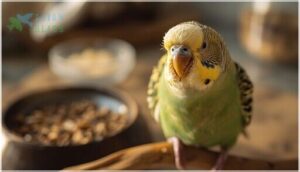
When a bird’s respiratory or digestive system gets infected, the signs show up pretty quickly and are hard to miss. You’ll notice changes in how your bird breathes, sounds, and behaves around food and water.
Let’s look at what these symptoms actually look like so you know what to watch for.
Labored or Rapid Breathing
When your bird’s breathing becomes labored or rapid, air sacculitis—a bacterial infection of the thin-walled air sacs—is often responsible. You’ll notice dyspnea indicators like open-mouth breathing, tail bobbing, or heavy panting, especially during minimal activity.
Tachypnea causes include hypoxemia from compromised lung function. These respiratory symptoms demand immediate diagnostic imaging and veterinary evaluation.
Nebulization therapy delivers antibiotics directly to infected air sacs, making it essential for managing pneumonia symptoms and respiratory distress effectively.
Nasal Discharge, Sneezing, and Coughing
When does nasal discharge progress from clear to thick and caseous? That’s a red flag for bacterial sinusitis. Discharge characteristics—ranging from serous to mucoid—reflect disease progression and sinus involvement. You’ll notice sneezing frequency increasing alongside coughing severity as infection spreads to lower airways.
This symptom trio demands diagnostic testing because similar respiratory symptoms occur across multiple pathogens. Early identification through nasal culture or PCR testing helps confirm the specific bacterial infection driving your bird’s respiratory distress.
Wheezing and Respiratory Sounds
When you hear crackling, wheezing, or snoring sounds from your bird’s breathing, bacterial infection may be progressing into the lower airways. These abnormal respiratory sounds indicate air sac inflammation and exudate buildup—a pathophysiological shift requiring immediate auscultation and diagnostic testing.
- Rales and coarse crackling suggest air sac involvement
- Stertor (snoring sounds) indicates upper airway obstruction
- Wheezing reflects airway narrowing and turbulent airflow
- Persistent sounds warrant culture or PCR testing
- Treatment timing directly impacts recovery outcomes
Vomiting, Regurgitation, and Diarrhea
When your bird vomits or shows diarrhea, bacterial infection may be damaging the digestive tract. Regurgitation causes include crop and upper gastrointestinal inflammation, while greenish-yellow diarrhea signals liver involvement. Dropping analysis reveals loose, malodorous stools replacing normal fecal coils.
These digestive infections—from chlamydia or E. coli—progress rapidly. Vomiting signs combined with diarrhea indicate severe gastrointestinal involvement requiring immediate veterinary culture or PCR testing to identify the pathogen and start appropriate antibiotic therapy before systemic bacterial disease advances.
Swollen Abdomen and Digestive Pain
When bacteria like E. coli invade your bird’s gut, the abdomen swells as inflammatory fluid and thickened intestines fill the coelom—creating that telltale pot-bellied appearance. Your bird may hunch, resist movement, or guard its belly when handled.
Watch for these signs of digestive distress:
- Visibly rounded, doughy abdomen indicating coelomic effusion
- Reluctance to perch or fly from abdominal pain
- Progressive weight loss despite the swollen appearance
Early veterinary imaging confirms the diagnosis and guides antibiotic treatment before systemic impact worsens.
Skin, Feather, and Eye Changes
Beyond respiratory and digestive issues, bacterial infections in birds often show up on the outside of your bird’s body. You’ll want to watch for changes in your bird’s skin, feathers, and eyes, since these can be early warning signs that something’s wrong.
Here’s what to look for.
Feather Loss and Poor Feather Quality
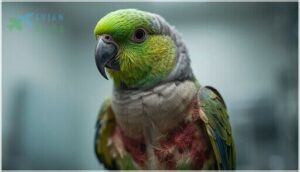
Throughout a bird’s life, feathers serve as a window into their health. When bacterial infections take hold, feather loss and poor feather quality emerge as telling signs. Staphylococcal folliculitis causes perifollicular swelling and reddening that progresses to localized feather loss if untreated. Generalized bacterial dermatitis creates intense itching, driving self-trauma and breakage of contour feathers.
Systemic diseases like circovirus predispose birds to secondary bacterial skin infections, while nutritional deficiencies weaken epithelial barriers. Poor feather quality—stress bars, depigmentation, brittleness—increases infection predisposition. Early recognition of feather abnormalities prevents progression and aids recovery through targeted antibiotic therapy and nutritional support.
| Infection Type | Feather Changes |
|---|---|
| Bacterial Folliculitis | Perifollicular swelling, localized loss |
| Generalized Pyoderma | Pruritus-driven breakage, alopecia |
| Dermatitis | Necrosis, crust formation, permanent deformity |
Skin Lesions or Redness
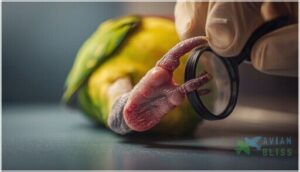
Beyond feather problems, bacterial skin infections manifest as visible lesions and redness that demand immediate attention. You might notice red-purple discoloration, localized ulcers with central scabs, or inflamed patches on your bird’s feet and body.
Staphylococcus species drive much of this damage, producing toxins that thicken and scale the skin. These lesion appearances vary by infection type—some progress rapidly within 24–48 hours, while others persist for months without intervention, directly impacting your bird’s mobility and comfort.
Swelling or Discharge Around Eyes and Beak
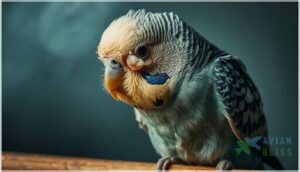
Swelling around your bird’s eyes or beak signals trouble you can’t ignore. Ocular discharge types range from clear tears to thick, caseous pus—each pointing to different bacterial etiologies like Mycoplasma or Chlamydia psittaci.
The infraorbital sinus sits beneath the orbit, so infections produce visible facial swelling, especially around the eye and beak base. Peri-beak involvement with foamy or crusted discharge indicates respiratory disease spreading outward, demanding immediate veterinary assessment.
Limb Swelling or Pododermatitis
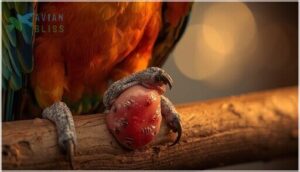
When you spot red, swollen pads on the underside of your bird’s foot, you’re likely seeing bumblefoot—a painful bacterial infection that starts as plantar inflammation and can progress through distinct stages to bone involvement. Raptor prevalence studies show over half of captive birds develop this condition, making early recognition critical.
Watch for these warning signs:
- Limping or favoring one leg when perching
- Warm, thickened skin with scabs or ulcers on footpads
- Reluctance to stand or grip perches normally
- Visible swelling extending up the limb or digits
- Behavioral changes like increased sitting or restlessness
Perch design directly impacts risk—smooth, narrow, or abrasive surfaces concentrate pressure on small areas, breaking down skin and allowing Staphylococcus bacteria to invade. Weight management matters too; heavier birds load their feet with more force, accelerating tissue damage.
Early bumblefoot stages show mild redness you can reverse with better husbandry. Later cases need surgical debridement and bandaging techniques that redistribute pressure away from infected areas while systemic antibiotics clear the pathogen.
Don’t wait for limb deformities or deep abscesses. If you notice any plantar swelling or your bird shifts weight constantly, schedule a veterinary exam immediately—catching pododermatitis early prevents permanent damage and chronic pain.
Diagnostic Steps for Suspected Infections
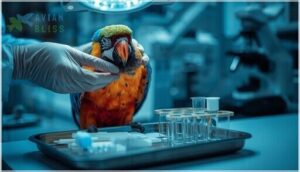
When you suspect your bird has a bacterial infection, time matters. A proper diagnosis requires specific veterinary tests that go beyond what you can observe at home.
Here’s what your avian vet will do to pinpoint the problem and start the right treatment.
Veterinary Physical Examination
When your bird shows clinical signs of infection, a veterinary examination is essential to uncover what’s happening beneath the surface. The physical exam usually follows a structured protocol, beginning with distant observation of posture, breathing pattern, and droppings before any handling occurs. This minimizes stress and reduces the risk of collapse in critically ill birds.
Your veterinarian will then use gentle restraint techniques—often a towel for small birds—to perform a head-to-tail regional examination. This systematic approach checks the eyes, nares, beak, crop, wings, coelomic cavity, legs, and cloaca to ensure no abnormality is missed. Palpation of the crop can reveal stasis or foreign bodies, while wing extension detects fractures or joint issues.
Body condition scoring over the keel evaluates your bird’s nutritional status, commonly using a 5- or 9-point scale. Low scores indicate emaciation, while high scores suggest obesity—both of which can compromise immune function and recovery.
The table below summarizes key components of the avian clinical examination:
| Exam Component | Assessment Focus | Clinical Findings |
|---|---|---|
| Distant Observation | Posture, breathing, droppings | Tail bobbing, fluffed feathers, abnormal activity |
| Restraint & Weight | Safe handling, gram-scale measurement | Body weight trends, stress response |
| Head & Respiratory | Eyes, nares, beak, cere symmetry | Nasal discharge, beak malformation, ocular swelling |
| Crop & Coelomic | Palpation for masses, stasis, eggs | Crop distension, abdominal masses, fluid |
| Wings, Legs, Cloaca | Joint mobility, skin integrity, vent | Fractures, pododermatitis, cloacal discharge |
These clinical findings guide diagnostic integration—the selection of targeted tests like cultures or imaging—to pinpoint the bacterial infection and tailor treatment effectively.
Microscopic and PCR Analysis
When your vet suspects bacterial infection, laboratory testing refines the diagnosis beyond clinical signs. Microscopic and PCR methods deliver complementary insights, though each has limitations you should understand:
- Fecal Gram stain reveals bacterial populations—more than 10% gram-negative rods signals potential infection, though it misses Mycobacterium entirely.
- Blood culture isolates systemic pathogens when bacteremia is present.
- Complete blood count detects inflammation through elevated white cells or toxic changes.
- Chlamydia detection via nested PCR achieves 26% positivity in pet birds, far exceeding culture sensitivity.
- Macrorhabdus PCR reaches 83% sensitivity but carries 17% false negatives—direct fecal examination remains essential for screening despite lower PCR sensitivity in some cases.
Importance of Early Diagnosis
Timing transforms outcomes: early detection and treatment dramatically reduce mortality and shorten treatment duration. When common symptoms of bacterial infection are spotted—such as respiratory distress, altered droppings, and lethargy—prompt veterinary action delivers measurable benefits.
| Benefit | Early Diagnosis | Delayed Diagnosis |
|---|---|---|
| Survival rates | >80% within 48 hours | Markedly lower |
| Treatment duration | 7–10 days (psittacosis) | Several weeks or longer |
| Zoonotic containment | Interrupts human transmission chains | Broader community spread |
Early recognition also brings economic advantages, reduces epidemic durations through policy implications, and prevents severe complications—making the importance of early diagnosis clear when recognizing signs of bacterial infection.
Preventing and Managing Bacterial Infections
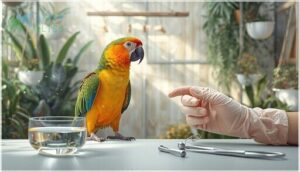
Preventing bacterial infections in your bird is far easier than treating them once they take hold. By focusing on a few key practices, you can greatly reduce your bird’s risk of illness and catch potential problems before they become serious.
Let’s look at the essential steps you can take to keep your feathered companion healthy and safe.
Hygiene and Sanitation Practices
You can’t fight what you can’t see—bacteria thrive in dirty cages, food bowls, and water dishes. Clean cages at least weekly, removing droppings and debris daily. Use appropriate disinfectant types like diluted bleach on pre-cleaned surfaces.
Wash food and water containers daily to prevent bacterial growth. Always practice human hygiene by washing your hands before and after handling birds. Dispose of waste promptly to eliminate pathogen reservoirs.
Quarantine Procedures for New Birds
Think of your new bird as a potential Trojan horse—what it carries inside may not show for weeks. Quarantine new birds for 30 to 45 days in a separate room with dedicated equipment and no shared airflow.
These biosecurity measures and isolation duration allow health screening to detect hidden infections before they spread. Practice strict handling hygiene: wash hands between birds, and monitor daily for respiratory or digestive signs.
End quarantine only after veterinary clearance and symptom-free observation, completing essential preventive measures for birds and preventing bacterial infections in birds through proper quarantine procedures for new birds and consistent hygiene practices.
Stress Reduction and Proper Nutrition
Your bird’s immune system runs on fuel—stress burns it down, and nutrition builds it back up. These practices form your foundation for stress mitigation and immune support:
- Feed formulated pellets with fresh vegetables to prevent nutritional deficiencies and vitamin A shortfalls that compromise respiratory barriers.
- Offer probiotics to support your bird’s gut microbiome and competitive exclusion of pathogens.
- Provide environmental enrichment through toys and foraging opportunities to reduce chronic stress and immune suppression.
- Maintain consistent feeding schedules for dietary enrichment and predictable husbandry routines.
- Guarantee adequate sleep in quiet, darkened spaces to support immune function.
A balanced diet for birds paired with low-stress management directly strengthens infection resistance.
Regular Health Monitoring and Vet Visits
Beyond nutrition and stress management, regular wellness exams catch bacterial infections before symptoms appear. Schedule annual veterinary visits for healthy adult birds—weight changes of just a few grams signal illness during these checkups.
Physical exams assess body condition, while fecal examinations detect bacterial numbers and parasites. Early detection through routine monitoring reduces treatment costs and improves outcomes markedly.
When to Seek Emergency Veterinary Care
Routine checkups matter, but some signs demand immediate action. If your bird shows open-mouth breathing difficulty, severe lethargy with inability to perch, seizures, or bleeding that won’t stop, contact emergency veterinary care right away—even after-hours.
Abnormal droppings with blood, rapid deterioration, or neurologic changes require urgent evaluation. Don’t wait overnight; respiratory distress can become fatal within hours, and zoonotic risks increase with delayed treatment.
Frequently Asked Questions (FAQs)
Can bacterial infections spread between different bird species?
Yes, bacterial pathogens spread readily between different bird species through multiple transmission routes. Salmonella, Mycoplasma, Chlamydia, Campylobacter, and antibiotic-resistant E. coli transfer among wild birds, poultry, and pet birds via droppings, aerosols, and shared environments.
How long does antibiotic treatment typically last?
Treatment duration varies widely—mild infections need 5 to 7 days of antibiotic therapy, while severe cases like chlamydiosis require 30 to 45 days. Always complete the full course to prevent antibiotic resistance.
Are certain bird breeds more susceptible to infections?
Breed genetics and immune response play measurable roles in bacterial infections. Psittacine species—parrots, cockatiels, budgerigars—show higher susceptibility to chlamydiosis and mycoplasma infections than many avian species.
Certain indigenous poultry breeds demonstrate greater disease tolerance.
Can humans contract bacterial infections from pet birds?
Pet birds carry zoonotic diseases that can infect humans. Psittacosis, caused by Chlamydia psittaci, shows high transmission rates through respiratory droplets.
You’re at risk handling droppings, cage debris, or breathing contaminated air near infected birds.
Whats the survival rate with early treatment intervention?
When you catch infections early, survival rates climb dramatically—often exceeding 80–90% with proper antibiotic therapy and supportive care.
Early detection and treatment outcomes depend heavily on pathogen variability impact and species survival rates.
Conclusion
What if the small detail you dismissed today becomes tomorrow’s emergency? Your bird won’t announce illness—it’s wired to conceal weakness.
But now you understand the bird bacterial infection signs that matter: behavioral shifts, respiratory distress, digestive changes, and physical abnormalities. These aren’t just symptoms to memorize; they’re your early warning system.
Check daily, maintain vigilant hygiene, and don’t hesitate when something feels off. Quick action doesn’t just treat infections—it saves lives.
- https://pmc.ncbi.nlm.nih.gov/articles/PMC7121861/
- https://www.petmd.com/bird/conditions/parasitic/c_bd_Bacterial_Diseases
- https://www.merckvetmanual.com/exotic-and-laboratory-animals/pet-birds/bacterial-diseases-of-pet-birds
- https://hefnerroadanimalhospital.com/signs-your-pet-bird-may-be-sick/
- https://my.clevelandclinic.org/health/diseases/25023-psittacosis