This site is supported by our readers. We may earn a commission, at no cost to you, if you purchase through links.

A pair of robins can complete a functional nest in as little as two days—yet most people walk past the entire construction process without noticing a single sign. Birds don’t announce their intentions. They work quickly, quietly, and with impressive precision, weaving spider silk into cup rims and timing their material runs to the earliest light.
Once you know what to look for, the signs birds are nesting become unmistakable: a chickadee disappearing into the same hollow three times in an hour, a mockingbird launching off a low branch at anything that moves within ten meters. The behaviors are there—you just need the right framework to read them.
Table Of Contents
Key Takeaways
- Birds hauling twigs, mud, spider silk, or soft plant fibers back to the same spot during dawn hours is one of the earliest and most reliable signs that nesting has begun nearby.
- Defensive behaviors like dive-bombing, sharp scolding calls, and broken-wing displays aren’t random aggression—they’re precise responses to how close you’ve gotten to eggs or chicks.
- Once hatching starts, the clues shift from behavior to evidence: white droppings beneath a ledge, begging calls from hidden chicks, and parents carrying fecal sacs away from the nest all confirm active young.
- Nesting season doesn’t end with the first brood—watch for fresh nest repairs and renewed material trips, which signal a second clutch is already underway.
Birds Carrying Nesting Materials
One of the clearest signs a bird is nesting nearby is watching it fly back and forth with materials clutched in its bill. Each trip tells you something different about what it’s building and where. Here’s what to look for.
For a deeper look at these flight patterns and what they reveal, bird nesting behavior and observation tips breaks it down beautifully.
Twigs, Moss, and Grass
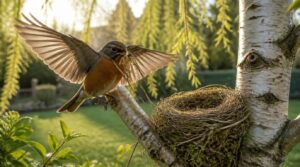
When a bird starts ferrying fresh twigs back and forth, nest building is underway. Species like robins and orioles favor flexible willow or birch twigs, roughly 5 to 20 centimeters long, that interlock without adding too much weight.
Moss lines the interior, regulating humidity and insulating eggs from temperature swings, while layered grass blades create a snug, wind-resistant cup.
Mud for Cup Nests
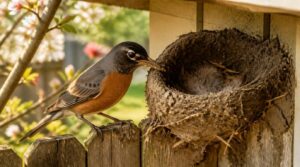
Mud takes nest construction a step further than twigs alone. Many species collect wet soil or clay, shaping it bill by bill into a sturdy cup. As it dries, the mud binding agent solidifies, creating walls that resist wind and minor impacts while providing reliable thermal insulation against daily temperature shifts. Many birds also demonstrate species-specific nesting styles to better suit their surroundings.
Watch for these signs of mud-based nesting activity:
- Cup-shaped nests pressed against walls, eaves, or branches, secured through surface attachment to rough substrates
- Smooth, adobe-like exterior layers that harden after repeated construction trips
- Mixed plant fibers woven into the mud for added crack resistance
- Interior cushioning with soft grasses or feathers, visible once the nest building materials dry
- Narrow cup openings that double as predator protection, limiting larger animals’ access
Robins are a classic example — they pack mud and straw into cup-shaped nests with precision. These nesting indicators are easy to spot once you know the telltale hardened walls left behind.
Spider Silk and Lichen
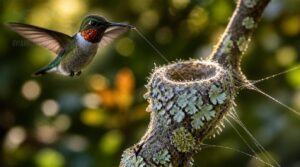
Some nest materials go far beyond basic twigs.
Hummingbirds collect spider silk to bind their nests, using its great tensile strength to anchor the structure to a branch while still allowing it to flex. They also weave in lichen as camouflage, taking advantage of lichen’s UV-shielding properties and textured surface to help the nest blend seamlessly into bark.
Pet Fur or Plant Down
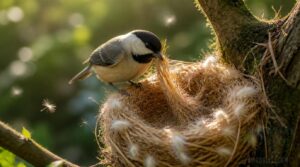
Beyond silk and lichen, birds often seek out softer nest-lining materials — and your backyard may already supply them. Pet fur and plant down are two of the most common finds, prized for their ability to trap air and hold warmth around eggs and hatchlings.
- Milkweed floss or cottony seed fibers cradle eggs against wind and rain
- Pet fur mixed with grasses improves camouflage while boosting nest insulation
- Domestic fur can be reused across multiple nesting seasons when available in quantity
Spring shedding isn’t just a grooming nuisance — it’s prime real estate for backyard birds stocking their nests.
Repeated Material Trips
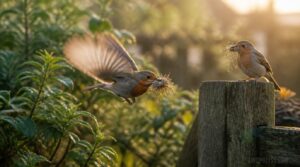
Watch closely during early spring, and repeated material trips reveal nesting activity long before you ever spot a nest. Birds concentrate runs during dawn activity peaks, hauling small loads of nest building materials several times each hour. Rain cuts trips short and noticeably shifts behavior. As nest construction advances, source preference shifts occur and trip frequency patterns gradually slow down.
| Trip Signal | What It Means |
|---|---|
| 2–6 loads/hour | Active nestbuilding activity |
| Dawn clustering | Peak load size variation |
| Fewer trips in rain | Weather impact on trips |
| Slowing frequency | Nest nearing completion |
Unusual Activity Around Nest Sites

Once birds pick a spot, they tend to stick with it — and their loyalty makes them surprisingly easy to track. Knowing where to look is half the work. Here are the key nest sites worth watching in your backyard.
Once you know the hotspots, checking out common bird nesting sites and materials in your backyard can help you support the species that keep coming back year after year.
Cavities and Nesting Boxes
Some of the most reliable nesting signs come not from treetops, but from holes. Cavity nesters like bluebirds, chickadees, and tree swallows frequently choose nesting boxes with a 1–1.5 inch entrance hole sized to exclude larger competitors.
When you notice birds repeatedly entering a fixed opening, that’s active use — not curiosity.
Shrubs, Trees, and Eaves
Many nesting birds skip the birdhouse entirely and settle into the dense canopy layers of shrubs, trees, or the sheltered ledges of eaves. Evergreen shrubs offer continuous cover year-round, making them a preferred nesting habitat for species that need concealment.
When you notice a bird repeatedly disappearing into the same shrub or eave overhang, that’s a clear nesting activity signal worth tracking.
Ground Nesting Areas
Some birds don’t look up — they look down. Species like ovenbirds and Black-and-white Warblers nest directly in leaf litter or bare soil, where ground vegetation height and color naturally disguise the nest.
During nesting season, watch for birds repeatedly visiting a low, unremarkable patch of ground — that quiet return is often the clearest sign of active nesting behavior nearby.
Hanging or Platform Nests
Some nests practically announce themselves.
Hanging nest design often creates a pouch swaying gently from a branch tip, while platform nests sit flat on wide limbs, layered with twigs and grass. Look for elevated nest placement in the canopy, where Baltimore orioles weave flexible pouches and eagles stack enormous stick platforms — both built to endure.
Frequent Site Visits
Once a nest site is active, repeated visits tell the real story. Tracking regular check intervals — and noting material changes, parental arrivals, or predation detection — helps you build a timeline of nesting activity.
These observations also create valuable community science records, linking increased bird activity to seasonal pattern tracking and helping document nesting signs across the full nesting season.
Protective Bird Behavior Near Nests
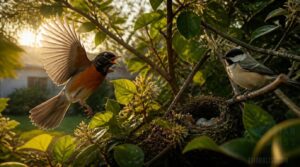
When birds start nesting nearby, don’t be surprised if they suddenly act like you’ve crossed a line. That calm robin or friendly chickadee can flip a switch fast once eggs or chicks are involved. Here’s what their protective behavior actually looks like up close.
Swooping or Dive-Bombing
Getting swooped by a defending bird can catch you completely off guard. When you wander too close to an active nest, a parent may launch a steep aerial dive — sometimes from 20 to 60 degrees — aimed directly at your head.
Territorial dive triggers usually include:
- Proximity to eggs or newly hatched chicks
- Early morning or late afternoon intrusions
- Dogs, children, or unfamiliar movement near nest sites
- Repeated approaches after an initial warning pass
This swoop defense pattern isn’t random aggression. The bird brakes mid-flight, adjusts its trajectory with precision, and may tap you with a wingtip or extend its feet on contact. After each pass, it circles back to reassess — ready to repeat if you haven’t moved. Recognizing these aerial attack timing cues helps you respond calmly rather than reactively.
Harsh Warning Calls
After a dive-bomb, what usually comes next is sound. A sharp, repeated burst of scolding — harsh warning calls — fires off the moment a parent bird detects you near the nest.
| Call Feature | What You’ll Notice |
|---|---|
| Frequency range | Roughly 4–9 kHz, cutting through ambient noise |
| Call duration | Under half a second, repeated rapidly |
| Alarm triggers | Movement, shadows, or rustling near the nest |
Fluffed Feathers and Postures
Sound tells you a bird is alarmed — but posture confirms it.
Fluffed feathers and body language cues are just as telling during nesting season. Alert nape feathers standing upright signal sharp attention, while full-body fluffing can mean the bird is conserving heat or feeling unwell.
Watch closely — posture rarely lies.
Broken-Wing Distraction Displays
Some birds don’t fight back — they fake an injury instead.
Broken-wing distraction displays trick predators into chasing a "wounded" parent away from the nesting site. Wilson’s plovers are classic performers, flopping and dragging a drooped wing while emitting sharp distress calls. The act ends only when the threat is safely misdirected — then the bird flies off cleanly.
Some birds don’t fight back — they fake a broken wing to lure predators away from the nest
Increased Territorial Behavior
As nesting season ramps up, you’ll notice birds becoming noticeably bolder about defending their space. Increased territoriality isn’t random — it’s driven by resource concentration effects, where food, mates, and nest sites cluster in a small area worth protecting.
Watch for these clear signals:
- Vocal warning signals grow louder and more rapid as you approach
- Boundary patrol flights circle the nest at regular intervals
- Sentinel behavior kicks in, with one adult standing guard while the other tends the nest
Breeding season expansion means birds may defend a wider area than usual, reinforcing territory through territorial songs and coordinated defensive behavior between partners.
Feeding Clues and Nestling Sounds
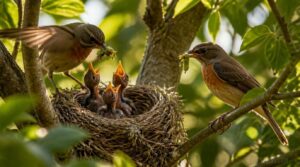
Once eggs hatch, the real work begins — and the clues are everywhere if you know where to look. Parents go into overdrive, and the nest itself starts telling a story through sound, movement, and some surprisingly telling housekeeping habits. Here’s what to watch and listen for.
Insects Carried Away
If you notice insects carried away from your yard—especially small caterpillars, aphids, or even spiders—it’s often a sign of active feeding near a nesting site. Parent birds gather these windborne migrants, ballooning spider silk hitchhikers, and storm-dispersed insects to feed their nestlings. Watch for repeated trips, particularly during nesting season, as birds supply their young.
Begging Calls From Chicks
One of the clearest nesting signs you’ll hear is a chorus of high-pitched begging calls rising from a hidden nest.
Hungry chicks ramp up both frequency and loudness as a hunger level indicator, calling more urgently when parents are away longer. Importantly, parents recognize individual chicks by call, responding fastest to the most intense voices — a real case of sibling competition dynamics shaping who gets fed first.
Scratching Inside Cavities
A subtle sound you might dismiss as wind — soft scraping from inside a nesting box — is actually one of the more telling nesting signs you can detect.
Cavity nesters like chickadees and bluebirds scratch inside cavities to clear old debris, compact fresh materials, and shape the inner lining.
Here’s what that scratching actually signals:
- Cavity cleaning behavior — birds remove old nest debris before construction begins
- Scratch marking signals — small scratch marks left on wood indicate repeated, active use
- Nest maintenance timing — activity spikes during egg-laying and early incubation phases
- Acoustic scratch cues — quiet, rhythmic scraping differs noticeably from sharper defensive pecking
When conditions favor nesting activity — particularly after rain when cavity walls soften — scratching intensifies. You may also notice fine debris or dust near the entrance, a reliable physical indicator of active nesting structures within your backyard ecosystem.
Parents Entering Hidden Spaces
Watch any cavity nester long enough, and you’ll catch a pattern. Parents don’t just fly straight in — they pause at the entrance, scan the surroundings, then slip inside at an angle to minimize exposure. They often vocalize softly before entering, a low contact call that settles nestlings.
Visits cluster around dawn and late afternoon, when feeding demand peaks.
Fecal Sac Removal
After a feeding visit, a parent bird often exits the nest carrying a small, white capsule — a fecal sac — and flies several meters away before dropping it. This nest sanitation routine reduces odor that could attract predators.
For backyard birding, spotting this behavior is one of the clearest signs of active nesting activity nearby.
Visible Signs of Active Nests
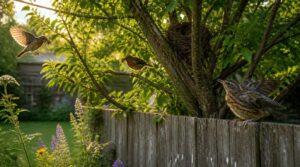
Sometimes the clearest proof isn’t a behavior—it’s what you can actually see. A quick look around the yard can tell you more than you’d expect, from telltale droppings to young birds testing their wings for the first time. Here’s what to watch for when you want to confirm a nest is truly active.
Eggs or Hatchlings Present
When you spot a clutch of eggs or newly hatched nestlings, you’ve found the clearest proof that a nest is active.
Fresh eggs display distinct egg color patterns — pale blue, porcelain white, or speckled — with an eggshell gloss that dulls as incubation progresses.
Hatchlings reveal themselves through constant movement and begging calls, and their rapid chick weight gain — nearly doubling in 7 to 10 days — signals a healthy brood.
White Droppings Below
Once hatching begins, look down — not just up. White droppings below a ledge, branch, or eave are a reliable signal that birds are spending significant time at that spot. The white portion is uric acid, a waste byproduct birds produce instead of liquid urine, and it usually makes up 50 to 80 percent of what you see.
Fledglings Nearby
Young birds hopping or fluttering near a nest site are a strong sign the breeding cycle is still active. During the fledgling independence phase, these birds have left the cup but aren’t fully self-sufficient yet. Parents continue delivering food and issuing soft guidance calls nearby.
Watch for these fledgling clues in your backyard:
- First flight attempts — short, low hops between branches or shrubs
- Wing exercise patterns — rapid flapping while perched, building flight muscle
- Begging calls — persistent, high-pitched sounds directed at nearby adults
- Fledgling social behavior — siblings clustering together on low perches while waiting to be fed
Parental fledging guidance keeps adults close and visibly protective during this window, so any aggressive swooping you notice may simply mean fledglings are nearby.
Fresh Nest Repairs
Once fledglings move on, the nest doesn’t always go quiet. If a second clutch is coming, you’ll often notice fresh nest repairs starting within days — birds patching worn rims, replacing dissolved mud, and relining the cup with soft materials.
| Repair Signal | What You’ll See | What It Means |
|---|---|---|
| Depth Restoration | Adults pressing down into the cup | Rebuilding bowl shape for new eggs |
| Rim Reinforcement | Fresh twigs added to the outer edge | Preventing collapse during brooding |
| Camouflage Enhancement | New leaves or moss pressed onto exterior | Blending nest back into surroundings |
| Repair Duration | Activity lasting 2–6 hours | Structural work nearly complete |
| Human Disturbance | Adults freezing or leaving mid-repair | Sign to back away immediately |
Watching nestbuilding resume at an existing site is one of the clearest indicators of continued nesting activity. When both adults work together, carrying nesting materials in short, repeated trips, the breeding season isn’t over — it’s just starting again.
Safe Observation Distances
How close is too close? As a general rule, stay at least 25 meters back from any active nest. When chicks are present or nesting activity peaks, increase that to 50 meters.
If birds show agitation — head-turning, alarm calls, or defensive swooping — retreat to 100 meters immediately. Respecting these distances keeps both you and the birds safe.
Frequently Asked Questions (FAQs)
How long does nesting season typically last?
Nesting season is nature’s busy season. For most of North America, the nesting season calendar runs roughly 4 to 6 months, from early spring through late summer.
Do birds reuse the same nest each year?
Some birds absolutely do. Nest site fidelity is common among ospreys and raptors, which return to the same nest year after year, adding fresh materials each season rather than starting over.
What time of day are birds most active nesting?
Most birds are active at dawn and dusk. Peak nesting runs from 6:00–9:00 AM, when insects emerge and temperatures stay cool, then resumes around 4:30–7:00 PM as birds finish repairs before nightfall.
Can weather affect when birds start nesting?
Yes, weather plays a big role. Temperature triggers nesting and insect emergence timing, while late frosts or heavy rainfall delays nesting. A warm spring can shift the entire nesting season earlier by several days.
How many eggs do most backyard birds lay?
Most backyard birds lay between 3 and 5 eggs per clutch, though species like chickadees reach 6 to Egg laying peaks in spring, with incubation lasting roughly 11 to 14 days.
Conclusion
Once you’ve seen it, you truly can’t unsee it—the signs birds are nesting are woven into everyday backyard moments most people walk straight past.
A chickadee’s third trip to the same hollow, a quick flash of mud on a robin’s bill, a sharp alarm call from a nearby branch—these aren’t random. They’re a coordinated system, and now you have the right framework to read it clearly.
Step outside. The nesting season won’t wait.
- https://www.fws.gov/story/nesting-season-bird-behavior
- https://www.kingsyard.com/blog/signs-birds-are-already-familiar-with-your-backyard
- https://www.massaudubon.org/programs/pleasant-valley/101692-exploring-bird-nesting-behavior
- https://centerofthewest.org/2020/10/06/spiders-webs-and-birds
- https://www.birdnote.org/podcasts/birdnote-daily/spider-silk-duct-tape-bird-nests