This site is supported by our readers. We may earn a commission, at no cost to you, if you purchase through links.
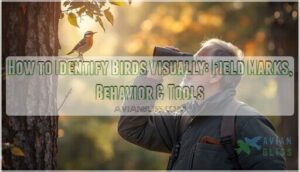
A flash of movement in the branches, a burst of color gone before you can focus—and then silence.
Most people shrug and walk on.
Experienced birders freeze, rewind the mental image, and start reading clues: bill shape, tail length, the way it clung to the bark.
That difference isn’t talent. It’s a learned system.
Once you know what to look for—size, silhouette, plumage patterns, behavior—birds stop blurring together and start telling you exactly who they are.
This guide walks you through how to identify birds visually, feature by feature, so every sighting becomes a puzzle you can actually solve.
Table Of Contents
Key Takeaways
- Reading bird’s shape, bill, and posture gives you reliable clues before color even comes into play.
- Behavior tells you as much as feathers do—watch how a bird moves, feeds, and interacts with others.
- Field marks like wing bars, eye rings, and rump contrast let you confirm a species even in a quick glance.
- Free apps like Merlin Bird ID and iNaturalist make accurate identification faster, but sharp photos and field notes seal the deal.
Key Visual Features for Bird Identification
Every bird gives you a set of visual clues the moment you spot it.
Shape, color, and movement all feed into that first impression — and so does the habitat, as this guide to identifying wild birds in the field explains so well.
Learning to read those clues quickly makes all the difference in the field.
Here are the key features to look at first.
Size and Body Shape
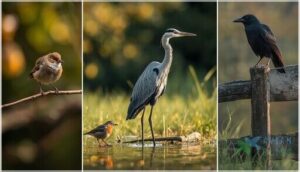
Size and body shape are your first clues in the field. Group what you see into body size categories — tiny, small, medium, or large — then compare it to a familiar bird. Is it sparrow-sized or crow-sized?
Check build shape types next: slim and elongated, or compact and chunky? Leg length ratios and tail length variations sharpen your reading quickly.
The Northern Cardinal status(https://www.audubon.org/bird-guide) is listed as Least Concern.
Bill Morphology and Function

Once you’ve nailed down body shape, shift your eyes to the bill.
Bill morphology is one of the sharpest field marks you’ll find.
A finch’s short, conical bill crushes seeds; a curlew’s long, decurved bill probes mud.
A finch’s stubby bill crushes seeds while a curlew’s long curved bill probes deep into mud
Notice tomial edge variations — serrated, smooth, or notched.
Seasonal bill color and rhamphotheca adaptations, including heat exchange bills like toucans’, round out your read.
Understanding seed‑eating beak adaptations helps distinguish finches from other small birds.
Wing and Tail Proportions
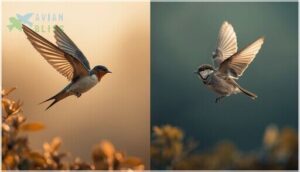
After the bill, let your eyes travel outward to the wings and tail. Wing body ratio and primary projection tell you a lot. Does the wing tip nearly reach the tail, or stop well short? Swallows push past the tail tip; forest sparrows fall short.
Tail length index and aspect ratio round out these visual cues, sharpening your bird identification techniques considerably.
Silhouette and Posture

Once you’ve clocked wing and tail length, shift your focus to how the bird carries itself. Perching Angle, Neck Carriage, and Leg Stance are powerful visual cues that reveal identity fast. A woodpecker’s vertical Body Tilt differs sharply from a dove’s hunched, front‑heavy posture.
Pairing these posture cues with range maps and seasonal data — as covered in this guide to field guides for backyard bird watching — turns a fleeting silhouette into a confident, loggable ID.
In Flight Silhouette, a heron tucks its neck while a crane stretches long. These bird shapes and behavioral clues work like field marks you can read at a glance.
Decoding Plumage Patterns and Colors
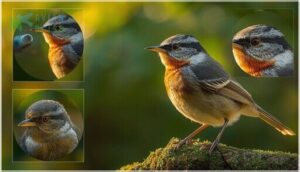
Plumage is often the first thing you notice, and it tells you more than you might expect.
Each patch of color, each stripe or spot, carries a specific meaning once you know where to look.
Here are the key markings that will help you read a bird’s appearance with confidence.
Head, Breast, and Back Markings
Plumage is your first real window into bird identification. Head Patterns alone can reveal a species — think crown stripes, eyebrow lines, or a bold facial mask. Look closely at these visual cues:
- Breast Markings: streaks, spots, or a clean unmarked chest
- Back Features: mottled scapulars, pale fringes, or contrasting rumps
- Marking Contrast: sharpness often signals age, sex variation between adults and juveniles
Field Marks for Quick Recognition
Field marks are your shortcuts — quick visual cues that cut through confusion fast. Wing bars, eye rings, and rump contrast let you confirm a species even in a fleeting glance.
A speculum patch flashes iridescent color on flying ducks, while a tail flash on juncos signals identity in seconds.
| Field Mark | Where to Look | Example Species |
|---|---|---|
| Wing bars | Folded wing stripes | Warblers, vireos |
| Eye ring | Circle around the eye | Vireos, flycatchers |
| Speculum patch | Secondary wing feathers | Mallard, Teal |
| Rump contrast | Lower back in flight | Wheatears, warblers |
| Tail flash | Outer tail feathers | Juncos, towhees |
Using Behavior and Habitat as Clues

bird’s behavior often tells you just as much as its feathers do. Watch how it moves, where it feeds, and who it hangs around with — and you’ll already have strong clues to work with.
Here’s what to pay attention to.
Typical Movements and Feeding Habits
How a bird moves tells you almost as much as how it looks. Watch these key behaviors:
- Ground foraging hops — robins and sparrows hop and peck, while towhees use a double-scratch kick through leaf litter.
- Aerial insect swarms — swallows and swifts loop and sweep through insect clouds with agile, shifting flight.
- Bark probing — nuthatches spiral headfirst down trunks; woodpeckers chisel upward methodically.
- Raptor hover dive — kestrels hang nearly motionless into the wind, then fold and drop onto prey below.
Preferred Habitats and Range
Where a bird lives narrows your choices fast. Wetland Species Assemblages pull in herons, rails, and ducks, while grasslands favor larks and pipits.
Vertical Habitat Use matters too — canopy birds rarely drop to the shrub layer.
Seasonal Range Shifts and Altitudinal Migration mean the same spot looks different in July versus January.
Urban Bird Communities surprise you with diversity, but always check range first.
Social Behavior and Flocking Patterns
How a bird behaves around others tells you a lot. Watch these patterns closely:
- Sentinel roles — titmice and chickadees lead mixed‑species flocks, giving alarm calls that other species respond to instantly.
- Flock density dynamics — tight, swirling groups often signal starlings; loose, drifting clusters suggest songbirds.
- Daily roosting cycles — large roosts build at dusk, helping confirm species through sheer numbers and location.
Step-by-Step Guide to Identifying Birds Visually

Knowing what to look for is one thing — knowing how to look is where it all comes together.
A simple, repeatable process makes bird ID feel less like guesswork and more like second nature.
Here’s how to work through it, step by step.
Observing and Recording Key Features
Think of each outing as a case file you’re building. Start with Focus Bird Selection — lock onto one individual and scan head to tail using Systematic Scanning. Lighting Considerations matter too; sun behind you reveals true colors and field marks.
| Field Note Structure | What to Capture |
|---|---|
| Size & Shape | “Sparrow-sized, chunky” |
| Visual Cues | Eye rings, wing bars |
| Behavior Patterns | Feeding style, posture |
| Photo Burst Technique | Flight, perched poses |
Comparing With Field Guides and Photos
Once you’ve logged your field notes, open your bird identification guides and match what you recorded. Guide Consistency matters — flip between illustrations and photos to cross‑check visual cues like Seasonal Plumage shifts or Lighting Effects on color.
- Compare Regional Range maps before confirming any match
- Check App Accuracy by verifying suggestions against guide text
- Use bird photography to spot fine field identification details
- Cross‑reference two guides when similar species appear
Tips for Difficult or Similar Species
Similar species trip up even seasoned birders, so slow down and focus on specifics. Head pattern nuances matter — does it show a supercilium or crown stripe? Check undertail covert clues, since rufous versus pale undertails can clinch a thrush ID.
Bill shape subtleties and flight style cues narrow things further. Seasonal plumage shifts add complexity, but comparing behavioral clues alongside visual cues makes the difference.
Best Tools and Apps for Visual Bird ID

The right tools can make bird ID faster and a lot more satisfying. Whether you’re in the field or reviewing photos at home, there’s something here to match how you like to work.
Here are three resources worth adding to your birding routine.
Top Free Bird Identification Apps
A few well-designed apps can seriously sharpen your identification skills in the field. These bird identification apps are free to use, mobile friendly, and built around AI-powered suggestions that improve with every sighting.
- Merlin Bird ID – AI analysis, offline regional packs, and multi-species sound detection
- Audubon Bird Guide – Filters by shape and color like portable field guides
- iNaturalist – Community verification brings research-grade accuracy
- BirdNET – Identifies 3,000+ species by sound alone
- Merlin’s custom Bird‑of‑the‑Day – Learns your location and season
Using Photography for Accurate ID
Apps get you started, but a sharp photo seals the deal.
Use fast shutter speeds, continuous autofocus, and spot metering to capture clear visual cues for bird identification. Good angle composition and lighting techniques reveal field marks that apps miss.
Keep metadata intact — date, time, and GPS support AI analysis later. Shoot ethically, stay back, and let the bird behave naturally.
Online Databases and AI Tools
Digging into online bird identification tools opens up a whole new level of accuracy.
Merlin AI identification draws on eBird data integration to match birds to your exact location and season. BirdNET acoustic analysis decodes calls from audio clips in seconds.
iNaturalist community verification catches what machine learning misses.
For a quick first guess, Google Lens quick‑ID works surprisingly well.
Frequently Asked Questions (FAQs)
What is the free app that identifies birds?
Merlin Bird ID, developed by Cornell Lab, is completely free to use.
It offers AI Sound Recognition, Offline Bird Packs, eBird Integration, and Multi-language Support — making it the top choice among bird identification apps worldwide.
How to identify a bird from a photo on an iPhone?
Snap the bird with burst mode on, use good light positioning, then open the photo in Merlin or try Visual Look Up — AI-powered recognition returns likely species in seconds.
How do weather conditions affect bird appearance?
Weather rewrites a bird’s appearance fast.
Wet feather darkening, cold‑weather fluffing, iridescent light shifts, and dust and mud staining all alter plumage, coloration, and field marks, so always cross‑check size and bill shape too.
How does molt change a birds identifying features?
Seasonal plumage shifts, eclipse plumage in ducks, juvenile‑adult transitions, and molting wing gaps all alter field marks, sexual dimorphism changes, breeding plumage, and nonbreeding colors you rely on.
Do regional color variations exist within the same species?
Yes, regional color variations absolutely exist. Geographic plumage clines, subspecies color forms, and climate-driven morphs mean the same species can look noticeably different depending on where you find it.
How reliable is bird ID at night or low light?
Night bird ID is tricky.
visual cues collapse in darkness, leaving only silhouette limitations to work with. audio supplementation, artificial lighting, and thermal imaging help, but most IDs stay a probable identification at best.
Conclusion
They say still waters run deep—and the same is true for patient eyes.
Every time you step outside, the birds around you are speaking a language you now know how to read.
Learning how to identify birds visually isn’t a destination; it’s a habit built one sighting at a time.
Trust the system: check the shape, read the markings, note the behavior.
The field is your classroom, and it never closes.
- https://www.birdful.org/what-are-the-4-keys-to-visual-bird-identification/
- https://www.raptorresource.org/2024/11/02/body-plans-and-shapes-identifying-birds-in-flight/
- https://www.basicsofbirding.com/blog/how-to-identify-birds-looking-for-key-field-marks
- https://www.allaboutbirds.org/news/bird-id-skills-field-marks/
- https://learnthebirds.com/12-bill-designs-in-birds/