This site is supported by our readers. We may earn a commission, at no cost to you, if you purchase through links.
A bird that arrives at your facility underweight, dull-eyed, and missing patches of feathers isn’t just hungry—it’s depleted at a cellular level.
Muscle tissue breaks down fast under stress, gut flora collapses, and immune function drops before visible symptoms appear.
Standard seed or pellet diets rarely cover what a compromised bird actually needs to rebuild.
That gap is where targeted supplementation does its real work.
Knowing nutrients matter, how to dose them by species and weight, and when to adjust based on recovery response gives rescue and rehab birds a measurably better shot at full rehabilitation.
Table Of Contents
Key Takeaways
- A rescue bird arriving underweight and dull-eyed isn’t just hungry — it’s depleted at the cellular level, so standard seed diets won’t cut it; targeted supplements covering vitamins A, D3, B-complex, amino acids, and probiotics are what actually drive recovery.
- Species differences aren’t minor details — toucans can’t handle high iron, finches need frequent micro-doses, and raptors require precise calcium-phosphorus correction, so matching the formula to the bird is non‑negotiable.
- Safe dosing starts at half the standard amount for malnourished birds and scales by weight (a 20g finch and a 500g African Grey need vastly different amounts), with daily monitoring of droppings, activity, and grams on a scale catching problems before they become crises.
- once bloodwork normalizes, feather regrowth hits 90%, and droppings stay consistent for 10 days, it’s time to scale back and loop in your avian vet to confirm the bird is genuinely healed, not just stable.
Key Nutrients for Rescue and Rehab Birds
When a bird comes into your care, its body is often running on empty — immune system down, bones fragile, energy gone.
Knowing when and how to give birds health supplements can make the difference between a slow decline and a real recovery.
The right nutrients aren’t a bonus; they’re the foundation every recovery is built on.
Here’s what your rescue or rehab bird actually needs to start healing.
Essential Vitamins for Immune Support
When a rescue bird’s immune system is already on the ropes, every vitamin counts. Vitamin A synergy strengthens mucous membranes and T-cell responses — rescue birds often need 3–10x standard levels.
Vitamin D3 signaling activates white blood cells, while Vitamin E antioxidant protection shields breast muscle from oxidative damage. Vitamin C absorption boosts Vitamin D uptake under stress.
B‑complex immunity rounds out cellular repair. Adequate vitamin D is critical for essential bone health support.
Minerals for Bone and Feather Health
Vitamins lay the groundwork, but minerals do the structural work.
Get the Calcium Phosphorus Ratio wrong — anything below 2:1 — and you’re looking at soft, deformable bones.
Magnesium Enzyme Support keeps calcium metabolism running; without it, Feather and Skin Health deteriorates fast.
Zinc drives Zinc Feather Pigment and keratin synthesis.
Manganese Bone Density improves measurably at 60 mg/kg.
Trace Mineral Balance isn’t optional — it’s what makes Feather Regrowth and Vitamin and Mineral Supplementation actually work.
Watch for calcium deficiency signs such as rickets and lameness in rescue birds.
Amino Acids and Energy Restoration
Beyond minerals, your bird’s recovery stalls without adequate amino acids.
Branched‑Chain Metabolism — leucine, isoleucine, valine — drives Leucine Muscle Preservation and halts tissue breakdown in a Nutritional Emergency.
Methionine Antioxidant Role shields liver cells, while Arginine Nitric Oxide improves blood delivery to healing tissue.
Glutamine Gut Support strengthens intestinal integrity so nutrients actually absorb.
Together, these Proteins fuel real Energy and Vitality Restoration for Bird Recovery and Healing.
Role of Probiotics in Recovery
Amino acids rebuild the body, but probiotics rebuild the gut. After antibiotics, gut flora restoration becomes your next priority.
Without beneficial bacteria, even the best avian nutrition won’t absorb properly. Probiotics handle diarrhea prevention, immune enhancement, and stress reduction all at once — 78% of breeders report visible gains within three weeks.
For bird rehabilitation, probiotic product selection matters. Bene-Bac Plus works well across species.
Choosing The Right Supplement Formula
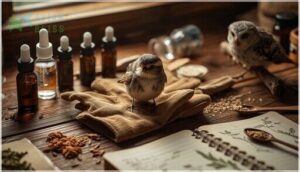
Not every supplement works for every bird, and choosing the wrong one can do more harm than good. Species, body condition, and how the formula is delivered all shape what a recovering bird actually needs.
Here’s what to weigh before you reach for a product.
Factors for Different Bird Species
Not every bird needs the same formula — species factors shape everything. A toucan’s dietary iron sensitivity means even small amounts of high-iron supplements can trigger iron storage disease. A finch’s rapid metabolic rate demands frequent, low-dose vitamins. Raptors need precise calcium-phosphorus ratio correction from meat-heavy diets.
Species-specific nutrition is non-negotiable: toucans can’t tolerate high iron, finches need frequent micro-doses, and raptors demand precise mineral correction
Match your nutritional supplements to avian nutrition science:
- Granivores: broad-spectrum multivitamins
- Frugivores: low-iron, antioxidant-rich formulas
- Carnivores: mineral-balancing, protein-sparing blends
Needs of Critically Ill or Malnourished Birds
When a bird arrives starving or critically ill, standard supplements won’t cut it. Emergency nutrition means starting feeds at roughly 1% of body weight, then scaling up gradually — that’s your refeeding protocol to prevent dangerous electrolyte crashes.
Fluid therapy and electrolyte balance come first.
Temperature management keeps hypothermic birds stable.
Stress reduction isn’t optional; it’s bird emergency care done right.
Formulation Types: Powders, Drops, and Pellets
rehabilitation supplementation shapes everything in rehabilitation supplementation.
Powders win on cost efficiency and shelf life — one jar treats dozens of birds, and mixing consistency is easier to control in mash or hand-feeding formula.
Liquid drops boost absorption speed for critical cases, delivered by syringe.
Pellets simplify avian nutrition long-term.
Match the format to the bird’s condition, weight, and preference.
Importance of Veterinary Guidance
No supplement plan survives contact with a sick bird without veterinary medicine behind it. An avian vet doesn’t just recommend products — they build individualized plans based on body condition, medical history, and species-specific needs.
- Dose Calculation by weight prevents toxicity — vitamin D3 turns dangerous at 4–10x requirements.
- Side-Effect Monitoring catches organ stress before it’s irreversible.
- Legal Compliance protects your facility and the birds you’re fighting to save.
Top Supplements for Rescue and Rehab Birds
Not every supplement on the market is worth your time — or your bird’s health.
The ones below have earned their place in rescue and rehab settings through real-world use and solid nutritional profiles. Here’s what’s worth keeping on your shelf.
1. VITOFARMA Bird Multi Vitamin Supplement
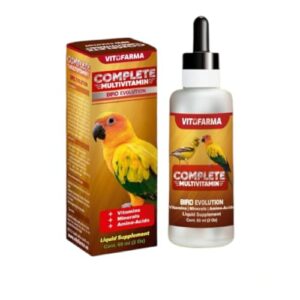
VITOFARMA’s liquid multivitamin packs vitamins A, D3, E, and B-complex into a 60 ml bottle that works for canaries, budgies, and parrots alike.
For weak birds that won’t drink on their own, you can dose directly into the beak — 3 to 4 drops for small species. Large birds get 30 drops in 8 ounces of water. Shake before every use, store between 15–30°C, and don’t exceed the labeled dose. One bottle, one consistent protocol.
| Best For | Bird owners looking to boost the health, immunity, and plumage of small breed birds like canaries, budgies, and parrots at any life stage. |
|---|---|
| Life Stage | All Life Stages |
| Form | Powder |
| Vitamins Included | Yes |
| Immune Support | Yes |
| Feather Health | Yes |
| Vet Recommended | No |
| Additional Features |
|
- Covers all the essentials — vitamins A, D3, E, and B-complex in one easy liquid formula
- Flexible dosing works for both small and large birds, and you can give it directly or mix it in water
- Supports young birds growing up and adult birds recovering from illness or tough winters
- Dosage has to be followed carefully, so it’s not totally hands-off
- No clear info on how it interacts with other supplements or medications your bird might be on
- Results can vary — every bird is different, and it may not work the same across all species
2. Oasis Small Bird Vitamin Drops
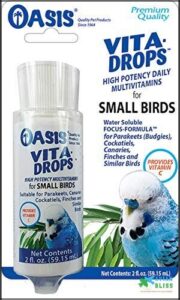
Oasis Small Bird Vitamin Drops cover the full spectrum — A, D3, E, K, B‑complex, and extra C — in a simple liquid you add to water or food.
For small birds like budgies, canaries, and finches, that boosted vitamin C matters during recovery.
Dose 2 drops per ounce of drinking water daily, and change the water every 1–2 days.
For sick birds refusing to drink, place one drop directly in the beak.
Store cool, don’t freeze.
| Best For | Small bird owners looking for an easy, all-in-one vitamin boost for parakeets, budgies, canaries, finches, cockatiels, and similar small birds at any life stage. |
|---|---|
| Life Stage | All Life Stages |
| Form | Liquid |
| Vitamins Included | Yes |
| Immune Support | Yes |
| Feather Health | Yes |
| Vet Recommended | No |
| Additional Features |
|
- Covers a wide range of vitamins including A, D3, E, K, B-complex, and extra C — solid daily nutritional support in one bottle
- Super easy to use — just add to drinking water or food, no fuss
- Made in the USA and works for birds of all ages, including during recovery when immunity needs a lift
- At only 2 ounces, the bottle runs out fast if you have multiple birds
- Ingredient concentrations aren’t disclosed, so it’s hard to know exactly what your bird is getting
- The smell and yellow-amber color can be a bit off-putting for some owners
3. Lafeber Avi-Era Bird Vitamin Powder
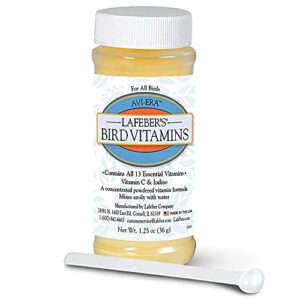
When you need a single powder that covers all 13 essential vitamins plus iodine, Lafeber Avi-Era is worth keeping on your shelf. It’s formulated by avian veterinarians and mixes into water or soft food — two small scoops per ounce of water, changed daily.
One scoop delivers 125 IU vitamin A and 15.6 IU D3, nutrients most seed-fed rescue birds are dangerously short on. Double the dose during illness, but check with your vet first.
| Best For | Bird owners who feed seed-based diets and want a vet-formulated vitamin powder that covers all the nutritional gaps in one easy mix. |
|---|---|
| Life Stage | All Life Stages |
| Form | Powder |
| Vitamins Included | Yes |
| Immune Support | Yes |
| Feather Health | Yes |
| Vet Recommended | Yes |
| Additional Features |
|
- Covers all 13 essential vitamins, including A and D3 — the ones seed diets almost always miss
- Formulated by avian vets and nutritionists, so you know it’s not just a generic blend
- Mixes into water or soft food, making it easy to work into your bird’s routine
- Some birds are picky and may reject the taste, so getting them to actually consume it can take trial and error
- A few buyers have reported the dosing scoop was missing from the package
- It’s not the cheapest vitamin option out there, which adds up over time
4. Nekton S Multi Vitamin for Birds
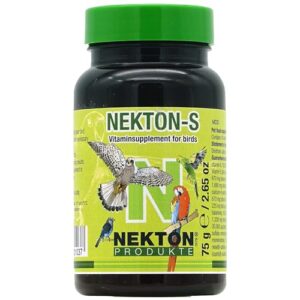
Where Avi‑Era covers the basics, Nekton S goes broader. Made in Germany, it packs 13 vitamins, 18 amino acids, and trace minerals like zinc and iron into one powder — dissolving cleanly into 250 ml of water with the included 1 g measuring spoon.
That amino acid profile matters in rehab: it compensates for lysine and methionine gaps common in seed‑heavy diets.
During stressful intake periods, you can safely double the dose temporarily without risking toxicity.
| Best For | Bird owners and rehab caretakers dealing with seed-heavy diets, breeding birds, or birds going through stress and recovery. |
|---|---|
| Life Stage | All Life Stages |
| Form | Powder |
| Vitamins Included | Yes |
| Immune Support | Yes |
| Feather Health | Yes |
| Vet Recommended | No |
| Additional Features |
|
- Covers a lot of ground at once — 13 vitamins, 18 amino acids, and key trace minerals in a single scoop
- The amino acid profile fills real nutritional gaps that seed diets tend to leave behind
- Safe to double-dose temporarily during high-stress periods without toxicity risk
- Turns the water yellow, which can look off-putting even if it’s harmless
- Can’t make up more than 5% of the daily ration, so it’s a supplement, not a fix-all
- Needs to be stored at room temperature in a dry spot — fridge and sunlight are both off the table
5. Hari Hagen Prime Parrot Vitamin Supplement
Nekton S covers a lot, but sometimes you need something built specifically for parrots.
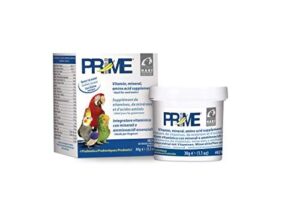
Hari Hagen Prime delivers 14 vitamins and 9 minerals in an ultra-fine powder that actually sticks to moist food — no settling to the bottom of a seed dish. It also brings L-lysine and DL-methionine for tissue repair and feather regrowth, plus live probiotics and digestive enzymes to rebuild gut function post-antibiotics. One 0.55 g scoop per 100 g of soft food, daily during recovery.
| Best For | Parrot owners looking to boost nutrition during recovery, breeding, or hand-feeding baby birds. |
|---|---|
| Life Stage | All Life Stages |
| Form | Powder |
| Vitamins Included | Yes |
| Immune Support | Yes |
| Feather Health | Yes |
| Vet Recommended | No |
| Additional Features |
|
- Packs 14 vitamins, 9 minerals, and key amino acids into one fine powder that sticks to food instead of sinking to the bottom
- Live probiotics and digestive enzymes make it a solid pick for birds rebuilding gut health after antibiotics
- Extra vitamin C and E give a real boost during breeding season or periods of stress
- At just 1.1 oz, it runs out fast — not ideal if you’re managing a larger flock
- The smell can be strong enough to turn off picky birds or sensitive owners
- A few buyers have run into issues with the packaging seal, which can affect freshness
6. Harrison’s Organic High Potency Bird Food
Sometimes a targeted supplement isn’t enough — you need the whole foundation rebuilt.
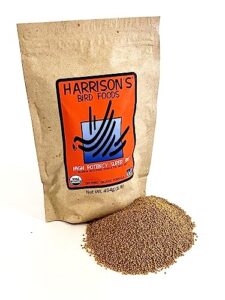
That’s where Harrison’s Organic High Potency Bird Food earns its place in rehab care.
It’s certified organic, non‑GMO, and vet‑developed, delivering 18.5% crude protein and 12% fat to help underweight or post‑illness birds regain body condition quickly.
The formula already includes vitamins A, D3, E, and B‑complex, so you won’t need to stack extras.
Start by replacing 25% of the old diet weekly until fully transitioned.
| Best For | Small to medium birds that are underweight, recovering from illness, molting, or being converted to a pellet-based diet. |
|---|---|
| Life Stage | All Life Stages |
| Form | Pellet |
| Vitamins Included | Yes |
| Immune Support | Yes |
| Feather Health | Yes |
| Vet Recommended | Yes |
| Additional Features |
|
- Certified organic and non-GMO with vet-developed nutrition — no need to pile on extra supplements
- High protein (18.5%) and fat (12%) formula helps birds bounce back fast after illness or weight loss
- Works for all life stages, so you can stick with one food through breeding, weaning, and beyond
- Pricier than most bird foods on the market, which can add up over time
- Some birds are picky and may resist the pellet texture, so the switch can take patience
- Certain sizes (like Fine) can be hard to find, and expiry date inconsistencies have been reported with some sellers
7. Harrison’s Organic Bird Food Coarse Pellets
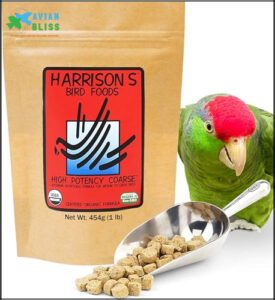
Once your bird stabilizes on High Potency, Harrison’s Organic Coarse Pellets become the long-term maintenance plan.
Designed for medium to large species — macaws, cockatoos, eclectus, pionus — these certified organic, non-GMO pellets deliver 15% protein and 5.5% fat, enough for daily upkeep without overloading a recovered bird’s system.
The balanced omega-3 and omega-6 ratio promotes feather quality and skin health year‑round.
Fresh pellets daily, don’t top off old food, and let your bird eat freely.
| Best For | Medium to large birds like macaws, cockatoos, eclectus, and pionus who need a reliable, long-term maintenance diet made from clean, organic ingredients. |
|---|---|
| Life Stage | All Life Stages |
| Form | Pellet |
| Vitamins Included | Yes |
| Immune Support | Yes |
| Feather Health | Yes |
| Vet Recommended | Yes |
| Additional Features |
|
- Certified organic and non-GMO, so you know exactly what’s going into your bird
- Vet and nutritionist formulated — it’s not just bird food, it’s a complete nutritional plan
- Works for all life stages, from breeding to recovery, so you’re not switching foods constantly
- It’s pricier than most bird foods, which adds up fast if you have a large bird
- Picky eaters may need a slow, patient transition before they’ll touch it
- Spirulina in the mix can cause hyperactivity or aggression in some birds, so watch for that
Safe Administration and Dosage Tips
Getting supplements right matters just as much as choosing the right ones.
Too much of a good thing can set a bird back fast, and too little won’t move the needle at all. Here’s what you need to know about giving supplements safely and adjusting as your bird recovers.
Mixing Supplements Into Food
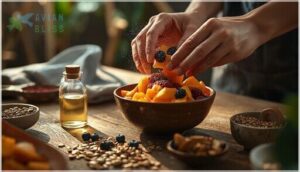
Dry seed mixes are a trap — powders settle to the bottom and go uneaten. For reliable supplementation, blend nutrients into an eggfood base or chopped fruit instead.
Soft food blending ensures full absorption. Moisture adhesion keeps probiotic sprinkling and vitamins clinging to each bite.
seed coating methods using oil work too — 10 ml per liter binds powders directly to hulls for consistent avian nutrition and recovery support.
Adjusting Dosage Based on Bird Weight

Weight-based scaling isn’t guesswork — it’s the foundation of safe dosing. A finch under 20 grams needs far less than a cockatiel at 90 grams or an African Grey at 400–500 grams. For rescue bird adjustments, start malnourished birds at half the standard dose.
Follow these species-specific dosing benchmarks:
- Finches (under 20g): one pinch Guardian Angel
- Cockatiels (80–100g): 0.5 cc Prime daily on vegetables
- Critical birds over 1 kg: begin at 3 pinches, monitoring weight gains every 3 days
Apply dose modification guidelines as nutrient balance improves.
Frequency and Method of Administration
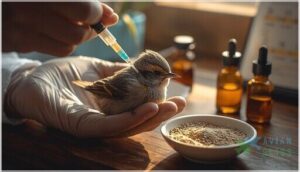
deliver supplements matters as much as what you give. Daily vs Weekly Dosing depends on condition severity — use daily supplementation during emergency care, tapering to 3–4 times weekly for maintenance.
Oral Syringe Technique by angling the tip left and dosing slowly.
Food Mixing Strategies beat Water Drop Timing for precision.
During molt, intensify Molt Cycle Scheduling to support Nutrient Balance and full Avian Nutrition and Diet recovery.
Monitoring for Adverse Reactions

Even small reactions can escalate fast. Watch for these five warning signs daily:
- Dropping Color Changes — greenish or unusual hues signal intolerance
- Regurgitation Frequency — frequent episodes suggest vitamin A excess
- Feather Plucking Trends — increased picking indicates nutrient imbalance
- Activity Level Shifts — lethargy or hyperactivity both warrant concern
- Weight Loss Patterns — rapid drop demands immediate Emergency Care
Don’t wait. Contact Veterinary Medicine and Care specialists promptly.
Monitoring Recovery and Adjusting Care
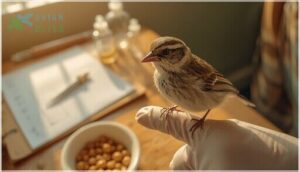
Recovery isn’t a straight line — it’s a series of small, measurable wins. Knowing what to watch and when to act makes the difference between a bird that plateaus and one that fully bounces back.
Here’s what to track and how to adjust your care as your bird improves.
Tracking Weight, Feathers, and Activity
Three numbers tell you almost everything: grams, feather score, and daily movement count.
Weigh each bird at the same time every morning using a gram-accurate scale. Morning weight logs catch a 5–10% drop before the bird looks visibly sick. Pair that with feather scoring — rate each body region from 0 (perfect) to 3 (heavy damage) — and you’ve built a recovery baseline.
| Metric | Healthy Trend | Warning Sign |
|---|---|---|
| Body Weight | +1–3% weekly gain | Loss over 3–5 days |
| Feather Regrowth | 1–3 new pin feathers/wing | No new growth in molting areas |
| Activity Level | Regular perching, preening, short flights | Sitting fluffed on cage floor |
Weekly trend charts that combine all three metrics reveal patterns weeks before a bird looks obviously worse. Activity sensor data adds another layer — a sudden drop in movement counts often signals pain or infection before other signs appear. That’s correlation analysis working in your favor: when weight stabilizes, feather scoring improves, and activity normalizes together, your supplement plan and avian nutrition strategy are supporting genuine healing.
Bird health and wellness depends on catching the small shifts early.
When to Modify or Stop Supplements
Once weight plateau breaks and feather regrowth covers 90% of affected areas, it’s time to reassess supplementation.
- Bloodwork thresholds normalize — vitamin A above 200 IU/g, electrolytes stable
- Dropping consistency holds firm for 10 days without digestive aids
- Hydration status stabilizes with potassium at 3.5–5.0 mmol/L
Bird health and wellness demands knowing when less is more.
Signs of Improvement or Concern
blood values normalize, watch the bird itself. feather sheen improves within weeks, and vocalization changes — soft chattering replacing silence — signal rising comfort.
perch behavior shifts upward; beak condition smooths out.
dropping consistency confirms gut recovery. These are your green lights.
labored breathing, sudden weight loss, or renewed lethargy demand immediate reassessment.
Collaboration With Avian Veterinarians
Your vet isn’t just a safety net — they’re your partner in Avian Care and Management.
When green lights appear, loop them in anyway. Solid Vet Protocol Development and Feedback Loop Integration keep recovery on track.
- follow‑up blood panels every few weeks
- weight logs and behavioral notes
- vitamin A and D3 levels per bloodwork
- Continuing Education Workshops on Bird Health and Nutrition
- Joint Research Grants or Clinical Trial Partnerships for complex cases
Frequently Asked Questions (FAQs)
What is the best supplement for calming birds?
NEKTON-Relax is a strong choice. It combines L-tryptophan, chamomile extract and valerian root to ease anxiety without sedation.
For extra support, L-theanine and a magnesium blend further stabilize mood and promote avian wellness.
Can supplements interact with prescribed bird medications?
Yes — absolutely. Calcium chelates tetracyclines, iron blocks doxycycline absorption, and zinc skews vitamin A and E balance.
Poor Mineral‑Drug Timing turns supportive care into sabotage.
Always confirm Veterinary Medicine protocols before stacking anything.
How should supplements be stored after opening?
Seal containers tightly, store below 26°C, and shield from light and humidity above 50%. Label each opening date — most vitamin supplements lose potency within 8–12 weeks once opened.
Are wild birds needs different from pet birds?
Wild birds burn 3–5 times more calories daily than pet birds. Foraging behavior, seasonal diet shifts, and habitat-driven micronutrients shape their needs in ways no cage diet can replicate.
What supplements are safe for baby birds?
Safe supplements for baby birds include vitamin A precursors like spirulina, probiotics for gut flora, and electrolyte solutions.
Match dosage timing and mineral balance to body weight for proper avian nutrition.
Can over-supplementation cause toxicity in birds?
Too much of a good thing becomes poison.
Over-supplementation causes real harm — Vitamin A Toxicity, Vitamin D3 Overdose, Zinc Toxicity Signs, Copper Accumulation Risks, and Selenium Overdose Indicators all threaten bird health fast.
Conclusion
tiny bird weighing less than a tennis ball demands nutritional precision than most humans ever manage for themselves.
But that’s the reality of bird health supplements for rescue and rehab birds—guesswork gets birds killed, while accurate dosing, the right formulation, and consistent monitoring get them airborne again.
Track weight weekly. Adjust when the data tells you to. Every gram gained, every new feather emerging, confirm the protocol is working.
- https://www.merckvetmanual.com/management-and-nutrition/management-of-the-neonate/care-of-orphaned-native-birds-and-mammals
- https://birdantibiotic.com/collections/bird-vitamins-immune-boosters
- https://www.aviform.co.uk/prolyte-c-probiotic-eu-approved-cage-aviary-bird-recovery-supplement/
- https://www.aviansupplies.co.uk/enhancing-captive-bird-health-the-power-of-prebiotics-probiotics-and-postbiotics/
- https://www.animed.co.uk/reptoboost-electrolyte-and-probiotic-powder-for-reptiles-100g