
This site is supported by our readers. We may earn a commission, at no cost to you, if you purchase through links.

American Goldfinch in July looks like a different bird than the one at your feeder in December.
That electric yellow fades to a muted olive‑brown, not because the bird is sick or stressed, but because its biology runs on a precise seasonal clock.
shifting day length works together with molt and hormones to redraw its appearance twice a year—and the goldfinch isn’t alone.
Songbird seasonal color changes follow patterns shaped by millions of years of survival pressure, from predator avoidance to mate attraction.
Understanding the mechanisms behind these shifts changes how you see every bird you encounter, in every season.
Table Of Contents
Key Takeaways
- Songbirds change color twice a year, not by magic, but through precisely timed molts driven by hormonal cascades triggered when lengthening days push light deep into the brain.
- The difference between a dull winter coat and its vivid breeding plumage is a survival strategy — camouflage when hawks are hunting, bright signals only during the brief window that courtship demands.
- Carotenoid pigments (the source of yellows, oranges, and reds) aren’t manufactured internally — birds must eat them, meaning diet quality directly shapes how brilliant a bird looks in spring.
- Disrupted or dull plumage outside normal molt windows is a conservation red flag, pointing to habitat stress, parasites, or pesticide exposure that researchers can track through spectrophotometric field analysis.
What Drives Songbird Seasonal Color Changes?
Songbirds don’t just swap out their wardrobe with the seasons — there’s precise biological machinery running the whole operation.
That seasonal rewiring plays out differently depending on where birds live, as explored in this breakdown of native songbird habitat zones and seasonal behavior.
A few key drivers work together to trigger these color shifts at exactly the right time of year.
Here’s what’s actually behind the change.
The Role of Molting in Color Shifts
Molting is the engine behind every plumage change you observe in songbirds.
Twice a year, feather pigment deposition locks in new colors during distinct molt windows — the prebasic molt renews worn feathers after breeding, while the prealternate molt restores vivid breeding colors just before courtship.
Molt cycle timing determines everything.
Fresh, smooth feather barbs even restore molt-induced iridescence that worn plumage simply can’t produce.
Recent research shows that fall molt advances[https://www.biology.utah.edu/news/as-climate-warms-migratory-songbirds-fall-molt-advances-by-a-day-every-year/) by about one day each year due to climate warming.
Hormonal Triggers and Day Length
Behind every molt cycle is a precise hormonal engine. As spring days lengthen, light penetrates deep into a songbird’s brain — triggering GnRH Seasonal Activation that launches the full Photoperiodic Hormone Cascade.
Melatonin Pulse Timing shortens with the nights, while Thyroid Hormone Modulation fine‑tunes feather follicle sensitivity. Rising testosterone enhances carotenoid pigments, producing vivid seasonal plumage change.
Later, Prolactin Breeding Brake cues the shift back.
Adaptation to Environmental Changes
Hormones set the schedule, but the environment fine-tunes the result. Three pressures shape how well seasonal color change actually works:
- Habitat-Specific Camouflage — dull winter plumage matches bare branches; brighter feathers emerge when leafy canopies provide cover.
- Food-Driven Pigmentation — carotenoid-rich diets produce vivid yellows and oranges; poor urban foraging causes Urban Dullness.
- Predation Timing — bold colors appear only during brief breeding windows, then fade when hawk pressure peaks.
Climate Mismatch now disrupts this balance — earlier springs can leave molting songbirds out of sync with their habitat.
Recent European data confirm urban dullness in great tits.
How Plumage Colors Evolve Through The Year
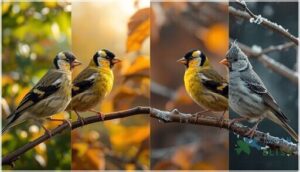
A songbird’s plumage isn’t static — it’s a living record of where that bird is in its annual cycle.
Those shifts are part of a broader phenomenon where seasonal color changes reshape a bird’s color pattern across the year, signaling health, age, and readiness to breed.
The shift between breeding and non-breeding seasons reshapes not just how birds look, but how they survive and compete.
Here’s how those color changes play out across the year.
Breeding Versus Non-Breeding Plumage
Think of breeding and nonbreeding plumage as a songbird’s two wardrobes — each worn for a specific job.
During breeding season, males display Sexual Selection Signals through rich carotenoid pigments, Feather Structural Shifts, and even Bill Darkening Patterns and Cloacal Swelling Correlation that signal reproductive readiness.
Outside it, the molting process dials everything back.
| Feature | Breeding Season | Nonbreeding Season |
|---|---|---|
| Plumage Tone | Bright, saturated | Dull, muted |
| Bill Color | Darkened | Pale or faded |
| Seasonal Color Change | Peak vibrancy | Subdued camouflage |
Camouflage and Predator Avoidance
Once breeding ends, survival takes over. Dull nonbreeding plumage isn’t a downgrade — it’s a precision tool. Background Matching against leaf litter and bare stems exploits Predator Vision Limits, making hawks work harder to spot a perched bird.
Dull nonbreeding plumage is not a downgrade — it is a precision survival tool that makes hawks work harder
Feather Wear Camouflage gradually sharpens disruptive patterns as pale edges abrade. Habitat Color Fit and Seasonal Behavior Sync — quieter songs, more time in cover — complete the strategy.
Sexual Dimorphism in Seasonal Colors
Not every songbird plays by the same rules. Rising testosterone drives males toward peak brightness during spring molt — a testosterone-driven brightness that females, with lower androgen levels, simply don’t match.
This molt timing divergence means males often display vivid breeding plumage while females stay subdued. That signal strength variation, shaped by sexual selection and avian plumage evolution, makes bird identification surprisingly straightforward once you know what to expect.
Biological Mechanisms Behind Color Transformation
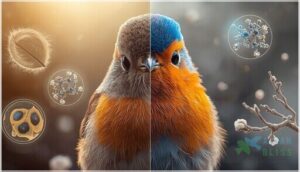
So what’s actually happening inside a bird when its feathers shift from drab to dazzling?
The answer comes down to a few key biological processes working in tight coordination.
Here’s a closer look at the mechanisms driving those seasonal transformations.
Pigment Vs. Structural Coloration
Not all color is created equal — feather coloration and structure rely on two distinct systems that age and shift very differently across seasons.
- Melanin durability makes blacks and browns weather‑resistant and slow to fade.
- Carotenoids produce yellows and reds but depend entirely on carotenoid availability in diet.
- Nanostructure iridescence creates blues through light scattering, not pigment.
- Preen wax effects subtly alter how nanostructures reflect light seasonally.
- Urban pollution impact reduces carotenoid access, dulling city birds’ breeding colors.
Glandular Regulation and Feather Growth
Behind every molt, there’s a hormonal orchestra conducting the whole show. Thyroid-mediated growth drives feather follicle activity — T3 and T4 literally determine how fast new plumage emerges.
Prolactin delay effects can push feather papillae regeneration back by nearly two weeks.
Meanwhile, melatonin interaction timing modulates prolactin’s suppressive pull, and corticosterone stress modulation keeps follicle hormone signaling stable, so seasonal plumage change doesn’t stall under pressure.
Timing and Sequence of Seasonal Molt
Molt isn’t random — it runs on a tight schedule shaped by photoperiod influence and life stage. Primary feathers replace themselves in orderly molt wave patterns, moving outward from the innermost feather. Here’s what drives the sequence:
- Partial vs complete molts determine how much plumage renews each cycle
- Age-specific molt means first-year birds often molt earlier or later than adults
- Geographic molt timing shifts with latitude, food availability, and migration demands
Iconic Songbird Examples of Seasonal Color Change
Some birds make the seasonal color shift hard to miss.
Across different species, the transformation plays out in ways that are surprisingly distinct — from dramatic swaps in body color to subtle feather wear that reveals what’s been hiding underneath all along.
A few standout examples show just how varied this process can get.
American Goldfinch Transformation
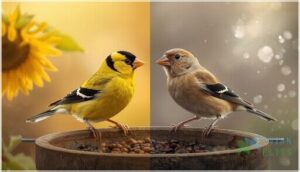
Few birds make seasonal plumage change as obvious as the American Goldfinch. The male’s vivid lemon-yellow breeding coat — fueled entirely by a carotenoid diet of lutein-rich seeds — gives way each fall to olive-brown winter feathers through a complete molting cycle driven by hormonal changes tied to shortening days. Watch for the bill color shift too: that vivid orange fades noticeably by October.
| Season | Male Appearance |
|---|---|
| Spring | Bright lemon-yellow body, black cap |
| Summer | Wings wear darker; orange bill peaks |
| Early Fall | Full molt begins; yellow fades |
| Winter | Olive-brown; dull bill; black cap gone |
| Late Winter | Winter shoulder patch visible on older males |
Age-related plumage differences matter here — experienced birders use that retained yellow shoulder patch to separate adult males from females at feeders. Social flocking signals the shift collectively: when a flock transforms from drab winter birds into vivid yellow males, the breeding season is close.
Snow Bunting and Ptarmigan Adaptations
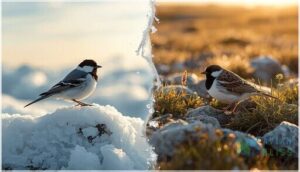
Where the Goldfinch relies on pigment, the Snow Bunting and Ptarmigan lean on feather wear and dense insulation.
Snow Buntings achieve Arctic camouflage through feathered tarsi and molt energy savings — buff tips simply abrade off each spring, revealing stark white beneath.
Ptarmigan cycle through full seasonal plumage change, trading white winter insulation for mottled summer cryptic feathers, while males briefly display bold sexual display shifts before molting back to safety.
Unique Patterns in Other Songbird Species
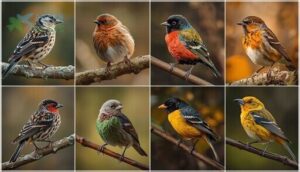
Not every species plays by the same rules. Seasonal brightness shifts more subtly — the Blackpoll transforms from bold black-and-white to olive-brown fall plumage entirely. Finch carotenoid cycles drive individual variation. Starling abrasion effects reveal iridescence without a full molt. Bunting age plumage progresses across years. Oriole delayed maturation keeps first-year males olive:
- Warblers shift brightness, not always pattern
- Finch carotenoid cycles vary by diet quality
- Starling abrasion effects expose spring iridescence
- Bunting age plumage reflects multi-season progression
- Oriole delayed maturation overlaps seasonal and age signals
Observing and Identifying Songbirds Year-Round
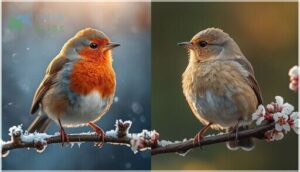
Knowing why plumage changes is one thing — spotting those changes in the field is where the real skill develops.
Songbirds don’t pause for easy identification, so learning to read seasonal cues quickly becomes essential.
Here’s what to keep in mind as you track these birds through every season.
Field Marks and Seasonal Identification
Even when plumage fades, core field marks hold steady.
Wing Bar Contrast and Crown Stripe Variability shift in intensity but stay in place, anchoring your seasonal identification.
Watch for Bill Color Shifts and Leg Color Changes as subtle age clues.
Juvenile Streak Patterns signal young birds, not new species.
Feather coloration changes — bird identification logic doesn’t.
Tips for Bird Watchers During Plumage Changes
Knowing your field marks is half the battle — acting on what you observe is the other half. During molt, check both sides of a bird for symmetrical molt checks; uneven loss often signals disease, not seasonal change.
Watch for pin‑feather identification on the crown, reduced feeder visitation patterns, and prolonged preening behavior cues. These details sharpen bird identification when plumage and seasonal color change muddy the picture.
Conservation Insights From Seasonal Coloration
Seasonal color change is more than a visual spectacle — it’s a conservation data stream. Dull or patchy plumage in breeding season flags population stress signals: poor habitat, parasite loads, or pesticide exposure.
Researchers use migration molt mapping and spectrophotometric analysis to pinpoint habitat quality indicators and color‑richness hotspots worth protecting.
Captive breeding monitoring tracks plumage brightness as a fitness proxy.
Sharp bird identification skills, applied consistently, feed directly into that larger conservation picture.
Frequently Asked Questions (FAQs)
What is the rarest color for a lovebird?
True albino lovebirds claim the top spot for Albino Rarity — pure white plumage, red eyes, and a recessive gene so elusive that even dedicated breeders rarely produce one.
Do birds change color seasonally?
Yes, many birds do change color seasonally. Through molting, hormonal changes, and seasonal feather wear, their feather coloration shifts dramatically — making bird identification a genuinely fluid challenge across the year.
Can diet affect a songbirds plumage color?
Absolutely — diet plays a direct role. Carotenoid intake during molt shapes yellow and red feather coloration, while protein influence enhances structural color. Poor nutrition dims plumage fast.
Do songbirds recognize each other after seasonal changes?
Like recognizing a friend by their laugh rather than their outfit, songbirds rely on vocal identity and social memory — not feather coloration — to maintain species recognition and courtship consistency long after plumage shifts.
How long does a full molt typically take?
Full prebasic molt duration depends heavily on species size influence — small finches wrap up in 4 to 8 weeks, while larger Blue Jays need 9 to Nutrition and photoperiod shape the timeline too.
Can disease or stress disrupt normal plumage changes?
Both disease and stress can derail normal molting.
Viral feather disease, nutritional deficiency effects, and elevated corticosterone impact feather coloration directly — producing stress bar indicators, parasite‑induced dullness, and disrupted hormonal control of plumage.
Conclusion
Look closer at the goldfinch that vanished from your feeder last spring—it didn’t leave. It transformed.
Songbird seasonal color changes aren’t cosmetic accidents; they’re a finely tuned biological language, spoken in feathers, written by light and hormones, edited twice a year. Every dull winter bird carries the blueprint of its splendid alter ego. Once you understand the mechanism driving these shifts, you don’t just identify birds differently—you read them.
- https://www.allaboutbirds.org/news/the-basics-feather-molt/
- https://avianreport.com/bird-molting/
- http://www.ofo.ca/site/page/view/articles.plumages
- https://www.sibleyguides.com/2012/05/the-annual-plumage-cycle-of-a-male-american-goldfinch/
- https://stateofthebirds.nhaudubon.org/bird_database/scarlet-tanager/