
This site is supported by our readers. We may earn a commission, at no cost to you, if you purchase through links.
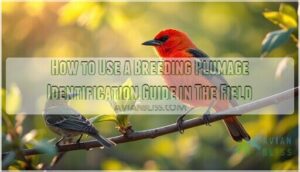
A scarlet tanager in full breeding color stops you cold—the bird practically glows against spring foliage, nothing like the dull olive female beside it. That visual shock is breeding plumage doing exactly what evolution designed it to do.
For most temperate songbirds, this transformation peaks between April and July, driven by hormonal shifts that swap worn winter feathers for fresh, richly pigmented ones. The same species can look like two completely different birds just weeks apart.
Knowing how to read those changes—the color layers, structural shifts, and subtle field marks—turns confusing sightings into confident identifications.
Table Of Contents
- Key Takeaways
- What is Breeding Plumage?
- Why Breeding Plumage Matters for Identification
- Key Characteristics of Breeding Plumage
- How to Identify Breeding Plumage in The Field
- Tools and Techniques for Observing Plumage
- Common Identification Challenges
- Species Examples: Breeding Plumage Highlights
- Frequently Asked Questions (FAQs)
- What are the 5 S’s of birding?
- What is breeding plumage?
- What is the rarest plumage color in birds?
- How long does breeding plumage typically last?
- Can diet influence the intensity of breeding colors?
- Do captive birds still develop breeding plumage?
- Which species show the most dramatic plumage changes?
- How does climate change affect breeding plumage timing?
- Conclusion
Key Takeaways
- Breeding plumage is triggered by lengthening days, which set off a hormonal chain reaction that swaps worn winter feathers for vivid, richly pigmented ones — peaking between April and July for most songbirds.
- The same bird can look like two completely different species just weeks apart, so knowing seasonal timing and key field marks — like head patterns, bill color, and iridescence — is what turns a confusing sighting into a confident ID.
- Sex, age, and molt stage all shape what you see, meaning a first-year male can look nearly identical to a female, and a bird mid-molt may show a patchwork of old and new feathers at the same time.
- Climate change is quietly shifting these windows earlier each year, so relying on a fixed calendar for peak plumage can now throw off your identification — staying flexible with timing is part of reading birds well.
What is Breeding Plumage?
Breeding plumage is one of nature’s most reliable seasonal signals — a temporary transformation that turns familiar birds into something almost unrecognizable. It doesn’t happen randomly; there’s a clear biological story behind the timing and the changes you’ll see. Here’s what’s actually going on.
The shift is especially striking in species like brown and red birds that develop vivid breeding plumage, where seasonal color changes signal fitness to potential mates.
Definition and Seasonal Occurrence
Breeding plumage is the set of feathers a bird wears during courtship and nesting — usually showing stronger colors and sharper patterns than at other times. These plumage cycles follow predictable seasonal triggers, with most temperate songbirds displaying their brightest looks between April and July.
Understanding these breeding windows is the real foundation of solid plumage identification, since the same bird can look strikingly different just weeks apart.
Biological Triggers and Hormonal Changes
Those seasonal color shifts don’t happen by accident — they’re driven by a precise chain of biological events. As days lengthen in late winter, photoperiod signals reach the brain and trigger hormone regulation through the hypothalamic-pituitary-gonadal axis, flooding the body with sex steroids that kick off molting and feather replacement.
Lengthening days trigger a hormonal cascade that transforms birds from the inside out
- Thyroid control fine-tunes molt timing, so feathers grow in fast and fully pigmented
- Metabolic cues from fat reserves and diet determine how vivid plumage changes actually appear
- Sexual dimorphism in birds reflects how differently males and females respond to these same hormonal shifts — making plumage identification more layered than it first looks
Differences Between Breeding and Non-breeding Plumage
Those hormonal shifts produce some striking results. Plumage coloration swings from vivid to muted as birds cycle through breeding and nonbreeding phases — a male mallard’s glossy green head fades into mottled brown eclipse plumage after nesting ends. Feather patterns sharpen or disappear entirely depending on the season.
Understanding these plumage changes makes molting cycles, species variation, and breeding plumage identification far more readable in the field.
Why Breeding Plumage Matters for Identification

Breeding plumage isn’t just about good looks — it’s one of the most useful tools you have for identifying a bird in the field. Knowing why it matters helps you read what you’re seeing with a lot more confidence.
Here’s what makes it worth paying attention to.
Role in Mating and Behavior
Bright colors aren’t just for show — they’re a full communication system. During mating season, breeding plumage drives mate selection, territorial signals, and pair bonding all at once.
Male house finches with deeper red plumage win more mates. Sage grouse strut elaborate courtship displays on leks.
Even social hierarchy gets sorted visually — ruffs use uniquely colored neck ruffs to signal dominance across avian mating rituals.
Impact on Field Identification
Clarity is what breeding plumage gives you in the field — and that’s worth a lot. Strong field marks, like the Dunlin’s black belly patch or the Yellow Warbler’s bright yellow face, make species differentiation straightforward when birds are in full breeding dress.
Beyond breeding plumage, rare pigmentation shifts like those behind bird xanthochromism and unusual yellow coloration show just how dramatically feather chemistry can reshape a bird’s appearance and survival odds.
Knowing these plumage variations and bird identification techniques sharpens your identification tips, turning tricky calls into confident ones.
Conservation and Research Significance
Breeding plumage is a window into population health. When biologists count territorial males in full color, they’re measuring real breeding output — not just birds passing through.
That data drives habitat preservation decisions, shapes species monitoring programs, and tracks climate adaptation by noting when plumage peaks earlier each year.
For biodiversity conservation and ornithological research, it’s one of the clearest signals wildlife conservation has. Researchers study climate change effects to better understand these shifts in population health.
Key Characteristics of Breeding Plumage

Breeding plumage isn’t just about brighter colors — it’s a whole package of changes that show up in different ways depending on the bird. Some shifts are obvious, others are easy to miss if you don’t know what to look for.
Here are the key characteristics worth knowing before you head out with your field guide.
Enhanced Coloration and Patterns
Color intensity in breeding plumage isn’t subtle — it’s a full visual broadcast. Melanin enhancement sharpens hoods, bibs, and masks into crisp, high-contrast field marks, while carotenoid pigments push yellows and reds toward their most saturated peak.
Iridescence effects catch light differently by angle, and ultraviolet signals boost pattern variation beyond what your eye detects.
Knowing these color layers sharpens your bird identification considerably.
Structural Changes (Crests, Tails, Etc.)
Beyond color, breeding plumage reshapes a bird’s entire silhouette. Crest development — like the Great Crested Grebe’s dramatic head tufts — transforms the head profile entirely. Tail elongation turns the Long-tailed Widowbird into something almost unrecognizable. Feather structure shifts too, with softer, airier textures replacing tight contour feathers.
Tracking these physical changes sharpens your bird identification skills considerably.
Differences by Sex and Age
Sex and age shape bird plumage more than most beginners expect. Sexual dimorphism is stark in species like the red-winged blackbird — males flash bold shoulder patches while females stay streaked brown.
Age variation adds another layer: juvenile plumage looks duller and messier, and plumage maturation takes years in some species. Molt patterns shift with breeding cycles, so a bird’s appearance genuinely changes season to season.
How to Identify Breeding Plumage in The Field

Spotting breeding plumage in the field takes more than just a quick glance — you need to know what to look for and when. The good news is that birds leave plenty of clues once you understand how to read them.
Here are three key things to focus on when you’re out watching.
Visual Cues and Field Marks
Reading bird plumage patterns in the field comes down to knowing exactly where to look. Focus on these four field marks:
- Head markings — sharper crown stripes and facial masks signal breeding condition
- Feather edges — crisp white wing bars and clean color blocks replace worn, dull fringes
- Beak colors — bills brighten noticeably, like the orange bill on breeding male goldfinches
- Iridescence effects — fresh feather types catch light differently, revealing metallic sheens on grackles and starlings
Seasonal Timing and Geographic Variation
Knowing when and where to look matters just as much as knowing what to look for. Breeding plumage doesn’t follow one universal calendar — latitude effects, elevation impacts, and regional variations all shift the window.
| Factor | Early Plumage Timing | Late Plumage Timing |
|---|---|---|
| Latitude | Southern US (Feb–Mar) | Canada (Apr–May) |
| Elevation | Lowland valleys | Alpine zones |
| Migration Patterns | Long-distance migrants | Short-distance residents |
| Climate Shifts | Warming coastal regions | High-elevation interiors |
| Regional Variations | Humid coastal populations | Arid inland populations |
Your bird identification guide may list April as peak season — but warmer springs have pushed many bird species several weeks earlier in recent decades.
Behavior Clues During Courtship Displays
Timing cues help you find birds, but their behavior seals the identification. Courtship rituals are your real field guide — watch for display postures where males puff out their chests, fanning tails wide to flash breeding plumage patterns. Aerial chases between rivals and the quiet closeness of pair bonding both pull hidden field marks into view.
Bird behavior studies confirm: movement reveals what stillness hides. Understanding bird courtship behaviors, including courtship display, is essential for accurate identification.
Tools and Techniques for Observing Plumage

Knowing what to look for is only half the battle — having the right tools makes all the difference in the field. The good news is you don’t need a lab or a research grant to observe breeding plumage up close.
Here are a few practical tools and techniques worth keeping in your kit.
Using Binoculars and Field Guides
Your optical equipment is the first key to unlocking breeding plumage details. A good pair of 8x or 10x binoculars — with a 32–42mm objective lens — gives you enough brightness and magnification to spot subtle field marks without the shaky image.
Pair that with a field guide showing labeled breeding plumage plates, and bird identification becomes much more straightforward during peak bird watching season.
Smart Bird Feeder Cams and Apps
Beyond binoculars, smart bird feeder cams take your bird watching to another level. These cameras handle plumage analysis automatically — AI recognition software compares bill shape, color blocks, and pattern placement for accurate species identification right at your feeder.
- Record breeding plumage in 1080p or 2K resolution
- Track bird behavior changes across seasons with timestamped visit logs
- Use pinch-to-zoom for detailed wildlife observation of throat patches and eye rings
- Compare early-spring versus peak breeding footage side by side
Photography Tips for Capturing Details
Getting your camera settings right makes all the difference when photographing breeding plumage. Use a shutter speed of 1/1000s or faster, aperture around f/5.6–f/8, and ISO 400–1600.
For lens selection, a 300–600mm telephoto with image stabilization keeps feather types sharp without disturbing birds.
Shoot in early light for natural color, and use continuous focusing techniques to track active displays.
Common Identification Challenges

Even with the right tools in hand, identification doesn’t always go smoothly — birds have a way of keeping you guessing.
A few common obstacles tend to trip up even experienced birders in the field. Here’s what to watch for.
Molting and Transitional Feathers
Molting can make even familiar birds look like strangers. During transitional phases, feather replacement happens gradually — so you might spot a sparrow with bright new breeding plumage on its head but worn, dull feathers still clinging to its back.
These molt patterns create plumage variation that trips up even experienced birders. Recognizing feather wear alongside fresh feather types helps you accurately read where a bird sits in its molting cycle.
Effects of Lighting and Environment
Light angle effects can completely fool your eyes in the field. A white egret’s breeding plumage turns creamy orange near sunrise, and backlighting hides color patterns entirely.
Environmental factors like overcast weather actually help — soft light reveals subtle feather types and fine field marks that harsh midday sun flattens.
Weather conditions like rain darken plumage, temporarily altering color perception and making familiar birds look unfamiliar.
Sexual Dimorphism and Intermediate Plumages
Sex differences in plumage variation can stop you cold in the field. A first-year male American Redstart, for instance, looks almost female — gray-headed, yellow-patched, nothing like the bold black-and-orange adult. That’s age identification in action.
Dimorphism patterns shift with molting cycles, so feather types matter as much as color. Combine sexual dimorphism clues with body structure, and breeding plumage starts making sense.
Species Examples: Breeding Plumage Highlights
Some birds make breeding plumage easy to spot — others take a second look to catch what’s changed. A few well-known species show the range of what’s possible, from subtle shifts to full-on seasonal transformations.
Here are some highlights worth knowing before you head out with your field guide.
Egrets and Herons

Egrets and herons are some of the most dramatic examples of plumage adaptations in North America. Watch for these three field marks during breeding season:
- Great Egrets grow long, lacy dorsal plumes and show bright green facial skin.
- Snowy Egrets develop wispy head plumes and a reddish flush near the bill.
- Cattle Egrets display orange-buff patches on the crown and chest.
Bird cam technology makes tracking these changes easier than ever.
Songbirds and Shorebirds
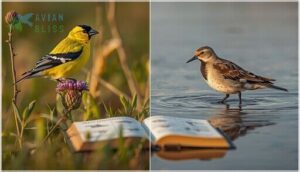
Songbirds and shorebirds show some of the boldest feather colors in North American bird species classification. A male American goldfinch flips from dull olive to sharp yellow practically overnight — that’s bird migration timing at work.
Shorebird identification techniques rely heavily on plumage patterns: dunlin gain a black belly patch, red knots turn brick-red.
Watching songbird behaviors and shorebird habitats sharpen your field observation skills fast.
Notable Regional Species and Variations

Regional plumage differences can flip your identification on its head. A male willow ptarmigan in Scandinavia shows rich chestnut across the head and neck, while Icelandic birds carry that color further down the breast — same species, different look.
Geographic adaptations like these affect breeding patterns across subspecies. Sharpening your field observation of species variations makes bird species classification far more reliable.
Frequently Asked Questions (FAQs)
What are the 5 S’s of birding?
Like a map with five landmarks, the 5 S’s of birding are Size Assessment, Shape Silhouette, Shade Recognition, Sound Identification, and Surroundings Analysis — your core bird watching tips for reading field marks, color patterns, and plumage accurately.
What is breeding plumage?
Breeding plumage is the vivid seasonal wardrobe a bird grows once a year. This transformation is driven by hormonal triggers that shift feather structure, deepen color variation, and sharpen mating signals across countless bird species.
What is the rarest plumage color in birds?
True blue is the rarest trick in the book — no bird makes blue pigment. That vivid blue plumage you see? It’s pure nanostructure, not color.
How long does breeding plumage typically last?
Plumage duration varies widely by species. Most songbirds show feather changes for 2–4 months, while Arctic shorebirds may keep breeding colors just 6–10 weeks before molt patterns shift them back to nonbreeding plumage.
Can diet influence the intensity of breeding colors?
Yes — you are what you eat, and so is a bird’s breeding color. Carotenoid effects, protein intake, and vitamin influence all shape plumage coloration and pigmentation directly through avian biology.
Do captive birds still develop breeding plumage?
Most captive birds still develop breeding plumage — as long as light cycles, diet, and hormones stay on track.
Strip away those cues, and even healthy birds may molt unevenly or skip their seasonal colors entirely.
Which species show the most dramatic plumage changes?
Some of the boldest seasonal transformations happen in widowbirds and scarlet tanagers. Widowbird males grow tail feathers up to 50 centimeters, while scarlet tanagers shift from olive-yellow to vivid scarlet through molting cycles driven by sexual dimorphism.
How does climate change affect breeding plumage timing?
Climate shifts are quietly rewriting molting cycles. Warmer springs trigger earlier breeding plumage, but photoperiod changes lag behind, creating mismatches that confuse avian migration patterns and challenge ornithology’s understanding of feather adaptations and temperature effects.
Conclusion
Every spring, the field holds a puzzle—feathers shift, colors intensify, and birds that looked familiar suddenly seem foreign. That moment of uncertainty is exactly where a solid breeding plumage identification guide becomes your sharpest tool.
Learn to read the cues: timing, behavior, structural changes, and color. Pattern recognition builds quietly, then clicks into place. The bird that stopped you cold in April becomes the one you confidently name by May.