This site is supported by our readers. We may earn a commission, at no cost to you, if you purchase through links.
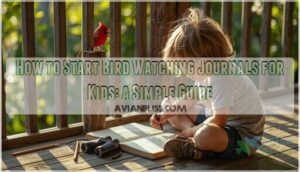
Most kids forget what they saw outside the moment they come back indoors. The red bird on the fence, the noisy one near the feeder—gone from memory by lunch. A journal changes that.
When a child stops to write down what they noticed, or sketches a wing shape from memory, something shifts. They start looking more carefully before they even pick up the pencil.
Bird watching journals for kids turn a walk outside into a small act of science, and the notebook becomes proof that they were paying attention. A few simple habits can make the whole thing stick.
Table Of Contents
Key Takeaways
- A bird watching journal trains kids to observe more carefully before they ever put pencil to paper, quietly building real scientific thinking habits outdoors.
- Choosing the right journal format for your child’s age matters more than most parents expect — the wrong one kills interest fast, while the right one does half the teaching for you.
- Tracking sightings across seasons turns a simple notebook into a living record, revealing patterns like migration shifts and weather-driven behavior that spark deeper curiosity.
- Kids can connect their journal entries to real citizen science platforms like eBird, making their backyard observations part of actual global wildlife conservation data.
Why Kids Benefit From Bird Watching Journals
A bird watching journal does more than just hold notes — it quietly builds skills your kid will use for life. From sharpening how they see the world to growing their confidence on the page, the benefits run deeper than you’d expect.
Pairing the journal habit with solid bird behavior observation techniques gives kids a real framework for noticing — and recording — what actually matters in the field.
Here’s what journaling actually does for young birders.
Boosting Observation and Recording Skills
Bird watching journals push kids to slow down and really look. To fill out a bird watching journal entry, your child has to notice details — wing color, beak shape, how the bird moves. Those observation techniques build naturally over time.
Each nature journaling session becomes a small science experiment. And with space for 50 sightings, the recording methods practically teach themselves. By using a bird watching journal, kids can develop essential skills in nature study and observation.
Encouraging Curiosity and Scientific Thinking
Once your child starts noticing details, curiosity kicks in naturally. A journal gives that curiosity somewhere to go.
Kids who practice nature journaling for children don’t just record birds — they start asking why. Why does this bird only show up in winter? Why does it prefer the feeder over the lawn? That’s real critical thinking and science literacy developing outdoors.
Try prompting these questions during bird watching for kids:
- What do you think this bird eats?
- Why might it be here today but not yesterday?
- What would happen if the feeder was empty?
- Where do you think it sleeps at night?
By incorporating nature journaling techniques, kids can develop a deeper understanding of the natural world.
Fostering Environmental Awareness and Stewardship
That curiosity doesn’t stop at questions — it grows into something bigger. Environmental awareness for kids develops naturally when they track which birds disappear after a cold snap or notice fewer visitors when the birdbath runs dry.
Nature journaling for children quietly teaches conservation for kids and eco-friendly habits by making wildlife preservation feel personal. Their journal becomes a small act of sustainable living.
Building Confidence in Art and Writing
That sense of stewardship carries right into the journal pages themselves. A bird watching journal — whether a printable journal, illustrated journal, or My Very Own Bird Watching Journal For Kids — gives kids creative freedom to sketch and write without pressure.
Artistic expression grows naturally here. So do writing skills and self reflection. Confidence building happens quietly, one messy, honest, wonderful entry at a time.
Choosing The Right Bird Watching Journal for Kids
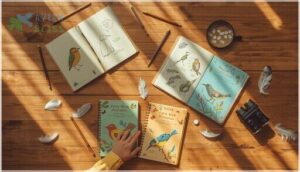
Not all bird journals are built the same, and picking the wrong one can kill a kid’s interest fast. The good news is there are a few simple things to look for before you buy or print anything.
A quick look at bird field guides designed for families can show you exactly what features make journaling click for younger kids.
Here’s what actually matters when choosing a journal your kid will stick with.
Key Features to Look For
Not all nature journals are built the same. A good bird watching journal uses quality paper — around 80 to 100 gsm — so marker won’t bleed through. Look for durable binding options, a smart space layout with room to sketch and write, and prompts guidance built into the journal design.
Printable journal pages work too, especially for bird identification on the go.
Age-Appropriate Journal Formats
Every age group needs a different kind of bird watching journal. Format variations matter more than most parents realize.
- Ages 3–5: big drawing spaces, simple coloring outlines, picture prompts for bird identification
- Ages 5–7: short writing lines, half-page sketches, basic bird illustrations
- Ages 8–10: detailed recording techniques, habitat notes, comparison boxes
My Very Own Bird Watching Journal For Kids nails this journal design balance across age groups.
Printable Vs. Bound Journals
Picking between a printable journal and a bound one really comes down to your budget and how your kid uses things. Printable journal pages cost less and let you reprint lost or ruined sheets.
Bound nature journals like My Very Own Bird Watching Journal For Kids offer better page durability and keep bird watching records organized.
Both have solid customization options and storage methods worth considering.
Guided Prompts and Layouts
A good bird watching journal does half the teaching for you. Look for journal page design that groups prompts by category — appearance, behavior, habitat — so kids know where to look first. Visual aids like sun icons for weather or ear symbols for sound make layouts easy to follow.
Strong prompt types push kids beyond basic recording techniques, asking things like "What was the bird doing?" That’s where real curiosity begins.
Step-by-Step Guide to Using a Bird Watching Journal
Using a bird watching journal doesn’t have to be complicated. A few simple steps can help your kid get started and actually stick with it. Here’s how to make the most of every page.
Setting Up Your Journal Pages

Setting up your bird watching journal pages doesn’t have to be complicated. A clean page layout tips the odds in your favor for consistent record keeping. Start with these three essentials for your journal page design:
- Draw headers for Date, Time, Weather, and Location at the top
- Add a bird species list section below
- Leave space for a simple bird log sketch area
What to Record During Bird Watching

Once you’re out there, your journal becomes a snapshot of the moment. Write down the bird species you spot, basic habitat notes, and weather conditions — cloudy skies really do change which birds show up.
Note bird behaviors too, like hopping, soaring, or hiding in brush. Simple sighting logs don’t need to be perfect. Just honest, curious, and yours.
Tips for Drawing and Describing Birds
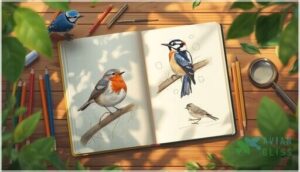
Drawing in your bird watching journal doesn’t need to be perfect. Start with simple shapes — circles, ovals, triangles — then build from there.
Focus on what makes each bird unique:
- Beak shapes (thick for seed eaters, thin for insect hunters)
- Wing patterns and feather details
- Distinctive bird poses
- Color zones like "bright red chest" or "gray back"
Label directly on your sketches for easy bird identification later.
Tracking Bird Sightings Over Time

Once your sketches are done, keep the momentum going by logging each sighting over time. Note the season, weather, and habitat — you’ll start seeing real patterns emerge.
Some birds only show up during migration. Others vanish when rain hits. Tracking bird counts across weeks turns your bird watching journal into a living record of wildlife observation that tells a bigger story.
Tracking bird sightings across weeks transforms a simple journal into a living record of the natural world
Creative Bird Watching Journal Activities for Kids

Journaling doesn’t have to stop at writing down what you see. There are some really fun ways to take it further and keep kids genuinely hooked on the whole experience.
Here are a couple of activities worth trying.
Drawing and Coloring Bird Species
Every bird has a story your kid can tell through art. Combining bird anatomy basics with simple color techniques turns a bird watching journal into a real illustrated journal. Start with shapes, then add feather patterns.
- Use directional strokes for realistic feather patterns
- Layer light colors first for natural species illustration
- Highlight beaks and markings for easy bird identification
Wildlife artistry starts simple.
Integrating Citizen Science Projects
Art brings birds to life on the page — but your kid’s bird watching journal can do something bigger. Through citizen science projects like eBird or the Great Backyard Bird Count, their nature journal entries become real wildlife conservation data.
Kids join community engagement efforts that shape bird conservation decisions worldwide. That’s outdoor education with actual environmental impact, turning simple observations into meaningful data analysis.
Top Bird Watching Tools for Kids’ Journaling
A good journal is just the start. The right tools make bird watching sharper, more fun, and way easier to stick with. Here are three worth adding to your kit.
1. Think Peak Kids Binoculars
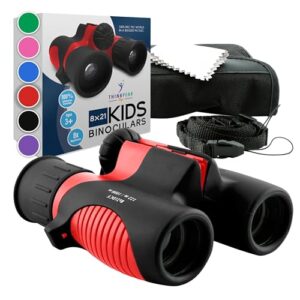
Good binoculars make a real difference when kids are trying to spot birds. The Think Peak Kids Binoculars have 8×21 magnification and BAK4 lenses, so distant birds come in sharp and clear. They’re built for small hands — rubber-coated, shockproof, and light enough for a day on the trail. The breakaway neck strap is a smart safety touch.
Kids can stop, look, and then sketch what they saw in their journal. That connection between seeing and recording is where the learning really sticks.
| Best For | Kids aged 3–12 who love being outside and are curious about nature, birds, and wildlife. |
|---|---|
| Target Age | 3–12 years |
| Bird Focus | Wildlife observation |
| Beginner Friendly | Easy center focus knob |
| Nature Education | Encourages STEM learning |
| Outdoor Use | Hiking and camping |
| Gift Suitability | Great for young explorers |
| Additional Features |
|
- 8×21 magnification with BAK4 lenses gives kids a sharp, clear view of distant birds and animals
- Shockproof, rubber-coated body with a breakaway neck strap — built to handle the bumps of outdoor adventures
- Waterproof and light enough for all-day hikes, camping trips, or backyard bird watching
- Rubber eye cups can be tricky to fold back for kids who wear glasses
- Some users noted focusing issues, with only one tube adjusting at a time
- Replacement parts aren’t available separately, so damage may mean replacing the whole unit
2. Peterson Field Guide To Backyard Birds
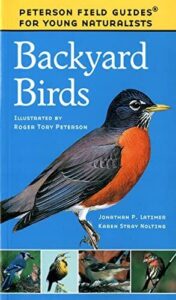
Once your kid spots a bird, they’ll want to know what it is. That’s where the Peterson Field Guide to Backyard Birds earns its place in the bag.
Built for young naturalists aged 4 and up, it covers around 20 common backyard species using Roger Tory Peterson’s iconic arrow-marked illustrations. Simple descriptions, side-by-side comparisons, and paired photos make identification fast.
At roughly 48 pages and under ten dollars, it’s light enough to carry and easy enough to actually use.
| Best For | Kids aged 4 and up who are just starting to notice birds in the backyard and want a simple, friendly guide to figure out what they’re looking at. |
|---|---|
| Target Age | 4 years and up |
| Bird Focus | Backyard birds |
| Beginner Friendly | Peterson Identification System |
| Nature Education | Teaches bird identification |
| Outdoor Use | Field bird watching |
| Gift Suitability | Ideal for young birders |
| Additional Features |
|
- Roger Tory Peterson’s arrow-marked illustrations make spotting key features quick and intuitive, even for little ones
- Lightweight and compact, so kids can actually carry it outside without complaint
- Includes a bird-watching log, which gives kids a fun reason to keep coming back to it
- Only covers around 20 species, so if a mystery bird shows up, there’s a good chance it won’t be in here
- No scientific names or distribution maps, which limits how far a curious kid can take their learning
- A bit thin on content for anyone who’s already past the total beginner stage
3. Woodland Bird Songs Book
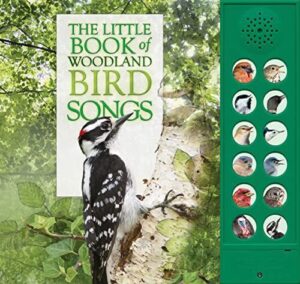
Sound changes everything. The Little Book of Woodland Bird Songs pairs twelve real bird calls with lifelike photos and simple descriptions — so your kid isn’t just reading about birds, they’re hearing them. Press a button, match the sound to the portrait, done.
Written for ages three and up, it covers species kids will actually encounter on walks. The sturdy board book format holds up to heavy use, and the "Did you know?" facts on every spread keep curious minds hooked well past bedtime.
| Best For | Kids ages 4–7 who love being outside, plus parents or grandparents who want to make nature walks a little more interactive. |
|---|---|
| Target Age | 4–7 years and beyond |
| Bird Focus | Common bird species |
| Beginner Friendly | Interactive song buttons |
| Nature Education | Fosters nature appreciation |
| Outdoor Use | Encourages outdoor exploration |
| Gift Suitability | Great gift for children |
| Additional Features |
|
- Real bird sounds at the press of a button — kids actually hear what they’re learning, not just read about it
- Tough board book build that survives the kind of handling kids give things they love
- Covers 12 species they’ll genuinely spot in the wild, so it stays useful beyond the bookshelf
- It’s a board book, so don’t expect something big — some people are surprised by the size
- The sharp corners mean you’ll want to keep an eye on younger siblings around it
- Sound quality could fade with heavy use over time, though it hasn’t been a common complaint
Frequently Asked Questions (FAQs)
Can bird journaling work for kids with disabilities?
Yes, absolutely. Bird journaling adapts well to almost any need. Kids can draw instead of write, record sounds instead of sketching, or use simple stickers to log what they spotted.
How do you keep kids motivated to journal consistently?
Short sessions beat long ones. Ten minutes a day, same time each day, builds the habit fast.
Let kids pick their prompts and celebrate small wins — a sticker, a high five, a happy dance.
What weather conditions are best for bird watching?
Mild, calm mornings work best. Light winds, partial clouds, and temperatures around 10–21°C keep birds active and visible.
After a light rain is also great — birds come out to feed and splash.
Can bird journals double as school science projects?
Absolutely. A bird journal checks every box a science teacher looks for — observations, data collection, sketches, and patterns over time. Many K–8 curricula already count wildlife recording as a formal requirement.
How do you store and preserve completed bird journals?
Treat a finished journal like a little time capsule. Store it flat, away from sunlight and damp spaces.
Clean hands, a sturdy box, and steady indoor temperatures keep every page sharp for years.
Conclusion
The best things often start small—a single red bird, a quick sketch, a name learned and remembered. Bird watching journals for kids turn those small moments into something that grows.
Each page fills in quietly, and before long, your child has a record of the world they’ve been watching. They start noticing what others walk past. That’s not a small thing. That’s a habit worth keeping, one backyard bird at a time.
- https://jenfarley.com/bird-watching-journal/
- https://www.desertusa.com/birds/bird-watching-journal.html
- https://www.reachinghappy.com/learn/free-bird-journaling-page/
- https://www.birdschoolproject.org/nature-journal
- https://www.calaes.com/blog/introducing-children-and-teenagers-to-the-fascinating-world-of-birds