This site is supported by our readers. We may earn a commission, at no cost to you, if you purchase through links.
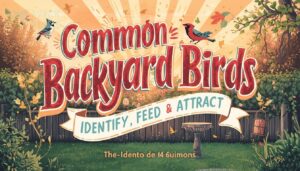
Step outside on a quiet Virginia morning and count how many birds visit your yard before your coffee cools—most people are surprised to reach double digits. Virginia sits along the Atlantic Flyway, one of North America’s busiest migratory corridors, which means your backyard hosts an ever-rotating cast of species across every season.
The Northern Cardinal stays year-round, the Dark-eyed Junco arrives with the first cold snap, and a Blackburnian Warbler might pass through for just a single April afternoon. Knowing who’s who—and what draws them in—turns a ordinary yard into something closer to a working habitat.
Table Of Contents
- Key Takeaways
- Most Common Virginia Backyard Birds
- Resident Birds Vs Seasonal Visitors
- Spot Birds by Size and Color
- Best Feeders for Backyard Birds
- Backyard Habitats That Attract Birds
- Frequently Asked Questions (FAQs)
- What are the most common backyard birds in North America?
- Are there native birds in your backyard?
- What is the most common bird in Virginia?
- What is the difference between backyard birds and fowl birds?
- How many birds are in your backyard?
- What birds live in backyards?
- What are the best birds to see in your backyard?
- What are the most common backyard birds in Virginia?
- How do I identify a bird in my backyard?
- What is the most common garden birds?
- Conclusion
Key Takeaways
- Virginia sits along the Atlantic Flyway, so your backyard naturally cycles through year-round residents like the Northern Cardinal (Cardinalis cardinalis), winter arrivals like the Dark-eyed Junco (Junco hyemalis), and brief spring migrants like the Blackburnian Warbler — all without you leaving your property.
- Matching your tube feeders to each species’ feeding behavior — tube feeders with Nyjer for finches, platform feeders with millet for sparrows and doves, suet cages for woodpeckers and wrens — dramatically increases which birds visit and how often.
- Native plants do more heavy lifting than any feeder: oaks provide nesting cavities, winterberry holly (Ilex verticillata) carries fruit deep into winter, and coral honeysuckle draws Ruby-throated Hummingbirds (Archilochus colubris) all season long.
- You can ID most backyard visitors by combining just two or three cues — bill shape, crest behavior, or a single behavioral quirk like the White-breasted Nuthatch’s (Sitta carolinensis) headfirst trunk descent — without needing a field guide in hand.
Most Common Virginia Backyard Birds
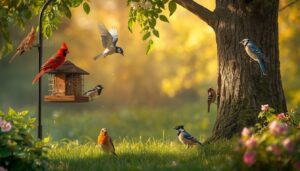
Virginia’s backyard is never really quiet — something’s always moving through the branches or calling from the fence line. Depending on the season, you might spot a dozen different species without ever leaving your yard.
From warblers passing through in spring to year-round cardinals and chickadees, Virginia’s backyard bird species shift with the seasons in ways that can surprise even seasoned birdwatchers.
Here are the birds you’re most likely to see.
Northern Cardinal
Few Virginia yard birds stop you in your tracks like the Northern Cardinal (Cardinalis cardinalis). Here’s makes it unmistakable:
- Males are vivid red, 8.7 inches long, with a bold crest and orange-pink bill.
- Females wear warm brown with reddish hints — subtle but beautiful.
- Territorial Song rings out year-round, defending habitat preference in shrubs and wooded edges.
- Courtship Feeding and Mating Displays cement pair bonds each spring.
- Winter Foraging brings them reliably to sunflower feeders — your most loyal cold-weather guest.
They’re a non‑migratory resident bird that thrives in forest edge habitat.
Carolina Wren
Don’t let its small frame fool you — the Carolina Wren (Theria ludovicianus) punches well above its weight. At just 4.5–5.5 inches, this common Virginia backyard bird species belts a rolling, teakettle song that carries surprisingly far.
It’s a year-round resident with no seasonal migration, favoring dense brush and nest boxes.
Suet feeders are your best attractant strategies.
American Crow
From the tiny wren to something far bigger — the American Crow (Corvus brachyrhynchos) is hard to miss. Jet-black and iridescent, they measure up to 21 inches with a wingspan near 40 inches. They appeared on 44% of Virginia checklists year-round.
What sets crows apart is their crow intelligence:
- They recognize human faces and remember them
- Tool use is documented in wild populations
- Roosting behavior draws winter flocks of thousands
- Their scavenging diet spans insects, carrion, seeds, and garbage
- Social structure keeps family groups bonded across seasons
Blue Jay
After the crow, here’s another bold personality: the Blue Jay (Cyanocitta cristata).
That electric-blue back, white face, and stiff black necklace make it unmistakable.
Its crest rises when agitated — a mood ring you can read from across the yard.
Appeared on 40% of Virginia checklists, Blue Jays travel in social family groups, cache seeds aggressively, and won’t hesitate to chase other feeder visitors away.
Carolina Chickadee
Don’t let its size fool you — the Carolina Chickadee (Poecile carolinensis) punches well above its weight. Spotted on 45% of Virginia’s winter checklists, it is a feeder staple worth knowing.
- Insect Hunting Techniques include hanging upside-down on branches to glean hidden prey
- Vocal Repertoire Variation signals everything from flock location to nearby predators
- Nest Box Size matters — aim for a 25mm entrance hole
Suet and peanut feeders are your best bet.
American Robin
The American Robin (Turdus migratorius) is practically Virginia’s unofficial lawn bird — that brick-red breast hopping across wet grass is hard to miss.
Its migration patterns shift subtly with seasons: winter foraging pulls it toward berry-laden trees like holly and juniper , while spring triggers territory defense and breeding behavior on open lawns.
Song variations — from cheerful whistles to low cuck calls — help you identify it by sound alone.
Mourning Dove
The Mourning Dove (Zenaida macroura) moves through your yard with quiet, unhurried purpose — soft gray presence that blends easily into daily life.
Ground feeding is its default, and it responds well to seed mixes scattered on low trays.
Three things define this bird:
- A fast, whistling takeoff signals predator awareness
- A short breeding cycle — eggs hatch in just 14 days
- Preference for inconspicuous nest site choice in low shrubs
Eastern Bluebird
The Eastern Bluebird (Sialia sialis) prefers edge habitats — open yards with scattered trees suit it perfectly.
Males perform striking courtship displays each spring, and females lay pale blue eggs in clutches of three to five.
Install a nest box with a 1.5-inch opening for predation prevention. Mealworms at your feeder cover their need for insect prey diversity year-round.
White-throated Sparrow
The White-throated Sparrow (Zonotrichia albicollis) arrives in Virginia each fall like clockwork. During winter, white-striped and tan-striped adults can be observed scratching through leaf litter while foraging.
Their distinctive song phrase, Oh sweet Canada, becomes particularly audible in late winter. Migration timing peaks from October through April, aligning with their seasonal presence in the region.
To attract these birds, scatter millet on a platform feeder, offering an easy food source that brings them closer to observers.
Dark-eyed Junco
The Dark-eyed Junco (Junco hyemalis) is one of winter’s most reliable backyard visitors in Virginia. Subspecies’ plumage variation means some birds appear slate-gray, others brownish — yet all share that unmistakable white tail feather flash when startled into flight.
Watch for them hopping through your yard’s mixed habitat preference of brushy edges and open ground.
Scatter a millet-heavy seed mix on your ground feeder, and they’ll keep coming back.
Yellow-rumped Warbler
After the juncos settle in, keep your eyes open for another winter regular — the Yellow-rumped Warbler (Setophaga coronata).
That bright Rump Patch ID is your quickest clue: a vivid yellow flash visible mid-flight.
- Shifts to Berry Feeding when insects disappear in cold months
- Covers a wide Subspecies Range across Virginia’s mixed woodlands
- Occasional Hybrid Warblers appear during migration
- Distinct Song Patterns help confirm ID by ear
- Peaks at 35% of winter checklists during migration
Common Grackle
From the quiet warblers, we shift to something louder — the Common Grackle (Quiscalus quiscula).
That iridescent plumage shifts from purple to bronze depending on the light. You’ll notice their pale yellow eyes instantly. Social flocking and urban foraging define this species, appearing on 35% of summer checklists, but dropping sharply in winter.
| Trait | Detail |
|---|---|
| Vocal Mimicry | Raspy squeaks, whistles |
| Nesting Preferences | High conifers, shrubs |
Resident Birds Vs Seasonal Visitors
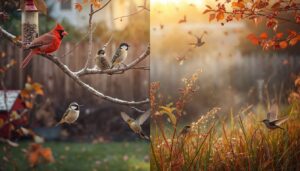
Not every bird you see in your yard is a permanent neighbor — some are just passing through, while others clock in and out with the seasons. Virginia’s backyard hosts a surprisingly varied cast depending on the time of year.
Here’s how to tell who’s staying, who’s visiting, and who only shows up when it gets cold.
Year-round Birds in Virginia
Some birds simply never leave. Virginia’s true year-round residents — Northern Cardinal, Carolina Wren, American Crow, Blue Jay, and Carolina Chickadee — are the backbone of any Virginia bird species guide. Understanding their Winter Foraging Patterns, Territory Defense behavior, and Song Identification cues turns your yard into a living field station.
| Species | Key Behavior | Attraction Tip |
|---|---|---|
| Northern Cardinal | Defends territory year-round | Black-oil sunflower seeds |
| Carolina Chickadee | Active foraging in cold | Suet + tube feeders |
| Carolina Wren | Ground-level insect hunting | Brush piles + Bathing Stations |
Keep feeders stocked and Predator Awareness in mind — cats and hawks are real threats. These Bird feeding and attraction tips, paired with a reliable Seasonal bird feeder recommendations routine, make your backyard their permanent address.
Summer-only Backyard Birds
While your year-round residents hold the fort, summer brings a whole new cast. Indigo Buntings (Passerina cyanea) and Baltimore Orioles arrive in May, riding caterpillar abundance peaks for insect feeding.
Morning Song Peaks occur just after dawn—a time when mating displays and nest-building timing align perfectly.
| Summer Species | Key Behavior |
|---|---|
| Indigo Bunting | Dawn Mating Displays |
| Baltimore Oriole | Fruit and insect foraging |
| Orchard Oriole | Summer bird feeding on ripe fruit |
| Common Grackle | Summer bird activity in flocks |
| Yellow-rumped Warbler | Summer bird resources in foliage |
Winter Backyard Birds
When temperatures drop, your backyard becomes a lifeline. Dark-eyed Juncos (Junco hyemalis) and White-throated Sparrows dominate both winter and summer backyard bird checklists in Virginia.
Cold weather survival for these birds depends on proper feeder placement and a heated bird bath setup.
| Winter Species | Winter Food Preferences |
|---|---|
| Dark-eyed Junco | Millet, ground seeds |
| White-throated Sparrow | Mixed seed, millet |
| Northern Cardinal | Black-oil sunflower |
| Carolina Chickadee | Suet, sunflower chips |
| Yellow-rumped Warbler | Berries, suet |
Migratory Birds to Watch For
Spring warbler peaks transform Virginia’s forest edges overnight. Migratory patterns of Virginia birds follow predictable corridors — high-altitude passages carry Scarlet Tanagers over mountain ridges, while wetland stopovers host Northern Waterthrush along streams. Urban migrant visits bring Cedar Waxwings to fruiting trees.
| Season | Key Migrants |
|---|---|
| Spring | Blackburnian Warbler, Indigo Bunting |
| Fall | Yellow-rumped Warbler, Dark-eyed Junco |
Birds Most Common at Feeders
A handful of species dominate Virginia feeders regardless of the season. Seed preference trends show that Northern Cardinals, American Goldfinches, Blue Jays, House Finches, and Mourning Doves respond strongly to attractant rotation strategies—such as swapping sunflower for safflower, which shifts which birds linger. Feeder placement tips and winter energy needs directly shape seasonal visit patterns.
| Species | Top Feeder Draw |
|---|---|
| Northern Cardinal | Safflower, sunflower |
| American Goldfinch | Nyjer, sunflower |
| Blue Jay | Peanuts, corn |
| House Finch | Black-oil sunflower |
| Mourning Dove | Mixed seed, millet |
Birds That Appear After Snow
A fresh snowfall works like a dinner bell for your backyard. Snow Mask Effects cut off ground insects, triggering a Feeder Activity Spike almost immediately.
When snow blankets the ground, your backyard feeder becomes the only restaurant in town
Watch for Flock Formation among Dark-eyed Juncos and White-throated Sparrows at platform feeders.
| Species | Post‑Snow Plumage | Behavior |
|---|---|---|
| Dark-eyed Junco | White tail flashes | Ground foraging |
| American Robin | Rusty-orange breast | Thaw Insect Surge |
| Northern Cardinal | Vivid red retained | Feeder dominant |
Spot Birds by Size and Color
Once you know what to look for, identifying backyard birds gets a lot easier. Size, color, and a few key physical traits can tell you exactly who’s visiting before they even make a sound.
Here are the most useful visual clues for the birds you’re most likely to spot in a Virginia yard.
Northern Cardinal Plumage and Bill Shape
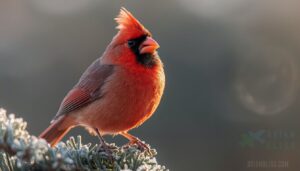
Few backyard visitors stop you mid-coffee like a male Northern Cardinal (Cardinalis cardinalis). That blazing red isn’t random — red hue saturation depends entirely on carotenoid diet influence, meaning richer food sources produce bolder color.
Notice the mask contrast dynamics: black facial markings sharpen his red silhouette.
His conical bill shape — thick, orange-coral — serves as your clearest bird identification guide clue for understanding bird size and shape for identification.
Blue Jay Crest and Bold Markings
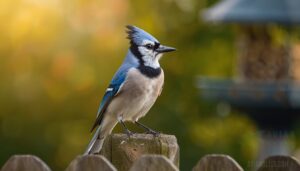
The Blue Jay (Cyanocitta cristata) is basically wearing a mood ring on its head. That mood-linked crest rises 2–3 inches when it’s alert — a reliable bird identification guide shortcut for backyard birdwatching.
Watch for:
- Crest height variations signaling calm vs. alarm
- Structural blue feathers — no true pigment, just light physics
- Black necklace emphasis sharpening its white face contrast
- Bold flight silhouette cues, even at distance
- High-contrast markings visible instantly at feeders
Mourning Dove Body Shape and Flight Sound
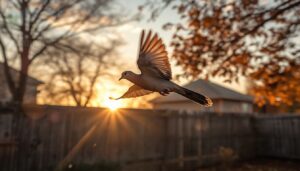
From bold crests to softer shapes — the Mourning Dove (Zenaida macroura) offers a completely different set of clues.
Its slender, tapered body and long pointed tail create a distinct silhouette profile that’s easy to spot in flight. That tail also works as a tail rudder function, steering precise turns.
Pointed wings enable wing drag reduction for quick bursts.
Your best cue, though? That sharp flight whistle characteristics — an unmistakable acoustic flight cue when identifying birds by sight and sound.
White-breasted Nuthatch Upside-down Feeding
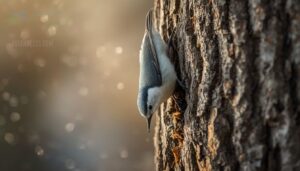
Unlike the dove’s graceful glide, the White-breasted Nuthatch (Sitta carolinensis) announces itself through behavior — specifically, headfirst foraging straight down a trunk.
That trunk positioning isn’t random. It exposes hidden insects that upright birds simply miss.
Bark texture matters too — rougher bark means more crevices to probe.
Watch for quick pauses — that’s predator vigilance.
They also practice food caching, tucking seeds into bark for leaner days.
American Goldfinch Seasonal Color Changes
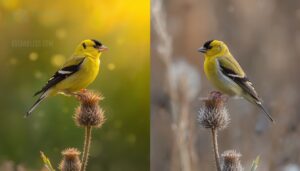
Few birds pull off a wardrobe change quite like the American Goldfinch (Spinus tristis). The molting cycle runs twice yearly — body feathers shift through a full plumage transformation each spring and late summer.
Males achieve peak brightness, lemon yellow with a sharp black forehead, while female camouflage stays olive-brown year-round. That seasonal pigment shift makes goldfinch identification genuinely season-dependent.
Chickadee Cap, Bib, and Call
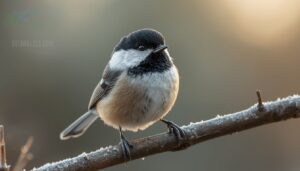
Color-shifting goldfinches teach your eyes to adapt — now train your ears. The Carolina Chickadee (Poecile carolinensis) gives you a Visual Vocal Cue that’s almost impossible to miss: jet-black cap’s plumage contrast against bright white cheeks, a solid bib’s markings detail beneath the chin.
Its chick-a-dee-dee call shifts in call frequency and seasonal vocal patterns — more frantic dee notes signal nearby danger.
Woodpecker Size and Back Pattern Clues
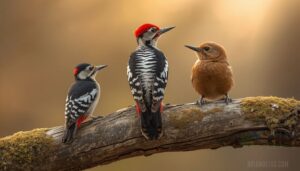
Size tells the story fast.
The Downy Woodpecker (Picoides pubescens) runs just 6–7 inches — stubby bill, compact flight silhouette. The Red-bellied (Melanerpes carolinus) stretches closer to 9 inches with a longer bill and bolder crest color marks.
Both wear ladder-like back bar patterns, but bill length clues and size ratios separate them instantly.
The Northern Flicker breaks the mold entirely — spotted chest, no barring.
Best Feeders for Backyard Birds
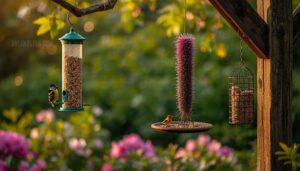
Picking the right feeder makes a real difference in which birds show up — and how often. Different species have different habits, so what works for a Carolina Chickadee won’t necessarily work for a Dark-eyed Junco.
Here’s a look at the feeders that do the most work in a Virginia backyard.
Tube Feeders for Chickadees and Finches
Tube feeders are the workhorses of any Virginia backyard setup. Fill one with Nyjer seed, keep the port size between 1.0 and 1.5 mm, and you’ll attract American Goldfinches, House Finches, and Carolina Chickadees within days.
Mount it 4–6 feet high for safe placement, and add a squirrel guard to protect against pests.
Choose a design with a removable base to ensure simple maintenance, keeping the feeder clean and functional.
Platform Feeders for Sparrows and Doves
Platform feeders open the floor — literally — to ground-loving visitors like Mourning Doves (Zenaida macroura) and Song Sparrows (Melospiza melodia).
Choose durable materials like UV-resistant recycled plastic with mesh bottoms for easy maintenance and drainage. Strategic placement 3–6 feet from shrubs helps deter predators.
Rotate a seasonal seed mix to keep visits steady:
- Millet for sparrows
- Cracked corn for doves in winter
- Mixed blends year-round
Suet Feeders for Woodpeckers and Wrens
Suet feeders are an essential tool for attracting woodpeckers and the Carolina Wren (Thryothorus ludovicianus). Choose a cage-style feeder with ¼-inch mesh dimensions, ensuring it is mounted 5–8 feet up. Height placement matters, particularly for tail-propping woodpecker species in Virginia.
Fill the feeder with high-fat suet blended with peanuts. Add squirrel baffles to deter unwanted visitors.
Follow a biweekly cleaning schedule to maintain hygiene and ensure birds return safely.
Peanut Feeders for Jays and Titmice
Blue Jays (Cyanocitta cristata) and Tufted Titmice (Baeolophus bicolor) both love peanuts — but they feed differently.
Hang a squirrel-resistant design with the right port size selection at 4–6 feet placement height. Offer peanut in the shell for jays; shelled pieces suit titmice better.
Among Virginia bird feeder types, peanut feeders reward consistent peanut type choice and a biweekly cleaning schedule.
Ground Feeding for Juncos and Cardinals
Some birds don’t need a fancy feeder — just a clear patch of ground. Dark-eyed Juncos (Junco hyemalis) and Northern Cardinals both forage naturally at ground level, especially in winter.
Scatter a seed mix of white proso millet and cracked corn across a flat, open ground patch.
After snow, this spot becomes critical for meeting their winter energy needs. Keep it clean and visible — predator safety matters.
Black-oil Sunflower Seed Favorites
If ground feeding opened the door, black oil sunflower seed keeps it wide open. Its Thin Hulls and Nutrient Richness — nearly 50% fat, 20% protein — make it the reference point for bird feeding preferences and diet across Virginia.
- Diverse Visitors: Cardinals, chickadees, and nuthatches all respond strongly.
- Winter Energy: High fat content sustains birds through cold spells.
- Seed Shelf-life: Store cool and dry; refresh every 1–2 days.
Mealworms for Bluebirds and Mockingbirds
Mealworms shift bird feeding preferences and diet into high-protein territory — especially during nesting season when Eastern Bluebirds (Sialia sialis) and Northern Mockingbirds need fuel for nestlings.
Live vs dried matters here: live mealworms move, and movement gets attention.
Aim for 10–20 per bird daily — solid portion control. Seasonal demand peaks in early spring.
Always practice feeder hygiene; wash trays every few days.
Backyard Habitats That Attract Birds
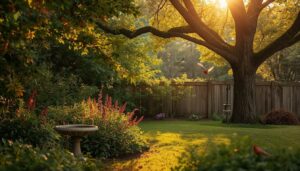
Feeders help, but the real draw is what your yard looks like as a whole.
Birds are always scanning for safe places to eat, rest, nest, and hide — and your habitat either checks those boxes or it doesn’t.
Here’s what you can do to make your backyard genuinely hard to resist.
Native Trees for Shelter and Nesting
Think of your yard as a neighborhood — birds need the right real estate.
Native oaks offer oak cavity habitat where bluebirds and wrens raise young, while pine needle cover from eastern white pines shelters nests through storms.
Dogwood fruit and insects draw hungry nestlings.
Walnut nut provision fuels fledglings, and hackberry bark crevices house woodpeckers.
Dead tree limbs and mature trees matter most.
Berry Shrubs for Fall and Winter Food
Native Berry Species are your yard’s natural pantry. Just as native trees shelter and nest, shrubs like winterberry holly (Ilex verticillata), arrowwood viburnum, and black chokeberry (Aronia melanocarpa) stock the shelves for fall and winter.
Your Fruit Ripening Schedule matters:
- Serviceberry fruits ripen early summer
- Aronia peaks after first frost
- Winterberry holds into deep winter
- Viburnum berries persist through February
Plant in well-drained Planting Soil with full sun for best fruit set. These shrubs deliver serious Winter Energy Value — sugars and fats that keep thrushes and waxwings warm overnight.
Seasonal feeding strategies for backyard birds work best when berry bushes bridge the gap between your bird feeder recommendations for Virginia and the bare months ahead.
Attracting birds with feeder and food choices pairs perfectly with native plants for birds that fruit naturally.
Follow simple Maintenance Pruning Tips — cut stems back after fruiting — and you’ll keep new berry wood coming every season.
Nectar Flowers for Hummingbirds
Want to roll out the welcome mat for a Ruby-throated Hummingbird (Archilochus colubris)? Plant for them.
Coral Honeysuckle, Cardinal Flower (Lobelia cardinalis), and Trumpet Vine offer the tubular blooms hummers can’t resist. Add Penstemon Blooms and Zinnia Plantings for season-long color.
Attracting hummingbirds with nectar plants beats any feeder alone — this bird-friendly landscaping approach keeps nectar-producing flowers blooming from spring through fall; native plants for birds do the real work.
Birdbaths and Clean Water Sources
Birds need water as much as food — don’t overlook it. A shallow basin design, just one to two inches deep, keeps smaller species safe.
Moving water features like submersible pumps deter mosquitoes and draw more visitors.
For bird bath placement, choose shaded spots near shrubs for predator safe placement.
Water quality maintenance means replenishing every two to three days.
Nest Boxes for Cavity Nesters
Installing nest boxes for cavity nesters transforms your Virginia yard into genuine bird habitat.
Keep entrance hole dimensions between 1 and 1.5 inches — small enough to shelter bluebirds and chickadees while blocking starlings.
Box placement height of 6 to 15 feet works best on open poles, with predator guard design attached below.
Choose cedar for material insulation choices, add ventilation strategies near the top, and you’re set.
Brush Piles for Cover and Insects
A brush pile might look like yard waste, but it’s one of the most functional structures you can build for birds.
Stack dead tree limbs into a 10–20 foot mound — large logs as the base, smaller branches on top.
This creates predator refuge zones, insect habitat diversity, and microclimate moisture pockets that shelter beetles and caterpillars.
Follow construction placement tips: keep piles 10 feet from feeders, and do a seasonal debris refresh to maintain structure.
Reducing Pesticides for Healthier Bird Yards
Pesticides quietly undermine everything you’re building for birds. Choosing Organic Soil Amendments and Native Plant Buffers reduces chemical dependency by up to 80% in year one.
Diverse plantings create Beneficial Insect Habitats and Microhabitat Diversity that naturally suppress pests.
When chemicals are unavoidable, practice Bird-safe Pesticide Timing — apply at dusk, away from feeders and water.
Avoiding pesticides for bird-friendly yards is simply the most effective bird-friendly landscaping choice you can make.
Frequently Asked Questions (FAQs)
What are the most common backyard birds in North America?
Step outside on any quiet morning, and you’ll likely spot a Northern Cardinal, Blue Jay, or Mourning Dove.
Seasonal Population Trends and Regional Species Distribution shape which birds visit your Virginia yard throughout the year.
Are there native birds in your backyard?
Yes — and more than you might expect.
Virginia hosts a rich mix of year-round residents and seasonal visitors, each following their own Seasonal Migration Patterns and fitting neatly onto any Native Species Checklist.
What is the most common bird in Virginia?
Citizen science data and survey methodology both point to the same answer: the Northern Cardinal (Cardinalis cardinalis). Cardinal population trends show it topping Virginia bird species checklists year-round, reliably.
What is the difference between backyard birds and fowl birds?
Backyard birds are wild species shaped by nature — free-roaming, seasonally variable, and self-sufficient. Fowl birds are domesticated livestock.
domestication levels, feeding strategies, habitat requirements, and movement patterns define each group entirely.
How many birds are in your backyard?
A typical suburban Virginia yard hosts 5 to 15 species across a year. Morning Activity Peaks reveal the most individuals at once — often 3 to 8 birds of a single species crowding your feeders.
What birds live in backyards?
Ever wonder what’s actually moving through your Virginia yard? Cardinals, crows, wrens, and jays claim it year-round — each shaped by urban adaptations, seasonal plumage shifts, and fierce nest site competition.
What are the best birds to see in your backyard?
Your best bets? The Northern Cardinal, Carolina Chickadee, and Eastern Bluebird.
Song identification and simple birdwatching gear turn these everyday visitors into rewarding family activities, especially when winter survival behaviors bring them close.
What are the most common backyard birds in Virginia?
Virginia’s yards host a reliable cast of characters.
Cardinals, Carolina Wrens, Blue Jays, American Crows, and Chickadees top the bird species checklist for Virginia — familiar faces shaped by seasonal movements, habitat usage, and population dynamics.
How do I identify a bird in my backyard?
Think of each bird as a living puzzle.
Its silhouette outline, tail shape, leg posture, vocal call, and flight pattern are your clues — your personal backyard bird ID chart hiding in plain sight.
What is the most common garden birds?
Citizen science surveys show the Northern Cardinal tops Virginia’s bird species checklist, appearing on 64% of summer checklists. Carolina Wrens, Blue Jays, and American Crows follow closely year-round.
Conclusion
Most people spend thousands on home décor to create "atmosphere"—meanwhile, a ten-dollar suet cake quietly turns your backyard into a five-star habitat that Carolina Wrens actually review favorably.
The common backyard birds of Virginia don’t ask for much: the right food, clean water, a native shrub or two.
Give them that, and you stop being a bystander to migration and start being part of it—one cardinal, one bluebird, one quiet morning at a time.