This site is supported by our readers. We may earn a commission, at no cost to you, if you purchase through links.

Walk past a juvenile hawk and an adult one perched side by side, and you’d be forgiven for thinking they belong to different species entirely. The mottled browns of a young bird’s plumage look nothing like the sharp, defined markings its feathers will eventually carry.
That contrast isn’t cosmetic—it runs down to the microscopic structure of each feather shaft, the density of interlocking barbs, and the way pigments deposit during growth.
Understanding juvenile vs adult bird feathers reveals a precise biological timeline, one that shapes how birds survive, communicate, and ultimately find their place in the flock.
Table Of Contents
- Key Takeaways
- What Defines Juvenile and Adult Feathers?
- Feather Development Stages in Birds
- Appearance: Juvenile Vs Adult Plumage
- Identification Tips for Birdwatchers
- Species Examples: Notable Feather Changes
- Plumage and Bird Behavior
- Conservation and Research Implications
- Frequently Asked Questions (FAQs)
- Conclusion
Key Takeaways
- Juvenile feathers aren’t just duller—they’re structurally weaker, with looser barb connections and narrower shafts that gradually rebuild toward adult strength through each molt cycle.
- That mottled brown camouflage on young birds isn’t random; it’s an active survival strategy that gives way to bold, vivid adult plumage once display and communication matter more than staying hidden.
- A bird’s molt timeline tells you its whole developmental story—small songbirds cycle through in weeks, while a Bald Eagle won’t show its iconic white head until around year five.
- Feather aging isn’t just a birdwatcher’s curiosity; scientists use molt patterns, feather wear, and plumage ratios to track whether endangered species are actually recovering.
What Defines Juvenile and Adult Feathers?
Bird feathers aren’t just feathers — they tell a story about age, survival, and purpose. Juvenile and adult plumage differ in ways that go well beyond color, touching on structure and function too. Here’s what sets them apart.
From dull juvenile browns to the sharp gray-and-black contrast of adults, Clark’s Nutcracker plumage changes reveal how feathers signal age and fitness in ways that go far deeper than color alone.
Feather Structure Differences
Juvenile birds don’t just look different from adults — their feathers are structurally different at nearly every level. Juvenile flight feathers have narrower rachis shapes, lower feather density, and looser barb microstructure, meaning the vane holds together less tightly under stress.
That’s why vane asymmetry is more pronounced in young birds, and why molting patterns gradually rebuild feather function and development toward the sturdy adult standard.
Understanding the basics of feather growth patterns is essential to recognizing these differences.
Color and Pattern Variations
Color tells the whole story of plumage evolution. Feather pigmentation in juveniles leans heavily on earthy browns and muted streaks — think of a young robin’s speckled breast compared to an adult’s vivid red. Pattern diversity shifts dramatically as birds mature, with iridescence effects and bold color morphs replacing juvenile plumage’s camouflage markings. Adult birds wear their plumage differences like a badge. Understanding bird plumage types is essential for identifying these differences.
Functional Roles in Bird Development
Beyond color, feathers serve real jobs at every stage of avian development. In juvenile birds, natal down locks in warmth — holding body temperature steady around 39°C — while early contour feathers cut heat loss as the chick grows.
Feather growth also shapes flight mechanics, with primary feathers reaching roughly 70% adult length by fledging. Plumage differences, then, aren’t just cosmetic; they’re developmental biology in action.
Feather Development Stages in Birds

A bird’s feathers don’t just appear fully formed — they go through a careful, staged journey from the moment a chick hatches. Each phase brings noticeable changes in color, texture, and function that tell you a lot about where a bird is in its life.
Here’s a closer look at the key stages that shape how those feathers develop over time.
Natal Down to Juvenile Transition
Every bird’s feather story begins the same way — wrapped in natal down, soft and fluffed for warmth. As fledgling development progresses, those downy coats give way to true juvenile feathers through a fascinating shift in feather morphology. Here’s how that avian development unfolds:
- Natal down features hookless barbules, providing basic insulation
- Thermal down follows, bridging the gap before juvenile molting begins
- Juvenile feathers emerge from the same follicles around day 20
These molting stages mark real plumage differences you can observe firsthand.
Molting and Feather Replacement
Molting is a bird’s way of rebuilding itself from the outside in, not just shedding. During molting cycles, feather regrowth follows precise replacement patterns: partial molts replace body feathers first, while flight feather replacement often comes later. These molting stages drive plumage renewal systematically, protecting juvenile bird development without sacrificing flight performance.
| Molt Type | Feathers Replaced | Purpose |
|---|---|---|
| Partial Post-Juvenile | Body + coverts | Energy efficiency |
| Complete Post-Breeding | All feathers | Full plumage renewal |
| Flight Feather Molt | Primaries, sequentially | Sustained flight ability |
Timeline From Juvenile to Adult Plumage
The timeline from juvenile to adult plumage varies widely depending on species. Small songbirds complete their juvenile plumage duration in roughly 6 to 10 weeks, entering a multi-year molt sequence that drives age-based color shifts toward vibrant adult tones. Larger birds, like Bald Eagles, follow species-specific maturation rates spanning five years.
Tracking these shifts gets easier when you study a species closely — the Great Crested Flycatcher’s age-based plumage changes offer a textbook example of how molt sequences unfold over multiple seasons.
Seasonal molt timing keeps plumage and moulting aligned with migration, supporting both juvenile bird development and accurate species identification and aging.
Appearance: Juvenile Vs Adult Plumage
One of the easiest ways to tell a juvenile bird from an adult is simply by looking at its feathers. The differences go beyond color alone — they include markings, contrast, and how the whole plumage comes together as a visual package.
Here’s what to look for across three key areas of appearance.
Common Coloration and Markings in Juveniles
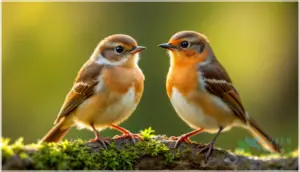
Juvenile plumage is nature’s camouflage kit. Drab brown tones dominate, with pheomelanin producing soft, washed-out feathers across most juvenile birds. Breast streaking styles tend to look blurry rather than crisp, and speckled robin underparts are a classic example. Scaled wing coverts and mottled juvenile tails complete the picture, making bird plumage identification and age determination tricky in the field.
| Juvenile Plumage Feature | Field Marker |
|---|---|
| Breast Streaking Styles | Blurry, diffuse lines |
| Scaled Wing Coverts | Buff-edged, layered look |
Vibrancy and Distinctiveness of Adult Feathers

Adult birds are where the real show begins. Adult pigment richness — from carotenoids producing vivid reds and yellows to deeper melanin-based blacks — makes plumage patterns sharp and unmistakable. Nanostructural colors create iridescent display patches that shift with the light, while ultraviolet plumage signals communicate what human eyes simply can’t detect. Preened feather sheen keeps breeding plumage looking its absolute best.
| Adult Feather Feature | Visual Effect |
|---|---|
| Carotenoid pigmentation | Rich reds, oranges, yellows |
| Nanostructural iridescence | Shimmering blues and greens |
Camouflage Vs Display Functions

Think of plumage as a bird’s shifting strategy — concealment early, communication later. Juvenile plumage relies on Habitat-Based Camouflage, using mottled Plumage Patterns to break outlines against bark or foliage. Breeding Plumage flips that logic, prioritizing Display Visibility Costs for courtship gains. Some Dual-Function Patterns serve both roles. This Ontogenetic Color Roles shift reflects the Ecological Importance of Plumage across life stages.
Plumage begins as camouflage and ends as performance — concealment gives way to communication as a bird matures
| Life Stage | Plumage Function | Predator Avoidance Strategies |
|---|---|---|
| Hatchling | Natal concealment | Stillness, background matching |
| Fledgling | Juvenile Plumage camouflage | Mottled upperparts, late flushing |
| Immature | Transitional patterning | Partial cryptic tones retained |
| Nonbreeding adult | Subdued coloration | Habitat retreat when alarmed |
| Breeding adult | Display Visibility Costs accepted | Open perches, bold posturing |
Identification Tips for Birdwatchers
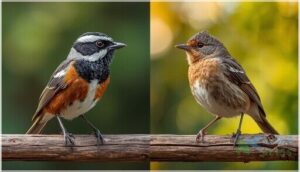
Telling a juvenile apart from an adult bird isn’t always obvious, especially when you’re standing in a field with binoculars and limited time.
A few reliable methods can sharpen your eye and make identification much easier. Here’s what to look for when you’re out watching birds.
Visual Cues to Age Birds in The Field
Aging a bird in the field comes down to reading subtle details. Check for wing covert contrasts — juvenile birds often show pale-brown outer coverts next to fresher, darker inner ones.
Plumage texture cues matter too: juvenile plumage looks loose and baggy, while adult feathers lie flat.
Tail tip shape, feather wear patterns, and eye color changes all sharpen your bird identification techniques considerably.
Behavioral Signs Linked to Feather Maturity
Beyond visual cues, behavior tells its own story. Birds in juvenile plumage trigger fewer Aggression Reduction Behaviors from territory holders — adults simply tolerate them more.
You’ll notice juveniles favoring dense cover, showing cautious Predator Evasion Responses, and emitting begging calls near food.
Adults, by contrast, claim central Roosting Site Choices and display confident Dominance Hierarchy Displays, reflecting fully realized feather development and avian behavior analysis patterns.
Tools and Resources for Feather Comparison
Once you’ve picked up on behavioral cues, the right tools sharpen what you see. Feather Atlas Databases let you match flight feathers from 438 North American species using pattern, color, and size. Mobile ID Apps like Merlin and eBird combine location data for faster Species Recognition.
Illustrated Field Guides show molt sequences in detail, while iNat and Online Citizen Science platforms through Birding Communities and Resources confirm tricky Microscopic Feather Analysis findings through crowd-sourced Bird Identification expertise.
Species Examples: Notable Feather Changes
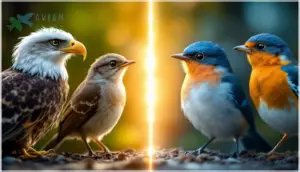
Some birds make it easy to track how much plumage can change over a lifetime. Watching the same species shift from dull, patchy feathers to bold, defined markings is one of the clearest ways to understand what all these stages actually look like in practice.
A few standout examples bring that journey to life.
Raptors (e.g., Eagles, Hawks)
Raptors offer some of the most dramatic feather development stories in the bird world. Take the Bald Eagle — its juvenile feathers start dark and mottled, and the iconic white head doesn’t arrive until around year five.
Red-tailed Hawk aging follows a similar pattern: watch for raptor tail banding, iris color transitions from yellow to red-brown, and gradually broadening wing feather shape through each molt sequence.
Waterfowl and Songbirds
Ducks and songbirds tell their age just as clearly, though in quieter ways. Waterfowl Plumage Ecology and Songbird Plumage Ecology share a common thread: juvenile birds start muted, then grow into bolder adult patterns.
Watch for these Age Clues In Flocks across Aquatic Vs Arboreal Habitats:
- Juvenile waterfowl carry soft down beneath early contour feathers, reducing insulation
- Adult ducks show sharp speculum patches and defined head markings
- Passerines fledge with fluffy, spotted plumage — classic camouflage for forest floors
- Migration-Ready Feathering develops after a partial preformative molt in young songbirds
- Worn, faded feather tips by late summer signal first-year Feather Development in both groups
Unique Cases in Australian Birds
Australia offers some of the most striking feather development patterns in the world. The Superb Fairy-wren contrasts sharply between sexes, with juvenile feathers starting grey-brown before males bloom into vivid blue. Rainbow Bee-eater stages shift from olive-green to radiant adult plumage, while Striated Pardalote molting takes roughly a year. Black Swan darkening and Tawny Frogmouth transitions round out this extraordinary bird development story.
Plumage and Bird Behavior
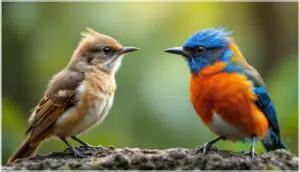
Feathers don’t just keep birds warm or help them fly — they’re also one of nature’s most powerful communication tools. The way a bird looks sends real signals to others around it, shaping everything from who it pairs with to where it’s allowed to feed.
Here’s how plumage drives behavior at each stage of a bird’s life.
Social Signaling and Mate Attraction
Feathers aren’t just for flying — they’re a bird’s resume. Adult breeding plumage functions as a complex communication system, broadcasting mate choice criteria through vivid courtship color signals.
Consider three key ways this works in bird behavior:
- Vibrant carotenoid hues signal male health and foraging ability
- Spotted juvenile deference cues reduce adult aggression during encounters
- Plumage-based status shapes mating rituals and partner selection
Brighter genuinely means better.
Territory Establishment in Adults
When breeding season arrives, adult territory claiming begins well before the first egg is laid. Males use plumage threat displays — fluffed feathers, upward-tilted bills, wing-spread intimidation — to warn rivals without physical conflict. Brighter plumage signals stronger ownership.
Seasonal territory timing peaks in March and April, with habitat territory size varying widely: Red-winged Blackbirds defend roughly 2,000 square meters, while eagles patrol vast open stretches.
Survival Advantages for Juveniles
Juvenile feathers aren’t just a stepping stone to adult plumage — they’re a survival toolkit. Cryptic Juvenile Coloration and Predator Evasion Plumage help young birds disappear into leaf litter, reducing predation risk markedly.
Outline Disruption Benefits blur body edges against backgrounds, while Thermal Insulation Down aids Thermoregulation during vulnerable early weeks.
Energy-Saving Plumage also diverts resources toward muscle growth, giving juveniles a real developmental edge.
Conservation and Research Implications

Feathers don’t just tell a bird’s story — they help scientists tell the story of entire species. By reading plumage, researchers can track population health, spot warning signs early, and measure how well conservation efforts are actually working.
Here’s how aging birds through their feathers plays a critical role in each of these areas.
Aging Birds for Population Studies
Knowing a bird’s age isn’t just satisfying trivia — it’s a cornerstone of population research. Through feather molt limits, primary wear scoring, and stable isotope aging, scientists can sort birds into precise age classes.
Feather generation analysis takes this further, helping researchers apply age-structured modeling to track recruitment, survival, and demographic shifts across avian life cycles — giving conservation teams a clear window into how juvenile birds and adult birds are faring over time.
Monitoring Plumage Changes in Conservation Efforts
Tracking plumage changes in the field has become one of conservation biology’s sharpest tools. Through Camera Nest Monitoring, researchers capture molting in real time — no disturbance, no guesswork. Photographic Molt Analysis then ages juvenile and adult birds accurately across seasons.
Five methods driving modern efforts:
- Plumage Marking Protocols — bleached feather codes identify individual birds across release sites
- Digital Feather Databases — match found feathers to species, age, and gender instantly
- Wing Tag Integration — colored tags expand sighting networks through public reporting
- Photographic Molt Analysis — sequential images track plumage development stage by stage
- Camera Nest Monitoring — continuous footage cuts manual checks by 75 percent
Importance in Tracking Species Recovery
All those monitoring techniques tie directly into something bigger — knowing whether a species is actually bouncing back. Plumage Age Ratios tell you if juvenile birds are entering populations fast enough to matter.
When Recruitment Trend Analysis and Plumage Demographic Modeling align, Recovery Threshold Indicators become reliable.
Juvenile Survival Signals in adult birds’ plumage development confirm what conservation biology and practice needs most: proof that protection is working.
Frequently Asked Questions (FAQs)
Can feather color indicate a birds health status?
Yes, feather color reveals a bird’s health. Carotenoid health signals indicate immune strength, nutritional color deficiencies dull plumage, stress-related fault bars mark trauma, bacterial plumage degradation fades iridescence, and environmental toxin markers embed directly into growing feathers.
Do weather conditions affect feather quality or appearance?
Weather absolutely shapes feather quality. Cold drives Temperature-Driven Insulation changes, heavy rain causes Rain-Induced Feather Damage, and sustained humidity triggers Plumage Darkening — all measurable shifts in avian biology that affect both structure and appearance.
How do birds clean and maintain their feathers daily?
Birds tap their preen gland, run feathers through their bills, splash in water, roll in dust, and sunbathe — each habit locking plumage into peak condition through simple, instinct-driven daily routines.
Are there birds that never develop distinct adult plumage?
Some species never shed their juvenile look. Neotenic island rails keep loose, barbule-lacking juvenile feathers lifelong.
Certain male manakins retain female-like plumage permanently.
These paedomorphic plumage species blur the line between youth and maturity entirely.
Can captivity alter a birds natural plumage development?
Captivity quietly rewires avian biology. Stress, poor nutrition, and artificial lighting all distort natural plumage development — producing dull juvenile feathers, altered wing morphology, and adult feathers that never quite reach their wild potential.
Conclusion
Feathers function far beyond simple flight—they narrate a bird’s entire life story across every molt and marking. Understanding juvenile vs adult bird feathers gives you a sharper lens for reading what each bird carries: its age, its readiness, its place in the natural order.
Watch closely enough, and plumage becomes a language you can learn to interpret. The more you observe, the more the field reveals itself, one feather at a time.