This site is supported by our readers. We may earn a commission, at no cost to you, if you purchase through links.

That scruffy bird at your feeder isn’t sick—it’s rebuilding itself from the inside out. Every late summer, songbirds shed hundreds of feathers in a precisely sequenced biological overhaul, swapping worn, parasite‑riddled plumage for fresh insulation before winter closes in.
The result looks alarming: bald patches, lopsided tails, spiky pin‑feathers poking through bare skin.
Most backyard observers misread these signs as disease or injury and pull their feeders in a panic.
Recognizing molting songbirds in your backyard turns that anxiety into something far more rewarding—a front‑row seat to one of nature’s most underappreciated survival mechanisms.
Table Of Contents
- Key Takeaways
- What is Molting in Songbirds?
- When Do Songbirds Molt in Backyards?
- How to Identify Molting Songbirds
- Differences in Molting by Age and Species
- Step-by-Step Guide to Observing Molting
- Supporting Molting Songbirds at Home
- Frequently Asked Questions (FAQs)
- How do birds act when they’re molting?
- What is the 60/40 rule for birds?
- How do you say "I love you" in bird language?
- What time of year do birds usually molt?
- What are the 4 stages of molting?
- What is the 3 3 3 rule for birds?
- Why put a potato in the bird feeder?
- What bird has 4 genders?
- How long will a bird remember you?
- Which bird has the highest IQ level?
- Conclusion
Key Takeaways
- Molting isn’t a sign of sickness — it’s a tightly sequenced annual overhaul that restores flight efficiency, insulation, and parasite control before winter hits.
- Visual cues like bald patches, mismatched feather colors, and spiky pinfeathers are normal markers of active feather replacement, not injury or disease.
- Age and species shape the molt experience significantly — juveniles retain dull, uniform feathers while adults show asymmetrical gaps and vivid color contrasts between old and new growth.
- You can meaningfully support molting birds by offering high-protein foods, fresh water, dense shrub cover, and minimal disturbance during the late summer peak window.
What is Molting in Songbirds?
Molting is the process by which songbirds shed and replace their feathers on a regular cycle — and understanding it changes how you see every bird at your feeder. It’s not random or messy; it’s a tightly controlled biological system built around survival.
Each species follows its own timing and sequence — dive into the full breakdown of songbird molting patterns and seasonal cycles to see just how precise it gets.
Here’s what’s actually happening, from feather structure to why this annual renewal can’t be skipped.
Definition and Purpose of Molt
Molt is avian biology’s built-in reset button. Once a year, songbirds shed worn feathers and grow fresh ones — a process central to feather integrity, thermoregulation, and parasite control. The molting cycle isn’t random; it reflects deep evolutionary trade-offs. Four core purposes drive feather replacement:
- Restore aerodynamic efficiency
- Rebuild insulation
- Reduce parasite load
- Signal breeding condition
Most songbirds begin their post‑breeding molting period in late summer.
Feather Structure and Renewal
Each feather is a marvel of keratin composition — shaft, barbs, and barbule interlocking to form a lightweight, aerodynamic vane. That structure doesn’t repair itself. Damage is permanent until the follicle growth cycle pushes a new pinfeather through the skin.
The feather insulation function([https://www.scienceofbirds.com/blog/the-parts-of-a-feather-and-how-feathers-work) helps maintain body temperature during molting.
| Component | Function | Fails When |
|---|---|---|
| Rachis | Structural spine | Kinked or snapped |
| Barbules | Vane cohesion | Frayed by wear |
| Follicle | Drives feather growth | Nutritionally stressed |
Why Songbirds Molt Annually
Annual molt isn’t optional — it’s survival math. Keratin wears out, and worn feathers quietly cost songbirds everything: flight efficiency drops, feather insulation weakens, and energy demands climb. Here’s what drives the cycle:
- UV and abrasion degrade primary feathers within months
- Hormonal regulation triggers follicle activity post-breeding
- Climate change impact is shifting molt timing earlier each year
- Feather replacement restores insulation before winter hits
When Do Songbirds Molt in Backyards?
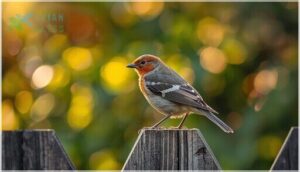
Timing is everything regarding molt — and songbirds have it down to a science.
Most species replace just a handful of feathers at once, a careful strategy explained in detail in this guide to understanding the bird molting process.
Several factors shape exactly when a bird starts swapping feathers, from the season and climate to the demands of breeding and migration. Here’s what drives the schedule.
Seasonal Timing of Molt
Timing is everything. Most backyard birds follow a two-part annual molt cycle built around survival demands.
The post-breeding window opens late July through September, once chicks are independent and energy is freed up.
A quieter pre-breeding pulse follows in late winter, revitalizing head and body feathers before courtship. Migration-linked molt adds another layer — some songbirds pause travel mid-route specifically to replace worn flight feathers.
Influence of Climate and Region
Where you live shapes everything about when your backyard birds molt. Climate and region pull the schedule in surprising directions:
- Latitude color shifts — American Redstarts molting farther north develop richer orange-red tones due to regional carotenoid availability.
- Elevation molt migration — Western warblers move upslope 500+ meters seeking insect-rich moisture during dry summers.
- Urban heat effects — City songbirds start molting earlier but finish later than rural counterparts.
- Temperature-driven timing — Warmer southwestern climates advance postbreeding molt by roughly one day per year.
Breeding and Migration Overlaps
Breeding and migration don’t just overlap — they compete. Post-breeding molt demands serious energy, yet migration-timed feathering can’t wait.
Most North American songbirds resolve this tension by completing their molt between nesting and fall departure, a tight overlap scheduling window.
Late breeders, like certain thrushes, compress that window further.
The energy trade-offs are real: rushing feather growth risks poor aerodynamics, while delaying migration risks arriving late.
How to Identify Molting Songbirds
Once you know molt is happening, the next step is learning to read it on the bird itself. Songbirds leave several reliable visual clues — you just need to know where to look.
Here are the three key signs to watch for.
Visual Signs and Patchy Plumage
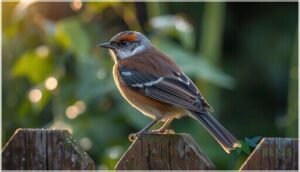
A molting songbird looks like it’s having a bad feather day — and that’s exactly what’s happening.
Watch for body feather gaps on the head and chest, wing edge notches where primaries are missing, and tail length variance between fresh and worn rectrices.
Color contrast blocks — dull old plumage beside rich new growth — define the bird molting process.
That scruffy silhouette is molting patterns doing their job.
Recognizing Pinfeathers and Blood Quills
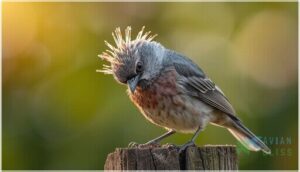
Look closely at your backyard birds and you’ll spot something notable: tiny spike-like pinfeathers emerging from the skin, clustered most thickly around the head and neck.
Sheath coloration tells the story — a waxy white tip, pink base from active blood supply. Blood quill hue runs dark maroon to bluish‑black where feather replacement is underway.
Preening behavior increases around these sensitive areas, carefully managing feather care without damaging live quills.
Symmetry and Molt Patterns

paired wing molt follows a mirrored logic — most songbirds drop the same-numbered primary on each wing within days of each other, keeping flight balanced. Those symmetrical seasonal wing steps along the wing edge are normal.
eccentric molt breaks this slightly in some first-year birds.
Use symmetry age clues: matched wear patterns signal healthy molt cycles; a gap on only one side usually means injury.
Differences in Molting by Age and Species

Not every bird you see molting is going through the same process — age and species shape the whole experience.
A juvenile American Robin sheds its spotted feathers differently than a seasoned adult does, and a resident sparrow follows a different timeline than a long-distance migrant.
Here’s what to look for across the most common patterns you’ll encounter.
Juvenile Vs. Adult Molting Signs
Age tells a vivid story in feather color contrast alone. Juvenile songbirds retain narrow, wear‑prone flight feathers through their first winter, giving wings a uniformly faded, brownish tone — no wing gap patterns, just even but dull primaries.
Adults, mid‑molt, show the opposite: dark fresh feathers mixing with lighter worn ones, symmetrical gaps marking active feather replacement.
Pinfeather sheaths and molt speed variability differ sharply between the two.
Species-Specific Molt Variations
Not every species follows the same script. Chickadees complete a single prebasic molt yearly, while goldfinches add a prealternate cycle that sharpens breeding color.
Some flycatchers skip inner primaries entirely — an incomplete feather replacement pattern tied to habitat-driven molt schedules. Migratory warblers often time molt around departure windows.
Sexual dimorphism means males and females of the same species can look dramatically out of sync.
Common Backyard Songbird Examples
That variation plays out clearly in your own backyard. Watch these five species closely during late summer:
- American Robin — patchy breast, visible wing gaps, fading juvenile spots giving way to adult plumage
- Northern Cardinal — males go temporarily bald, crest drops first, bright red returns by fall
- House Finch — crown thins, red dulls mid-molt, color intensity tied directly to diet
- Black-capped Chickadee — 2,500 feathers replaced in sequence, head first, wings last
- Song Sparrow — juveniles retain worn outer coverts longest, breast streaks blur during patchy phase
Step-by-Step Guide to Observing Molting

Spotting a molting songbird takes more than a quick glance — it rewards a little patience and a consistent routine. Once you know what to look for, your backyard becomes a surprisingly rich classroom.
Here’s how to make the most of every visit to your feeder or birdbath.
Where and How to Watch Birds
To catch molting songbirds in action, position matters more than patience. Place feeders 10–12 feet from dense shrubs — birds need that cover to feel safe. Watch from edges where lawn meets vegetation; that’s where molting patterns are clearest.
| Technique | Why It Works |
|---|---|
| Simple Hide | Reduces flushing, keeps birds relaxed |
| Best Lighting | Sun behind you reveals feather replacement detail |
Quiet observation, neutral clothing, and edge habitat turn your backyard into a classroom.
Photographing and Tracking Changes
Once you’ve found your viewing spot, your camera becomes the real record-keeper. Lens selection matters — a 300–600mm telephoto fills the frame without crowding molting songbirds.
Shoot RAW for feather replacement detail. Store images in dated folders and log metadata consistently.
Temporal comparison across weeks reveals molting patterns clearly. Upload labeled shots to eBird — that’s backyard bird conservation in action.
Noting Behavior and Feather Growth
Watching closely pays off.
A molting songbird’s behavior tells the story its plumage hints at — notice preening frequency spike as birds nibble pinfeather sheaths open, flight adjustments to shorter hops, and energy rest patterns shifting toward midday stillness.
Count feather bar growth rings on shed feathers; each bar marks roughly one day.
These behavioral and structural clues map feather replacement and molting patterns with surprising precision.
Supporting Molting Songbirds at Home

Molting takes real energy — more than most backyard visitors ever let on. The food, water, and calm you provide can make a measurable difference in how well a bird comes through it.
Here’s what actually helps.
Providing Proper Nutrition and Water
Feather replacement burns through protein fast — new feathers are over 90% keratin, so nutrition isn’t optional. Stock your feeders with high-protein seeds, shelled peanuts, and suet cakes to cover that metabolic demand.
Feathers are over 90% keratin, so feeding molting songbirds high-protein seeds isn’t kindness — it’s survival
Live mealworms add calcium and vitamins that support strong shafts.
Don’t forget fresh water access daily, plus grit stations nearby.
Molting songbirds need every advantage you can offer.
Creating a Safe, Low-Stress Environment
Reducing stress during feather replacement is just as important as food. Molting patterns stall when birds feel unsafe — so your backyard setup matters.
- Dense Shrub Cover using native inkberry or rhododendron
- Install Predator‑Proof Feeders with baffles and cage‑style guards
- Create Quiet Resting Areas 10–12 feet from Natural Plant Barriers
- Maintain Stable Temperature Zones with layered evergreen thickets
Songbirds thrive when avian health and bird behavior align with a calm, sheltered space.
Minimizing Disturbances During Molt
Noise management and pet control aren’t optional extras — they’re core molting strategies.
Keep dogs leashed near shrub beds, cats indoors during late summer, and noisy yard work scheduled outside peak molt months.
Place feeders 2–3 meters from cover, and observe through windows or fixed hides.
Respecting human proximity limits protects bird behavior, promotes healthy molting patterns, and reflects genuine wildlife conservation.
Frequently Asked Questions (FAQs)
How do birds act when they’re molting?
Molting birds get quieter, more secretive, and less active.
You’ll notice reduced activity at feeders, increased preening intensity on new pin feathers, and a shift toward dense cover — classic bird behavior patterns during feather replacement and growth.
What is the 60/40 rule for birds?
The 60/40 rule splits bird identification: spend 60% on structure—shape, bill, posture—and 40% on plumage. Structure stays reliable even when songbirds show patchy, uneven feathers during active molt.
How do you say "I love you" in bird language?
Birds say "I love you" through courtship feeding, allopreening rituals, soft contact calls, duet singing, and gift‑giving displays—each behavior a precise, instinct-driven signal of trust, commitment, and partnership between bonded songbirds.
What time of year do birds usually molt?
Most songbirds peak their Molting Season during late summer — July through early September — after the Breeding Season ends.
Spring Partial molts refresh Plumage before courtship, while Latitude Shifts and Climate Change Effects increasingly reshape these Migratory Schedule-linked Molting Patterns.
What are the 4 stages of molting?
Think of it as a four-act story: Feather Growth, Active Shedding, Replacement and Expansion, then Stabilization and Wear — each stage driven by hormonal control and shaping distinct bird molting patterns from start to finish.
What is the 3 3 3 rule for birds?
The 3-3-3 rule means watching one bird for 3 minutes, staying 3 meters away, and recording 3 distinct features — a simple habit that sharpens your eye for molting patterns and feather growth.
Why put a potato in the bird feeder?
Cooked potato is a calorie boost hiding in plain sight. It delivers vitamin C, easy digestion, and winter energy — fueling feather growth during molting without taxing already-stressed songbirds.
What bird has 4 genders?
The white-throated sparrow (Zonotrichia albicollis) is often called the "four-gender bird."
Its supergene morphs produce four distinct types — white-striped and tan-striped males and females — each with unique color-morph behavior and disassortative pairing strategies.
How long will a bird remember you?
depends on the species.
Common backyard songbirds may remember your routine for several months, while crows can recall specific individuals for over a decade. Interaction frequency and emotional impact shape memory span substantially.
Which bird has the highest IQ level?
African grey parrots and New Caledonian crows top the charts.
African greys master language and concepts; New Caledonian crows rival apes in tool-use intelligence.
Corvid brain size alone signals impressive avian biology.
Conclusion
Feathers fall, but knowledge fills the gap they leave behind. Recognizing molting songbirds in your backyard reframes every bald patch and bristling pin-feather as evidence of biological precision, not distress. You’re no longer watching a sick bird—you’re witnessing a survival system refined over millions of years.
Keep your feeders stocked, your disturbances minimal, and your observations sharp. The birds doing the hard work of renewal deserve a backyard that quietly, competently helps them.