This site is supported by our readers. We may earn a commission, at no cost to you, if you purchase through links.
Your binoculars lock onto a bird in the hedgerow: brown, streaky, eye stripe, flicking its tail. Song Sparrow? Savannah Sparrow? In that moment, every little brown bird feels like a trick question.
The good news is that songbirds rarely hide their identity; they advertise it in their body shape, bill design, plumage patterns, behavior, and voice. When you learn to read those clues together, lookalikes start to fall into place.
Soon you won’t just identify similar songbird species—you’ll notice the subtle details that make each one feel distinct and familiar. That’s when birding starts to feel deeply personal and rewarding.
Table Of Contents
- Key Takeaways
- Key Features for Identifying Songbirds
- Comparing Similar Songbird Species
- Distinguishing Songs and Calls
- Habitat and Range Considerations
- Tips for Accurate Songbird Identification
- Frequently Asked Questions (FAQs)
- What are some common songbirds?
- Which is the best bird song identifier?
- How do juvenile songbirds differ from adults?
- Can weather conditions affect songbird identification?
- How does molting change a songbirds appearance?
- Do songbirds look different across geographic regions?
- How reliable is color alone for species identification?
- Conclusion
Key Takeaways
- A bird’s body shape, bill design, plumage patterns, behavior, and song work together as a complete ID system — relying on just one clue will trip you up.
- Behavioral cues like tail flicking, wing quivering, and foraging posture are field marks in motion, often as reliable as color or pattern.
- Lookalike species like Song Sparrow vs. Savannah Sparrow come apart quickly once you stack habitat preference, call style, and one or two subtle physical details side by side.
- Training your eyes and ears together — syncing wing flashes with calls, noting seasonal song changes, and logging field notes — is what turns occasional lucky IDs into consistent, confident birding.
Key Features for Identifying Songbirds
Spotting the differences between songbirds can feel tricky at first, but there are a few key clues to watch for. If you know what to look for, you’ll start noticing patterns that make identification easier.
For a deeper dive into subtle plumage changes and molt patterns, see this guide on recognizing molting backyard songbirds.
Let’s break down the main features that help you tell one species from another.
Body Size and Shape Differences
Even before you catch a bird’s song, size and shape give you solid clues. Check the wing-to-body ratio—long wings mean open fields, short wings signal forest dwellers.
Notice tail length proportion and leg length variance; these reveal perching or ground‑foraging habits. Crest height impact and body mass index help with species comparison and pinpointing field marks.
- Tail length proportion highlights plumage patterns
- Crest height impact adds to Bird Identification Techniques
- Leg length variance informs Birdwatching Tips
Bill Shape and Feeding Habits
Bill shape is basically a bird’s lunchbox — it tells you exactly what’s on the menu.
A bird’s bill is nature’s menu — shape reveals diet at a glance
Cone-shaped seeders like finches and cardinals crack tough shells effortlessly. Long probing bills slip into bark and blossoms. Sturdy digging bills muscle through soil for beetles. Flat aerial catchers snatch bugs mid‑flight. Thin nectar probers fit perfectly into tubular flowers — nature’s straws. Spot the bill, crack the species.
cone‑shaped seed crackers are the most common bill type worldwide, perfectly adapted for cracking seeds.
Color Patterns and Plumage Markers
Spotting a songbird’s plumage patterns is like reading a secret code. For instance, Wing Bar Variations and Crown Stripe Patterns can separate lookalikes quickly. Supercilium Contrast and Iridescent Feather Zones shine in sunlight, while Seasonal Plumage Shifts keep you guessing year‑round. Field marks are your bread and butter for species comparison in birdwatching and songbird identification.
- Wing Bar Variations
- Supercilium Contrast
- Seasonal Plumage Shifts
Remember that wingbars are stripes across the folded wing are a key field mark for identification.
Behavioral Cues and Movements
Just as plumage patterns tell their story, bird behavior offers field marks in motion. Watch for Tail Flicking and Perch Bobbing—these signal alertness and balance.
Wing Quivering often pairs with bird vocalization, while Foraging Posture reveals feeding style. Social Synchronization in flocks is a clue to migration patterns and habitat clues.
Here’s a quick comparison:
| Behavior | What to Look For | Why It Matters |
|---|---|---|
| Tail Flicking | Quick tail moves | Alertness, balance |
| Wing Quivering | Subtle wing shakes | Song, alarm signals |
| Perch Bobbing | Body tilts | Foraging, stability |
| Foraging Posture | Feeding stance | Diet, habitat clues |
| Social Sync | Group movement | Migration patterns |
Comparing Similar Songbird Species
songbirds look so much alike, it’s easy to mix them up at first glance.
A handy way to sort them out is this detailed songbird comparison chart guide, which highlights key visual differences.
Knowing what sets them apart can make spotting the right species a lot more fun.
Let’s walk through few pairs that often confuse even seasoned birdwatchers.
American Robin Vs. Eastern Bluebird
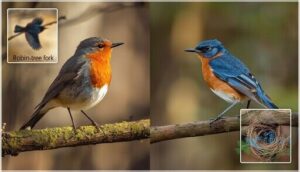
Ever notice how a bright orange breast color contrast stands out against a dark gray back? That’s your American Robin. Eastern Bluebirds, in comparison, sport a vivid blue back and a softer orange chest.
Watch their wing beat rhythm and tail shape in flight—robins look rounder, bluebirds flatter. Listen for distinct bird vocalization and check nesting site preference for reliable field marks.
House Finch Vs. Purple Finch
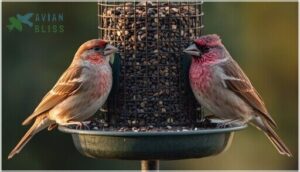
fool even experienced birders. The House Finch shows rosy red streaking across its face and chest, while the Purple Finch looks like it was dipped in raspberry juice—richer, deeper color overall. field marks during seasonal plumage shifts:
- House Finch: streaky brown sides, slender build
- Purple Finch: cleaner white belly, stockier frame
- Feeding aggression often reveals territorial displays at feeders
Song Sparrow Vs. Savannah Sparrow
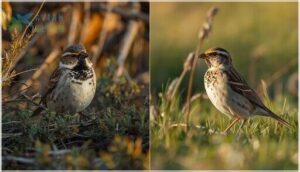
When you compare Song Sparrow and Savannah Sparrow side by side, subtle field marks make all the difference. Song Sparrows look chunkier, with bold streaks and a central breast spot, while Savannah Sparrows show a slimmer build, a yellow eyebrow, and finer streaks. Pay attention to Habitat Preference, Migration Timing, and bird vocalization—these cues sharpen your songbird identification skills.
| Feature | Song Sparrow | Savannah Sparrow |
|---|---|---|
| Field Marks | Bold streaks, spot | Finer streaks, yellow eyebrow |
| Habitat Preference | Thickets, brush | Grasslands, open fields |
| Winter Plumage | Streaky, brown | Pale, crisp streaks |
| Nesting Sites | Low shrubs, ground | Ground, grasses |
| Territorial Calls | Complex, varied | High, insect-like |
Northern Cardinal Vs. Pyrrhuloxia
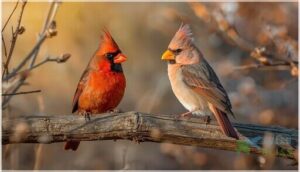
Think all bright red birds are cardinals? Not quite—Pyrrhuloxia throws a curveball.
Notice Crest Morphology: the Northern Cardinal’s tall, pointed crest versus Pyrrhuloxia’s shaggier style. Bill Curvature tells another story—Pyrrhuloxia has a hefty, parrot-like bill.
In winter plumage, cardinals keep their bold reds, while Pyrrhuloxia fades gray.
Range Overlap is limited, but vocalizations and territorial displays also help with species comparison.
Distinguishing Songs and Calls
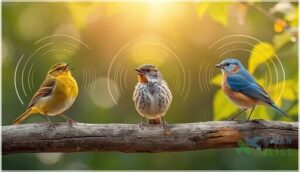
In the case of songbirds, listening can be just as important as looking. Their voices hold clues that help you tell one species from another. Let’s explore some ways you can use songs and calls to sharpen your identification skills.
Unique Vocal Signatures
What sets one bird’s song apart from another? It’s all in the details: Formant Patterns shape the color of each note, Rhythm Tempo marks a steady beat, and Pitch Contour draws the melody’s ups and downs. Syllable Cadence and Amplitude Dynamics add flair.
Mastering these traits turns Bird Songs and Calls into your best tools for songbird identification.
Mimicry in Songbirds
mockingbird weave a medley of neighbor calls into its song? That’s Mimicry Evolution in action—one of the most fascinating bird behaviors you’ll encounter.
For species comparison and songbird identification, watch for these mimicry clues:
- Predator Deterrence
- Cognitive Benefits
- Territory Expansion
- Seasonal repertoire shifts
- Acoustic blending for songbird conservation and ornithology studies
Seasonal Changes in Songs
Songs shift with the seasons just like your wardrobe does. Spring Dawn Chorus kicks off loudly and layered as males compete for territory. Summer Heat Silence rolls in by afternoon. Fall Migration Calls grow shorter, conserving energy. Winter Frost Timbre turns clipped and sharp.
| Season | Song Trait | Humidity Resonance Shift |
|---|---|---|
| Spring | Long, complex territorial bursts | High moisture amplifies range |
| Summer | Reduced midday output | Heat suppresses resonance |
| Fall | Short migration contact calls | Drier air limits carry |
| Winter | Sharp, repetitive warning notes | Cold flattens song projection |
Tracking these patterns sharpens your songbird identification instincts considerably.
Using Apps and Field Guides for Audio ID
When seasonal shifts muddle bird songs, apps like Merlin and BirdNET step in with Spectrogram Interpretation and Confidence Scoring.
Offline Sound Libraries let you study Bird Songs anywhere, while Community Verification adds trust.
Regional Song Databases update bird ID accuracy.
Field guides link audio to field marks, making birdwatching easier—especially when songbird identification gets tricky in overlapping habitats.
Habitat and Range Considerations
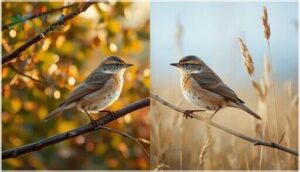
Where you spot a songbird can tell you a lot about its identity.
Habitat and range play a big role, especially when birds look alike or share regions.
Let’s take a closer look at how location and movement can help you sort out similar species.
Regional Overlaps and Lookalike Species
Although lookalikes can feel frustrating, regional overlap sharpens songbird identification skills. When species share a Range Habitat, focus on:
- Fine field marks and plumage patterns—tiny Plumage Variations on wings, tail, or face.
- Vocal Distinctions; similar birds tweak tempo and notes when interaction zones form.
- Habitat clues, Seasonal Overlap Shifts, and Microhabitat Preferences for species comparison and identification.
Urban Vs. Rural Songbirds
overlap zones get even trickier once you compare city blocks to farm fields.
In urban birdwatching, Noise Adaptation, bold Bird Behavior and Ecology, and different Perch Selection stand out.
Rural birds face higher Predator Pressure, less Diet Flexibility, and later Breeding Timing.
Use these habitat clues for Species Comparison and Identification across Habitat and Migration Patterns in your region.
Migration Patterns Affecting Identification
When spring bird migration ramps up, you’ll see migration patterns scramble your usual Songbird Identification cues.
Elevational Migration Shifts and Stopover Habitat Changes reshuffle which birds appear where.
Plumage Molt Timing, Seasonal Vocal Adaptations, and Mixed‑Species Flock Dynamics blur field marks.
Studying Habitat and Migration Patterns, plus broader avian migration and behavior, keeps you oriented during intense bird migration waves.
Tips for Accurate Songbird Identification

Accurately telling similar songbirds apart comes down to how you look, listen, and keep track.
The next few tips will give you a simple structure to practice all three.
Use them as a checklist as you move through the list below and compare each species.
Using Comparison Charts Effectively
well-built songbird comparison chart cuts through confusion fast.
Keep your chart layout clean — three to five species max — and use color coding to match plumage patterns at a glance.
Consistent axis scaling prevents misleading size comparisons, while interactive tooltips reveal habitat clues and data source transparency on demand.
That’s what makes bird species identification actually stick.
Observing in Different Lighting and Seasons
- From Spring dawn lighting to Winter low sun, you ride changing light to sharpen bird species identification year-round.
- Notice Dappled shade effects in forest bird habitats, where Seasonal plumage contrast and fine plumage patterns highlight habitat clues.
- With Sunset silhouette ID at dusk and awareness of migration patterns, you compare shapes and flight styles to confirm tricky lookalikes each season.
Recording Field Notes and Photos
Treat every outing like a mini research trip: note Observation Timing, weather, and behavior, then match each entry to photos using clear Photo Naming and simple Metadata Standards.
Add GPS Tagging, Lighting Techniques, and key field marks to sharpen songbird identification.
These habits turn casual Birdwatching and Tourism into serious Bird Species Identification—practical Bird Watching Tips that upgrade everyday Bird-ID.
Integrating Visual and Auditory Cues
Think of songbirds identification as training your brain to sync Sight with Sounds & Songs. When Wing flash cues or Head tilt signals match a phrase, that’s Cross‑modal timing and Spatial cue alignment working together for faster Bird ID.
Use a tiny Multisensory checklist on every walk:
- link flashes to Bird Species Identification
- pair calls with perches, Birdwatching Tips
- practice
Frequently Asked Questions (FAQs)
What are some common songbirds?
Common songbirds you’ll see include American Robin, Eastern Bluebird, House Finch, Song Sparrow, and Northern Cardinal.
Urban feeder favorites, Backyard nesting species, Migratory stopover birds showing Seasonal plumage shifts and Regional color variations in parks and neighborhoods.
Which is the best bird song identifier?
Merlin Bird ID is the bird song identifier.
It offers Real-time analysis, Database breadth, Offline mode, UI design, Noise reduction, songbird comparison chart tools, and guidance for Bird Identification and Conservation, Ornithology, Avian Species, Songbird Conservation.
How do juvenile songbirds differ from adults?
Like sketches beside paintings, juveniles show softer shapes, drabber plumage, Gape Size, Feather Softness, shaky learning flight, and Vocal Practice.
Molting Stages with a songbird comparison chart sharpens bird identification, ornithology, and avian species birdwatching.
Can weather conditions affect songbird identification?
Yes, weather affects identification: Wind noise impact, Rain visibility reduction, Snow contrast boost, Temperature vocal shifts, and Fog auditory clarity reshape birdwatching, ornithology, avian ecology, migration patterns, and how you use a songbird comparison chart.
How does molting change a songbirds appearance?
During complete molt, all body feathers renew: Feather color shift, Plumage texture change, Wing shape changes, Tail length variation, and Body silhouette.
These changes make Bird Identification of songbirds, bird species challenge avian biology, ornithology and research.
Do songbirds look different across geographic regions?
In regions, songbirds show geographic variation in bird species; Molt Timing, Altitude Adaptations, Local Diet Influence, Pigment Variation, and Seasonal Color Shifts reshape appearance.
Bird identification uses ornithology and bird research on avian migration and behavior.
How reliable is color alone for species identification?
Appearances deceive; color identifies bird species and songbirds, but lighting effects, color perception bias, seasonal molt, geographic variation, and UV reflectance mislead.
Ornithology and bird research, birdwatching and tourism, avian science and research use cues, not color.
Conclusion
The theory holds true: the more you look, the more you see. Every birder who once stared blankly at a streaky brown sparrow eventually reached the moment when the pieces clicked.
Body shape, bill, behavior, song—none of it feels overwhelming once you’ve trained your eye to read the whole picture. When you learn to identify similar songbird species through layered observation, the hedgerow stops being a puzzle and starts feeling like a conversation you finally know how to join.
- https://en.wikipedia.org/wiki/Bird
- https://wordpress-1344453-4933761.cloudwaysapps.com/types-of-singing-birds/
- https://www.allaboutbirds.org/guide/American_Robin/overview
- https://www.reconnectwithnature.org/news-events/the-buzz/difference-between-house-finch-vs-purple-finch/
- https://animaldiversity.org/accounts/Cardinalis_cardinalis/