This site is supported by our readers. We may earn a commission, at no cost to you, if you purchase through links.

Most people grab whatever binoculars are on sale and wonder why their arms tire out after twenty minutes or their eyes strain trying to hold a blurry image steady. For seniors, that frustration compounds fast—a pair that’s too heavy, too stiff, or built without adequate eye relief can turn a peaceful morning of birdwatching into a headache.
The right binoculars for seniors balance weight, optical clarity, and ergonomics in ways that make a genuine difference over hours of use. These seven models were chosen because they solve real problems, not because they look good on a spec sheet.
Table Of Contents
- Key Takeaways
- 7 Best Binoculars for Seniors
- Key Features Seniors Need
- Best Magnification for Older Eyes
- Choosing by Activity and Use
- Comparing Budget, Comfort, and Value
- Frequently Asked Questions (FAQs)
- Can you use binoculars with astigmatism?
- How much should I pay for a good pair of binoculars?
- What are the best binoculars for the average person?
- Can binoculars help with macular degeneration or low vision?
- How do I clean binocular lenses safely at home?
- Should seniors use a neck strap or harness?
- How long do quality binoculars typically last?
- Are refurbished binoculars a reliable option for seniors?
- Conclusion
Key Takeaways
- Eye relief of 15–18 mm and twist-up eyecups aren’t just nice-to-haves—they’re what separates a comfortable morning of birdwatching from one that ends with a headache.
- The 8×42 configuration hits the sweet spot for most seniors: stable enough to hold by hand, bright enough for dawn light, and light enough that your arms won’t give out before the birds do.
- Weight is the feature most buyers underestimate—anything over 700 g will wear on you within 20–30 minutes, so magnesium-alloy or open-bridge designs aren’t just marketing terms.
- You don’t need to spend $1,000 to get genuinely good glass—the $174–$420 range covers waterproofing, ED optics, and lifetime warranties that hold up in real-world conditions.
7 Best Binoculars for Seniors
Not all binoculars are built with seniors in mind, but the seven options below genuinely are.
Each one was chosen for the qualities that actually matter on a morning walk—light weight, easy grip, and clear optics—as covered in this guide to bird watching binoculars for seniors.
Each one earns its spot based on real specs — weight, eye relief, grip, and optical quality — not just brand recognition.
Here’s what made the cut.
1. Nikon Monarch HG 8x42mm Binocular
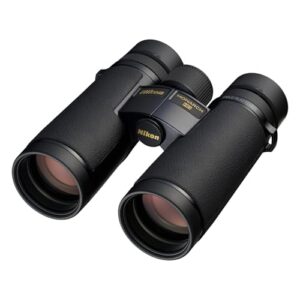
If you want one binocular that covers nearly everything, the Nikon Monarch HG 8×42 is hard to beat.
Its magnesium-alloy chassis keeps weight at just 1.5 lb, so your arms won’t tire during a long morning of birdwatching. The 17.8 mm eye relief means eyeglass wearers get the full picture — no squinting, no clipping.
ED glass and dielectric-coated prisms deliver sharp, color-accurate images even at dusk. The locking diopter and turn-and-slide eyecups make setup quick and personal.
| Best For | Birders, hikers, and wildlife watchers who want premium optics in a lightweight, all-weather package and don’t mind paying for quality. |
|---|---|
| Magnification | 8× |
| Objective Lens | 42 mm |
| Waterproof | Yes, 5m immersion |
| Fog-Proof | Yes, to 5000m |
| Lens Coating | Fully multi-coated, dielectric |
| Eye Relief | Long eye-relief |
| Additional Features |
|
- Edge-to-edge sharpness with ED glass and dielectric coatings — colors stay true even in low light
- Lightweight magnesium body at just 1.5 lb makes it easy to carry all day
- Fully waterproof and fog-proof, so it handles anything from mountain hikes to rainy mornings in the field
- At ~$979, it’s a serious investment that won’t suit every budget
- Lens caps insert into the tubes rather than flipping over, which can feel fiddly in the field
- Compared to top-tier rivals like the Swarovski SLC, the focus wheel feels slightly less smooth and chromatic aberration is a touch more noticeable
2. Celestron Nature DX ED Binoculars
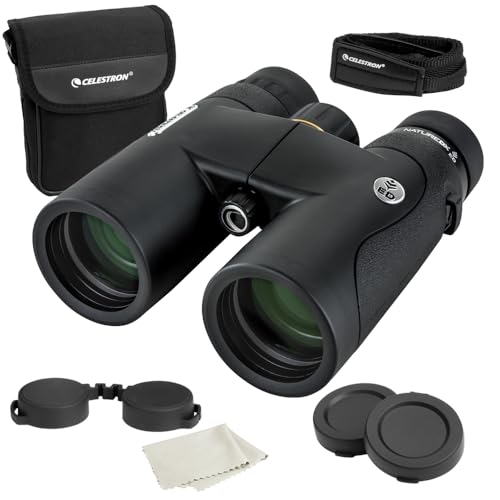
The Nikon sets a high bar, but the Celestron Nature DX ED punches well above its $199 price tag. ED glass keeps colors sharp and edges clean, while fully multi-coated optics with phase-corrected BaK-4 prisms push light transmission high enough for solid dawn-and-dusk performance.
Twist-up eyecups accommodate glasses wearers comfortably.
One honest caveat: at 950 g, it’s heavier than ideal for long sessions — your arms will notice. A tripod adapter thread helps when steadiness matters most.
| Best For | Birdwatchers, wildlife observers, and outdoor enthusiasts who want quality low-light performance without spending a fortune. |
|---|---|
| Magnification | 8× |
| Objective Lens | 42 mm |
| Waterproof | Yes, nitrogen-purged |
| Fog-Proof | Yes, nitrogen-purged |
| Lens Coating | Fully multi-coated, dielectric |
| Eye Relief | Twist-up eyecups |
| Additional Features |
|
- ED glass and phase-coated BaK-4 prisms deliver sharp, color-accurate images even at dawn or dusk
- Weather-sealed and nitrogen-purged, so rain, fog, or humidity won’t slow you down
- Built-in tripod adapter thread is a handy bonus for steady, extended viewing sessions
- At 950 g, it’s on the heavier side — long handheld sessions will wear on your arms
- Some users report loose eyecups and a tripod plate that can come free under stress
- Less ergonomic than premium models, which can mean more fiddling with focus over time
3. Athlon Optics Midas G2 UHD Binoculars
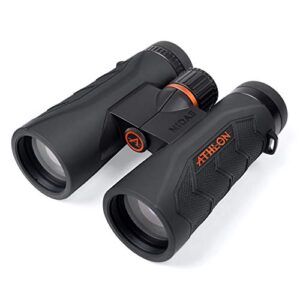
If weight is something you’re watching, the Athlon Optics Midas G2 UHD is worth a close look. At 680 g, it’s noticeably lighter than the Celestron and easier to hold steady on long outings.
The magnesium chassis keeps it rugged without the bulk. UHD glass paired with ED optics and ESP dielectric coatings delivers bright, true-color images — even in dim morning light.
Twist-out eyecups and generous eye relief make it genuinely comfortable for glasses wearers.
| Best For | Birders, hunters, and outdoor enthusiasts who want sharp, true-color optics in a durable but relatively lightweight package — especially those who wear glasses. |
|---|---|
| Magnification | 8× |
| Objective Lens | 42 mm |
| Waterproof | Yes, weather-resistant |
| Fog-Proof | Yes |
| Lens Coating | ESP dielectric coating |
| Eye Relief | Twist-out eyecups |
| Additional Features |
|
- UHD glass with ED optics and ESP dielectric coatings gives you bright, accurate colors even in low light
- Magnesium alloy body is tough and light without feeling cheap
- Twist-out eyecups and generous eye relief make long sessions comfortable for glasses wearers
- At 24 oz, it can still tire your arms out on a full day in the field
- Narrower field of view compared to lower-magnification options makes scanning wide-open spaces a bit trickier
- Users with a shorter inter-ocular distance may need to fiddle with the objective cap rings to dial in proper eye relief
4. ZEISS Terra ED Binoculars
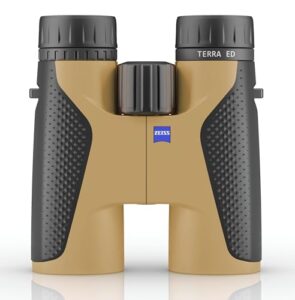
Step up to the ZEISS Terra ED 8×42, and you’ll notice the difference almost immediately. SCHOTT ED glass keeps colors true and edges sharp, while the hydrophobic multicoating shrugs off rain without smearing your view.
At 695 g, it stays comfortable during longer outings.
The large focusing wheel responds quickly with just one finger — no fumbling.
Nitrogen-filled and waterproof, it deals with whatever the weather throws at it.
At $419.99, it earns its price.
| Best For | Birdwatchers, hunters, and wildlife enthusiasts who want premium optics that hold up in tough conditions without being too bulky to carry all day. |
|---|---|
| Magnification | 8× |
| Objective Lens | 42 mm |
| Waterproof | Yes, nitrogen-filled |
| Fog-Proof | Yes, nitrogen-filled |
| Lens Coating | Anti-reflective, hydrophobic |
| Eye Relief | Standard eyecups |
| Additional Features |
|
- ZEISS ED glass with 88% light transmission gives you bright, color-accurate views even in low light — dawn and dusk included.
- Fully waterproof and nitrogen-filled, so rain, fog, and humidity just aren’t a problem.
- The large focusing wheel is fast and easy to use with one finger, even with gloves on.
- The hard case doesn’t fit the strap, which makes quick access more annoying than it should be.
- Objective lens caps are fixed to the body and come with no real instructions — a minor but noticeable oversight.
- Some chromatic aberration creeps in at the edges, and the close-focus distance is on the longer side.
5. Carson RD Waterproof 8×42 Binoculars
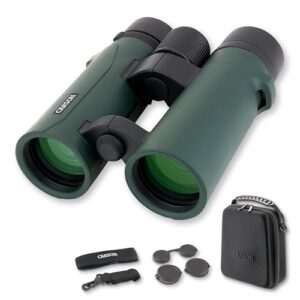
At $174.99, the Carson RD 8×42 punches well above its price. Its open-bridge design keeps the weight down to just 1.4 lb, so your arms won’t tire during a long morning at the bird feeder.
Pair it with a solid field reference like this guide to common birds in North Carolina and you’ll spend less time squinting at pages, more time watching.
The 17 mm eye relief and twist-down eyecups work with your glasses, not against them.
BAK-4 prisms and fully multi-coated lenses deliver bright, sharp views, and the nitrogen-filled, O-ring sealed body manages rain without hesitation.
Tripod-mountable, too — a nice bonus for steadier hands.
| Best For | Birders, hikers, and casual wildlife watchers who want solid full-size optics without spending a fortune. |
|---|---|
| Magnification | 8× |
| Objective Lens | 42 mm |
| Waterproof | Yes, O-ring sealed |
| Fog-Proof | Yes, nitrogen-filled |
| Lens Coating | Fully multi-coated |
| Eye Relief | 17 mm |
| Additional Features |
|
- Lightweight at 1.4 lb with a wide 372 ft field of view — easy to carry and quick to pan
- Waterproof and fog-proof build handles rain and mist without missing a beat
- 17 mm eye relief and twist-down eyecups make it genuinely comfortable for glasses wearers
- The soft case feels cheap — zippers are weak and there’s no belt loop for field carry
- The eye relief adjustment knob is loose and can slip out of position
- Optics are good for the price but won’t match premium glass in low light or edge sharpness
6. Xgazer 8×42 Ultra HD Binoculars
Xgazer 8×42 Ultra HD sits at $179 — a reasonable ask for what it delivers.
Multi-coated lenses cut glare and pull in enough light for early-morning birdwatching, while the 426 ft field of view at 1,000 yards gives you plenty of room to track a moving subject without losing it.
Twist-up eyecups and smooth diopter adjustment make it glasses-friendly.
Just know it runs heavier at 1.11 kg, so shorter sessions suit it better than all-day carries.
| Best For | Birders, wildlife watchers, and outdoor enthusiasts who want sharp, weather-ready optics without spending a fortune. |
|---|---|
| Magnification | 8× |
| Objective Lens | 42 mm |
| Waterproof | Yes, O-ring sealed |
| Fog-Proof | Yes, gas-purged |
| Lens Coating | Anti-reflective Certvision |
| Eye Relief | Standard eyecups |
| Additional Features |
|
- Crystal-clear images thanks to the anti-reflective Certvision coating — great in low light or early morning
- Fully weatherproof build handles rain, mist, and fog without missing a beat
- Comes with everything you need right out of the box — case, strap, rain guard, and more
- At 1.11 kg, it’s on the heavier side and can wear on your arms during long outings
- Fixed 8× magnification won’t cut it if you need serious reach for very distant subjects
- Some users have run into focusing imbalance over time, and warranty support can be slow to respond
7. Vortex Diamondback HD 8×42 Binoculars
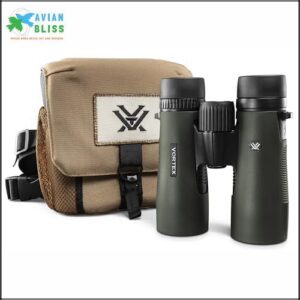
At just 227 g, the Vortex Diamondback HD 8×42 is remarkably light for a full-size binocular — your arms won’t notice it after an hour on the trail.
HD optics with dielectric and phase-corrected roof prism coatings deliver sharp, color-accurate images even at dawn or dusk.
Twist-up eyecups, argon purging, and O-ring sealing check every practical box.
The real closer? Vortex’s unconditional lifetime warranty covers defects without questions asked — solid peace of mind for any long-term investment.
| Best For | Outdoor enthusiasts — birders, hunters, and hikers — who want lightweight, high-quality optics they can rely on in any weather. |
|---|---|
| Magnification | 8× |
| Objective Lens | 42 mm |
| Waterproof | Yes, O-ring sealed |
| Fog-Proof | Yes, argon-purged |
| Lens Coating | Fully multi-coated, dielectric |
| Eye Relief | Twist-up eyecups |
| Additional Features |
|
- Sharp, bright images even in low light thanks to HD glass and dielectric coatings
- At just 227g, it’s easy to carry all day without arm fatigue
- Vortex’s unconditional lifetime warranty means you’re covered, no questions asked
- The focus wheel is very sensitive, which can make fine-tuning between distances a little fiddly
- The included soft case doesn’t feel as tough as the binoculars themselves
- Warranty won’t cover loss, theft, or purely cosmetic wear
Key Features Seniors Need
Not every binocular is built with seniors in mind, and the difference really shows once you’re out in the field. A few key features can make the gap between an enjoyable outing and a frustrating one.
Here’s what to look for before you buy.
Lightweight Design and Portability
Carrying heavy gear all day will wear you out fast—and that’s exactly what the lightweight design prevents.
Look for a Magnesium Alloy Body or Carbon Fiber Construction, since both cut weight by 20–40% without sacrificing durability.
A Low Center Gravity and Compact Foldable Form make portable optics easy to hold steady, while a Quick-Release Neck Strap keeps compact binoculars comfortable for hours.
Ergonomic Grip and Handling
good grip makes the difference between steady viewing and shaky frustration.
Look for an Anatomical Grip Shape with a Non-slip Textured Surface, rubberized panels and weather-resistant grip material keep control firm even with damp or gloved hands.
Balanced Weight Distribution reduces wrist strain, while an Adjustable Thumb Rest locks your hold naturally, making the ergonomic design feel like an extension of your hand.
Choosing ergonomic grips reduces hand fatigue during extended use.
Easy Focus Mechanisms
A stiff or sluggish focus wheel turns a peaceful birding moment into a frustrating fumble. That’s why easy focus mechanisms matter so much.
A rubberized focus knob with smooth focus throw lets you lock onto subjects quickly, while the internal focusing design keeps balance consistent as you adjust.
The central focus wheel operates both eyes together, and individual diopter rings fine-tune each eye separately with fine-tuning tolerance that accommodates prescription differences.
Eye Relief for Eyeglass Wearers
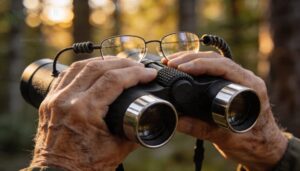
If you wear glasses, eye relief for eyeglass wearers isn’t optional — it’s the difference between a clear view and a dark ring around the edge. Look for at least 15–18 mm of Extended Eye Relief and glasses-friendly eyecups with twist-up Adjustable Eyecups that fold down instantly.
Proper Glasses Frame Clearance, Pupil Alignment, and Comfort Distance keep ergonomic design considerations for elderly users front and center.
Brightness and Optical Clarity
Clear optics matter more than most people realize — especially at dusk or in shade. ED Glass Clarity and Prism Transmission Efficiency determine how much detail actually reaches your eyes.
- Light Gathering Power increases with fully multicoated lenses, pushing transmission above 90%
- ExtraLow Dispersion ED glass delivers Chromatic Aberration Reduction, keeping colors clean
- Contrast Preservation sharpens edges in busy scenes
- High contrast imaging helps track birds against bright sky
- Low light performance extends your viewing into golden-hour conditions
Tripod-ready Stability Options
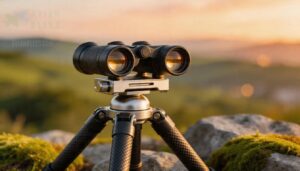
Even the sharpest optics won’t help much if your hands are shaking. That’s where a tripod changes everything — especially with hand tremor.
Carbon Fiber Legs absorb vibration without adding bulk, while a Center Column Lock stops creeping mid-view.
Arca Swiss Plate makes mounting fast, and Ball Head Precision lets you pan smoothly.
Vibration Damping Ballast and image stabilization benefits for shaky hands become immediately noticeable.
Best Magnification for Older Eyes
Picking the right magnification isn’t just a spec-sheet decision — it can make or break your whole experience out in the field. Too much power, and every little hand tremor turns into a shaky mess; too little and you’re squinting at distant birds wondering what you’re even looking at.
Here’s what older eyes actually need from a binocular’s magnification.
Why 7x is Easiest to Steady
Think of it this way — every step up in magnification makes your hands look shakier.
At 7x magnification, reduced angular shift means minor tremors barely register on the image.
Hand tremor damping is almost built-in, since gentle breathing alone can settle the view.
Smooth panning feels natural, depth of field stays forgiving, and glasses-friendly eyecups make alignment easy.
Why 8×42 Suits Most Seniors
Most seniors land on 8×42 as their sweet spot — and it’s easy to see why. The magnification balance keeps handheld stability solid without demanding a tripod, while 42 mm objectives pull in enough light for dawn birdwatching.
Lightweight construction and ergonomic design reduce fatigue fast.
Add glasses-friendly eyecups with 17.8 mm eye relief, easy-to-use controls, and lens coating durability, and you’ve got a genuinely capable daily pair.
When to Avoid 10x Binoculars
10x binoculars sound impressive, but they can work against you if hands aren’t rock-steady. Image shake becomes obvious fast, and hand tremor sensitivity turns every small movement into a blurry mess.
Here’s when to skip them:
- You notice tremors during extended viewing
- Low-light sessions cause reduced brightness issues
- Short eye relief creates vignetting with glasses
- Narrow field makes tracking birds frustrating
Field of View for Easier Tracking
wide field of view does more work than most people realize.
For seniors, Wide Angle Scanning reduces Tracking Latency Reduction by letting you sweep the horizon without losing your target.
Most 8×42 models offer 6–7 degrees of FOV Edge Brightness and Peripheral Vision Clarity, supporting Smooth Pan Capability.
Paired with glasses‑friendly eyecups and ergonomic design, that field of view width makes handheld use genuinely relaxed.
Exit Pupil and Low-light Comfort
Your exit pupil tells you how much light actually reaches your eye — and that number matters more at dusk than any other spec.
For low-light comfort, focus on:
- Exit Pupil Size of 5.25 mm (standard in 8×42s) matches natural Pupil Dilation Matching at twilight.
- Prism Coating Efficiency drives Low-light Transmission above 90%, sharpening Night Vision Comfort.
- Eye relief for eyeglass wearers with glasses-friendly eyecups preserves full light transmission without vignetting.
Choosing by Activity and Use
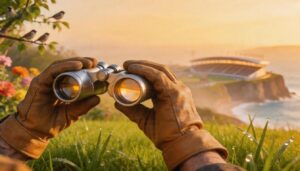
Not every pair of binoculars fits every outing, and the right choice often comes down to what you’re actually doing with them. A great pick for backyard birding might feel awkward at a stadium or frustrating on a foggy coastline.
Here’s how different activities shape what you should look for.
Birdwatching and Backyard Wildlife
Backyard birdwatching rewards patience — and the right glass. An 8×42 configuration gives you a wide, stable view that tracks warblers through native plant habitat without straining your arms.
Lightweight construction keeps sessions comfortable, while glasses-friendly eyecups with 17+ mm eye relief let you watch naturally.
Add a water feature design nearby, and birds come to you — making feeder placement tips and image stabilization less critical than you’d think.
Travel and Sightseeing Needs
Traveling light isn’t optional — it’s survival. When you’re scanning city sites or catching details on a distant cathedral, compact optics with lightweight construction make all the difference.
Here’s what to prioritize for travel sightseeing:
- Pocketable Design – Under 700 g fits comfortably in a daypack
- Glasses-friendly eyecups – 15+ mm eye relief keeps your prescription in play
- Quick-Release Straps – Hands-free mounting lets you move without fumbling
- Travel-Friendly Accessories – Ergonomic design with City Site Scanning range built in
Sports Events and Concerts
Sports and concerts are different from sightseeing — the action never holds still. Whether you’re following a striker across the pitch or watching a guitarist move across the stage, you need a wide field of view that tracks fast without losing your subject.
| Feature | Why It Matters |
|---|---|
| Wide field of view | Tracks fast-moving players or performers without constant readjusting |
| Stadium Seating Comfort | Lightweight under 700 g reduces neck and arm fatigue during long events |
| Stage Lighting Adaptation | Fully multi-coated lenses handle shifting concert lighting without glare |
| Vibration‑Resistant Grip | Rubberized housing steadies 8x magnification without a tripod |
| Low‑Light Stadium | 42 mm objectives pull in enough light for evening kickoffs and indoor arenas |
An 8×42 with glasses‑friendly eyecups and a smooth focus wheel accommodates both sports events and concert viewing without fumbling when the moment counts.
Marine and Humid-weather Viewing
On the water, conditions shift fast — spray, salt air, and sudden rain don’t warn you first. That’s why nitrogen-filled, fogproof binoculars with an IPX7 waterproof rating matter here more than anywhere else.
Look for a salt-resistant finish, rust-resistant coating, and weatherproof housing.
High contrast coating cuts glare off waves, a wide horizon view helps track vessels, and an integrated compass keeps you oriented.
Everyday Nature Observation
Not every nature outing needs a trail. Your porch, garden, or kitchen window can reveal just as much — if your optics are up to it.
For Close Focus Details on Backyard Bird Patterns, Seasonal Plant Changes, and Insect Activity Timing, an 8×42 with a 5–6 ft close‑focus distance works best:
- Morning Light Contrast sharpens with fully multi‑coated lenses and a wide exit pupil.
- Lightweight materials like magnesium alloy keep your arms steady through repeated short looks.
- Glasses‑friendly eyecups with 16–18 mm eye relief prevent vignetting without removing your glasses.
- Waterproof and fogproof construction manages dew‑heavy mornings without skipping a beat.
- Low‑light performance and field of view balance at 8× lets you follow movement across shrubs comfortably.
Comparing Budget, Comfort, and Value
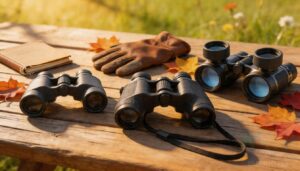
Picking the right binoculars means weighing more than just price — comfort, durability, and long-term value all matter just as much. A pair that costs less upfront but strains your hands or fogs up in drizzle isn’t really a bargain.
The cheapest binoculars aren’t a bargain if they strain your hands or fog up in the rain
Here’s what to look at before you commit.
Budget Versus Premium Binoculars
Budget-friendly options handle sunny afternoons just fine, but the gap shows when light drops.
Premium binoculars earn their price through ED Glass that cuts color fringing, Phase-Corrected Prisms that sharpen edges, and a Magnesium Alloy Body that keeps weight honest.
For serious birding, the Price-Performance Balance tips toward premium optical coatings — cleaner glass purity means less eye strain over a long morning out.
Weight Limits for Longer Sessions
Even a well-built pair of binoculars becomes a burden once your arms hit their Arm Fatigue Threshold — usually around 20–30 minutes of continuous hold. Weight Distribution Balance and Neck Torque Management matter as much as raw weight.
For session comfort, target these guidelines:
- Stay under 700 g (24 oz) for long outings
- Choose magnesium-alloy frames for lightweight binoculars without sacrificing durability
- Prioritize balanced, non-front-heavy designs for Handshake Mitigation
- Follow Session Duration Guidelines — rest every 15–20 minutes
- Consider weight grip and eye relief together, not separately
Waterproof and Fog-proof Protection
Reliable optics don’t quit when the weather turns. Binoculars built with O-ring Sealing and Gas Purging — usually nitrogen-filled or argon-filled — block moisture from ever reaching the lenses inside. That matters most on foggy mornings or coastal outings.
| Protection Feature | What It Does |
|---|---|
| IPX7 Rating | Survives 1m submersion for 30 minutes |
| Fog-proof Construction | Prevents internal condensation |
| Hydrophobic Lens Coating | Repels rain and surface moisture |
Weather-resistant housing keeps your view clear when conditions change fast.
Optical Coatings Worth Paying For
Not all coatings pull equal weight.
A quality Anti-Reflective Coating boosts light transmission above 90%, so multicoated lenses deliver noticeably brighter images at dusk.
Dielectric coated prisms and phasecoated BaK4 prisms sharpen contrast dramatically.
A Hydrophobic Top Coat and Oleophobic Finish repel water and fingerprints, while a Scratch-Resistant Layer protects daily handling.
ED dielectric multicoat and ArmorTek multicoat add UV Protection that guards your eyes long-term.
Warranty and Long-term Value
A good pair of binoculars is a long-term investment, not a one-time purchase. Premium brands like Nikon and Zeiss offer Repairable Design with replaceable eyecups and focus wheels, supporting Material Longevity for years of daily use.
Many include a lifetime warranty or Transferable Warranty, protecting Resale Value Retention if you ever upgrade. Extended Service Plans add extra peace of mind beyond standard coverage.
Frequently Asked Questions (FAQs)
Can you use binoculars with astigmatism?
Yes, you can — but astigmatism image distortion won’t disappear through diopter adjustment limits alone.
Prescription lens compatibility matters here: keep your glasses on for full optical clarity and vision comfort strategies to work properly.
How much should I pay for a good pair of binoculars?
For most uses, $200–$500 hits the sweet spot — strong optics, solid build, real comfort. Under $150 cuts corners on brightness. Over $1,000 is rarely necessary unless you’re out daily.
What are the best binoculars for the average person?
For most people, 8×42 binoculars hit the sweet spot — solid Price Performance Balance, easy handling, and genuine Low Light Brightness without the bulk.
They’re simply the easiest, most multipurpose choice you can buy.
Can binoculars help with macular degeneration or low vision?
Binoculars can help with low vision for distance tasks — spotting signs, watching a stage — but they won’t restore central vision lost to macular degeneration.
That damage lives in the retina, not the lens.
How do I clean binocular lenses safely at home?
Think of your lenses like a fine camera sensor — one wrong swipe and the damage is done.
Start with a blower to lift loose dust, then use a microfiber cloth with a coated-lens-safe solution, wiping gently from center outward.
Should seniors use a neck strap or harness?
For longer outings, a support system wins on load distribution — it spreads weight across your shoulders, cutting shoulder fatigue substantially.
A neck strap offers adjustability, ease and minimal setup time, but sacrifices mobility impact and comfort over time.
How long do quality binoculars typically last?
Quality binoculars generally last 10 to 20 years, with premium models exceeding that through proper maintenance practices.
Service life depends heavily on durability and build quality, environmental stress, and component degradation over time.
Are refurbished binoculars a reliable option for seniors?
Yes, refurbished binoculars can be reliable — if seal integrity, optical cleanliness, and seller reputation check out. Prioritize inspected, higher-end models with return windows for the best price-performance ratio.
Conclusion
Cut to the chase and invest in binoculars for seniors that fit your needs. The right pair can be a significant improvement, offering crystal-clear views without straining your eyes or arms.
Consider binoculars for seniors with features like ergonomic grips and adequate eye relief, making them easy to use and worth every penny for hours of enjoyable birdwatching or nature observation.
- https://www.opticscentral.com.au/blog/choosing-the-right-binoculars-for-astronomy/
- https://www.accio.com/plp/binoculars-for-elderly
- https://www.eagleeyeuk.com/the-importance-of-eye-relief-in-binoculars/
- https://www.foreseenoptics.com/stop-chasing-magnification-choose-binoculars-by-usable-field-of-view
- https://pmc.ncbi.nlm.nih.gov/articles/PMC1705708/