This site is supported by our readers. We may earn a commission, at no cost to you, if you purchase through links.
Somewhere between a flash of yellow in the canopy and the moment you finally raise your binoculars, the bird is gone. Every birder knows that feeling—and almost always, the culprit isn’t slow reflexes but the wrong optics. The difference between a crisp, locked-on view and a blurry scramble comes down to a handful of specific features that most buyers overlook when standing in a store aisle comparing price tags.
Magnification, prism type, field of view, close focus distance—each one shapes how you actually experience birds in the field. These technical details directly influence whether you capture fleeting details or miss them entirely.
Get them right, and your binoculars disappear; you stop thinking about the tool and start seeing the bird.
Table Of Contents
- Key Takeaways
- Magnification and Lens Size
- Field of View and Focus
- Coatings, Glass, and Prisms
- Comfort, Fit, and Durability
- Weight and Hand Fatigue on Long Bird Walks
- Eye Relief for Glasses Compatibility
- Diopter Adjustment for Personal Vision Tuning
- Eyecups, Grip Texture, and Handling Comfort
- Waterproof, Fog-proof, and Nitrogen-purged Designs
- Armor, Housing Materials, and Long-term Durability
- Strap and Harness Features for Better Carry Comfort
- Top 8 Birding Binocular Models
- 1. Vortex Diamondback HD 8×42 Binoculars
- 2. Vortex Crossfire HD 8×42 Binoculars
- 3. Celestron Nature DX 8×42 Binoculars
- 4. Vortex Triumph HD 10×42 Binoculars
- Bushnell O Xtreme 10×42 Binoculars
- 5. Adasion 12×42 HD Waterproof Binoculars
- 6. Occer 12×25 Waterproof Compact Binoculars
- 7. Hontry Compact 10×25 Binoculars
- Frequently Asked Questions (FAQs)
- Conclusion
Key Takeaways
- The 8×42 configuration is the gold standard for most birders because it balances image steadiness, light gathering, and field of view across every habitat type.
- Glass quality — specifically ED glass, phase-correction coatings, and BAK4 prisms — determines whether you see a birds’ field marks or just its outline.
- A wide field of view matters more than raw magnification when you’re chasing fast-moving birds through foliage, because it cuts acquisition time dramatically.
- Comfort features like eye relief, weight distribution, and waterproofing aren’t optional extras — they decide whether your binoculars stay home or hit the trail with you.
Magnification and Lens Size
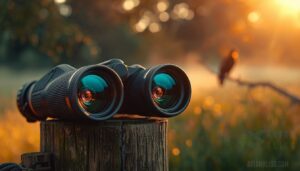
Magnification and lens size are the first things worth getting right — everything else builds on that foundation.
The numbers on the barrel aren’t just specs; they directly shape what you see, how bright it looks, and whether you can hold the image steady. What each configuration actually means for you in the field.
Understanding how magnification and aperture work together in binoculars helps you make sense of those numbers before you ever raise them to your eyes.
Why 7x and 8x Work Best for Most Birders
Most birders opt for 7x or 8x magnification for a key reason: handshake steadiness outweighs raw power when tracking fast-moving subjects like warblers. At these levels, image shake is roughly halved compared to 10x binoculars, enabling faster target acquisition and reducing frustration. This advantage stems directly from the larger exit pupil advantage inherent to 7× optics.
Greater depth of field keeps more of the scene sharp, while low-light performance improves during dawn and dusk. Users also experience reduced neck strain over extended periods and benefit from a wider field of view for quicker target location.
- Greater depth of field keeps more of the scene sharp
- Low-light comfort improves at dawn and dusk
- Reduced neck strain over long walks
- Wider field of view for quick target finding
When 10x Binoculars Are Worth The Trade-off
That said, 10x binoculars earn their place when extended range detail genuinely matters. Open habitat advantage is real — scanning distant shorebirds across a marsh or spotting raptors soaring over prairie, that extra magnification resolves feather patterns you’d otherwise miss.
Handheld steadiness remains workable at 10x, unlike higher powers.
The tradeoffs of higher magnification include a smaller exit pupil and reduced light gathering ability, so know your terrain first.
Why 8×42 is The All-around Birding Standard
Pull back from the 10x debate, and one configuration keeps rising to the top: the 8×42. It’s not hype — it’s proven field reliability, tested across marshes, canopy, and open grassland alike.
Here’s why it earns universal, accessories-ready, all-day trust:
- Ideal hand-hold — 8x magnification stays steady without a tripod
- Wide habitat adaptability — woods, wetlands, and open fields, one pair
- Field of view stays broad enough for fast acquisition
- Cost performance balance — serious glass without premium sticker shock
- Eye relief generally suits eyeglass wearers comfortably
The 42mm objective lens size hits the sweet spot: bright images, manageable weight.
Objective Lens Size Versus Portability
That 42mm sweet spot does come with a tradeoff worth naming: front bulk. A 32mm binocular usually weighs 20–25 ounces, while most 8×42 models exceed 30. On a long trail, that difference becomes real fatigue.
If backpack fit and travel light matter more to you than maximum brightness, the lens diameter tradeoff favors compact binoculars — smaller objective lens size, noticeably lighter carry.
Exit Pupil and Low-light Performance
Here’s a number worth knowing: divide your objective lens size by magnification and you get the exit pupil — the beam of light your eye actually receives. An 8×42 delivers a 5.25mm exit pupil, well-matched to a dark-adapted pupil at dawn.
Exit pupil matching is what drives real twilight brightness and dusk image clarity, not marketing language.
Low-light contrast lives in that math.
Brightness Differences Between Compact and Full-size Models
Compact binoculars trade portability for real-world dim performance — and you feel that gap most at dawn. The numbers tell the story:
- Dawn light advantage: 8×42 full-size delivers a 5.25mm exit pupil vs. 3.1mm in an 8×25 compact
- Age-related pupil loss: Older eyes need that larger beam more, not less
- Contrast in shade: Light-gathering ability of objective lenses determines what you see under canopy
- Color fidelity boost: Better coatings in full-size models keep feather tones clean
Compact versus full-size binoculars ultimately comes down to when and where you bird most.
Field of View and Focus
Field of view and focus don’t get as much attention as magnification, but they’re often what separates a frustrating morning from a great one.
When a warbler drops into dense brush or a hawk cuts across the sky, how fast you can lock on matters more than you’d think. Here’s what to look for.
Why Wide Field of View Matters for Birding

Field of view is fundamentally your window onto the world — and in birding, a wider window changes everything. An 8-degree field of view covers 420 feet at 1,000 yards, offering genuine landscape awareness and eye placement tolerance when lifting binoculars quickly.
This extra width significantly enhances horizon scanning, flock tracking, and wide-angle viewing across open water or meadows, minimizing the need for constant repositioning.
Easier Bird Acquisition in Flight and Foliage

Tracking a warbler darting through a thicket tests every birder’s scanning technique. A wide field of view reduces motion blur and related problems by providing your eyes more target framing room — so rapid reacquisition after losing a bird becomes instinct, not luck.
Strong silhouette contrast, aided by the solid light-gathering ability of objective lenses and a healthy exit pupil, ensures close focus and magnification work together when birds vanish into foliage.
Field of View Differences Between 8x and 10x

The numbers tell a clear story. An 8×42 generally shows around 377–393 feet at 1,000 yards; a 10×42 drops to 330–341 feet — roughly a 10–15% scene width advantage for the 8x.
Here’s what that means in practice:
- Acquisition speed impact — more scene = faster bird location
- Habitat context visibility — dense foliage reveals surrounding branches
- Peripheral awareness gain — movement at the edges stays visible
- True field measurement — always compare this spec, not apparent field
Close Focus for Feeders, Warblers, and Butterflies
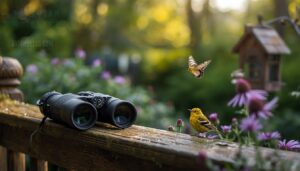
Most birders overlook close focus until a warbler lands three feet away. For feeder distance optimization, a 2–3 meter close focus accommodates typical backyard setups well. For warbler near-field views or insect close focus on butterflies, go shorter — 1.5 meters or less.
| Scenario | Ideal Close Focus | What You’ll See |
|---|---|---|
| Bird feeder watching | ~3 meters | Head, beak, eye detail |
| Warbler near-field view | 1.5–2 meters | Wing bars, eye rings |
| Insects and flowers | 1–1.5 meters | Wing veins, color bands |
| General forest birding | 2–3 meters | Perched birds in shrubs |
| Butterfly identification | ~1–2 meters | Eye-spots, markings |
Short focus mechanisms do add complexity, but the detail payoff is real. Close focus trade-offs exist — ultra-short mechanisms can soften edge sharpness slightly — but most modern designs minimize this. The light-gathering ability of objective lenses remains unaffected. These close focus features for observing birds and insects expand what a single pair can do.
Focus Wheel Speed and Precision in The Field
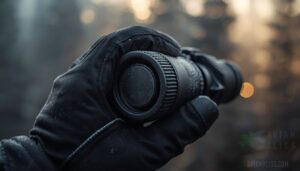
The focus wheel is where ergonomics and ease of use get real. A good gear ratio — one to two full turns, close focus to infinity — balances rapid refocus against fine precision. Look for a tactile wheel you can find without looking down, because glove-friendly focus matters on cold mornings.
What separates good wheels from great ones:
- Smooth action without gritty spots mid-turn
- Large enough diameter for gloved hands
- One controlled sweep across the full range
- No audible focus wheel noise that spooks nearby birds
- Handheld stability improves when weight considerations favor lighter builds
Matching Viewing Performance to Habitat Type
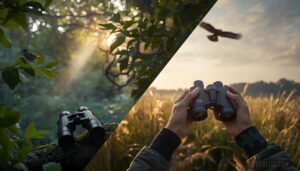
Dense canopy reach calls for an 8x with a wide field of view — birds vanish behind leaves fast. Open-field distance scanning rewards 10x magnification.
Twilight light gathering depends on objective lens size: 42 mm pulls ahead at dawn.
Rapid flight tracking needs a wider viewing window.
Mixed-habitat versatility? An 8×42 with solid low-light performance and weather-resistance and durability manages almost everything.
Coatings, Glass, and Prisms
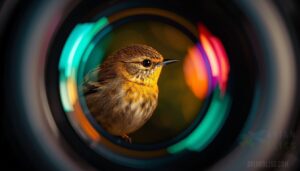
Most birders obsess over magnification, but what’s happening inside the glass matters just as much. The coatings, prism type, and glass quality determine whether you’re seeing a bird or a slightly blurry approximation of one.
Here’s what to look for.
Fully Multi-coated Optics and Light Transmission
Light must pass through 10 to 16 glass surfaces inside binoculars, and uncoated glass loses roughly 5% of light at every crossing. Fully multicoated optics employ Nanocoating Technology to drastically reduce these losses.
This technology delivers critical advantages:
- Reflectivity Reduction drops each surface’s loss below 0.5%
- Broadband Coating ensures balanced transmission across all visible wavelengths
- Transmission Percentages climb to 90–97% overall
- Twilight Performance remains sharp when birds are most active
This translates to exceptional light-gathering capability and superior image brightness during critical moments.
ED Glass for Sharper Feather Detail
Extra-low dispersion ED glass solves a problem coatings alone can’t fix: color fringing. When different light wavelengths land at slightly different focal points, you lose feather-edge delineation — white birds against dark water are the worst offenders.
ED glass keeps those wavelengths together, delivering contrast edge sharpening, subtle color separation, and high-magnification precision that makes fine pattern clarity genuinely useful for field identification.
Phase-correction Coatings in Roof Prisms
Roof prisms split light into two paths that exit slightly out of sync — a phase mismatch that quietly kills contrast and softens feathered detail.
Phase correction coatings fix this through dielectric stack design and polarization compensation, adding a precisely calculated phase alignment that brings both paths back together.
The result is genuine astigmatism mitigation, contrast enhancement, and sharper resolution without sacrificing brightness.
BAK4 Versus BAK7 Prism Performance
The glass your prism is made of quietly determines everything else.
BAK4 prisms outperform BAK7 in three measurable ways:
- Pupil geometry — BAK4 delivers a perfectly circular exit pupil; BAK7 clips the edges, reducing even illumination.
- Edge sharpness and contrast boost — internal reflections stay controlled, keeping feather detail crisp corner-to-corner.
- Pricing impact — BAK4 costs more, but you’re upgrading the whole optical performance chain.
Roof Prism Versus Porro Prism Trade-offs
Regarding prism technology, the choice between roof prisms and porro prisms shapes nearly every other trade-off you’ll make.
Roof prisms win on Compact Portability and Sealing Simplicity — they’re easier to waterproof and lighter to carry.
Porro prisms offer stronger Depth Perception and lower Manufacturing Cost.
That Value Trade-off is real: porro vs roof prisms isn’t about better or worse, just different priorities.
Reducing Glare, Fringing, and Color Distortion
Glare, fringing, and ghost images are the enemies of clean bird identification. Fully multi-coated antireflection coatings slash the 4–5% light loss at every air-to-glass surface, eliminating washed-out highlights. Dielectric coatings and blackened interiors with baffling techniques absorb stray scatter before it muddies the view.
Extralow dispersion ED glass corrects color distortion, pulling wavelengths to a common focus—no purple fringe on a backlit warbler.
Comfort, Fit, and Durability
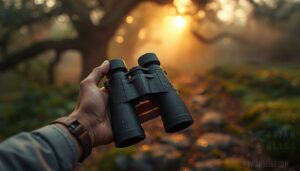
Optical quality gets you a sharp image, but comfort determines whether you actually carry those binoculars into the field every single day.
Sharp optics impress, but comfort decides whether you actually reach for them
The best glass in the world won’t help if the pair digs into your hands by mile two or fogs up the moment you step into cool morning air.
Here’s what to look for in fit, feel, and long-term durability.
Weight and Hand Fatigue on Long Bird Walks
A full-sized 8×42 typically tips the scales at 615–725 g — manageable for an hour, but punishing after four. It’s not just the weight itself; the repeated raise-and-lower motion loads your forearms and quickly builds up neck pressure.
Weight distribution matters too: a front-heavy binocular puts more strain on your wrists. This repetitive motion and poor balance grind you down faster than weight alone.
Compact binoculars and lighter designs, paired with shoulder support from a strap, make the difference on long days. These solutions address both ergonomics and endurance.
Eye Relief for Glasses Compatibility
Eye relief is the spec that matters most for birders who wear glasses. It refers to the distance between the eyepiece and your eye—a space quickly reduced by glasses frames. Target 16 mm or more to ensure comfort.
Adjustable eyecups and low-profile eyepieces can help, but glasses-fit testing in person remains the only reliable method to confirm your eye relief tolerance before purchasing.
Diopter Adjustment for Personal Vision Tuning
Once you’ve sorted eye relief, diopter adjustment is your next personal calibration. Most birding binoculars offer a correction range of roughly plus or minus two diopters — enough for Vision Synchronization between unequal eyes.
Cover each objective lens separately, focus per eye, then view both together. This process ensures Proper Diopter Calibration, which cuts eye fatigue noticeably during long sessions.
Set it once; leave it alone.
Eyecups, Grip Texture, and Handling Comfort
Physical comfort is where specs stop mattering and your hands take over. Twist-up ergonomics let you dial eyecup height precisely — critical for glasses wearers. Rubber armor grip and thumb indents keep control when your palms are wet or cold.
- Twist-up adjustable eyecups with intermediate stops suit different face shapes
- Silicone eyecup material choice cushions without scratching eyeglass lenses
- Rubber armoring absorbs drops and resists temperature extremes
- Thumb indents reduce grip force, cutting fatigue on long walks
- Textured grip texture analysis reveals which surfaces actually hold in rain
Waterproof, Fog-proof, and Nitrogen-purged Designs
Once your grip is solid, the next threat comes from the sky. Rain, mist, and marsh humidity will find any weak point in your optics. That’s where seal integrity and nitrogen purging matter — O-ring seals block moisture entry while dry gas fill prevents internal condensation.
Look for IPX7 weather-sealed optics: they handle immersion, not just splashes, keeping your view clear when weather resistance and durability count most.
Armor, Housing Materials, and Long-term Durability
Sealed against weather, your binoculars still need to survive the physical punishment of fieldwork. That means housing matters.
- Rubber Armor Protection absorbs drops up to 1.5 meters and stays grippy in rain
- Magnesium Chassis Strength runs 20–30% lighter than aluminum while holding alignment after trail knocks
- Polycarbonate Body Durability withstands –40°C to 60°C without warping
- Armor Grip Texture keeps sweaty hands secure during dawn counts
- UV-Stabilized Resilience prevents rubber cracking for a decade outdoors
Quality backs this with O-ring sealing, ArmorTek coating, and lifetime warranty coverage — weather resistance and durability you can actually count on.
Strap and Harness Features for Better Carry Comfort
Even the best binoculars become a burden after four hours on a warbler walk. Wide padded shoulder straps spread weight across your shoulders instead of grinding into your neck — 1.5-inch designs cut pressure roughly in half.
A chest rig design with anti-bounce stabilizer keeps optics steady while you move. This setup prevents jostling, ensuring clarity during active use.
Adjustable length sliders and quick-release attachments add flexibility, adapting to different body types and situations. These features make accessories for binocular comfort genuinely worth carrying.
Top 8 Birding Binocular Models
All that theory lands differently once you’re holding a real pair in your hands.
The eight models below span a range of budgets, magnifications, and use cases — so whether you’re a backyard feeder watcher or a dawn-patrol warbler chaser, there’s something here worth a close look.
Here’s what made the cut.
1. Vortex Diamondback HD 8×42 Binoculars
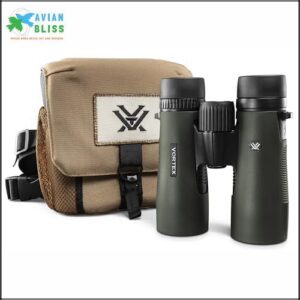
The Vortex Diamondback HD 8×42 punches well above its price class. Its HD optical system delivers sharp, color-accurate images, while the fully multi-coated lenses with dielectric and phase-correction coatings ensure brightness even in low morning light.
At just 21.8 ounces, it offers a 393-foot field of view and a 5-foot close focus, making it versatile for activities like warbler chases or feeder watching.
The included GlassPak strap and unconditional lifetime warranty solidify its value as a smart long-term investment.
| Best For | Birders, hunters, and outdoor enthusiasts who want sharp, reliable glass without spending a fortune. |
|---|---|
| Magnification | 8x |
| Objective Lens | 42mm |
| Prism Type | Roof |
| Lens Coating | Fully Multi-Coated |
| Waterproof | Yes, Argon-Purged |
| Rubber Armor | Yes |
| Additional Features |
|
- Crystal-clear HD optics with great color accuracy, even in low light
- Tough and waterproof — rain, fog, or dusty trails aren’t a problem
- Lifetime warranty that actually means something, and it’s transferable
- The focus wheel is a bit too sensitive, making fine adjustments tricky
- The diopter has no lock, so it can shift on you without warning
- The included carrying case feels like an afterthought compared to the binoculars themselves
2. Vortex Crossfire HD 8×42 Binoculars
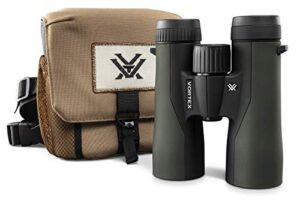
The Crossfire HD 8×42 sits a step below the Diamondback in Vortex’s lineup, but don’t let that fool you. At $129.99, it delivers the same 8×42 configuration with a 5.25 mm exit pupil and a 393-foot field of view — solid numbers for tracking warblers through dense canopy.
Its HD optical system with fully multi-coated lenses keeps images bright and true, ensuring clarity in various lighting conditions.
Nitrogen purging and O-ring seals handle rain without complaint, making it reliable in wet environments.
The included GlassPak strap and unconditional lifetime warranty make it genuinely hard to beat at this price, offering both convenience and long-term peace of mind.
| Best For | Birders, hikers, and casual hunters who want reliable, sharp optics in a lightweight package without breaking the bank. |
|---|---|
| Magnification | 8x |
| Objective Lens | 42mm |
| Prism Type | Roof |
| Lens Coating | Fully Multi-Coated |
| Waterproof | Yes, Nitrogen-Purged |
| Rubber Armor | Yes |
| Additional Features |
|
- HD fully multi-coated lenses deliver bright, color-accurate images across a wide field of view
- Waterproof and fog-proof construction holds up in rain, humidity, and rough conditions
- Unconditional lifetime warranty plus the included GlassPak harness add serious long-term value at this price point
- 8× magnification starts to feel limited when you’re glassing terrain beyond 300 yards
- Smaller objective lenses mean it struggles a bit more than premium models in low-light situations
- Warranty won’t cover you if the binoculars are lost, stolen, or only cosmetically damaged
3. Celestron Nature DX 8×42 Binoculars
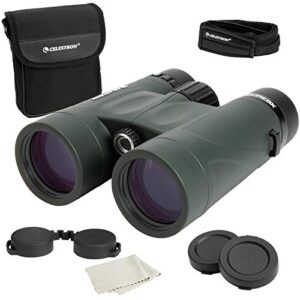
The Celestron Nature DX 8×42 punches well above its price tag. You get BaK-4 phase-coated roof prisms and fully multi-coated lenses — features that usually cost twice as much — delivering a bright, contrast-rich image with a 7.4° field of view.
The nitrogen-purged, waterproof housing manages dawn mist without hesitation, while 17.5 mm of eye relief ensures glasses wearers won’t miss the edges of the frame.
A close focus of around 6.5 feet makes observing feeder birds and butterflies genuinely satisfying.
| Best For | Birdwatchers, hikers, and outdoor enthusiasts who want solid optical performance without spending a fortune. |
|---|---|
| Magnification | 8x |
| Objective Lens | 42mm |
| Prism Type | BaK-4 Roof |
| Lens Coating | Fully Multi-Coated |
| Waterproof | Yes, Nitrogen-Purged |
| Rubber Armor | Yes |
| Additional Features |
|
- BaK-4 phase-coated prisms and fully multi-coated lenses deliver bright, sharp images that rival pricier options
- Waterproof, fog-proof, and nitrogen-purged — ready for early mornings and unpredictable weather
- Lightweight and compact with a 6.5 ft close focus, great for birding and nature walks
- Eye cup screws can loosen over time, which gets annoying fast
- The included neck strap is pretty uncomfortable for long outings
- Edge sharpness doesn’t quite match premium ED glass binoculars at higher magnification
4. Vortex Triumph HD 10×42 Binoculars

At $99, the Triumph HD 10×42 is hard to argue with. You get 10× magnification and a 42 mm objective — useful for scanning distant shorebirds or treetop canopy — backed by fully multi-coated lenses and nitrogen-purged, waterproof construction.
The 4.2 mm exit pupil is narrower than an 8×42’s 5.25 mm, so low-light performance is modest.
However, the 17 mm eye relief and included GlassPak strap add real comfort.
Vortex’s unconditional lifetime warranty seals the deal for budget-conscious beginners.
| Best For | Budget-conscious beginners who want a reliable, durable pair of binoculars for birdwatching, hunting, or hiking without breaking the bank. |
|---|---|
| Magnification | 10x |
| Objective Lens | 42mm |
| Prism Type | Roof |
| Lens Coating | Fully Multi-Coated |
| Waterproof | Yes, Nitrogen-Purged |
| Rubber Armor | Yes |
| Additional Features |
|
- Fully multi-coated lenses with nitrogen-purged, waterproof construction make it ready for any weather
- Comfortable to use for long sessions thanks to adjustable eyecups, diopter control, and the included GlassPak harness
- Vortex’s unconditional lifetime warranty is a rare find at this price point
- No tinted or polarized lenses, so glare can be a real issue in bright, high-contrast conditions
- The 4.2 mm exit pupil means low-light performance won’t wow you compared to wider options
- The included pouch isn’t padded, so it offers minimal protection against hard drops or rough handling
Bushnell O Xtreme 10×42 Binoculars
Built for the elements, the Bushnell H2O Xtreme makes a strong case as a field-ready 10x binocular. With 42mm objective lenses, BaK-4 prisms, and fully multi-coated glass, user experience feels surprisingly polished for the price. Waterproof and nitrogen-purged, its weather resistance and durability hold up in marshes and coastal rain.
Here’s what stands out on cost value:
- Sealed O-ring construction needs minimal maintenance routine
- Weather resistance rivals pricier competitor comparison models
- 305 ft field of view tracks moving birds confidently
- Warranty service backs long-term ownership’s peace of mind
5. Adasion 12×42 HD Waterproof Binoculars
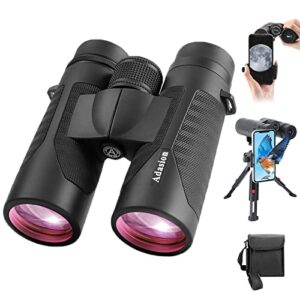
If you want higher magnification without jumping to a spotting scope, the Adasion 12×42 HD is worth considering. Its 12x magnification brings distant warblers noticeably closer, though your hands need to stay steady—shake becomes more noticeable at this power.
The binoculars feature BAK4 prisms and fully multi-coated lenses, which help maintain brightness despite the higher magnification. They are IPX7 waterproof, nitrogen-purged, and weigh just 1.2 lb, combining durability with portability.
The included phone adapter is a bonus for documentation, though aligning it requires patience.
| Best For | Birders and wildlife watchers who want strong magnification and all-weather durability without spending a lot. |
|---|---|
| Magnification | 10x |
| Objective Lens | 42mm |
| Prism Type | BaK-4 Roof |
| Lens Coating | Fully Multi-Coated |
| Waterproof | Yes, IPX7 |
| Rubber Armor | Yes |
| Additional Features |
|
- 12x magnification with BAK4 prisms and multi-coated lenses keeps images bright and sharp, even in lower light
- IPX7 waterproofing and fog-proof build means you can take these out in rain, mist, or dusty conditions without worry
- At 1.2 lb, they’re light enough for long days out, and the included phone adapter is a nice bonus for snapping photos of what you spot
- Higher magnification means any hand tremor shows up more — a tripod helps, and one’s included, but setup takes extra time
- The phone adapter needs careful alignment to avoid dark borders around your shots, which can get frustrating in the field
- Optical quality is solid for the price, but if you’re comparing to premium glass, you’ll notice the difference in very low light or at extreme distances
6. Occer 12×25 Waterproof Compact Binoculars
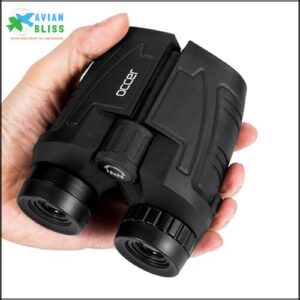
Not every birding outing calls for a 12×42. Sometimes you just need something that fits in your jacket pocket. The Occer 12×25 weighs only 8.8 oz and measures roughly 110 x 50 mm — small enough to forget you’re carrying it.
BAK4 prisms and fully multi-coated lenses keep the image sharper than you’d expect at this price (~$39). The 273-foot field of view at 1,000 yards is genuinely wide for a compact 12x.
Just note: no nitrogen purging means fogging is a real risk in cold, humid conditions.
| Best For | Casual birders, hikers, and travelers who want a lightweight, pocketable binocular for daytime and dusk use without breaking the bank. |
|---|---|
| Magnification | 12x |
| Objective Lens | 42mm |
| Prism Type | BAK4 Roof |
| Lens Coating | Fully Multi-Coated |
| Waterproof | Yes, IPX7 |
| Rubber Armor | Yes |
| Additional Features |
|
- Genuinely compact and lightweight — easy to toss in a jacket pocket or day bag
- BAK4 prisms and fully multi-coated lenses deliver solid image clarity for the price
- Adjustable eyecups make them comfortable whether you wear glasses or not
- Small 25 mm objective limits light-gathering, so low-light performance takes a hit
- No nitrogen purging means fogging is a real concern in cold or humid conditions
- 12× magnification can feel shaky hand-held, making it harder to get a steady view
7. Hontry Compact 10×25 Binoculars
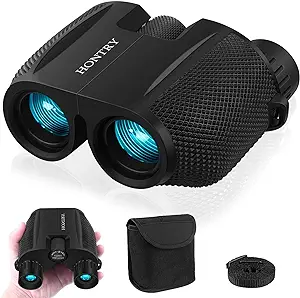
Stepping down in magnification from the Occer, the Hontry Compact 10×25 trades extra power for a noticeably smoother viewing experience. At 9.6 oz and pocket-sized, it’s genuinely easy to carry.
BAK4 prisms and fully multi-coated lenses push light transmission to around 96%, ensuring crisp daytime images and true-to-life colors.
The exit pupil measures just 2.5 mm, limiting low-light performance during dawn or dusk birding. For optimal results, stick to midday outings, where it excels well above its price point.
| Best For | Families, casual outdoor enthusiasts, and travelers who want a lightweight, easy-to-share binocular for daytime birdwatching, concerts, or wildlife spotting without breaking the bank. |
|---|---|
| Magnification | 12x |
| Objective Lens | 25mm |
| Prism Type | BAK4 Roof |
| Lens Coating | FMC Broadband |
| Waterproof | Yes |
| Rubber Armor | Yes |
| Additional Features |
|
- Pocket-sized and ultralight at just 9.6 oz, making it effortless to toss in a bag or glove box
- BAK-4 prisms deliver sharp, high-contrast images with impressive color accuracy for the price
- Adjustable IPD (60–75 mm) means kids and adults can both use it comfortably
- Struggles noticeably in low-light conditions — dawn and dusk outings will leave you wanting more
- The included soft case and lanyard feel cheap and won’t hold up to serious wear
- Extended handheld use gets shaky after about 15 minutes, so don’t expect rock-solid stability without support
Frequently Asked Questions (FAQs)
How do I clean binocular lenses in the field?
Start by blowing off loose dust before touching the glass — grit scratched across coated lenses causes permanent haze. Then wipe gently with a microfiber cloth using light, outward spiral strokes.
Can kids use adult birding binoculars comfortably?
Older kids and teens can handle adult 8×42 binoculars reasonably well.
Younger children usually struggle — the barrels are too wide apart, the weight tires small arms fast, and eye relief becomes tricky.
Do binoculars need calibration over time?
Most binoculars stay well-calibrated for years — unless you drop them.
After a hard knock, check for double images along distant edges. If you spot splitting, it’s time for a professional realignment.
What accessories pair well with birding binoculars?
A shoulder harness beats a neck strap on long walks — it spreads the load across your shoulders.
Pack a lens pen and microfiber cloth too.
Birds won’t wait while you squint through smudged glass.
How does altitude affect binocular optical performance?
At altitude, sealed and nitrogen-purged binoculars matter most. Pressure drops stress weak seals, letting moisture in and fogging prisms. Good fog-proof models handle climbs past 3,000 meters without losing image clarity.
Conclusion
The right pair of binoculars puts the world at your fingertips—but only if you know what features matter in birding binoculars before you buy. Magnification, glass quality, field of view, and close focus distance aren’t just specs on a box; they’re the difference between watching a warbler working a branch and watching empty leaves shaking.
Choose deliberately, match the optics to how and where you bird, and the tool disappears entirely, leaving only the bird.
- https://sfvaudubon.org/binoculars-a-birding-must-have/
- https://columbusaudubon.org/resources/learning-aids/beginners-guide-to-binoculars-for-birding/
- https://hawkwatch.org/how-to-select-the-right-binoculars-for-birdwatching/
- https://www.allaboutbirds.org/news/best-affordable-compact-binoculars-review/
- https://saratogasprings.wbu.com/full-sized-binoculars