This site is supported by our readers. We may earn a commission, at no cost to you, if you purchase through links.
A bird bath does two things well: it invites wildlife into your yard, and without much effort, it invites mosquitoes too. Still water sitting in a shallow basin is exactly what a female mosquito needs to lay hundreds of eggs, and warm weather shrinks the time from egg to biting adult down to less than a week. Most gardeners don’t realize the problem is already cycling beneath the surface before they spot a single wriggler.
The good news is that small, deliberate choices about design, placement, and upkeep make mosquito-free bird water features entirely achievable, keeping your yard a haven for birds rather than a breeding ground.
Table Of Contents
Key Takeaways
- Still water is a mosquito magnet, so keeping your bird bath moving with a solar fountain or bubbler breaks the breeding cycle before it starts.
- Shallow, smooth-surfaced basins placed in partial sun and away from dense shrubs make your water feature naturally harder for mosquitoes to use.
- BTI dunks are your safest chemical-free backup, killing larvae within 72 hours without harming birds, fish, or beneficial insects.
- Changing water every one to two days in warm weather and scrubbing the basin weekly are the two habits that do the most mosquito-control work.
Why Mosquitoes Gather in Bird Water
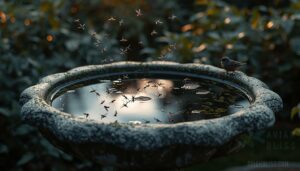
Mosquitoes don’t pick your bird bath by accident — still, shallow water is exactly what they’re looking for. A few simple factors turn a welcoming water feature into a breeding ground before you even notice.
Choosing the right basin design matters more than you’d think — a shallow bird bath that deters mosquitoes limits the standing water depth they need to lay eggs.
Here’s what draws them in.
Still Water and Mosquito Egg-laying
Still water is basically a welcome mat for mosquitoes. Females are drawn to standing water by surface tension traps and waterline preference, laying eggs right at the edge or just above it. Egg adhesion keeps those eggs stuck like glue until rain or a refill triggers hatching cue detection. Even dry eggs survive months — drought-resistant eggs can wait up to eight months before hatching. Removing these sources eliminates the standing water breeding risk.
Watch for eggs in these spots:
- Along basin edges and container walls
- On debris floating near the waterline
- In corners where water barely moves
Shallow Dirty Basins Vs Moving Water
Shallow dirty basins become perfect feeding grounds once eggs hatch, providing larvae plenty of organic debris for feeding without effort. Standing water also aids egg attachment through surface tension and allows larvae to breathe easily.
Incorporating moving water to deter mosquitoes disrupts this cycle—water circulation and agitation break the calm surface, making mosquito breeding prevention in standing water almost simple with easy installation required.
Warm Weather and Fast Larval Growth
Warm water speeds everything up. Once temperatures hit around 28–35°C, larval development can shrink from weeks down to just five days, meaning generation turnover happens fast. Temperature thresholds matter here — too cold, and mosquitoes slow down, but summer bird baths sit right in their sweet spot.
Watch for these warning signs:
- Cloudy, warm water sitting undisturbed for more than two days
- Tiny wriggling movement near the surface
- Water that feels warmer than the surrounding air
Debris, Algae, and Hidden Breeding Spots
Speed isn’t the only problem — what’s sitting in your water matters just as much. Leaves, seed hulls, and algae create an algal biofilm breakdown layer that shelters larvae from fish and birds.
Cracked water traps hide inside grooves and seams, where hidden groove inspection gets skipped. These overlooked areas become breeding grounds, undermining efforts to control larvae.
Your bird bath maintenance routine should treat every corner as a potential mosquito breeding prevention zone, not just the open surface. Thorough cleaning of all surfaces is critical to eliminate risks.
Why Bird Baths, Fountains, and Ponds Differ
Not all water features carry the same mosquito risk — and understanding the differences puts you in control.
- Bird baths have low volume capacity and standing water, so bird bath maintenance for mosquito control needs to happen every few days.
- Fountains require higher energy but water circulation and agitation to deter mosquitoes makes them naturally safer.
- Ponds demand balancing pond depth for birds and fish alongside ecological complexity and seasonal durability.
- Each feature attracts different bird species attraction patterns.
Best Designs for Mosquito-Free Features
The design of your water feature does more work than you might think for keeping mosquitoes away. A few smart choices in shape, depth, and surface material can make a real difference before you even think about treatments or upkeep.
Here are the design elements worth getting right from the start.
Shallow Wide Basins for Bird Baths
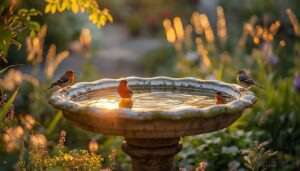
Think of your bird bath as a tiny puddle, not a pool. A shallow, wide basin — no deeper than 1 to 2 inches — gives birds multi-species access while keeping standing water thin enough to discourage egg-laying. A broad rim width lets birds land and balance easily.
For gradual, bird-safe edges that double as natural landing zones, these bird habitat conservation tips walk you through the details.
Ground-level placement works well for some species, but slightly raised baths stay cleaner longer.
Smooth Surfaces That Are Easy to Clean
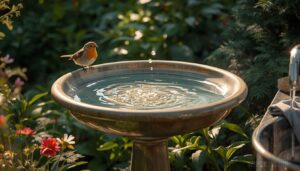
Your basin material matters more than you’d think. Smooth, non-porous surfaces like glazed ceramic, stainless steel, polyresin composite, or glass panels leave mosquito larvae nowhere to hide and make safe cleaning methods for bird baths almost effortless. Sol-gel coatings work well on concrete too.
For nontoxic cleaning, try these:
- Wipe stainless steel daily with a damp cloth
- Rinse polyresin composite basins with a hose
- Scrub glazed ceramic weekly with diluted vinegar
Sloped Sides Instead of Steep Walls
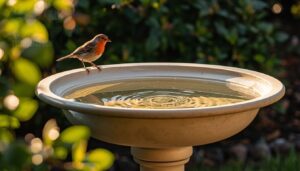
Steep walls trap water in tight corners, giving mosquitoes exactly what they need to breed undisturbed.
Sloping edges solve this naturally, enabling gentle access for birds and wildlife escape if something slips in. Edge drainage carries water cleanly outward, while cleaning efficiency improves—a brush reaches everything easily.
That’s your simplest win for standing water elimination and smarter mosquito control strategies for garden water features.
Proper Pond Depth for Birds and Fish
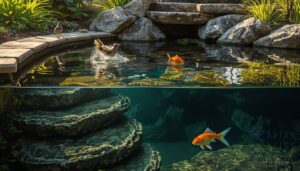
Depth does more work than most people realize. Shallow shelves of 10 to 20 cm give birds safe bathing access, while a fish overwintering depth of at least 60 cm keeps goldfish alive through cold months. This depth zoning strategy also promotes thermal stability, slowing algae growth and discouraging mosquito egg-laying.
Balancing pond depth for birds and fish means all species share the water comfortably.
Avoiding Stagnant Corners and Dead Zones
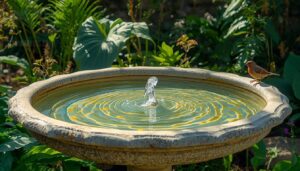
Corners are where stagnant water hides, and mosquitoes know it. Sharp angles slow water circulation and create dead zones that even good aeration can’t easily reach.
Rounded shapes with minimal recess design and perimeter flow channels keep water moving edge to edge. Uniform circulation gradient and targeted water jets help prevent edge vortex buildup, cutting standing water risks before larvae ever appear.
Adding Stones and Perches Without Trapping Water
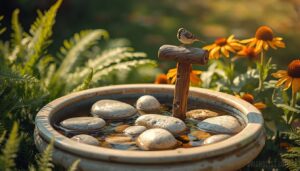
Stones and perches add real value, but placement matters.
Angled Stone Placement sheds water off surfaces, while Drainage Gap Strategy ensures water drains freely by leaving space between rocks.
Elevated Perch Design keeps resting spots above the waterline.
Choose Removable Rock Modules for easy scrubbing.
Watch Textured Rock Surfaces for hidden pooling pockets that invite mosquito control problems.
Placement and Plants That Reduce Pests
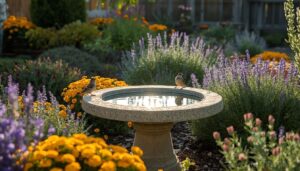
Where you place your water feature matters more than most people think, and so do the plants you choose around it.
The right spot and the right greenery can quietly discourage mosquitoes while making your space more welcoming for birds. Here’s what to keep in mind when setting up your feature for the best results.
Part Sun Placement to Limit Algae Growth
Morning sun exposure keeps the water inviting for birds, while afternoon shade timing prevents heat from speeding up algae and bacterial growth. Aim for partial sunlight throughout the day, and keep the basin away from reflective paving to help with glare mitigation.
Good airflow drying around the feature, paired with a surface shading ratio from nearby branches, aids natural mosquito control without extra effort.
Open Sightlines That Attract Birds Safely
Once you’ve sorted your sun and shade balance, think about what birds actually see before they land. Panoramic visibility matters — birds scan wide perimeter spaces and clear edge views before committing to a bath. An unobstructed approach and elevated observation point give them confidence.
Your bird bath becomes part of a genuinely bird and pollinator-friendly pond environment when it simply feels safe to visit.
Distance From Dense Shrubs and Standing Water
Feeling safe is one thing—staying mosquito-free is another. Dense shrubs nearby create a shrub buffer zone where mosquitoes rest and hide, making separation distance guidelines critical.
Keep your feature 10–15 feet from thick vegetation and standing water. This airflow corridor discourages resting mosquitoes, promotes microhabitat isolation, and optimizes drainage zone placement to work in your favor.
Native Aquatic Plants That Support Water Quality
Plants do more than look pretty — they’re your pond’s quiet cleanup crew. A good seasonal plant mix manages nutrient uptake, oxygen production, and shade creation all at once, which keeps algae thin and water clear.
- Hornwort oxygenates below the surface
- Water iris manages phosphorus and nitrogen
- Water celery filters runoff near the edges
Together, they support microbe enhancement and natural water filtration, making biological mosquito control easier without any chemicals.
Marginal Plants That Reduce Erosion and Stagnation
Where your pond meets dry land, the right marginal plants hold everything together. Soft Rush Roots bind saturated soil up to 12 inches deep, while Iris Edge Binding locks banks in place year-round.
Pickerelweed Margins shade stagnant edges, and Sweet Flag Filtration absorbs excess phosphates.
Cattail Bank Stabilization anchor gradually sloping edges beautifully. These native plants — reeds and sedges included — keep moving water flowing freely without erosion.
Bird-friendly Flowers Near Water Features
Choosing the right flowering plants near your water feature does double duty — pulling in hummingbirds while building a layered pollinator habitat. Cardinal flower and bee balm are colorful hummingbird lures with seasonal bloom timing that fills summer’s nectar gap. Swamp milkweed and buttonbush add tall shrub overlooks, while salvia keeps nectar-rich blooms going all season.
This bird-friendly landscaping naturally discourages mosquitoes by keeping wildlife active around the water.
Safe Ways to Stop Larvae
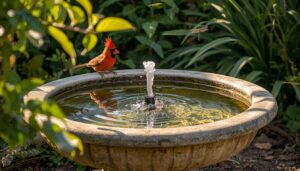
Once you spot larvae, the good news is you have real options that won’t harm the birds you’re trying to attract.
Some work by keeping water moving, others by introducing nature’s own pest fighters.
Here are the safest, most effective ways to stop mosquitoes before they ever leave the water.
Solar Fountains, Bubblers, and Drippers
Solar fountains are one of the simplest tools you can add to a bird bath or small pond. A brushless motor runs quietly and keeps water moving all day, which prevents mosquito larvae from surfacing to breathe.
You can adjust the solar panel tilt to maximize sunlight exposure, ensuring consistent operation. This feature enhances efficiency, particularly in varying weather conditions.
The nozzle pattern variety allows customization between a gentle bubbler or soft ripple, both effective for mosquito control strategies in garden water features. These options balance aesthetic appeal with practical functionality.
Recirculating Pumps for Constant Water Movement
A submersible pond pump does something solar fountains can’t always manage — it keeps water circulating even on cloudy days. Wet-rotor technology cools the motor using the water itself, so it runs quietly and reliably.
Look for a low‑power consumption model with an adjustable flow rate to match your basin size.
Consistent water circulation is your steadiest defense against mosquito control problems all season.
BTI Mosquito Dunks for Bird Baths
When moving water isn’t enough, BTI Mosquito Dunks offer a reliable backup. Drop a partial dunk into your bird bath, and it slowly releases Bti, killing larvae within 72 hours.
One dunk lasts 30 days or more, so the dunks’ longevity works in your favor. Store unused dunks in a cool, dry spot to maintain effectiveness.
Always follow the regulatory label instructions for the safe use of BTI larvicides in bird baths.
Choosing BTI Products Labeled Safe for Wildlife
Not all BTI products are alike, so checking the label before buying matters. Look for these key details:
- Strain identification: The label should name a Bacillus thuringiensis israelensis strain and include an EPA registration number.
- Formulation type: Match the product — dunk, granule, or briquet — to your water feature size.
- Dosage guidelines: Follow label instructions exactly for the safe use of BTI larvicides in bird baths.
Environmental safety for wildlife depends on correct application.
Guppies or Mosquito Fish in Larger Ponds
For larger ponds, small fish like guppies or Gambusia affinis serve as excellent biological control methods for mosquito larvae. A species comparison highlights that mosquitofish win on breeding cycle speed, producing up to 100 young every six weeks.
Follow local legal restrictions before stocking, and maintain a stocking density of four to six fish per ornamental pond. This ensures effective larval control without overpopulation.
Their temperature tolerance simplifies pond ecosystem management throughout the season, making them a reliable choice for year-round use.
Why Broad-spectrum Pesticides Should Be Avoided
Guppies and mosquito fish handle larvae without any chemicals — and that matters more than you might think. Broad-spectrum pesticides cause serious non-target damage, killing bees and beneficial insects essential to gardens. They also pose real risks to pollinators and water contamination for nearby ponds.
Broad-spectrum pesticides kill the bees and beneficial insects your garden depends on
Integrated pest management and eco-friendly pest control work better by preserving nature’s balance:
- They spare pollinators and natural predators
- They prevent resistance development in mosquito populations
- They keep soil and water free from chemical runoff
- They support long-term environmental safety for wildlife
Maintenance Habits That Keep Water Clear
Good design only gets you so far — what really keeps mosquitoes away is what you do every week.
A little routine goes a long way toward keeping your water feature clean, clear, and safe for birds. Here’s what your maintenance habit should look like throughout the season.
How Often to Change Bird Bath Water
Heat-driven frequency matters more than you might think. Change your bird bath every one to two days during warm weather, as standing water can attract egg-laying mosquitoes within 48 hours. Heavy bird usage patterns also dirty the water faster, so trust your eyes—refresh it when it appears soiled.
In cooler seasons, intervals stretch to every few days, but remain vigilant: if it looks cloudy, refresh it now. This simple habit ensures a safe, clean water source for birds year-round.
Weekly Pond and Fountain Inspection Checklist
A quick weekly walk-around keeps your pond and fountain running clean and mosquito-free. Check these three things every time:
- Pump noise check and intake screen cleaning — listen for grinding sounds and clear any debris blocking the screen.
- Surface scum assessment and leak spotting — look for film, damp seams, or sudden water drop.
- Perch stability review — make sure stones don’t trap standing water underneath.
Scrubbing Basins to Remove Algae and Slime
Scrubbing your basin every four days prevents algae buildup. Tool selection matters: use a stiff plastic brush for porous concrete, while smooth glazed surfaces require a soft cloth.
For cleaning solutions, a 1:10 bleach mix or white vinegar effectively loosens slime. Let the solution sit briefly, then scrub thoroughly.
Removing Leaves, Seed Hulls, and Organic Debris
Clearing out leaves and seed hulls is one of the simplest pond maintenance wins you can get. Organic debris turns your clean basin into a mosquito nursery fast. Here’s how to stay ahead of it:
- Use skimmer netting daily to lift floating material before it sinks.
- A mesh leaf guard blocks most debris before it even lands.
- Manual debris removal with a gloved hand works well for shallow baths.
- Water surface agitation from a bubbler pushes debris to the edges for easy scooping.
- Stick to a removal scheduling routine — every 24–48 hours during warm months.
These maintenance practices to prevent mosquito breeding keep proper cleaning techniques for bird baths simple and effective, preventing standing water in outdoor spaces from becoming a problem.
Checking for Mosquito Larvae and Wrigglers
Tiny wrigglers near the surface serve as your early warning sign. Conduct a white basin scan every few days—using a pale bowl makes mosquito larvae far easier to spot. This simple method helps detect infestations early.
For further verification, try the stir water test: healthy water will clear quickly, while the presence of larvae causes them to dart downward in panic. To confidently distinguish mosquito larvae from similar organisms, refer to this larvae size guide:
| Sign | Mosquito Larvae | Lookalike |
|---|---|---|
| Movement | Jerky wriggle | Smooth glide |
| Position | Surface-hanging | Bottom-resting |
| Shape | Tube-tailed | Rounded or flat |
A quick surface ripple check and familiarity with lookalike identification ensure your standing water remains clean. These proactive measures protect both water quality and bird safety.
Seasonal Upkeep for Spring, Summer, and Fall
Each season brings its own upkeep rhythm, and staying ahead of it keeps your water feature working all year long.
- Spring: Run a spring seal inspection on pumps, liners, and tubing before mosquitoes become active
- Summer: Match your summer refill frequency to the heat — daily if needed
- Fall: Clear leaves early and finish fall drainage preparation before the first frost
- Year-round: Combine water circulation systems with biological control methods for eco-friendly mosquito control practices
Frequently Asked Questions (FAQs)
What water features do not attract mosquitoes?
A moving water feature is practically a mosquito’s worst nightmare. Solar fountains, aerated waterfalls, and water agitators keep surfaces churning constantly, making egg-laying nearly impossible for mosquitoes seeking calm, still water.
How to keep mosquitoes out of bird water?
Keeping mosquitoes out of bird water comes down to three things: movement, cleanliness, and smart design. Swap still water for DIY aeration, and mosquitoes lose their favorite breeding ground fast.
Can mosquito netting be used over bird baths?
Mosquito netting can cover a bird bath, but it blocks birds from using it. Moving water or BTI dunks work better for a mosquito-free environment without limiting bird access.
Which bird species visit water features most often?
Robins and sparrows visit most often, followed by chickadees and finches, wrens, and cardinals and jays. Ducks and herons prefer larger ponds, while hummingbirds favor misters over still bird baths.
Are copper or ceramic basins better than plastic?
Copper and ceramic both beat plastic. Copper’s antimicrobial benefits slow bacteria growth naturally, and ceramic’s smooth glaze makes cleaning easier.
Plastic scratches quickly, trapping algae. For long-term material durability, copper or ceramic win every time.
How does rainfall affect mosquito control in ponds?
Rain can be a double-edged sword for your pond. Storm-water flushing may dilute larval habitat, but rain-driven pooling in quiet corners creates fresh mosquito breeding spots within days.
Conclusion
A little mindful attention goes a long way for mosquito-free bird water features. Moving water, clean basins, smart placement, and BTI dunks here and there close the door on larvae before they become a problem.
Birds don’t ask for much—just fresh, safe water they can trust. Give your yard that small gift, and the reward comes back daily in feathers, song, and a garden that genuinely feels alive.