
This site is supported by our readers. We may earn a commission, at no cost to you, if you purchase through links.
Miss the wing-bar pattern on a warbler and you’ve lost the identification—sometimes for good, because the bird won’t hold still for a second look. That split-second window separates a confirmed sighting from a frustrating "probable," and it’s exactly where your optics either earn their place or fail you. Serious birders have long understood this: the binoculars in your hands shape what you’re capable of seeing, not just how clearly you see it.
Quality glass resolves crown markings that distinguish a Nashville from a Tennessee Warbler, tracks a shorebird’s leg color across 200 meters of mudflat, and pulls detail from a shaded canopy without washing out contrast. The difference between a $50 pair and a properly spec’d optic—ED glass, fully multi-coated lenses, phase-corrected roof prisms—isn’t marginal; it’s the difference between guessing and knowing.
Table Of Contents
- Key Takeaways
- Why Quality Binoculars Matter
- Better Identification From Farther Away
- Features That Improve Birding
- Choosing Between 8x and 10x Magnification
- Objective Lens Size and Brightness
- Wide Field of View for Scanning
- ED Glass for Sharper Color Accuracy
- Fully Multi-coated Lenses and Better Contrast
- Roof Prisms, Phase Correction, and Image Sharpness
- Eye Relief for Eyeglass Wearers
- Fast Focus Performance for Moving Birds
- Low-Light Optics Give Birders an Edge
- Comfort and Durability Matter Outdoors
- Lightweight Binoculars Reduce Hand Fatigue
- Balanced Grip Improves Stability
- Rubber Armor Helps Protect Against Drops
- Waterproof Construction for Rain and Wetlands
- Fog-proof Nitrogen Filling for Changing Temperatures
- Matching Binocular Size to Travel and All-day Use
- Choosing Value Based on Budget and Birding Goals
- Top 7 Binoculars for Bird Watchers
- Frequently Asked Questions (FAQs)
- What is the best strength of binoculars for bird watching?
- How much should I spend on birding binoculars?
- How often should binoculars be professionally cleaned?
- Can binoculars damage your eyes with extended use?
- Are used or refurbished binoculars worth buying?
- Do binoculars work well with camera attachments?
- What warranties do birding binocular brands offer?
- Conclusion
Key Takeaways
- Quality optics — ED glass, fully multi-coated lenses, and phase-corrected roof prisms — aren’t upgrades; they’re the difference between confirming an ID and losing it for good.
- Magnification matters less than you’d think: 8x hits the practical sweet spot for most birders, balancing field of view, handheld stability, and low-light brightness better than 10x in mixed habitat.
- For all-day fieldwork, comfort and durability aren’t afterthoughts — weight under 700g, rubber armor, waterproof O-ring seals, and nitrogen purging directly affect how long you can bird and how much you’ll actually see.
- The $290–$640 mid-range is where most birders get the best return — models like the GPO Passion ED or Vortex Diamondback HD deliver near-premium optical performance without the flagship price tag.
Why Quality Binoculars Matter
The difference between a frustrating outing and a pivotal identification often comes down to what’s in your hands. Quality binoculars don’t just magnify — they reveal the fine details that separate one species from another, at distances that keep birds calm and behaviors natural.
Pairing sharp optics with a solid reference — like this guide to Florida birds with long beaks — makes it far easier to connect beak shape to behavior in the field.
Here’s why that matters, point by point: fine details enable precise species identification, while maintaining distance ensures birds remain calm and exhibit natural behaviors.
See Plumage Details That Separate Similar Species
Sharp optics turn subtle marks into decisive clues. Wing bars, crown markings, underwing markings, and tail patterns can separate nearly identical species at a glance — if your glass resolves them clearly.
- Wing-bar width and alignment age a bird reliably
- Crown markings split sibling species fast
- Tail patterns confirm ID on fleeting flyovers
- Feather wear reveals maturity at a distance
- Leg coloration clinches tricky shorebird calls
Color fidelity for species identification depends entirely on optical clarity and image sharpness — poor glass simply hides the answer. Even when females look identical, distinct male plumage and song can keep species separate, illustrating the power of subtle visual and acoustic cues.
Identify Birds From a Respectful Distance
Staying back keeps the encounter honest. Long-range birding isn’t just ethical — it’s smarter. Binoculars let you close the gap optically, not physically, so the bird keeps feeding while you study.
Legal buffer zones exist for good reason, and a silent approach with solid magnification means you rarely need to push closer anyway.
Track Movement and Behavior More Accurately
Beyond distance, behavior tells the real story. A wide field of view lets you follow a bird’s flight path mapping without losing it in the frame, while image stabilization smooths out the motion blur that ruins wingbeat rhythm analysis.
You’ll catch behavioral cue recognition—a quick head bob, a wing flick—that unaided eyes miss when observing at speed.
Improve Confidence During Fast Field Identifications
Catching a fast bird on a brief perch demands instant visual checks — no time to second-guess. Good glass delivers rapid pattern matching, so those mnemonic cues you’ve memorized from pocket field guides actually click in the field.
Here’s what builds that confidence:
- Image clarity and edge-to-edge sharpness reveal fine marks without hesitation
- A wide field of view keeps the bird in frame
- Low-light performance extends usable ID windows at dawn
- Color fidelity for species identification separates nearly identical plumages
- Magnification and objective lens size balance brightness against handheld stability
Habitual scanning rhythm improves dramatically when your optics keep pace.
Make Every Birdwatching Outing More Rewarding
Every outing improves when your gear stops being the limiting factor. Whether you’re coordinating group experiences on a wetland walk, contributing sightings to citizen science platforms, or integrating photography alongside your glass, optical performance shapes what you actually record.
Seasonal highlights hit differently when low-light performance and field of view importance isn’t holding you back — and that’s exactly what top birdwatching binocular picks for 2026 deliver.
Better Identification From Farther Away
Good binoculars don’t just bring birds closer — they reveal details your eyes simply can’t catch on their own. From the faint wing bar on a distant warbler to the subtle hook of a raptor’s beak, the difference between a quality pair and a mediocre one shows up fast in the field.
Here’s what better glass actually lets you see.
Wing Bars, Eye Rings, and Beak Shape
Three critical field marks—wing bars, eye rings, and beak shape—can clinch tricky identifications. Quality glass is essential, as it reveals plumage details that unaided eyes might miss, especially when age variation and seasonal changes alter species patterns unpredictably.
Apply this field-mark checklist under diagnostic lighting:
- Wing bars: Check width, spacing, and edge sharpness.
- Eye rings: Note completeness (full vs. partial) and color.
- Beak shape: Conical, hooked, or decurved instantly indicates the species group.
- Color fidelity for identification relies on fully multi‑coated lenses.
- A wide field of view becomes crucial when tracking fast-moving targets.
Optical performance hinges on these features, ensuring accurate observations in dynamic field conditions.
Spotting Subtle Size and Color Differences
Size and color are where tricky identifications lie. A 42 mm objective paired with fully multi-coated lenses delivers the light transmission efficiency needed to separate buff from cream, or rufous from orange, at real-world field distances. Proportional cues—body depth, neck length, tail projection—only register reliably when clarity holds edge to edge.
| Cue Type | What to Look For |
|---|---|
| Subtle shade shifts | Buff vs. cream on underparts |
| Hue nuances | Rufous vs. orange on flanks |
| Proportional cues | Neck length, body depth |
| Fine pattern detection | Streaking density on breast |
| Edge contrast | Clean vs. diffuse color boundaries |
Your field of view determines how much you capture before the bird moves.
Following Birds in Flight or Dense Foliage
A bird that darts behind a branch doesn’t wait for you to refocus. Wide field of view considerations become critical here—broader views let you reacquire quickly using foliage angle shifts and burst tracking techniques.
Silhouette identification, tail shape cues, and flight path analysis work best with 8x magnification, strong close-focus capability, and solid light transmission efficiency cutting through layered cover.
Viewing Distant Shorebirds, Raptors, and Waterfowl
Shorebirds, raptors, and waterfowl each demand a different approach — and your optics have to keep up with all three.
- Shorebirds reward careful habitat scanning techniques across mudflats; bill shape and leg color separate lookalikes fast.
- Raptors at altitude observation points reveal themselves through silhouette and behavioral cue identification during seasonal migration patterns.
- Waterfowl require long-range birding discipline, especially under thermal disturbance management conditions that blur distant targets.
Why Binoculars Outperform Unaided Vision
Your naked eye is a decent tool — binoculars are a precision instrument. Magnification closes the gap on distant subjects, while larger objectives boost light gathering ability and low-light performance at dawn and dusk.
Binocular fusion sharpens depth through stereoscopic depth perception, while wider field of view considerations for bird identification improve motion detection and visual stability.
Better color fidelity and reduced eye strain ensure every scan counts, enhancing overall observational efficiency.
Features That Improve Birding
Not all binoculars are built the same, and the differences that matter most to birders come down to a handful of specific features. Getting these right means clearer views, faster finds, and less eye strain over a long day in the field.
Here’s what to look for before you buy.
Choosing Between 8x and 10x Magnification

Choosing between 8x and 10x binoculars comes down to three honest trade-offs: Handshake Tolerance, Scanning Width, and Distant Detail.
- 8x offers a wider field of view — better for tracking warblers through foliage.
- 10x delivers greater reach across wetlands and open shorelines.
- 8x suits beginners and mixed-habitat birding.
- 10x rewards experienced birders with steadier hands.
- Habitat suitability and user skill level should drive your final call.
Objective Lens Size and Brightness
Once you’ve settled on magnification, objective lens size becomes your next critical decision—directly controlling brightness. The number after the "x" in specs like 8×42 represents the objective diameter in millimeters. Larger objectives gather more light, significantly improving transmission efficiency and twilight factor during dawn and dusk.
| Spec | Exit Pupil |
|---|---|
| 8×42 | 5.25 mm |
| 10×42 | 4.2 mm |
| 8×56 | 7.0 mm |
| 10×50 | 5.0 mm |
| 8×32 | 4.0 mm |
A bigger exit pupil size ensures your eye receives more light, which is vital for low-light performance. The table above illustrates how objective diameter and magnification affect exit pupil dimensions.
The brightness-portability trade-off is undeniable: while larger objectives enhance light intake, they add bulk. For most birders, 42 mm strikes the ideal balance, offering ample brightness without compromising portability.
Wide Field of View for Scanning
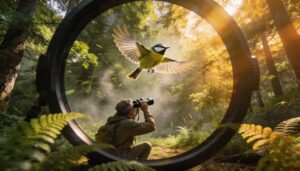
Brightness gets you into the scene — but wide field of view keeps you in it. For birdwatchers, scan speed optimization matters the moment a warbler flushes from cover.
A field of at least 400 ft at 1,000 yards delivers edge-to-edge sharpness, homogeneous illumination across the frame, and peripheral vision integration that makes fast-moving bird detection feel almost instinctive — no constant repositioning required.
ED Glass for Sharper Color Accuracy
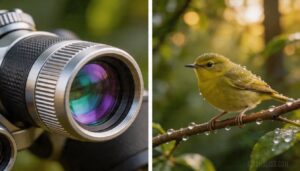
Wide field of view puts the bird in frame — ED glass tells you exactly what you’re looking at. Extra-low dispersion lenses deliver three things that matter for color fidelity in birdwatching species identification:
- Chromatic Aberration Reduction — no color fringing on high-contrast edges
- True Color Rendition — accurate greens and browns when plumage looks nearly identical
- High-Magnification Clarity — ED glass integration keeps distant raptors sharp without distortion
Premium optics with ED glass turn guesswork into certainty.
Fully Multi-coated Lenses and Better Contrast
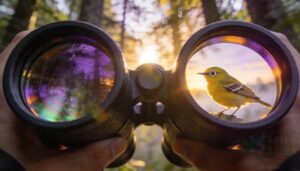
Even after ED glass locks in accurate color, what actually drives that image to your eye is the coating system. High-quality multicoated lenses push light transmission above 90%, so dark feather clarity and shadow detail don’t collapse when a warbler sits backlit against the morning sky.
Multicoatings significantly boost contrast and color fidelity, ensuring subtle features like wing bars and eye rings are instantly separated, while similar olive-brown plumages remain distinct.
| Coating Benefit | Field Impact |
|---|---|
| Contrast Boost | Wing bars and eye rings separated instantly |
| Color Fidelity | Similar olive-brown plumages stay distinct |
Multicoating benefits compound—reducing glare, delivering truer optical performance, and enabling sharper species identification.
Roof Prisms, Phase Correction, and Image Sharpness

Roof prisms keep binoculars slim and field-ready, but the geometry creates a phase split between two light paths — and without phase‑correction coating, that split costs you resolution where it matters most. Roof prism alignment must be nearly perfect, or fine detail goes soft.
What phase correction actually delivers for birders:
- Microcontrast boost that separates feather edges from background noise
- Edge‑to‑edge sharpness across the full field, not just center
- Diffraction loss mitigation along the roof edge’s perpendicular axis
- Crisp plumage detail on shorebirds and small passerines at distance
- A view that feels stable and confident, not washed or hazy
Eye Relief for Eyeglass Wearers
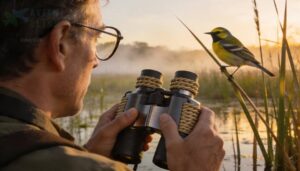
If you wear glasses, eye relief isn’t a minor spec — it’s the difference between seeing the full image and staring at a clipped, vignetting mess. High eye-point design keeps that vantage distance comfort intact, letting you see edge to edge without pressing your frames against the eyecups. Aim for at least 16 mm.
Adjustable eyecups and proper glasses frame fit make the diopter adjustment actually work.
Fast Focus Performance for Moving Birds
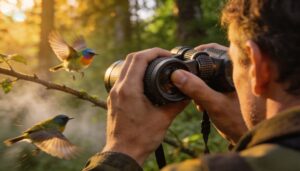
A bird on a branch one second, gone the next — that’s where a central focus wheel earns its place. One smooth rotation covers both barrels simultaneously, so rapid refocusing doesn’t cost you the shot.
The close focus range down to 5–10 feet accommodates birds that dart suddenly close.
Focus smoothness and one-handed adjustment keep fast-moving birds centered without fighting the glass.
Low-Light Optics Give Birders an Edge

Most birds don’t wait for perfect lighting — dawn and dusk are peak activity windows, and that’s exactly when cheap glass starts letting you down.
The optics you carry into those low-light hours determine what you actually see versus what you guess at. Here’s what to look for when the light gets hard.
Why Dawn and Dusk Demand Better Glass
Dawn and dusk are peak activity windows for most species — and the hardest times to see clearly. Your pupils dilate in low light, which increases pupil aberrations and reduces depth perception, softening the fine detail needed for confident IDs. Rod sensitivity takes over from cone vision, so color contrast drops fast. Transient light conditions — shifting between shade and open sky — add eye strain quickly.
That’s why evaluating low-light performance matters when choosing binoculars. High-quality multi-coated lenses and the right objective lens size are critical for overcoming these visual challenges.
How Larger Objectives Collect More Light
Think of the objective lens as a bucket in a rainstorm — a bigger bucket catches more. Aperture area scaling explains why: light gathering follows the square of the diameter, so a 42 mm objective captures noticeably more light than a 32 mm. This directly boosts exit pupil size, improving low-light performance.
Coating efficiency boost and controlled magnification and objective lens size keep brightness-weight tradeoff manageable without sacrificing light transmission.
Reducing Glare in Wooded and Wet Habitats
Glare hits hardest in marshes and under broken canopy, where reflected light off wet leaves or open water can flatten an otherwise strong image.
Anti-Reflective Coatings cut surface reflection losses from roughly 4% down to 0.5% per lens surface, and Lens Shading blocks stray side light before it enters.
Fully multicoated optics paired with Polarized Lenses sharpen wetland contrast dramatically — keeping field marks readable where light bounces worst.
Seeing Detail in Shaded Canopies
Canopy shade presents unique challenges, as Lightfleck Variation creates shifting pockets of Color Shift, causing plumage to flatten faster than expected. Weak lowlight performance further complicates visibility, resulting in Motion Silhouettes rather than distinct bird details.
Strong Shade Contrast and Edge Clarity depend on:
- High objective lens size (42 mm+) for light transmission
- High-quality multicoated lenses that preserve color rendition
- Exit pupil width keeping detail visible through dark gaps
- Phase-corrected optics sharpening texture through Lightfleck Variation
When Image Stabilization Helps Long-range Viewing
Even in good light, long-range birding falls apart fast when hand tremors turn a distant raptor into a blur. That’s where gyro stabilization earns its place — it actively counters shake in real time, giving you Extended Reach Vision that a standard 10x magnification pair simply can’t match handheld.
Canon’s 10x42L IS WP demonstrates how Handheld Zoom Stability transforms long-range birding, especially for Flight Tracking Ease across open water or sky.
| Scenario | Without Stabilization | With Gyro Stabilization |
|---|---|---|
| Raptor observation at distance | Image jitters constantly | Detail holds steady |
| Marine Viewing Aid on moving boat | Nearly unusable | Smooth, trackable view |
| Hand shake reduction at 10x | Fatigue sets in fast | Confident, extended sessions |
Comfort and Durability Matter Outdoors

A great view through the glass means nothing if your hands give out by noon or your binoculars quit in a rainstorm. The best birding pairs are built to go where you go — lightweight enough for all-day carries, tough enough to handle whatever the field throws at them.
Here’s what to look for when comfort and durability are part of the decision.
Lightweight Binoculars Reduce Hand Fatigue
Weight adds up fast when glassing shorebirds for hours. Binoculars built with magnesium construction or a carbon fiber body usually come in under 600 g — sometimes closer to 500 g — which makes a real difference in observation stamina.
Pairing that with reduced barrel length and a lightweight strap system ensures hands stay steadier longer, reducing hand shake and keeping portable binoculars comfortable all day.
Balanced Grip Improves Stability
Grip Pressure Balance — firm but never crushing — eliminates hand tremors, while positioning hands near the eyepieces achieves Lever Arm Reduction. Tucking elbows inward provides Forearm Support and optimizes Weight Distribution.
These Steady Hand Techniques, combined with ergonomic design and smart weight considerations, directly extend observation stamina by enhancing stability and reducing fatigue.
Rubber Armor Helps Protect Against Drops
Rubber armor does more than look rugged — it’s your first line of defense when binoculars slip from a strap or knock against a rocky ledge. The rubberized outer layer delivers genuine Shock Absorption and Impact Shielding, cushioning internal optics before the force reaches them.
Paired with a rugged magnesium chassis, this Rubber Buffering dramatically improves Drop Survivability and overall Field Ruggedness during real birding conditions.
Waterproof Construction for Rain and Wetlands
When you’re stalking shorebirds along a rain-soaked marsh or scanning waterfowl through a downpour, sealed O-ring construction is non-negotiable — it’s what keeps moisture out of the barrel entirely. Quality rainproof optics rely on continuous waterproof membranes and tight joint sealing at every seam and connection point.
Material durability matters here too, since wet weather birding demands weather-resistant housings that do not degrade after repeated soaking.
Fog-proof Nitrogen Filling for Changing Temperatures
Even nitrogen-purged binoculars handle temperature swings that would fog standard optics completely. During the Nitrogen Purge Process, manufacturers remove all moisture-filled air and replace it with dry nitrogen — delivering Moisture-Free Sealing and Thermal Pressure Stability across shifts from -40°C to 50°C. The result is a fogproof, weather-resistant design.
- Clear dawn views without internal condensation interrupting plumage detail
- Corrosion Prevention that extends Long-Term Optic Clarity over years
- Reliable weatherproofing and durability across every habitat you’ll bird
Matching Binocular Size to Travel and All-day Use
Size dictates how long you’ll actually carry them. Compact binoculars for travel and casual use—like an 8×25 at 11 ounces—slip into any bag, making them ideal compact carry options for city trips.
Full-size 8×42s demand strap use guidance to manage their 1.6-pound frame across long sessions. Matching travel-friendly lens sizes to your itinerary is the real key to day-long ergonomics.
Choosing Value Based on Budget and Birding Goals
Your budget tier analysis should start with how often you actually bird — not with price tags. A casual weekend observer doesn’t need what a shorebird fanatic chasing rarities does. Goal-driven choices beat prestige every time.
Buy for how you bird, not for how you want to be seen
- Entry-level ($100–$150): solid waterproof basics for backyard birding
- Midrange ($290–$640): best price-to-performance ratio for most birders
- Premium ($1,000+): fluorite ED glass for serious identification work
- Upgrade planning roadmap: buy once at midrange, skip the cheap cycle
Top 7 Binoculars for Bird Watchers
Finding the right binoculars comes down to matching the glass to how, where, and how often you bird. The options below cover the full range — from budget-friendly entry points to premium optics worth every penny.
Here’s what made the cut for 2026.
1. Celestron Nature DX 8×42 Binoculars
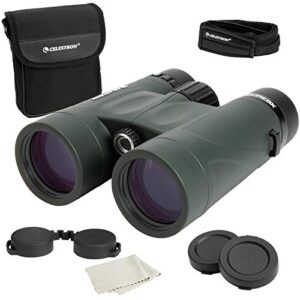
The Celestron Nature DX 8×42 is the go-to entry point for birders seeking real optical performance without overspending. Its 8× magnification ensures a steady handheld view, while 42 mm objectives capture ample light for dim environments like shaded woodlands or dawn patrols.
Phase-coated BaK-4 prisms and fully multi-coated lenses deliver sharp, high-contrast images that exceed expectations for its $100–$150 price range.
Twist-up eyecups and a 6.5 ft close-focus distance enhance versatility, making it ideal for both backyard feeders and marshland observations.
| Best For | Birders, hikers, and outdoor enthusiasts who want solid optical performance without spending a fortune. |
|---|---|
| Magnification | 8× |
| Objective Diameter | 42 mm |
| Waterproof | Yes, nitrogen-purged |
| Eyecup Type | Twist-up |
| Prism/Optics Coating | BaK-4, phase-coated, fully multi-coated |
| Target User | Adult |
| Additional Features |
|
- BaK-4 phase-coated prisms and fully multi-coated lenses give you sharp, bright images that punch well above the price tag
- At 1.75 lb with a rugged, waterproof build, it’s easy to carry all day without feeling like a burden
- Twist-up eyecups and a 6.5 ft close-focus distance make it just as useful at a backyard feeder as in the field
- The eyecup screws have a reputation for loosening over time, which gets annoying fast
- The included neck strap is pretty underwhelming — you’ll probably want to swap it out
- Edge sharpness doesn’t quite match pricier ED glass options, and hand tremors can be an issue without a tripod
2. Vortex Diamondback HD 10×42 Binoculars
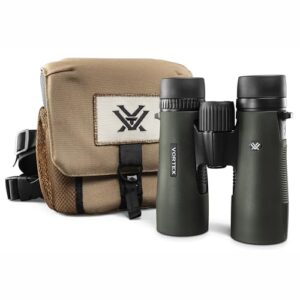
Step up your range, and the Vortex Diamondback HD 10×42 earns serious consideration.
The 10× magnification pulls distant shorebirds and raptors into sharp focus, while the 42 mm objectives and fully multi-coated dielectric lenses keep the image bright through dawn’s dim light.
At 21.3 oz, it won’t wear you down on an all-day outing.
The 330 ft field of view at 1,000 yards tracks moving birds reliably.
Vortex’s unconditional lifetime warranty backs every purchase without fine print.
| Best For | Birders, hunters, and outdoor enthusiasts who want solid HD optics and a bombproof warranty without paying flagship prices. |
|---|---|
| Magnification | 10× |
| Objective Diameter | 42 mm |
| Waterproof | Yes, argon-purged |
| Eyecup Type | Twist-up |
| Prism/Optics Coating | Fully multi-coated, dielectric, Armortek |
| Target User | Adult |
| Additional Features |
|
- Sharp, color-accurate images thanks to fully multi-coated dielectric lenses — great from dawn into midday
- Built tough with argon-purged, waterproof barrels and rubber armor that handles rain and rough handling
- Vortex’s unconditional lifetime warranty is as good as it gets — no hoops to jump through
- The focus wheel is very sensitive, which makes dialing in fine adjustments a bit tricky
- The diopter has no lock, so it can drift out of position in a bag or pack
- Low-light performance is decent but won’t match larger-objective or higher-end glass
3. Nikon Monarch HG 8×42 Binocular
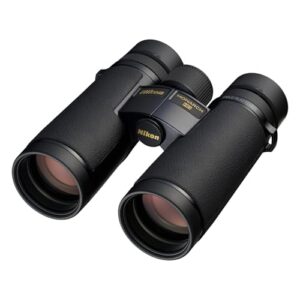
If the 10× magnification feels like too much reach for your style, the Nikon Monarch HG 8×42 offers a compelling alternative—delivering a wide, bright, and remarkably sharp edge-to-edge view. Its Field Flattener Lens System justifies the claim with a 145-meter field of view at 1,000 meters, minimizing distortion at the margins.
The binoculars excel optically, thanks to ED glass and phase-correction coatings, which elevate color accuracy and contrast beyond expectations for its price range.
At 665 grams with a magnesium chassis, it ensures comfortable all-day carry, while the locking diopter securely preserves your personalized focus setting.
| Best For | Birders, wildlife watchers, and outdoor enthusiasts who want premium optics in a lightweight, weather-ready package without going full top-tier budget. |
|---|---|
| Magnification | 8× |
| Objective Diameter | 42 mm |
| Waterproof | Yes, 5 m rated |
| Eyecup Type | Turn-and-slide |
| Prism/Optics Coating | ED glass, dielectric, phase-correction |
| Target User | Adult |
| Additional Features |
|
- Edge-to-edge sharpness is genuinely impressive—the Field Flattener Lens System actually delivers on its promise
- ED glass and phase-correction coatings punch well above the price point for color accuracy and contrast
- Tough magnesium chassis, fully waterproofed, and light enough to wear all day without neck fatigue
- At around $979, it’s a serious investment—not a casual purchase
- The insert-style objective lens caps are a minor but real annoyance compared to pop-off designs on rival models
- Optically excellent, but Swarovski and Zeiss still have a slight edge if you’re chasing absolute perfection
4. Swarovski CL Companion Binoculars
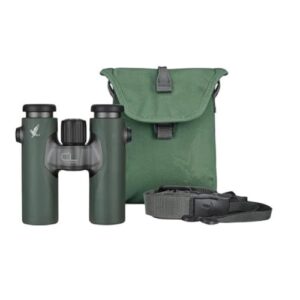
Where the Nikon trades on value, the Swarovski CL Companion 8×30 trades on refinement. At $1,469, it’s a serious investment — but what you’re buying is 90% light transmission, an 8.0-degree field of view, and a 550 g body that won’t punish your neck on a six-hour walk.
The 30 mm objective is more compact than a 42 mm, so low-light performance has limits. However, in daylight, tracking a warbler through dense canopy feels almost smooth.
| Best For | Birders, hunters, and sightseers who want a refined, compact optic and are willing to pay a premium for top-tier glass and craftsmanship. |
|---|---|
| Magnification | 8× |
| Objective Diameter | 30 mm |
| Waterproof | Not specified |
| Eyecup Type | Not specified |
| Prism/Optics Coating | Not specified |
| Target User | Adult |
| Additional Features |
|
- Exceptional 90% light transmission delivers strikingly clear, bright images in daylight
- Compact 8×30 form factor is easy to carry on long days out without neck or shoulder fatigue
- The Urban Jungle green finish looks sharp and blends naturally with outdoor gear
- At $1,469, it’s a tough sell for casual users or anyone just getting into the hobby
- The 30 mm objective struggles in low-light situations compared to larger 42 mm alternatives
- Not a great fit for kids or anyone with limited grip strength
5. Bushnell Legend Ultra HD Binoculars
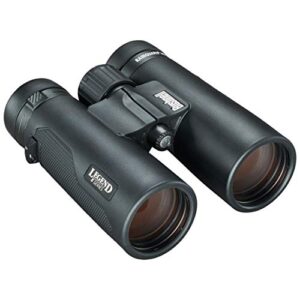
At roughly half the price of the Swarovski CL Companion, the Bushnell Legend Ultra HD 10×42 punches well above its tier.
ED Prime glass cuts color fringing noticeably, and the fully multi-coated lenses with Ultra Wide Band coating deliver strong contrast across bright-edge and shaded conditions alike.
The magnesium chassis keeps weight at around 700 g — solid without feeling punishing.
It’s waterproof, fog-proof, and backed by a lifetime warranty, making it a practical, long-term choice for serious field work.
| Best For | Outdoor enthusiasts, hikers, and wildlife watchers who want high-quality glass and a wide field of view without spending premium money. |
|---|---|
| Magnification | 10× |
| Objective Diameter | 42 mm |
| Waterproof | Not rated |
| Eyecup Type | Twist-up silicone |
| Prism/Optics Coating | Fully multi-coated |
| Target User | Adult |
| Additional Features |
|
- Huge 340 ft field of view makes it easy to track moving subjects — great for birding, sports, or scanning open landscapes
- Wide, comfortable eyecups work well with glasses, so you can use them all day without fatigue
- Light enough at 1.43 lb to carry on long hikes without it becoming a burden
- The diopter adjustment ring’s O-ring has been reported to wear out or stiffen up after a few months of regular use
- Slight brightness drop toward the edges can show up in tricky lighting situations
- No confirmed waterproof or fog-proof rating, which is a real concern if you’re out in rain or humid conditions
6. Swarovski NL Pure 8×32 Binoculars
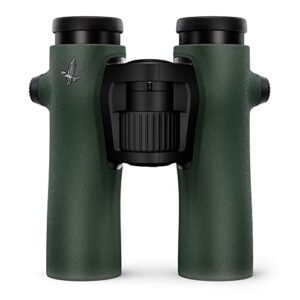
The Swarovski NL Pure 8×32 is built for birders who refuse to compromise on optical quality but don’t want to haul a heavy setup all day.
At 640 g, it’s the most compact model in the NL Pure line—yet it delivers a 492 ft field of view, sharp edge-to-edge clarity via ED glass and field-flattener optics, and a 2 m close-focus distance.
The 18 mm eye relief works well for eyeglass wearers, while the waterproof, nitrogen-filled construction ensures durability in challenging field conditions.
| Best For | Serious birders and wildlife watchers who want top-tier optics in a compact, all-day carry package. |
|---|---|
| Magnification | 8× |
| Objective Diameter | 32 mm |
| Waterproof | Yes, sealed |
| Eyecup Type | Adjustable |
| Prism/Optics Coating | SwaroVision proprietary coatings |
| Target User | Adult |
| Additional Features |
|
- Exceptional image clarity with true-to-life color and sharp detail, even at the edges — great for spotting feather patterns fast.
- Wide 492 ft field of view makes tracking birds in flight or across open terrain feel effortless.
- Comfortable and balanced design holds up well on long days in the field without straining your hands or eyes.
- At $2,799, it’s a serious investment that puts it out of reach for a lot of casual hobbyists.
- The lens cover straps can loosen over time, which gets annoying when you’re setting the binos down between watches.
- Rubber grip and metal hardware have some durability quirks — the strap slider is slick enough to chip teeth, and the grip may degrade in hot, humid climates.
7. GPO Passion ED 8×42 Magnesium Binoculars
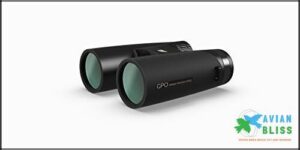
The GPO Passion ED 8×42 is where serious birding meets sensible spending. At $501, it sits at the upper edge of mid-range, yet its magnesium body, ED glass, and GPObright multi-layer coatings deliver performance exceeding its price.
Its specifications cater to all-day use: 8x magnification, a 426-foot field of view, and 18 mm eye relief. The 1.8-meter close-focus distance ensures crisp views of nearby subjects, like warblers. These features form a solid optical package for extended scanning.
Minor drawbacks include slight play in the focus knob and the absence of included lens caps. Still, the optical package remains hard to beat at this price point.
| Best For | Birders, hunters, and sports fans who want serious optical performance without crossing into flagship price territory. |
|---|---|
| Magnification | 8× |
| Objective Diameter | 42 mm |
| Waterproof | Yes, fully sealed |
| Eyecup Type | Adjustable aluminum |
| Prism/Optics Coating | ED glass, GPObright multi-layer |
| Target User | Adult |
| Additional Features |
|
- ED glass with GPObright multi-layer coatings gives you sharp, high-contrast views with minimal color fringing
- Magnesium alloy build keeps it light enough for all-day use while still feeling solid in hand
- Fully waterproof and fog-proof, so rain or humidity won’t stop your session
- The focus knob has a bit of play, which can make dialing in precise focus a little frustrating
- Lens caps aren’t included in the box — you have to ask for them separately
- Edge sharpness and brightness fall slightly behind premium rivals, especially noticeable in low light or high-contrast scenes
Frequently Asked Questions (FAQs)
What is the best strength of binoculars for bird watching?
For most birders, 8x is the sweet spot. It’s steady enough to hold by hand, bright enough for shaded woodland, and wide enough to catch fast-moving birds before they vanish.
How much should I spend on birding binoculars?
Most birders find the sweet spot between $240 and $650 — enough to get sharp optics, smooth focus, and real field performance without spending premium prices you may not yet need.
How often should binoculars be professionally cleaned?
There’s no universal schedule — it depends on how you use them. Fair-weather birders might go 15–20 years between professional cleanings, while those birding beaches or marshes may need service far sooner.
Can binoculars damage your eyes with extended use?
Extended use won’t damage your eyes, but it can cause fatigue, headaches, and dryness. Misaligned IPD or skipped breaks are usually the real culprits — not the binoculars themselves.
Are used or refurbished binoculars worth buying?
Yes — used or refurbished binoculars are worth it, especially mid- to high-end models.
You can save 30–50 percent while getting equivalent optical performance, provided the lenses are clean and collimation is intact.
Do binoculars work well with camera attachments?
Binoculars can work with camera attachments, but image sharpness rarely matches a dedicated lens. Smartphone adapters and tripod mounts help, though results suit casual sharing more than serious documentation.
What warranties do birding binocular brands offer?
Warranty coverage varies widely by brand.
Vortex stands out with an unconditional lifetime warranty — no questions asked.
Swarovski and Zeiss both offer lifetime optical coverage, while Nikon provides 10 years on optics.
Conclusion
Clearly, optics matter—and that pun is fully intended. The bird doesn’t wait: every outing, you’re either equipped to confirm what you’re seeing or you’re not. No amount of field experience closes that gap when your glass lets you down.
The seven pairs listed here earn their place across real birding conditions. Choose the one that fits your budget and go see something worth remembering.
- https://www.bestbinocularsreviews.com/
- https://www.allaboutbirds.org/news/bird-id-skills-field-marks/
- https://indianaaudubon.org/2025/11/18/birding-101-using-external-anatomy-to-understand-birds/
- https://www.ornitheology.com/post/getting-started-in-birdwatching-learn-to-describe-a-bird
- https://www.birdwatchingdaily.com/birds/david-sibleys-id-toolkit/appreciating-wingbars/