This site is supported by our readers. We may earn a commission, at no cost to you, if you purchase through links.
Birding doesn’t wait for good weather. The marsh harrier you’ve tracked for an hour doesn’t pause because rain starts falling, and the morning mist over an estuary often holds the most interesting species. That’s exactly where ordinary binoculars start letting you down—fogged lenses, water-streaked glass, and the creeping dread of moisture working its way inside.
Waterproof binoculars solve a problem every serious birder eventually faces: the field is wet, unpredictable, and unforgiving on gear. Nitrogen-purged optics, O-ring seals, and hydrophobic lens coatings aren’t just marketing specs—they’re the difference between a ruined session and a clear, steady view of a bird you’ve waited months to spot.
The five models ahead cover a range of sizes, magnifications, and price points, so you can find the right pair for how and where you bird.
Table Of Contents
Key Takeaways
- Waterproof binoculars with nitrogen purging, O-ring seals, and hydrophobic lens coatings aren’t optional upgrades — they’re what keep your view clear when rain, mist, and temperature shifts would otherwise shut your session down.
- For birding, the sweet spot is 8x–10x magnification paired with a 42mm objective lens, giving you a wide field of view, a bright image in low light, and enough stability to track fast-moving birds without a tripod.
- IPX7-rated, rubber-armored builds aren’t just marketing — they mean your binoculars can handle saltwater spray, freezing temps, accidental drops, and years of hard field use without fogging or failing inside.
- The five models reviewed span a range of sizes and price points, but the consistent standouts share BAK4 prisms, full multi-coatings, and fogproof construction — features that separate genuinely field-ready optics from gear that looks good on a shelf.
Why Waterproof Binoculars Help Birders
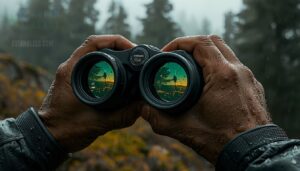
Waterproof binoculars aren’t just a nice upgrade — for most birders, they’re the difference between a frustrating outing and a great one. Weather rarely cooperates, and your optics shouldn’t be the reason you pack up early.
Understanding what makes binoculars worth the investment for birders helps you stop guessing and start choosing gear that actually holds up in the field.
For most birders, waterproof binoculars are the difference between a frustrating outing and a great one
Here’s why waterproof models consistently come out on top.
Clearer Views in Rain, Humidity, and Mist
When rain rolls in mid‑session, waterproof binoculars keep your view sharp where standard optics blur.
Hydrophobic Lens Coatings bead water off instantly, while Anti‑Glare Treatments cut reflections off wet surfaces.
Enhanced Light Transmission and Mist Scattering Reduction preserve Edge‑to‑Edge Clarity even in heavy haze.
- Repels raindrops for uninterrupted lowlight performance
- Reduces glare on rain‑slicked surfaces
- Maintains contrast in humid, misty air
- Preserves sharp edges through haze
- Keeps your rainproof view stable at dawn
Reduced Internal Fogging for Steady Image Quality
Even after the rain clears, fogging from temperature shifts can still blur your view. That’s where nitrogen purged, fogproof waterproof binoculars earn their keep — Thermal Management Design and Moisture Absorbing Materials stabilize the internal environment, while Seal Material Innovation and Temperature Gradient Control keep condensation out for good.
| Fog Prevention Feature | What It Does |
|---|---|
| Nitrogen Purging | Displaces moist air inside the housing |
| Hydrophobic Lens Coatings | Repels water from lens surfaces |
| O-ring Seals | Blocks external moisture intrusion |
| Thermal Management Design | Reduces condensation during temp swings |
| Moisture Absorbing Materials | Maintains dry internal microclimate |
Your birdwatching optics stay fog-free, delivering consistent image clarity across changing conditions. A high transmission anti‑reflective coating can further improve clarity while repelling moisture.
Better Durability for Frequent Outdoor Use
Fog-free optics are only part of the story — your gear also needs to hold up to the knocks of real field use.
Impact-Resistant Housing and Lightweight Alloy Frames keep things sturdy without weighing you down, while rubber armor and Reinforced Grip Texturing prevent slips on wet mornings.
UV Stabilized Plastics resist sun damage, and Drop Test Certified, nitrogen purged, weatherproof gear with rugged design and shock resistance simply lasts longer.
Longer Birding Sessions in Changing Weather
Durable gear that survives the field naturally keeps you out there longer. With a waterproof and fogproof design, you won’t cut sessions short just because the sky turns moody.
Adaptive Comfort Features like adjustable eye relief and Modular Carry Solutions let you stay focused for hours.
Thermal Stabilization and low light performance, and changing weather stops feeling like a reason to pack up.
For even more on navigating tricky conditions, birding optics built for low-light and all-weather use breaks down what IPX7 ratings and nitrogen purging actually mean in the field.
Key Features for Birding Optics
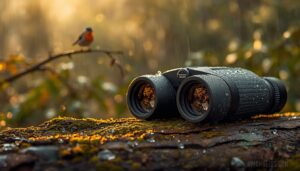
Not every pair of binoculars is built for birding, and the difference really shows in the field. A few key features separate a frustrating experience from a great one.
Here’s what to look for before you buy.
8x to 10x Magnification for Stable Handheld Viewing
Most birders find their sweet spot between 8x magnification and 10x magnification — and for good reason. Here’s why that range works so well in the field:
- Angular Shake Reduction stays manageable at 8x, keeping birds in frame without a tripod
- Field of View stays wide enough to track fast-moving species through dense canopy
- Exit Pupil Size remains bright, especially useful at dawn or dusk
- Eye Relief of 15mm+ ensures comfortable viewing, even with glasses
- Focus Mechanism Speed paired with Image Stabilization on select 10x models sharpens distant detail without Hand Grip Ergonomics suffering
25 Mm to 42 Mm Objective Lenses for Light Gathering
Think of objective lens diameter as your binoculars’ window to the world — the bigger it is, the more light rushes in.
A 42mm objective lens dramatically outperforms a 25mm in low light performance, gathering roughly four times more light. For dawn or dusk birdwatching, that diameter brightness boost is everything.
Quality coating efficiency and a healthy exit pupil keep your waterproof binoculars delivering sharp, bright images when it matters most.
Wide Field of View for Tracking Moving Birds
When a warbler darts through a gap in the canopy, you have about one second to lock on. That’s where a wide field of view earns its keep.
Look for at least 250 ft at 1,000 yards — it facilitates rapid reacquisition, flock tracking, and better depth cues for motion perception.
Strong edge contrast keeps birds crisp against shifting backgrounds, making your waterproof binoculars genuinely work harder during real bird watching adventures.
Lightweight Designs for All-day Comfort
heavy pair of binoculars will wear you down long before the birds stop moving. That’s why magnesium alloy frames and soft touch coating matter — they shave 15–25% off the weight while keeping your grip secure.
Padded neck straps and breathable mesh padding spread the load across your shoulders, and a centered balance point means your arms stay fresh for hours.
Eye Relief for Eyeglass Wearers
If you wear glasses, eye relief can make or break your birding experience. Look for at least 15–16 mm of long eye relief so you get a full, edge-to-edge view without pressing your lenses against the eyepiece.
Adjustable eyecups twist up or fold down to dial in your comfortable viewing distance. A glasses-friendly design on waterproof binoculars keeps that clear sight picture steady — even in the rain.
Waterproof Sealing and Fog Prevention
A good pair of waterproof binoculars isn’t just about keeping the rain out — it’s about what happens on the inside, too.
The sealing technology built into quality birding optics is what separates a reliable field companion from one that fogs up the moment temperatures shift.
Here’s what to look for concerning waterproof construction and fog prevention.
O-ring Seals That Block Water Intrusion
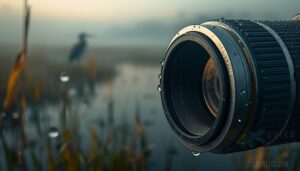
A tiny rubber ring is quietly doing heavy lifting inside your waterproof birding binoculars. O-ring seals sit in precision-machined grooves — gland design matters here — and compress against mating surfaces to block every drop.
Material selection, usually FKM or silicone, ensures seal longevity even in saltwater coastal habitats.
IPX7 waterproof design and standardized testing methods confirm that seal integrity holds, keeping your view fogproof and clear.
Nitrogen or Argon Purging to Prevent Fogging
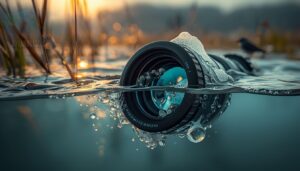
Once the O-rings seal out water, the next problem is the air already trapped inside. That’s where nitrogen purging comes in.
Manufacturers flush moist air out and replace it with dry nitrogen or argon fill, dropping internal dew point control to below -70°C. This fogproof design keeps oxygen thresholds under 2%, so your view stays crystal clear when temperatures shift fast.
Rubber Armor for Grip and Shock Resistance
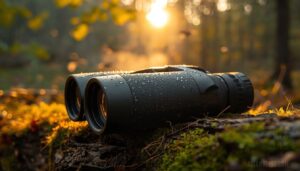
Beyond keeping moisture out, your binoculars also need to survive a day in the field. Rubber armor manages that job well.
Its granulated texture stays grippy even with wet hands, while temperature flexibility keeps it from cracking in cold or heat.
Viscoelastic shock damping absorbs accidental knocks, and UV durability prevents surface cracking over seasons.
Modular grip replacement means you won’t retire a solid pair just because the outer layer wears down.
IPX-rated Protection for Wet Field Conditions
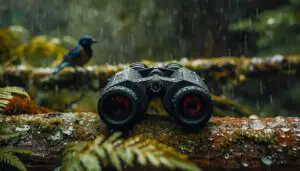
That rubber armor pairs naturally with a rating system you can actually trust — the IPX Certification Process.
Think of IPX ratings as a field-tested promise:
- IPX4 — manages rain splash resistance during typical showers
- IPX5 — survives heavy downpours and rinse-offs
- IPX7 — Water Immersion Benchmarks confirm protection up to 1 meter for 30 minutes
- IPX8 — built for prolonged submersion
Your waterproof binoculars stay fogproof and weatherproof through Humidity Condensation Control and solid Field Drying Protocols, keeping birdwatching sessions uninterrupted.
Corrosion-resistant Builds for Coastal Birding
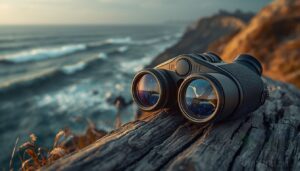
Coastal birding puts your gear through a punishing gauntlet — salt spray, humid sea air, and constant moisture. That’s where marine-grade alloys, anodized aluminum frames, and titanium hinges earn their keep.
PVD coating adds a hard, salt-resistant shell over the housing, while salt-spray testing confirms real-world durability. Combined with rubber armor and waterproof seals, these durable eco-friendly materials make your binoculars genuinely ready for marine use.
Top 5 Waterproof Birding Binoculars
Choosing the right binoculars doesn’t have to feel overwhelming. There are a handful of waterproof models that consistently stand out for birding — each one hitting a different sweet spot of magnification, weight, and price.
Here are five worth a close look.
1. Occer 12×25 Waterproof Compact Binoculars
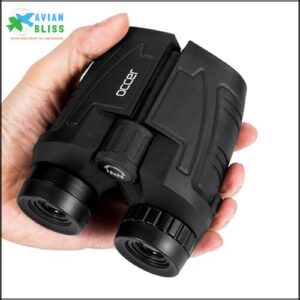
The Occer 12×25 punches above its size for casual birders who want portability without sacrificing too much clarity.
At under 0.6 pounds, you can carry it all day without your neck paying the price.
The 12x magnification brings distant birds in close, and BAK4 prisms keep edges sharp.
Its waterproof ABS housing with rubber armor manages rain and rough handling well.
The 15mm eye relief means eyeglass wearers won’t miss a thing — a small detail that makes a real difference in the field.
| Best For | Casual birders, hikers, and travelers who want lightweight, portable binoculars that work well for everyday outdoor use without breaking the bank. |
|---|---|
| Magnification | 12× |
| Objective Lens | 25 mm |
| Prism Type | BAK4 |
| Lens Coating | FMC Broadband |
| Waterproof | Yes |
| Eyecup Type | Twist-up/down |
| Additional Features |
|
- Compact and light enough to carry all day without fatigue
- Adjustable eyecups make it comfortable for eyeglass wearers
- BAK4 prisms with broadband coatings deliver solid image clarity for the size
- Small 25mm objective struggles in low light or dim conditions
- No nitrogen purging means fogging can be an issue in cold or humid weather
- 12x magnification can feel shaky hand-held, making it harder to get a stable view
2. Flynant 20×50 Waterproof Binoculars
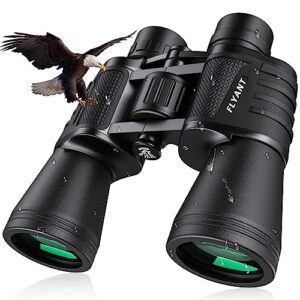
Flynant 20×50 is built for serious distance work — its 20x magnification and 50mm objective lenses pull in fine detail when you’re scanning a far treeline at dawn. BAK4 prisms and full multi-coating deliver solid light transmission, so early morning sessions don’t leave you squinting.
rubber-armored housing tolerates rain and rough terrain without complaint, and the central focus wheel works smoothly with one hand.
Just note that hand shake at 20x is real — a tripod adapter helps a lot.
| Best For | Outdoor enthusiasts, birdwatchers, and hunters who want strong long-range magnification on a budget and don’t mind using a tripod for steady views. |
|---|---|
| Magnification | 20× |
| Objective Lens | 50 mm |
| Prism Type | BAK4 Porro |
| Lens Coating | Full Multi-Coating |
| Waterproof | Splash-resistant |
| Eyecup Type | Fixed ergonomic |
| Additional Features |
|
- BAK4 prisms and full multi-coating pull in solid light — great for low-light dawn or dusk sessions
- Rubber-armored housing handles bumps, drops, and light rain without babying
- Central focus wheel is smooth and easy to operate with one hand
- Real-world magnification may land closer to 10x than the claimed 20x
- No tripod mount included, and at high magnification, hand shake makes steady viewing tough
- Not ideal for glasses wearers — the eyepiece design can cut down your field of view
3. Gigapenguin 15×52 HD Binoculars
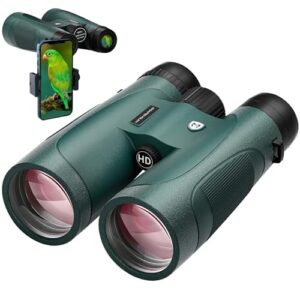
If you want serious reach without spending serious money, the Gigapenguin 15×52 HD is worth a look. Its 52mm objective lenses pull in light well during dawn and dusk sessions, and the BAK4 dielectric-coated prisms keep colors true and contrast sharp.
You get a 22mm eyepiece for comfortable viewing and a built-in smartphone adapter for quick digiscoping moments.
At $68.86 and roughly 1 kg, it’s heavier than compact options — a tripod helps steady that 15x magnification considerably.
| Best For | Bird watchers, wildlife observers, and stargazers who want strong long-range performance on a budget and don’t mind carrying a bit of extra weight. |
|---|---|
| Magnification | 15× |
| Objective Lens | 52 mm |
| Prism Type | BAK4 Roof |
| Lens Coating | Full Multi-Coating |
| Waterproof | Yes |
| Eyecup Type | Twist-down |
| Additional Features |
|
- 52mm lenses and BAK4 dielectric prisms pull in light beautifully, making dawn and dusk sessions genuinely usable
- The 22mm eyepiece gives a comfortable, wide view — and the twist-down eyecups work well whether you wear glasses or not
- Built-in smartphone adapter means you can snap photos of distant subjects without carrying extra gear
- 15x magnification amplifies every hand tremor, so you’ll really want a tripod for steady viewing
- At nearly 1 kg, it’s noticeably heavier than compact binoculars — long hikes will remind you of that
- The included carrying case is pretty basic and won’t hold up well in rough field conditions
4. Adasion 12×42 HD Waterproof Binoculars
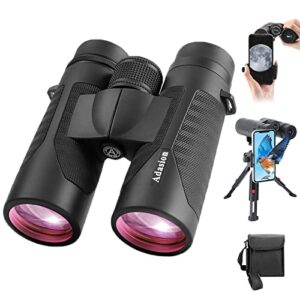
The Adasion 12×42 HD punches above its price tag for everyday birding. You get 12× magnification with a 367 ft/1,000 yd field of view — wide enough to track a warbler darting through dense canopy without losing it.
BAK4 prisms and fully multi-coated lenses keep images bright even at dawn. IPX7 waterproofing manages rain without fuss.
At just 1.2 lb with twist-up eyecups, it’s comfortable all day, and the included phone adapter makes spontaneous digiscoping genuinely easy.
| Best For | Casual birders, wildlife watchers, and travelers who want solid optics and smartphone-ready features without spending a fortune. |
|---|---|
| Magnification | 12× |
| Objective Lens | 42 mm |
| Prism Type | BAK4 Roof |
| Lens Coating | Full Multi-Coating |
| Waterproof | IPX7 |
| Eyecup Type | Twist-up |
| Additional Features |
|
- 12× magnification with BAK4 prisms and multi-coated lenses delivers bright, sharp images — impressive for the price point
- IPX7 waterproofing and fog-proof build mean you can take it out in real-world weather without babying it
- At 1.2 lb with adjustable eyecups, it’s comfortable for long sessions whether you wear glasses or not
- The phone adapter needs careful alignment to avoid the dark vignetting around the edges, which takes some patience to dial in
- Packing everything back into the case is a bit of a puzzle — the velcro flap struggles to close when you’ve got all the accessories in there
- Optical quality is solid for everyday use, but don’t expect it to keep up with premium glass in true low-light or extreme long-range situations
5. Aurosports Compact 10×25 Binoculars
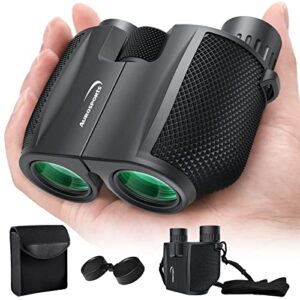
Sometimes the best birding companion fits right in your jacket pocket.
The Aurosports 10×25 weighs just 0.5 lb and delivers 10× magnification through BAK4 prisms and fully multi-coated lenses — so you’re not sacrificing image quality for convenience.
Adjustable eye width makes it comfortable for kids and adults alike, and the rubber armor manages wet mornings without complaint.
It won’t replace a full-sized 42 mm optic for low light, but for casual outings and travel birding, it’s a smart, lightweight pick.
| Best For | Casual birders, families, and travelers who want a lightweight, pocket-friendly optic for outdoor adventures, concerts, or stadium events. |
|---|---|
| Magnification | 10× |
| Objective Lens | 25 mm |
| Prism Type | BAK4 |
| Lens Coating | Full Multi-Coating |
| Waterproof | Not stated |
| Eyecup Type | Silicone shock-absorbing |
| Additional Features |
|
- BAK4 prisms and fully multi-coated lenses give you a clear, bright image in a surprisingly small package
- At just 0.5 lb, it’s easy to toss in a jacket pocket or daypack without a second thought
- Adjustable eye width means kids and adults can both use it comfortably
- The fabric strap feels flimsy and has a habit of detaching with regular use
- Lens caps aren’t attached, so losing them is just a matter of time
- Glasses wearers may struggle to get a clean view, and some lighting conditions can produce an annoying halo effect
Frequently Asked Questions (FAQs)
How do I clean waterproof binoculars properly?
Rinse lenses with lukewarm fresh water, then gently wipe with a microfiber cloth. Skip paper towels — they scratch coatings.
Use lens solution only for stubborn smudges, and always keep caps on during storage.
Can waterproof binoculars be used for marine wildlife?
waterproof binoculars work great for marine wildlife.
They handle salt spray, sea mist, and humidity well, giving you clear, steady views of dolphins, seabirds, and whales from shore or a wet deck.
Do waterproof binoculars work in freezing temperatures?
Freezing temps? Waterproof binoculars handle them better than most birders expect.
Nitrogen purging keeps internal lenses fog-free, O-rings seal out snowmelt, and rubber armor stays grippy even when your fingers don’t.
How long do O-ring seals typically last?
O-ring seals usually last one to ten years, depending on the material and conditions.
With proper care and storage, birding binoculars maintain solid waterproof integrity for five or more years.
Are waterproof binoculars safe for children to use?
Waterproof binoculars are generally safe for kids, especially models with rubber armor, breakaway neck straps, and lightweight builds under 500 grams. Adult supervision and a proper fit make all the difference.
Conclusion
Cheap binoculars look fine on a shelf—but hand them to a birder standing in a coastal marsh at dawn, and they fail exactly when it matters most.
That’s why waterproof binoculars are best for birding: they hold up where the best sightings actually happen. Rain, mist, and humidity don’t pause for inferior gear.
The five models covered here give you reliable optics built for real conditions, so the only thing you’re focused on is the bird.