This site is supported by our readers. We may earn a commission, at no cost to you, if you purchase through links.
Most birders remember their first confirmed sighting with startling clarity—the exact light, the angle of the branch, the split second before the bird moved. What they can’t remember, six months later, is where it happened or what the weather was doing. Memory is a poor field notebook.
Starting a bird watching journal fixes that gap, turning fleeting observations into a personal database that compounds in value the longer you keep it. The right setup—format, tools, and entry habits—makes the difference between a journal you’ll actually use and one that stalls after week two.
Table Of Contents
- Key Takeaways
- Choose Your Bird Journal Format
- Set Up Your First Entry
- Organize Notes for Better Tracking
- Top 5 Bird Watching Journals
- Frequently Asked Questions (FAQs)
- What are the 5 S’s of birdwatching?
- What is the 60/40 rule for birds?
- What do people put in a bird watching journal?
- Can kids start a bird watching journal too?
- How do I journal birds seen while traveling abroad?
- Should I join a local birding club as a beginner?
- How do I handle duplicate sightings of the same bird?
- Can bird journal data help with conservation efforts?
- Conclusion
Key Takeaways
- Your format choice — paper, digital, or hybrid — shapes whether your journaling habit actually sticks, so pick the one that fits how you already move through the field, not the one that sounds ideal in theory.
- Every entry needs the same core data: date, time, GPS coordinates, weather conditions, and both common and scientific species names — without that consistency, your notes can’t reveal patterns over time.
- Adding confidence ratings to each ID keeps your data honest and, over time, measurably sharpens your identification threshold against confirmed sightings.
- Monthly summaries and seasonal logs transform scattered field notes into something genuinely powerful — migration timing, habitat shifts, and species diversity trends that would stay invisible in raw entries alone.
Choose Your Bird Journal Format

The format you choose shapes everything — how much you write, what you track, and whether the habit sticks. no single right answer, just the one that fits how you actually move through the world.
what to think about before you commit.
Physical Vs. Digital Bird Watching Journals
Both formats have real strengths — and real trade-offs. A paper field log gives you tactile feedback and zero battery dependence, working reliably in any weather.
A good notebook pairs naturally with well-chosen optics, and beginner birding tips and essential gear guides can help you build a reliable kit from the start.
A digital field notebook offers searchability features, instant data backup, and direct syncing with tools like the eBird Mobile App. Using consistent naming conventions helps keep your database organized.
Consider your workflow:
- Field conditions
- Recording speed
- Long-term data needs
Pocket Notebook Vs. A5 Size
Size matters more than you’d think. Pocket notebooks — around 3.5 by 5.5 inches — win on portability comparisons and one-handed field use, though the limited writing surface area means tighter entries.
A5 size opens up your journal layout considerably, giving you room for detailed sketches and longer notes. carry method flexibility and typical birding style should drive that choice.
Weather-resistant Paper for Field Use
Portability sorted — now think about what happens when the skies open up.
Rite in the Rain, Synthetic Stone Paper, and Yupo Synthetic Sheets all handle rain without smearing, thanks to strong ink compatibility with ballpoint and gel pens.
Tear resistance runs 3–5x higher than standard paper, and UV protection keeps entries legible for years.
Temperature tolerance from -20 to 60°C means these all-weather notebooks for field birding perform through every season.
Some even use eco-friendly materials — a solid bonus.
Essential Tools for Beginner Birders
Weather-proof paper manages the rain — but the right gear manages everything else.
Start with 8×42 binoculars specs for solid magnification without shaky hands.
Pair that with a pocket-sized field guide and a bird ID app for quick cross-referencing.
GPS tagging locks in exact sighting locations, an audio memo captures calls instantly, and waterproof clothing keeps you in the field longer.
Hybrid Notebook and App Workflow
A hybrid digital and paper workflow gives you the best of both worlds.
Capture sightings offline in your pocket notebook, then sync everything later — the app manages auto tagging, voice transcription, and GPS embedding automatically.
Cross-device access means your data lives everywhere, and smooth sync keeps eBird checklists current without double entry.
It’s a clean system that actually holds up in the field.
Set Up Your First Entry
Your first entry sets the tone for everything that follows — get it right, and the habit sticks.
There’s a handful of key details every solid bird journal entry needs, and once you know them, logging becomes second nature.
Here’s what to capture from the start.
Record Date, Time, and Location

Every sighting tells a story — but only if you record it precisely.
Log the date using ISO 8601 formatting (2026-04-26), time in 24-hour format, and include time zone specification to avoid confusion across regions.
Note the exact site name, elevation, and nearby landmarks.
This metadata completeness and field data standardization ensure your entries stay consistent, comparable, and ready for long-term analysis.
Add GPS Coordinates for Each Sighting

pin on a map means nothing without precision behind it. Record your GPS coordinates in decimal degrees — latitude and longitude, both, to at least five decimal places — and note the datum used (WGS84 or NAD83) for datum consistency across entries.
Flag any weak-signal readings immediately. Geotagged photos reinforce your georeferenced observations, while mapping integration lets you visualize sighting clusters with satisfying clarity.
Note Weather, Habitat, and Effort

Think of conditions as context — without them, your field notes are just a list.
Log temperature influence and wind effects first: a 20 km/h gust pushes birds into shrubs and kills distant detections.
Note habitat classification — open field, forest edge, pond margin — then effort recording: exact start and end times.
Barometric correlation matters too; pressure drops often precede visible passerine movement worth tracking in your birdwatching journal.
Log Common and Scientific Names

Two names per species — that’s the rule. Write the common name first for quick field communication, then follow it with the binomial: genus capitalized, species epithet lowercase, both italicized — Turdus migratorius, not "turdus Migratorius."
Regional name variations make synonym cross-referencing essential for solid species documentation.
Authority citation practices matter in formal records, but for daily entries, consistent binomial formatting guide habits that keep your species index clean and your bird species identification data airtight.
Use Confidence Ratings for Identification

Not every sighting is a sure thing — that’s where confidence ratings earn their place. Add a simple three-point scale to your birdwatching journal: strong, possible, or unknown.
This rating scale design keeps your bird species identification honest and your data validation tight. Regular calibration against confirmed sightings sharpens your threshold determination over time, making your identification confidence genuinely meaningful rather than just a gut feeling.
Organize Notes for Better Tracking

Raw notes are only useful if you can actually find what you’re looking for later. little structure goes a long way — the right system turns scattered observations into a dataset you can genuinely learn from.
organize your entries so every sighting counts.
Create a Simple Code Key
Build your personal coding system before your first field session—retrofitting one later is a headache. A well-designed code key keeps your birding journal organization tight and your entries scannable at a glance.
- Sheet Placement – Tape your reference sheet inside the front cover.
- Abbreviation Standards – Use 2–4 characters; avoid ambiguous letters.
- Color Coding – Assign colors to confidence levels or habitat types.
- Key Expansion – Leave blank rows for new species without rebuilding your species index pages.
Track Species, Behavior, and Vocalizations
With your code key in place, every entry gets sharper. Log each species using both common and scientific names, then record observation duration precisely — it matters for data validation flags later.
Note foraging postures, territorial displays, and interaction counts between individuals.
For bird calls, categorize by type: alarm, contact, or song.
Habitat correlation and acoustic indexing turn raw field notes into real, analyzable data.
Add Sketches, Photos, or Audio Notes
Beyond call types, your birdwatching journal gains real depth through media. Sketch layering techniques — drawing wing angles over a photo, then annotating plumage — sharpen your visual text integration.
Photo metadata management keeps GPS and timestamps intact automatically.
Audio tagging strategies label clips by song type for instant retrieval.
A hybrid media workflow stitches all three into one entry seamlessly.
Use Monthly Summaries and Seasonal Logs
Monthly summaries and seasonal logs turn scattered entries into a living record of seasonal bird patterns. Your monthly summaries capture total species, checklist count, and notable migration timing — while seasonal logs group spring, summer, autumn, and winter data for clear comparison.
- Build Trend Visualization line charts from monthly species totals
- Use Comparative Charts to spot seasonal changes year over year
- Tag entries by habitat for seasonal observation tracking
- Keep Data Backup copies of all logs off-device
Seasonal patterns that once felt invisible become readable — almost predictable.
Review Entries to Spot Migration Patterns
Once your entries stack up, reviewing them reveals something impressive — actual bird migration phenology unfolding in your own handwriting. Look for seasonal timing shifts in first-arrival dates, flag stopover site mapping clusters where species consistently reappear, and trace altitudinal shift trends across months.
Reviewing your own field notes transforms handwritten entries into a living map of bird migration unfolding across seasons
Confidence rating analysis sharpens these reads.
Species diversity patterns, phenology metrics, and seasonal migration rhythms all surface when you simply sit down and look back.
Top 5 Bird Watching Journals
right journal makes a real difference — not just for keeping records, but for staying motivated long enough to build a habit worth keeping. There are a handful of options that birders actually reach for in the field, each suited to a slightly different style of observation.
Here are five worth knowing about.
1. The Birder Birdwatching Journal
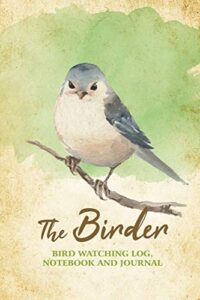
The Birder Birdwatching Journal keeps things refreshingly simple — and that’s exactly the point. At $9.99, it’s an easy starting point for anyone just getting serious about logging sightings.
The dual-page layout pairs a sketch or photo space on the left with structured prompts on the right, covering species, weather, location, and markings.
Its 6×9 compact size fits a backpack without complaint. With 58 dedicated entry slots across 120 pages, it won’t overwhelm you — it’ll just get you started.
| Best For | Beginner birders and hobbyists who want a simple, affordable way to start logging sightings without a lot of fuss. |
|---|---|
| Price | $9.99 |
| Page Count | 120 pages |
| Dimensions | 6 x 9 in |
| Field Sketching | Dedicated sketch page per entry |
| Species Tracking | Per-entry species prompts |
| Field Guide Included | No |
| Additional Features |
|
- At $9.99, it’s a low-risk buy — great as a gift or a first journal for someone just getting into birding.
- The dual-page layout is thoughtful: sketch or photo on the left, structured prompts on the right, so you’re not staring at a blank page wondering what to write.
- Compact enough to toss in a bag and actually take out in the field.
- Thin paper means no watercolors or heavy inks — keep it to pencil or light pens.
- No species checklist or ID guide built in, so you’ll still need a separate field guide.
- Only 58 entry slots, which fills up fast if you’re birding regularly or logging multiple sightings a day.
2. Rite in the Rain Birding Journal
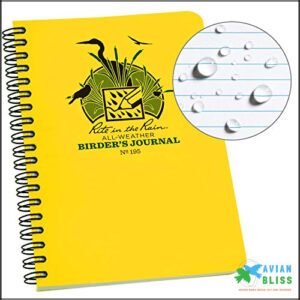
If you’ve ever lost notes to a sudden downpour, the Rite in the Rain Birding Journal solves that problem before it starts. Its waterproof, oil-proof paper shrugs off rain, sweat, and mud — your field notes stay legible no matter what the morning throws at you.
At $10.95, it’s a working tool.
The compact 4.625 × 7-inch format fits a jacket pocket, and each of the 32 fill-in pages pairs a sketch area with ruled lines for structured, on-the-spot entries.
| Best For | Birders, hikers, and field researchers who need a rugged, pocket-sized notebook that can handle rain, mud, and sweat without losing a single note. |
|---|---|
| Price | $10.95 |
| Page Count | 64 pages |
| Dimensions | 4.625 x 7 in |
| Field Sketching | Sketch side per entry |
| Species Tracking | Fill-in species fields |
| Field Guide Included | No |
| Additional Features |
|
- Waterproof, oil-proof paper holds up in real outdoor conditions — rain, sweat, mud, even a laundry mishap
- Compact enough to slip into a jacket pocket and light at just 3.2 oz
- Each page pairs a sketch area with ruled lines, so your entries stay organized in the field
- Only 32 fill-in entries per notebook, so heavy users will burn through them fast
- Regular water-based ink won’t work — you’re limited to pencil or all-weather pens
- The small size might feel cramped if you prefer more writing room
3. Birding Journal Through The Seasons
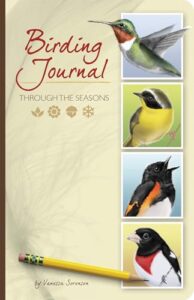
Think of this journal as a year-round companion built around how birds actually behave. The Birding Journal Through the Seasons organizes your entries by monthly and seasonal sections — so you’re not just logging sightings, you’re building a timeline.
At $12.04, it’s 148 pages of mixed-weight paper with space for sketches, maps, and free-form notes.
A lifetime sighting checklist and multi-year pages live in the back.
One limitation worth knowing: ballpoint pens smear on the coating — go with a fine-tip Sharpie instead.
| Best For | Birders who want to track sightings across seasons and build a personal life list over multiple years. |
|---|---|
| Price | $12.04 |
| Page Count | 148 pages |
| Dimensions | 5.5 x 8.4 in |
| Field Sketching | Monthly sketch space |
| Species Tracking | Lifetime sighting checklist |
| Field Guide Included | No |
| Additional Features |
|
- Organized by month and season, so comparing year-over-year arrival dates is genuinely easy
- Includes handy reference tips (feeder foods, birdhouse specs) so you’re not juggling a separate guide
- Lifetime checklist and multi-year pages in the back make it a single go-to volume
- Not spiral-bound, which makes flat writing a bit awkward in the field
- The paper coating smears with ballpoint or gel pens — you’ll need a fine-tip Sharpie
- Water-resistant but not waterproof, so a heavy downpour could damage the pages
4. Cornell Bird Life List Journal

The Cornell Bird Life List Journal is built to last — literally. Its flexibind hardcover holds 264 pages organized around the 2018 eBird/Clements taxonomy, covering North American, Hawaiian, and accidental species.
At $19.95, you’re getting twelve hand-drawn color illustrations by Rigel Stuhmiller, open-ended pages for sketches and notes, and a multi-column checklist for tracking trip-specific totals.
One heads-up: the paper is slick, so blot carefully or you’ll smear your ink before the sighting even dries in memory.
| Best For | Birders of any skill level who want a durable, beautifully designed journal to track sightings, sketches, and life list milestones over the long haul. |
|---|---|
| Price | $19.95 |
| Page Count | 264 pages |
| Dimensions | 6 x 8.75 in |
| Field Sketching | Open sketch pages |
| Species Tracking | eBird/Clements life list |
| Field Guide Included | No |
| Additional Features |
|
- Sturdy flexibind hardcover and 264 well-organized pages make it feel like something you’ll actually keep forever.
- Twelve hand-drawn color illustrations by Rigel Stuhmiller give it a personal, artful touch you won’t find in generic birding logs.
- Open-ended pages plus a multi-column checklist make it easy to log dates, locations, notes, and trip-specific tallies all in one place.
- The paper has a slick finish, so ink can smear if you’re not careful to blot as you write.
- No field guide features here — no ID keys, no water resistance, so it’s strictly a journal, not a trail companion.
- The multi-column checklist has no column headings, which can get confusing fast when you’re juggling separate lists for different trips or people.
5. Sibley Bird Life List Diary
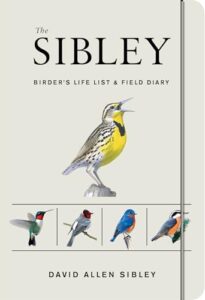
The Sibley Bird Life List Diary is the field companion that actually thinks like a birder. At $18.11, its 304 pages cover 923 North American species — organized to match Sibley’s field guides, so you’re never mentally translating between books.
Three distinct sections handle detailed entries, a six-column checklist, and a numbered life list up to 1,024 species.
Fair warning: the cover scuffs easily, and the 2017 taxonomy misses newer splits.
Keep a pen handy for manual updates.
| Best For | Birders of any experience level who want a structured, portable way to log and organize their North American sightings over time. |
|---|---|
| Price | $18.11 |
| Page Count | 304 pages |
| Dimensions | 5.31 x 7.64 in |
| Field Sketching | Notes space per species |
| Species Tracking | 923-species checklist |
| Field Guide Included | No |
| Additional Features |
|
- Covers all 923 North American species in Sibley’s order, so it pairs naturally with the field guide you’re probably already carrying
- Three separate sections — species entries, a six-column checklist, and a numbered life list — keep everything organized without overlap
- At $18.11 for 304 pages, it’s an affordable way to track a lifetime of sightings in one place
- The cover scuffs and wears easily, so it may not hold up well to years of regular field use
- The index has some errors and is printed in light gray, which makes it harder to read in low light
- Taxonomy is frozen at 2017, so newer species splits and Hawaiian birds aren’t included — you’ll need to add those by hand
Frequently Asked Questions (FAQs)
What are the 5 S’s of birdwatching?
The 5 S’s of birdwatching are Size, Shape, Silhouette, Sound, and Season.
Together, they give you a reliable framework for identifying birds quickly — even when lighting is poor or a species is partially hidden.
What is the 60/40 rule for birds?
The 60/40 rule splits your bird care focus: 60% on safety — secure housing, nutrition, hazard checks — and 40% on enrichment like foraging and bonding. Balance both, and your birds genuinely thrive.
What do people put in a bird watching journal?
Most birders log the date, location, species name, behavior, and weather for each sighting. You’ll also want to note plumage details, vocalizations, and your confidence in the ID.
Can kids start a bird watching journal too?
Absolutely.
Kids take to bird journaling faster than you’d think. A pocket notebook fits right in a small backpack, and simple prompts — color, size, beak shape — keep entries short, accurate, and genuinely fun.
How do I journal birds seen while traveling abroad?
Traveling turns your journal into a passport of sightings. Log GPS coordinates, local taxonomy, and regional common names. Note the country and region — species names shift across borders.
Should I join a local birding club as a beginner?
Yes — joining a local birding club is one of the smartest moves you can make early on.
You’ll get guided walks, instant mentorship, and a community that genuinely accelerates your learning.
How do I handle duplicate sightings of the same bird?
Don’t delete that entry — not yet. Flag it, note the GPS match, compare plumage or call patterns, and keep both until evidence confirms they’re truly the same bird.
Can bird journal data help with conservation efforts?
Your journal entries do more than track birds — they feed real conservation science.
eBird alone uses community observations to identify priority habitats, guide restoration, and detect population declines before they become crises.
Conclusion
A thousand field sessions won’t sharpen your eye the way one well‑kept journal will. Knowing how to start a bird watching journal is only the first step—the real return comes from staying consistent, reviewing what you’ve logged, and watching patterns emerge across seasons.
Your notes become a mirror of the landscape itself, changing quietly over time. Start simple, stay specific, and let the record grow.
The birds will keep showing up. So should your pen.