This site is supported by our readers. We may earn a commission, at no cost to you, if you purchase through links.

A bird arriving at a still birdbath and a bird arriving at one with a gentle dripper behave noticeably differently—the second lands faster, stays longer, and returns more often. That pattern isn’t coincidence or preference in any casual sense; it reflects sensory systems shaped over millions of years to locate safe, fresh water in the wild.
Moving water broadcasts layered signals: low-frequency acoustic pulses that carry hundreds of meters through dense vegetation, and ripple-generated light patterns that flash distinctly against still surroundings.
Understanding why birds are attracted to water movement means understanding how they actually perceive their environment—and that knowledge turns a basic backyard setup into something birds treat as a reliable resource.
Table Of Contents
- Key Takeaways
- Why Moving Water Attracts Birds
- It Signals Fresh, Safe Water
- Birds Hear Water Before Seeing It
- Shimmering Ripples Catch Bird Eyes
- Moving Water Supports Bird Health
- Different Birds Prefer Different Flow
- Bird Bath Movement Reduces Mosquitoes
- How to Add Bird-Friendly Movement
- Frequently Asked Questions (FAQs)
- Conclusion
Key Takeaways
- Moving water sends birds a layered signal—sound that carries hundreds of meters and ripple-generated flashes of light—that still water simply cannot replicate, triggering instincts shaped over millions of years to find fresh, safe sources fast.
- Birds hear your bath before they see it, with soft, rhythmic dripping at 40–50 decibels acting as an acoustic beacon that draws songbirds, guides residents through dense cover, and gives exhausted overnight migrants a reliable place to land.
- Beyond attraction, moving water actively supports bird health by encouraging regular bathing, aiding feather maintenance, keeping water oxygenated, and preventing stagnant conditions that breed mosquitoes and algae.
- Different species need different flow—songbirds prefer a gentle dripper, hummingbirds thrive with a fine mister, doves want calm shallows, and larger birds avoid turbulence—so matching your setup to your target visitors makes a measurable difference.
Why Moving Water Attracts Birds
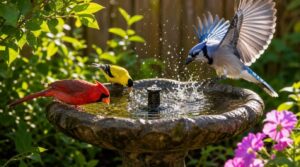
When you add moving water to your backyard, you’re doing more than decorating — you’re speaking a language birds have understood for millennia. Moving water triggers a powerful combination of visual cues and sound and movement that birds rely on to evaluate any water source quickly. The shimmer of ripples catches their eye during flight, while the soft drip of water flow reaches them before they’re even close enough to see it.
Together, these instincts make moving water one of the most reliable ways to attract birds to your backyard water features season after season.
That multisensory signal facilitates predator vigilance — birds assess a site’s safety faster when water activity is visible and audible.
Moving water also offers thermal cooling on hot days, encourages social gathering at a reliable spot, and helps with energy conservation by reducing search time.
Access to water also provides essential hydration during hot days, which is vital for birds’ thermoregulation.
It Signals Fresh, Safe Water
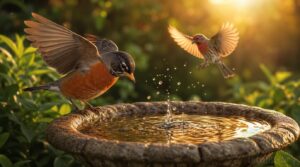
Birds don’t just stumble onto water randomly — they’re reading signals. Moving water sends a clear message that what they’re seeing is fresh, safe, and worth landing for.
Here’s what those signals actually are.
Sound Suggests Clean Water
Bird bath sounds like matters more than you might think. Birds rely on a steady water murmur and low frequency tone to judge water quality before landing. A clear acoustic cue—soft, rhythmic, with an absence of a harsh buzz—signals clean, safe water.
Freshwater cues like quiet, consistent dripping communicate freshness through acoustic signaling in birds, reducing hesitation and drawing more visitors.
Ripples Show Surface Movement
Sound gets them close, but ripples seal the deal. When a dripper or bubbler disturbs the surface, it generates capillary ripples with tight wavelength variation and amplitude decay spreading outward in expanding rings. That surface roughness scatters sunlight into shimmering cues birds can detect from the canopy.
Ripple interaction between multiple disturbances creates layered, fluid visual cues. These interactions produce a gentle motion that makes your bath unmistakable against still surroundings.
Freshness Cues Reduce Hesitation
Ripples do more than dazzle — they communicate. Micro‑current signals and a consistent flow rhythm tell birds this is a fresh and reliable water source, not a stagnant puddle. Visual renewal perception works alongside sound and sight: moving water continuously exposes a clean, renewed surface.
That predictable water cadence, paired with low‑noise aeration, cuts hesitation fast. Birds respond to these combined cues by approaching with confidence:
- Constant motion signals ongoing replenishment
- Clear, rippling surfaces suggest clean water
- Visual cues reinforce what their ears already detected
- Familiar rhythm means a dependable, safe stop
Easier to Find From Above
From high in the canopy or mid-flight, moving water creates aerial contrast patterns that still water simply can’t match. Sunlight hits ripples at angles that produce glint timing peaks—brief flashes birds track instinctively as flight-path indicators. These visual cues make high-altitude spotting reliable, so birds locate your bath faster than you’d expect.
Edge highlighting where water meets basin rim sharpens visibility further. This combination of dynamic reflections and defined edges ensures your bath stands out against natural surroundings, guiding avian visitors with precision.
Birds Hear Water Before Seeing It
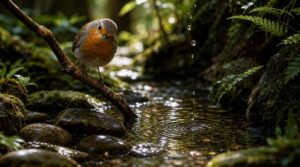
Birds often locate water by sound long before it comes into view. Their hearing is tuned to pick up even faint dripping or trickling across surprisingly wide distances.
Here’s how that acoustic sense actually works in practice.
Dripping Sounds Attract Songbirds
A simple dripper does more than you might expect. Songbirds rely on acoustic localization to pinpoint water before it ever comes into view, and droplet rhythm becomes a reliable auditory beacon cutting through ambient noise.
Temporal irregularity in the drip pattern actually works in your favor — songbirds associate that variability with natural springs.
Low-frequency reach and sound propagation carry those percussive taps hundreds of meters, drawing bird attraction toward your bath.
Trickling Guides Nearby Birds
Once a dripper establishes consistent water flow, nearby birds already within your garden use it as a real-time navigational anchor — mapping perch-to-water pathways through dense cover without hesitation. Gentle motion and seasonal trickle timing reinforce conspecifics’ learning cues, enabling resident birds to signal territory boundary and nest site proximity to one another.
This dynamic process steadily increases bird attraction around your bath, as the reinforced cues create a reliable framework for social and spatial communication among the avian population.
Migrants Follow Water Noise
Migratory species crossing hundreds of miles overnight rely on acoustic habitat mapping to locate water before dawn breaks. Your moving water feature acts as an auditory beacon, providing flight fatigue relief and energizing rest stops at critical moments.
Your moving water feature is an auditory beacon guiding exhausted migrants to safety before dawn
- Water noise guides nocturnal orientation cues during low-visibility arrivals
- Migration stopover success improves near streamside foraging benefits
- Sound and shimmer help birds pinpoint safe drinking zones
- Water movement signals predictable, reusable landing habitat
Gentle Sounds Work Best
Soft, steady dripping—around 40–50 decibels at one meter—hits the sweet spot that birds actually respond to. Too loud, and it masks ambient cues; too quiet, and they miss it entirely.
| Sound Element | Why It Works |
|---|---|
| Ideal decibel range | Avoids acoustic masking of natural signals |
| Drop rate (1–3/sec) | Creates rhythmic consistency that birds recognize |
| Frequency tuning | Matches songbird hearing sensitivity |
| Sound and shimmer combo | Doubles detection distance |
Shimmering Ripples Catch Bird Eyes
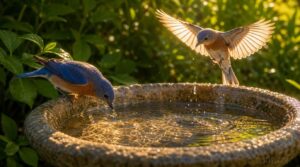
Sound gets birds close, but sight is what seals the deal. When sunlight hits a rippling surface, it throws off quick, scattered flashes that birds can spot from the treetops or mid-flight.
Here is how that visual signal works in their favor.
Sunlight Flashes on Water
When sunlight hits a rippling water surface, it doesn’t just reflect — it fragments into glint geometry, producing caustic patterns that shift with every wave.
Sun angle effects determine how intense these flashes appear, with high midday angles generating sharp, concentrated bursts of light.
Surface refraction bends and scatters these rays, creating flash visibility that provides powerful visual stimulation for birds scanning from above.
Movement Stands Out Naturally
Beyond those sharp light bursts, moving water also creates pattern disruption against static surroundings — and that contrast edge detection is something birds rely on instinctively.
Visual salience spikes when active light plays ripples across a uniform background like soil or leaves.
This is stream mimicry at work: gentle motion and shifting ripples signal "water here" through motion-induced depth that still surfaces cannot replicate.
Visible From Trees
That edge delineation effect becomes even more powerful when considering a bird’s aerial vantage point. Glittering water patches and reflective ripple signatures function as aerial visual beacons from canopy height, where micro-movement outlines contrast sharply against static foliage. Birds scanning from trees instinctively track these moving water patterns—ripples create readable geometry that still surfaces simply do not produce.
This dynamic visual language makes your bath a reliable birdwatching attractor. From above, the interplay of light and motion forms a distinct, instinctual signal, drawing avian attention to what static water features cannot offer.
Helps Birds Locate Baths
That same aerial legibility works at the garden scale, too. Positioning your water movement feature within 10–20 meters of perching sites uses perch proximity and elevated positioning to shorten discovery distance considerably.
Pathway visibility improves when color contrast separates the basin from surrounding foliage.
Sound and shimmer together—ripples catching light from consistent water flow—create a reliable, consistent timing signal that birds learn to return daily.
Moving Water Supports Bird Health
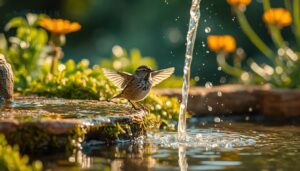
Moving water does more than just look and sound appealing to birds — it actively aids their wellbeing in ways that still water simply can’t match.
From feather condition to hydration, the benefits are surprisingly practical. Here’s what moving water actually does for the birds visiting your yard.
Encourages Regular Bathing
Moving water doesn’t just attract birds — it changes how often they actually bathe. The gentle, predictable flow of a dripper or low-velocity fountain establishes a Daily Bathing Rhythm that birds return to consistently. That steady water movement reduces hesitation, so birds’ bathing behavior shifts from occasional to habitual.
Shallow water with gentle circulation also promotes bird hydration and thermal regulation, particularly during migration and warm months.
Helps Feather Maintenance
Wet feathers are the starting point for everything birds do to maintain their plumage. After bathing in moving water, preening behavior begins immediately — bills realigning barbs, spreading uropygial oils for waterproofing, and completing parasite removal along each feather vane.
Here’s what that feather maintenance process actually delivers:
- Preening Benefits — restores proper barb overlap for insulation and flight
- Feather Strengthening — improves keratin integrity when feathers stay clean and hydrated
- Parasite Removal — water flow dislodges mites and debris missed during dry grooming
- Molt Support — consistent bathing helps new feathers emerge cleanly during replacement cycles
- Nutrient Intake — plumage maintenance is more effective when protein and fatty acid levels support follicle health
Supports Drinking Needs
Thirst quenching doesn’t happen by accident — birds drink most reliably when fresh water cues are working in their favor. Moving water triggers water source attraction instinctively, prompting water intake frequency that enables rapid rehydration after flight.
That steady water flow signals safety, encouraging avian hydration across both resident and migratory species, and dehydration prevention becomes a natural outcome of adequate hydration built around consistent, clean water access.
Reduces Stagnant Buildup
Stagnant water doesn’t just look uninviting — it actively harms birds.
Consistent water circulation drives surface turbulence and water turnover, keeping sediment suspension continuous so debris never settles. This microbe dilution effect prevents algae buildup, disrupts mosquito breeding, and facilitates bacterial growth prevention across the basin.
Clog avoidance follows naturally, as flow sweeps organic matter away before it accumulates and compromises your bath’s integrity.
Promotes Cleaner Water
Continuous water circulation does more than just move water — it actively filters it. Aeration benefits include oxygenated water that suppresses bacterial growth and prevents algae at the microbial level. Sediment suspension keeps particles from settling, while contaminant dilution and pathogen reduction lower health risks with each use.
This process functions as mechanical filtration working passively, maintaining water hygiene birds can rely on daily.
Different Birds Prefer Different Flow
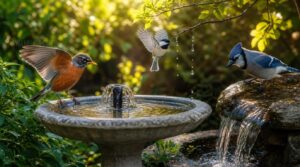
Not every bird wants the same thing from a water source, and that’s actually good news for backyard birders. Body size, behavior, and habitat all shape what a bird finds comfortable or threatening at the bath.
Here’s how different species respond to water movement.
Songbirds Like Gentle Motion
Songbirds aren’t drawn to chaos — they’re drawn to calm. Species like warblers, finches, and wrens show consistent bird bathing behavior around light, consistent water flow, where a simple dripper creates just enough surface motion to signal safety.
This gentle movement aids energy conservation and learning behavior, helping songbirds map reliable sources along their flight path without triggering predator avoidance instincts activated by stronger turbulence.
Hummingbirds Enjoy Fine Mist
Hummingbirds operate differently from other backyard visitors. Fine misters create microclimate cooling that helps them sustain their high metabolism, while dew mimicry signals reliable hydration nearby. This shapes their bird bathing habits around efficiency, not soaking. Feather aerodynamics depend on it — a drenched bird cannot hover.
Fine misters deliver the following benefits for hummingbirds:
- Rapid hydration from droplets collecting on leaves
- Efficient bathing without full immersion
- Feather aerodynamics preserved through light, controlled moisture
Water movement matters — and misters are built for exactly this kind of bird attraction to water features.
Doves Prefer Calm Shallows
Doves operate on completely different terms from hummingbirds. They require calm shallows—still water with a maximum depth of 1–2 inches, flat edges for ease of landing, and open edge visibility to spot threats quickly.
Low water turbulence is crucial here. Perch proximity to the bath also encourages confident approach, reflecting clear bird species preferences for shallow water safety.
Larger Birds Avoid Turbulence
Where doves draw the line, larger birds go even further. Hawks, herons, and owls rely on wing loading and updraft navigation to manage their flight altitude efficiently — and that same physics makes turbulent water unappealing. Their bird species preferences lean toward smooth air routes and calm conditions. Watch for these traits:
- Avoid churning or splashing basins
- Prefer shallow water and bird-friendly water depth under 2 inches
- Show turbulence avoidance at busy, high-flow baths
- Favor open, still surfaces that mirror their calm flight behavior
Species that avoid moving water aren’t being picky — that’s simply smart bird behavior.
Migration Expands Visitor Variety
Migration changes everything at your bird bath. During spring and fall, a seasonal visitor influx brings thrushes, vireos, and warblers—species that rarely appear outside migration windows—effectively transforming your yard into a bird migration stopover on transnational wildlife networks.
Moving water draws a greater variety of bird species, attracting up to 30% more than still baths, making it your best migration-season asset.
Bird Bath Movement Reduces Mosquitoes
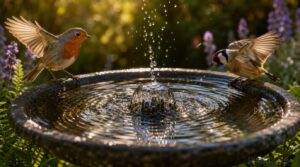
Moving water does more than attract birds — it quietly works against mosquitoes the whole time it’s running.
A still birdbath is basically an open invitation for egg-laying; a moving one isn’t. Here’s exactly how that works.
Surface Motion Blocks Egg Laying
Moving water is a quiet but effective form of egg deterrence. Mosquitoes require a calm, undisturbed substrate to deposit eggs—a condition disrupted by flow turbulence. This dynamic environment denies them the stability needed for oviposition.
Ripple displacement constantly reshapes the shifting edge of water features, rendering surfaces unrecognizable as viable breeding sites. The turbulence created by movement ensures no stagnant zones remain, further deterring mosquito activity.
Devices like water wigglers exploit basic water flow dynamics, leveraging avian sensory perception to your advantage. By introducing motion, these tools attract birds while repelling mosquitoes, creating a natural barrier against breeding.
Circulation Limits Larvae
Even when eggs are not laid, any larvae that hatch face a tough environment. Water flow dynamics work against them at every stage — here’s how circulation manages the problem:
- Larval transport sweeps larvae away from calm zones before they mature
- Shear inhibition disrupts settlement at attachment points
- Retention pockets form briefly but flush larvae before development completes
- Dispersal distance increases, scattering larvae beyond survivable range
- Moving water denies mosquito larvae the stillness required to thrive
Less Algae Growth
Aeration benefits go beyond mosquito control, as the same circulation that disrupts larvae actively suppresses algae growth. By agitating the water, aeration breaks stagnant surface films where algae establish, while simultaneously raising oxygen levels.
This process naturally limits nutrients, as moving water raises oxygen levels and prevents the warm, calm conditions that fuel blooms. Submersible pumps and drippers play a critical role by eliminating stagnation, further disrupting algae’s ideal habitat.
When combined with sunlight management and temperature control, this approach transforms your dripper into a surprisingly effective algae prevention system.
Cleaner Backyard Habitat
All that algae prevention and mosquito suppression adds up to something bigger: a genuinely cleaner backyard habitat. Your dripper maintains natural filtration by keeping microbial balance in check, improving overall water quality while reducing runoff reduction concerns near garden beds.
Better habitat connectivity follows naturally, since birds rely on predator detection cues — like clear, ripple-broken water surfaces — to feel secure enough to return.
Safer Water for Birds
Safer water is ultimately about more than just mosquito prevention — it’s about trust. When your setup uses non-toxic materials, filtered rainwater, UV filtration, and anti-clog filters, birds receive genuinely clean water without chemical irritants.
- Predator-safe placement lets birds drink without stress
- Outdoor pump safety standards protect both birds and equipment
- Water quality improves with consistent circulation
- Cleanliness directly supports the health of visiting species
This focus on purity and safety ensures that cleanliness and health remain interconnected for every species that visits.
How to Add Bird-Friendly Movement
Adding movement to your bird bath doesn’t require a complicated setup or a big budget. A few simple additions can make a real difference in how many birds find and use your bath.
Here’s what actually works.
Use Shallow Bath Basins
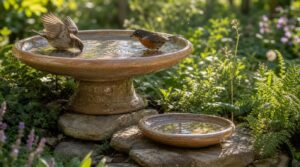
The basin you choose matters more than most people realize.
For material selection, stainless steel and ceramic both work well—smooth, cleanable, and durable.
Keep depth standards in mind: a bird-friendly water depth of 1 to 2 inches lets small birds wade safely.
Rim Perch Design provides birds a landing zone, while Base Stability prevents tipping.
In winter, a submersible heater effortlessly controls ice formation.
Choose Gentle Drippers
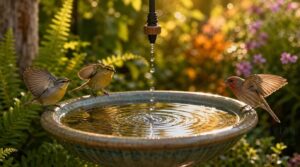
Not all drippers are equal — the right choice depends on your bird mix and bath size. Adjustable flow drippers let you dial in light, consistent water flow at 1–3 drops per second, ideal for attracting more birds like warblers and finches.
Ceramic dripper durability holds up against mineral-rich water for years.
Mount any dripper 4–6 inches above the basin for proper height positioning and flow rate tuning.
Clean your dripper system every one to three weeks to prevent clogging.
Try Solar Bubblers
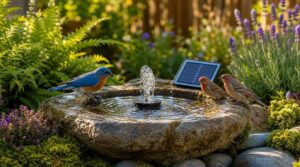
Solar bubblers take things a step further. Powered by sunlight panel orientation toward peak daylight hours, these bird-friendly fountain units run automatically, no outlet required.
Battery buffer systems ensure water movement on cloudy days, while the energy savings over traditional pumps accumulate rapidly.
The gentle bubbling creates moving water birds notice quickly, and aesthetic foam features blend seamlessly into garden environments.
Clean Pumps Weekly
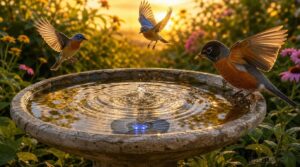
Your solar bubbler won’t do much good with a clogged pump. A weekly maintenance routine keeps everything running right:
- Inspect seals and housing for cracks during each cleaning frequency check
- Rinse filters and run flow rate monitoring to catch pressure drops early
- Follow your lubrication schedule for submersible pumps to reduce bearing wear
- Complete electrical safety checks on wiring and connections to prevent shorts
Consistent pump filter maintenance stops bacteria before it builds up, keeping water aeration effective and your bath genuinely bird-friendly.
Adjust Flow Seasonally
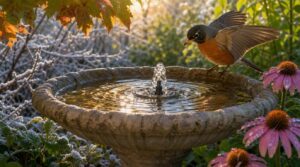
Once your pump’s clean, consider how seasonal changes impact bird needs. Summer Flow Boost offsets evaporation and provides cooling during peak heat, while Winter Flow Reduction prevents ice buildup and maintains accessible moving water.
Sync your flow with early bird activity via Dawn Timing, and apply Humidity‑Adjusted Flow when conditions shift. These strategies ensure your bath remains functional year-round.
Smart seasonal water management keeps your bath working effectively in all weather.
Frequently Asked Questions (FAQs)
Do birds remember specific water sources over time?
Yes — birds show strong site fidelity to reliable water sources. Through spatial mapping and water memory, resident birds return to familiar bird baths across seasons.
Age influences and seasonal recall shape how consistently individuals revisit the same spots.
Can moving water attract birds during nighttime hours?
After dark, moving water becomes a quiet nocturnal acoustic beacon. Moonlit water glints and dusky rippling visibility guide thirsty birds in, while predator-masking water sounds and nighttime hydration cues encourage them to linger safely.
Which colors in bird baths appeal most to birds?
Green basins and earth tones blend naturally with surrounding foliage, reducing predator wariness.
Blue rims signal water clarity, while red accents draw hummingbirds.
Textured surfaces on stone or ceramic add grip and visual confidence.
Does water temperature affect how often birds visit?
Water temperature directly shapes bird hydration behavior. Cold water preference peaks during heat stress, while ideal temperature around natural pond levels sustains steady visits.
Seasonal temperature shifts and thermal comfort zones influence when and how often birds arrive.
Conclusion
Darwin observed that organisms are exquisitely adapted to detect exactly what sustains them—and birds finding water is a perfect illustration. Understanding why birds are attracted to water movement isn’t just backyard trivia; it’s a window into sensory evolution refined across millennia.
Add a dripper or solar bubbler, and you’re not decorating a birdbath—you’re broadcasting a signal birds are hardwired to answer. This simple addition transforms your setup into a beacon for avian visitors.
Give them something worth landing for, and they’ll come.
- https://www.outdoorartpros.com/blogs/news/how-does-water-movement-in-a-bird-bath-benefit-birds
- https://shopbackyardbirdcenter.com/blogs/backyard-bird-feeding-tips-joys/help-migrating-birds-find-water-why-moving-water-matters?srsltid=AfmBOooqmLQdts7HV190bddZ8fR-LUhWLskLHEUNaoEKAxOn8tPxHhUK
- https://pubmed.ncbi.nlm.nih.gov/22278454/
- https://www.birdfy.com/blogs/blogs/why-birds-prefer-moving-water?srsltid=AfmBOopdjBQNe48GvohKBEJJSO1nlLIqoDcdseAT1C-mo7r_jeyMFlYq
- https://stlwildones.org/moving-water-for-birds-terpstra/