This site is supported by our readers. We may earn a commission, at no cost to you, if you purchase through links.

Watch a birdbath on a still afternoon and you’ll notice something curious—birds often fly right past a full, clean basin to find a leaky faucet dripping into a puddle nearby. That instinct isn’t random.
Birds evolved alongside rivers, springs, and rain-fed streams, so moving water registers as a reliable signal: fresh, oxygenated, and safe to drink. A static pool, however spotless, doesn’t broadcast those same cues.
The question of whether birds prefer moving water in baths cuts straight to how avian senses actually work—sound and shimmer together form a detection system more powerful than either alone.
Understanding that system changes how you design, position, and maintain a bath worth visiting.
Table Of Contents
Key Takeaways
- Birds are wired to trust moving water because it mimics the streams and springs they evolved with, making sound and shimmer together a far stronger signal than a spotless, still basin ever could be.
- Gentle motion—think a dripper at 1–3 drips per second—consistently draws more small birds than strong splashing does, because overwhelming flow triggers stress responses and drives them away for good.
- Different species want different setups: warblers and finches chase ripples and sound, hummingbirds prefer fine mist, while cardinals and mourning doves feel safest at a calm, shallow basin no deeper than 1.5 inches.
- Keeping your bath healthy means weekly scrubbing with a vinegar solution, continuous water movement to block mosquito breeding, and a submersible heater with thermostat control when winter temperatures drop toward freezing.
Why Do Birds Prefer Moving Water?
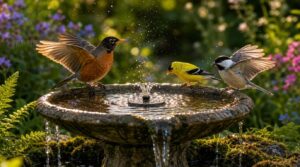
Birds aren’t just stopping by your bath for a drink — they’re responding to specific sensory signals that tell them the water is safe and fresh. Moving water triggers those signals in ways a still basin simply can’t.
A simple drip attachment for your bird bath is often all it takes to trigger those instincts and bring in species you’ve never seen before.
Here’s why that matters and what’s actually pulling them in.
Trickling Sounds Signal Fresh Water
Birds find streams by hearing the water before they see it. This auditory beacon provides them with an acoustic detection range far exceeding their visual capabilities. The consistent rhythm of trickling water signals a fresh source, distinguishing it from a stagnant pool.
This gentle sound also avoids triggering predator alert responses, as sudden splashes might. The steady flow ensures birds can approach safely, relying on sound to guide them to reliable water sources.
Ripples Create Visible Shimmering Cues
Beyond sound, birds are also scanning for visual cues—and that’s where Ripple Light Refraction becomes powerful. Subtle ripples bend sunlight into shifting bright lines across the basin’s surface, creating a shimmer of agitated water visible from the canopy. This Shimmer Angle Guidance effect pulls birds toward the water’s edge:
- Glint Intensity Variation sharpens in direct sunlight, boosting visibility from greater distances.
- Micro Sparkle Interaction with textured basin surfaces scatters light into diverse, eye-catching specks.
- Cue Duration Persistence keeps ripples visible for several seconds after each disturbance.
- Moving water creates contrast against still surroundings, acting as a reliable visual cue for passing birds.
- Repeated ripple cycles maintain bird attraction by delivering predictable, steady shimmering signals.
Moving Water Mimics Natural Streams
That shimmer isn’t just eye-catching—it’s familiar. Moving water with Stream‑like Meanders and Eddy Habitat Creation mimics the natural streams birds evolved alongside. Gentle water flow forms Oxygen‑Rich Microzones that boost Insect Fly‑zone Enhancement, drawing birds in to feed and bathe.
Seasonal Flow Variation and wetland mimicry reinforce bird attraction, because your bath starts feeling less artificial and more like home.
Audio and Visual Cues Increase Visits
When birds notice faster when sound and sight work together. Rhythmic auditory cues—like the steady sound of water hitting a basin—combine with visual components, such as rippling surfaces, to trigger Multisensory Integration, pulling birds in from surprising distances. Visual Contrast around the bath rim sharpens this signal.
Studies confirm that simultaneous visual and auditory cues for birds consistently produce higher visitation rates than either cue alone.
Why Drippers Often Attract Small Birds
Drippers work so well for small birds because every element speaks directly to their instincts. The rhythmic drip pattern produces localized sound cues that finches, warblers, and sparrows can pinpoint from the canopy. Maintaining the optimal water depth of 1–2 inches further enhances safety for small birds.
Here’s why drippers consistently outperform other moving water features for smaller species:
- Microdroplet accessibility lets birds drink without submerging
- Shallow water stays safe and approachable
- Perch proximity near the dripper outlet reduces exposure time
- Oxygenated water taste signals freshness, encouraging repeat visits
Yes, Many Birds Prefer Moving Water
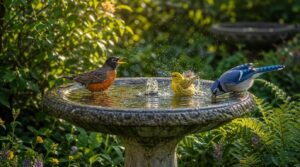
Moving water does not work the same way for every bird — and which is actually the interesting part. Some species will fly right past a still basin to reach a trickling fountain, while others want nothing to do with the movement.
Here’s what shapes those preferences and which setup usually wins out.
When Moving Water is More Attractive
Moving water works best when small passerines are your target. Birds like Warblers and Wrens rely on behavioral learning cues — once they find a reliable source, they return reliably.
For Cardinals specifically, the setup is a bit different — check out these tips on choosing the right bird bath depth and design for Cardinals to make sure they feel secure enough to actually use it.
Attracting birds with moving water becomes especially effective during migration and summer heat, when seasonal temperature relief matters most.
| Condition | Moving Water Advantage | Key Species |
|---|---|---|
| Hot summers | Cooling, aerated surface | Warblers, Wrens |
| Migration periods | Strong auditory beacon | Finches, Robins |
| Dense habitat | Cuts through ambient noise | Small passerines |
When Still Water Works Better
Not every species chases the ripple. Cardinals and Mourning Doves lean toward calm surface appeal — a low-noise environment with crystal-clear water that lets them assess depth and spot approaching predators before committing to a bath.
Still water, when paired with gentle edge design and shaded still zones, suits these larger, warier birds best. Key features include:
- Calm basins under 2 inches deep support safe entry
- Flat, textured bottoms prevent slipping during bathing
- Shaded spots moderate temperature and reduce evaporation
- Wide open margins provide unobstructed predator watch lines
How Flow Strength Affects Bird Comfort
Flow strength isn’t a minor detail — it’s the difference between a bird that lingers and one that never lands. Light, consistent water flow creates gentle ripples that support stress reduction and microrefuge formation along basin edges, where small birds feel sheltered enough to drink and bathe.
Aeration benefits follow naturally, boosting water quality, while thermal cooling keeps surface temperatures comfortable. This directly influences feeding efficiency and overall bird comfort.
Why Gentle Motion Beats Strong Splashing
Think of it this way: a fire hose isn’t a drinking fountain.
Just as a fire hose makes a poor drinking fountain, overwhelming water flow drives birds away rather than welcoming them
Strong splashing compromises feather integrity, disrupts perch stability, and triggers stress responses that drive small birds away permanently.
Gentle splashes, by contrast, offer three clear advantages:
- Stress reduction through predictable, low-velocity flow
- Minimal water waste via low-flow options
- Sustained feather integrity during bathing
A gentle fountain simply works better for most species.
Do Birds Prefer Fountains or Drippers?
Both fountains and drippers attract birds, but they serve different needs. Fountains cover more basin area, supporting multiple bathers at once, while drippers deliver a precise, audible drip that pulls small passerines directly to the source.
| Feature | Fountains | Drippers |
|---|---|---|
| Noise Perception | Broad ambient sound | Sharp, localized plinking |
| Installation Simplicity | Requires pump setup | Attaches to existing bath |
| Seasonal Performance | Best in warmer months | Reliable year-round |
Which Birds Like Moving Water?
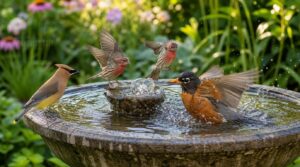
Not every bird wants the same kind of water feature, and that gap matters more than most people realize. Body size, natural habitat, and bathing behavior all shape what a species finds comfortable.
Here’s a closer look at which birds gravitate toward moving water and which ones don’t.
Robins, Finches, Warblers, and Wrens
Robins, Finches, Warblers, and Wrens consistently gravitate toward moving water, drawn by its auditory and visual cues. Their dietary preferences for insects and fruit during seasonal foraging, combined with smaller body size, make gentle ripples ideal for bathing. These factors collectively influence their habitat choices.
Plumage signaling and territorial songs near water sources also support nest site selection, as these species weave their presence into active, sound-rich environments. Such behaviors underscore the interplay between ecological needs and reproductive strategies in dynamic aquatic settings.
Hummingbirds and Fine Mist Sprays
Unlike warblers and wrens that wade into rippling basins, hummingbirds interact with moving water differently — they hover through fine mist rather than splashing around.
That mist functions as a feather preening aid, loosening dust and supporting plumage moisture benefits without soaking delicate plumage. Evaporative cooling kicks in as droplets evaporate mid-flight, easing heat stress.
Adjust mist frequency and nozzle selection to produce a soft, overhead spray that fits natural bird behavior around moving water.
Cardinals and Calm Basin Preferences
Cardinals sit closer to the still-water end of the spectrum. Where hummingbirds crave mist, cardinals want a calm, shallow basin — roughly 0.5 to 1.5 inches deep — with feather-safe textures that won’t snag plumage.
A gentle drip rate appeals more than any bubbling fountain.
Morning bath timing matters too, since group bathing dynamics peak early.
Seasonal shade strategies and nearby shrubs complete the setup.
Mourning Doves and Still Water
Mourning Doves tell a different story than cardinals. These still-water species thrive in environments with quiet surface calm and shallow basins no deeper than 1.5 inches. Their water needs surge during hot, dry spells, with morning drinking peaks aligning with feeding routines.
Proximity to feeding sites is equally critical. Installing sandy landing pads near water sources ensures accessibility, encouraging their presence.
- Prefer calm, undisturbed water surfaces
- Visit most heavily at dawn and dusk
- Need shallow depth for safe liftoff
- Favor bare ground or gravel approaches
- Increase visits dramatically during dry seasons
Larger Birds That Avoid Turbulent Water
Several large bird species — herons, hawks, and owls — actively avoid turbulent water. Their reliance on stable environments stems from physical limitations that make erratic conditions hazardous.
Their tall, heavy frames cannot handle unpredictable splash or strong currents without losing balance. This vulnerability underscores the importance of uniform water motion, edge-rounded basins, broad-leg perches, and low-noise pumps in accommodating these birds.
| Species | Water Preference | Key Requirement |
|---|---|---|
| Great Blue Heron | Still water | Visual cover placement |
| Red-tailed Hawk | Calm, shallow pools | Stable footing |
| Barred Owl | Gentle drip only | Low-noise pumps |
Best Moving Water Bath Designs
Getting the design right makes a real difference in how many birds actually use your bath. A few key features—depth, texture, flow type, and placement— determine whether birds feel safe enough to stick around.
Here’s what to look for when choosing or setting up a moving water bath.
Shallow Water Depth for Bathing
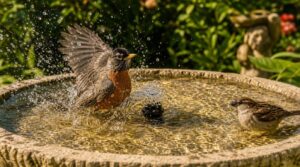
Depth matters more than most birders realize. For small birds, keep your moving water between 0.5 and 2 inches deep — that’s the ideal depth that enables natural bird bathing behavior without risk.
Shallow water depth also helps with temperature stability, since thin layers heat and cool evenly. It’s easier to clean, too, makes easy maintenance a practical bonus alongside better predator visibility.
Sloped Basins and Textured Surfaces
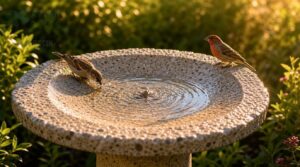
Basin geometry does more quite work than you’d think.
A slope angle optimization of 1 to 3 degrees guides moving water toward the center, eliminating stagnant pockets while balancing water depth for small bird safety. Pair sloped sides with a rough textured bottom — micro‑groove traction prevents slipping on wet surfaces.
Your design checklist:
- Keep shallow water depth between 2 and 4 centimeters at the basin’s lowest point
- Choose natural stone or terrazzo for material slip resistance when wet
- Incorporate overflow edge design that maintains a continuous wetting film across textured surfaces
- Select UV‑stable finishes to prevent surface degradation from prolonged sun exposure
- Facilitate gradual slope transitions so birds move comfortably between resting and bathing zones
Bird-Friendly Drippers and Bubblers
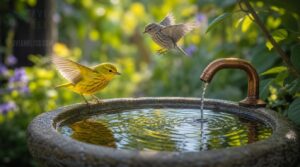
Drippers and bubblers are your two most reliable tools for generating meaningful water movement without overwhelming smaller species. A dripper calibrated to 1–3 drips per second produces the gentle, plinking sound that consistently draws warblers and finches.
Battery-powered wigglers and submersible bubblers offer adjustable flowrates suited to seasonal adjustments. Non-toxic materials and a consistent maintenance routine ensure all visiting species remain safe.
Solar Fountains Versus Electric Pumps

Solar-powered fountains eliminate wiring and cut installation costs, making them a practical first choice — but seasonal reliability drops on cloudy days unless a battery backup stores surplus energy.
Electric fountains, by contrast, run continuously regardless of weather, delivering steadier moving water flow and consistent noise levels year-round.
For energy efficiency balanced against performance, climate ultimately decides the winner.
Safe Placement Near Cover
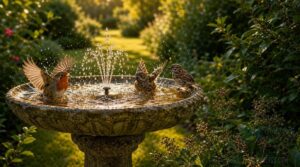
Placement is where safety and attraction meet. Position your moving water bath 3 to 6 meters from dense shrubs, balancing cover distance with open sightlines — birds won’t visit if predator sightlines favor ambush. Maintain an escape route width of roughly 1 meter toward camouflaged perches like low hedges.
Make seasonal cover adjustments as vegetation thins in winter, keeping retreat paths consistently clear.
Predator Visibility and Escape Routes
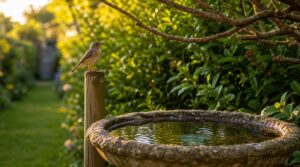
Clear sightlines make or break a bath setup. Birds use elevated perches nearby to spot threats up to 20% earlier, while escape corridors—roughly 1 meter wide—let them execute protean flight patterns that confuse predators mid-pursuit.
Prioritize these four elements for garden predator safety:
- Raised perches within 2 meters
- Cover proximity under 6 meters
- Unobstructed escape corridors
- Shallow water near shrub edges
Keep Moving Bird Baths Healthy
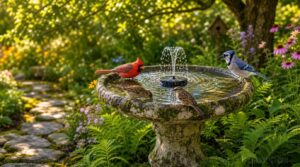
A moving bird bath does a lot of good work, but only if you keep it in good shape.
Stagnant water, algae buildup, and frozen surfaces can undo everything you’ve set up.
Here’s what to stay on top of throughout the year.
Preventing Mosquitoes With Water Movement
Still water is a mosquito nursery — and that’s exactly what you don’t want near a bird bath. Bubble aeration and surface agitation are your best tools for mosquito control, as continuous water movement forces larvae below the surface, disrupting their access to air. This method leverages larval suffocation to prevent breeding.
Comparing still vs. moving water for mosquito control makes the advantage clear: egg deterrence starts the moment ripples begin. The agitation creates an inhospitable environment for egg-laying, breaking the reproductive cycle early.
Add temperature monitoring to catch warming spells that accelerate mosquito breeding before they become a problem. Proactive measures ensure bird baths remain safe and mosquito-free.
Reducing Algae and Bacteria Growth
Moving water does more than deter mosquitoes — it actively fights algae and bacteria, too. Continuous water circulation disrupts biofilm formation on textured surfaces and limits the light penetration that filamentous algae need to thrive.
Seasonal aeration encourages beneficial bacteria to outcompete algae through nutrient limitation, reducing phosphate and nitrogen availability.
UV filtration adds another layer, inhibiting microbial growth without leaving chemical residues harmful to birds.
Cleaning Bird Baths Weekly
Regular cleaning is essential for maintaining a genuinely safe bath, even with good water flow. Every week, empty the basin and scrub all surfaces using a vinegar solution—one part white vinegar to nine parts water—then rinse thoroughly. This process removes biofilm that circulation misses.
Your choice of cleaning tools matters. A stiff brush effectively reaches textured areas, where algae prevention and mosquito breeding prevention begin at the basin level.
Summer Cooling and Water Refills
Summer heat puts your bath to the test. When temperatures climb past 25°C (77°F), shallow basins lose water fast through evaporation and splashing—so morning refill timing matters. Topping off at dawn keeps water cooler longer.
Positioning a shaded refill station, or using gravity-fed refilling from a rain barrel with cool groundwater, helps regulate water temperature and extend the summer cooling benefits of continuous water flow.
Winter Flow, Heaters, and Ice Prevention
When temperatures drop below freezing, keeping liquid water available becomes one of the most impactful things you can do for winter birds. Winterizing bird baths to prevent freezing doesn’t require complicated equipment—just smart choices.
- A submersible heater with thermostat controls activates only when water temperature nears 0°C, saving energy
- Ice notch design channels edge ice away from pump intakes
- Anti-freeze mats insulate the surface against cold air
- Insulation wrapping around basin walls reduces heat loss greatly
- Microflow pumping creates continuous movement that naturally slows freezing
These winter fountain options keep birds drinking safely all season.
Pump Maintenance and Safe Power Use
Your submersible pump needs consistent attention to keep birds safe and water flowing. Check this monthly routine:
| Task | Detail | Frequency |
|---|---|---|
| GFCI Protection | Test Ground Fault Circuit Interrupter outlet | Monthly |
| Seal Inspection | Check for leaks at shaft seals | Monthly |
| Vibration Isolation | Inspect rubber anti-vibration pads | Monthly |
| Start-Up Purge | Clear air from suction lines before restarting | Each restart |
| Maintenance Log | Record run hours and anomalies | Ongoing |
Safe electrical wiring outdoors isn’t optional — electrical hazards near water demand a GFCI outlet every time.
Frequently Asked Questions (FAQs)
Why are no birds coming to my birdbath?
Birds avoid birdbaths due to improper placement, stale water, incorrect depth, or predator exposure. Lack of perches nearby also reduces visits. Addressing these basics helps attract more species consistently.
Can moving water attract migratory birds during travel?
Yes, moving water attracts migratory birds during travel. While still pools go unnoticed, rippling drippers and energy-efficient pumps signal fresh hydration at migratory stopover sites, giving exhausted travelers a reliable migratory health boost along habitat corridors.
Do birds visit moving baths more at certain times?
Yes — dawn visits peak between 6 and 9 AM, with an afternoon surge from 2 to 5 PM. Migration peaks and rainy day visits also drive seasonal spikes in moving bath activity.
Does water temperature affect how often birds bathe?
Does water temperature affect how often birds bathe? Absolutely. Lukewarm water around 10–15°C encourages more frequent visits, while thermal stability throughout the day facilitates consistent bathing patterns across seasons.
Can multiple birds share a moving water bath?
Multiple birds can absolutely share a moving water bath.
Gentle flow naturally reduces dominance hierarchies, enabling rotational bathing and multi-species tolerance — so several visitors cycle through within minutes.
Do urban birds respond differently to fountain sounds?
Urban birds have learned to cut through the noise.
Despite ambient noise masking fountain sounds, species’ acoustic preference still drives them toward moving water when temporal sound patterns align with quieter morning intervals.
Conclusion
Like a dinner bell’s ringing across a quiet neighborhood, the sound and shimmer of moving water tells birds exactly what they need to hear. Do birds prefer moving water in baths? The evidence is clear—gentle motion consistently draws more species, more often.
Match your setup to the birds you want: a dripper for warblers, a misting jet for hummingbirds, a calm basin for doves. Small adjustments in your bath’s design produce measurable, lasting results.
- https://www.birdfy.com/blogs/blogs/why-birds-prefer-moving-water?srsltid=AfmBOopP99vn4dqCRp4U7kErr_qlYt5gcwBC3LpZXNEmMQgaxtxBkxHk
- https://outdoors.stackexchange.com/questions/16116/do-backyard-birds-prefer-birdbaths-with-moving-water
- https://gardenforwildlife.com/blogs/learning-center/wildlife-friendly-water-features?srsltid=AfmBOoruzrfdvPgN5slqJRik7mS0crLtPmCYHy24DzX0n1_JS020yM1R
- https://georgiawildlife.com/out-my-backdoor-moving-water-acts-bird-magnet
- https://boulderfountain.com/blog/how-to-attract-birds-using-water-features-fountains