This site is supported by our readers. We may earn a commission, at no cost to you, if you purchase through links.
Autumn strips birds of their best outfits. The blazing warblers and sharply patterned vireos of spring give way to a parade of drab olives, washed-out yellows, and streaky browns that can make even experienced birders second-guess themselves.
The problem isn’t your eyes—it’s your approach. Most misidentifications happen because people reach for color first, which is exactly the wrong instinct when prebasic molt has flattened every field mark you memorized in May.
Shape, structure, and the marks that don’t fade are your autumn field toolkit. Once you know what to look for—bill geometry, wing projection, the tail patterns that survive molt intact—those "mystery birds" start resolving fast.
Table Of Contents
Key Takeaways
- In fall, shape and structure are your best tools—bill geometry, wing projection, and silhouette hold up far better than color when molt has flattened every field mark you memorized in spring.
- Certain field marks—wing bars, eye rings, rump patches, and tail patterns—survive the prebasic molt intact and give you reliable anchors when overall plumage turns frustratingly drab.
- Knowing the predictable misidentification traps (olive-gray warbler lookalikes, eclipse-plumage ducks, immature males) puts you ahead of the confusion before it starts.
- Pairing regional field guides and eBird seasonal checklists with app-based filters narrows a 200-species list down to the handful of candidates actually moving through your area right now.
Start With Shape, Not Color
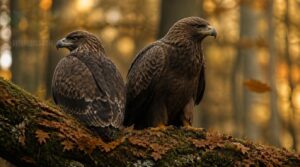
Color is the first thing your eye jumps to — and in fall, it’s almost always the wrong place to start. Muted plumage, worn feathers, and flat autumn light will send you down dead ends faster than you’d expect.
Shape and size hold up far better under tricky conditions — a habit worth building early, as this guide to telling apart similar-looking songbirds makes clear.
Instead, train your attention on the structural cues that never change, no matter the season.
Silhouette and Posture
Recognizing a bird by its silhouette — before a single feather color registers — is the skill that separates confident birders from frustrated ones.
Silhouette, not color, is what separates confident birders from frustrated ones
Upright vertical stance narrows your candidate list instantly: a tall, narrow profile perched against a branch signals something very different from a squat, crouching form working the ground below.
Bill Shape Clues
Once you’ve locked in silhouette, the bill becomes your next anchor. A hooked, downward-curved tip screams seed-prying finch; a long, slender probe belongs to a warbler working crevices.
- Conical bills — sparrows and small finches
- Chisel-like bills — woodpeckers drilling bark
- Fine-pointed tips — insect foragers in leaf litter
Wing and Tail Length
From bill shape, your eye naturally climbs outward — wingspan and tail geometry carry real diagnostic weight in autumn flocks.
Wing aspect ratio separates migrants from residents fast. Long-distance travelers carry pointed, swept wings; primary-to-secondary ratios averaging 0.80–0.95 produce that characteristic narrow silhouette cutting through open sky. Broader, rounded wings belong to forest birds maneuvering through canopy.
Tail length shifts perception of overall size. Thrushes show wing lengths exceeding tail length by roughly 5–15 percent — a subtle but reliable gap. Migratory species generally carry longer tails relative to body size than resident forms, which sharpens silhouette-based separation in mixed autumn groups.
Research shows that brighter male kestrel skin is linked to higher-quality winter territories.
| Feature | Long-distance Migrant | Resident Species |
|---|---|---|
| Wing shape | Pointed, swept | Broad, rounded |
| Primary ratio | 0.80–0.95 | Lower |
| Tail vs. wing | Shorter proportionally | Often equal or longer |
| Silhouette in glide | Kite-like, narrow | Compact, rounded |
| Identification cue | Wing tip reach | Tail-to-body ratio |
Compare wing tip reach against the shoulder line — a quick field check requiring no equipment, just habit.
Perching Stance Differences
Perching stance reads body weight distribution instantly.
Center of gravity placement drops lower in larger thrushes — they crouch, widening their stance — while a chickadee holds nearly vertical, riding a slender twig through leg joint angles that minimize muscular strain.
When a predator enters the picture, that relaxed posture tightens: toe grip mechanics sharpen, joints compress, and the bird’s whole frame shifts forward, flight-ready.
This same shift in body awareness connects to how birds perceive their environment on a deeper level — much like how structural feather colors change with light and angle, a bird’s threat response is as much physics as instinct.
Size Comparisons Nearby
Few reference points sharpen your eye faster than a bird standing right next to another. A House Sparrow stretches roughly 12–15 cm; a Blackbird beside it — at 25–28 cm — nearly doubles that silhouette instantly.
Three size anchors worth memorizing:
- House Sparrow (~12–15 cm)
- Starling (~22–27 cm)
- Blackbird (~25–28 cm)
Decode Autumn Plumage Changes
Autumn strips away the vibrant breeding colors you relied on all spring, leaving birds that look like muted, unfamiliar strangers.
Understanding what’s actually happening beneath those duller feathers — the biology driving the change — gives you a real edge in the field.
Here’s what to pay attention to when fall plumage has you second-guessing yourself.
Nonbreeding Feather Colors
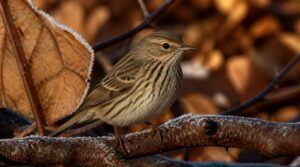
The prebasic molt doesn’t just swap feathers — it rewrites the color story entirely.
Carotenoid pigments drop sharply, pulling vivid yellows and oranges down to pale, washed-out edging. Eumelanin takes over, spreading dull grays and browns that merge seamlessly into shadowed leaf litter.
Structural iridescence fades too, as microstructures become less optically active.
The result? Deliberate seasonal camouflage, not accidental dullness.
Molt Limits and Patches
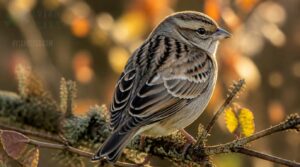
Think of molt limits as fault lines — the boundary where old feathers meet new ones mid-tract, creating subtle but readable contrast. On the greater coverts, fresh vs. worn feather contrast makes these seams unmistakable up close.
Scapular patches can shift a bird’s back from uniform gray to a checkerboard of dull and bright — a reliable clue hiding in plain sight.
Juvenile Streaking Patterns
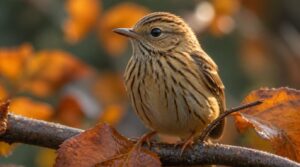
Juvenile passerines arriving in autumn carry a built-in age marker: narrow, parallel streaks running diagonally from breast to flank — usually 2–4 mm long — that adult plumage simply doesn’t replicate.
- Streak density increases as juveniles approach first-winter plumage
- Throat streaks extend onto cheeks, separating similar-toned species
- Wing covert markings align with feather rows, adding a second streaked layer
- Morning shadows sharpen shadowed feather lines, making streaks crisper
Duller Fall Feather Tones
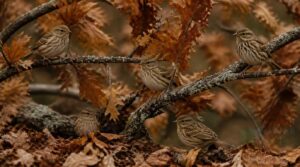
After the prebasic molt, birds trade vivid carotenoid-rich yellows and reds for muted olive-gray and brown tones — a deliberate trade-off favoring camouflage over visibility. Structural blues and iridescent sheens flatten noticeably, giving fall plumage a soft, matte quality.
That drabness isn’t accidental; it lets birds disappear into leaf litter and dull bark with surprising efficiency.
Light and Weather Effects
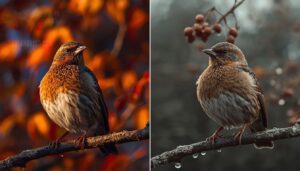
The same bird can look like two different species depending on when and where you observe it.
Golden hour light — that low-angled morning or late-afternoon sun — saturates russet and amber tones, making already-muted fall plumage appear warmer than it truly is.
Overcast skies do the opposite, flattening browns into cool gray.
Neither condition shows you the bird’s actual color.
Check Reliable Fall Field Marks

Even when autumn strips away a bird’s boldest colors, certain field marks hold their ground all season long. These structural and pigment-based features won’t fade with the molt — and knowing where to look makes all the difference.
Here are the five most reliable fall field marks to keep in your toolkit.
Wing Bars
Pale wing bars are among the most reliable fall field marks you can use — they persist even when carotenoid pigments fade and overall plumage shifts to muted olive-gray. Look for covert-tip bars running parallel to the wing edge, noting width, spacing, and contrast.
Double bars often signal thrushes; fainter, narrower bars after molt completion suggest juveniles.
Eye Rings
Wing bars get you in the door — eye rings close the deal.
A complete white eye ring, like the Nashville Warbler’s, persists through fall molt, making it one of the most dependable visual cues available. Unlike carotenoid-dependent colors, these rings rely on structural pigmentation that doesn’t fade with the prebasic molt.
Check circularity and sharpness across multiple angles before committing.
Breast Streaks
Breast streaks divide the thrush family cleanly from the warblers.
Thrushes display bold, evenly spaced streaks running down the breast — consistent regardless of season.
Warblers carry fine, dense streaking, sometimes reduced to faint smudging in fall.
Run your eye vertically: spacing and stroke weight tell you more than color ever will.
Rump Patches
When streaks stop being the clue, shift your eye rearward — rump patch coloration stays vivid even when autumn dullness strips everything else. The yellow-rumped Warbler‘s bright patch blazes against faded flanks.
Oval-shaped, smooth in texture, and often catching light differently than surrounding feathers, it reads clearly even during brief flyovers — your fastest diagnostic at medium distance.
Tail Pattern Clues
Beyond the rump, the tail itself rewards close attention. Certain patterns — subterminal crossbars, white-tipped outer feathers, rufous undertail coverts — hold through autumn molt cycles and don’t blur with wear.
- Forked tails → swallows, agile fliers
- Graduated tails → thrushes
- Rectangular tails → fast songbirds
- Rounded tails → perching, sallying species
Tail flicking rhythm separates species at a distance when plumage fails you.
Avoid Common Fall Misidentifications
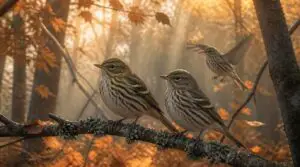
Fall can make even familiar birds feel like strangers, and that uncertainty adds up fast when multiple species share similar dull plumage.
A few predictable traps catch birders off guard every season — and knowing them in advance puts you well ahead of the confusion.
Here are the most common fall misidentification pitfalls worth watching for.
Olive-gray Warbler Lookalikes
Fall strips warblers down to their most frustrating form. Five species — MacGillivray’s, Mourning, Bay-breasted, Tennessee, and Blackpoll — all converge on olive-gray tones that blur clean distinctions.
Your anchor is eye-ring prominence: MacGillivray’s shows a bold white break; Blackpoll’s is conspicuous; Mourning’s fades. Check the hood, supercilium, and wing-bar width before committing to any ID.
Female-like Eclipse Ducks
When a male Mallard slides into eclipse plumage, he becomes his own impostor.
Bill color is your fastest split — the drake’s turns plain yellow while the hen’s stays dull orange with dark saddling. Pair that with the subdued wing speculum and his closer-to-cover foraging behavior, and you’re no longer guessing.
Immature Male Confusion
Immature males present a spring-absent puzzle — juvenile-to-adult change introduces plumage neither fully one nor the other. Erratic streaking, inconsistent field marks, and boundary-testing coloration shifts mimic adult females convincingly.
Check wing bar contrast and bill maturation together; no single mark resolves it.
Age determination requires the whole picture, not a shortcut.
Thrush Eye-ring Differences
Among the olive-backed thrushes, the Swainson’s eye ring — bold, buff, fully encircling — is your clearest anchor.
Gray-cheeked thrushes show little to none, producing a flatter face. Hermit thrushes carry a reddish tail instead. Veeries offer a near-blank face.
When the ring pairs with a pale iris, that spectacled look locks the ID.
Artificial Lighting Mistakes
Warm light is a quiet saboteur. A sodium vapor lamp or even low-angle afternoon sun can shift autumn plumage by ~200 kelvin, nudging a gray-brown flank toward burnt orange — enough to send you reaching for the wrong page.
Meanwhile, cool LED backlighting flattens eye rings and washes out breast streaks.
Trust shape first; check lighting before you trust color.
Use Tools for Confident Identification

Getting the ID right doesn’t have to come down to memory alone — the right tools sharpen your eye and fill the gaps when autumn plumage leaves you second‑guessing.
Whether you’re tracking down a mystery warbler or confirming a rarity on your patch, a few reliable resources make all the difference. Here’s what belongs in every fall birder’s toolkit.
Regional Fall Field Guides
A good regional field guide cuts your identification time in half — not by listing every species on the continent, but by narrowing the field to what’s actually around you in autumn.
Audubon’s regional guides, organized across eight geographic zones, pair seasonal behavior notes with habitat-specific plumage plates that reflect what birds look like during fall migration, not their crisp breeding portraits.
EBird Seasonal Checklists
A regional guide tells you what’s plausible; eBird tells you what’s actually being seen right now, two miles from your yard.
Seasonal checklists tie every observation to a specific date and location — meaning you can filter for fall migration windows in your county and see exactly which species your neighbors logged last October.
Birding App Filters
eBird shows you what’s been seen; a good birding app lets you interrogate why it might be your bird.
Location and date filters alone can cut a 200-species list down to a manageable dozen autumn candidates — then bill shape, wing bar, and breast streak selectors sharpen that further, anchoring your guess in stable field marks rather than unreliable fall color.
Multi-angle Bird Photos
Once your app filters and hands you a shortlist, a single photo rarely seals the deal.
Multi-angle documentation — profile, head‑on, and three‑quarter views — captures wing bars, rump patches, and eye rings that one frame will miss.
Shoot eye‑level, use back‑button AF to track subtle movement, and log angle, light direction, and location in your metadata.
Dated Backyard Checklist
Five data points beat fifty vague impressions.
A dated backyard checklist — logging plumage details, habitat, elevation, and exact date alongside routine yard tasks like gutter cleaning and irrigation checks — builds a longitudinal record that exposes patterns invisible to casual observation.
Scroll back six Octobers, and you’ll see which species reliably appear, and when.
Frequently Asked Questions (FAQs)
How do bird calls differ in autumn migration?
Autumn calls are quieter and more fragmented than spring song. Warblers emit brief high-pitched chips; thrushes give soft nocturnal chirps. Dawn flight bursts spike within the first 30 minutes after sunrise, peaking on nights with moderate tailwinds.
Which habitats attract the most fall migrants?
Deciduous forests draw the heaviest fall migrant concentrations — abundant fruit and arthropods make them essential refueling stops.
Wetland edges and riparian corridors rank close behind, while agricultural zones often function as barriers pushing birds toward remaining forest patches.
How does rain affect autumn bird behavior patterns?
Rain shifts foraging to ground level — earthworm activity spikes after showers, drawing robins and thrushes onto lawns. Heavy downpours delay migration departures, compressing activity into narrow windows between storm bands.
Can binocular magnification improve fall identification accuracy?
Yes — 8x to 10x magnification hits the sweet spot, balancing exit pupil brightness, depth of field, and a wide enough field of view to identify birds by plumage details without hand-shake ruining the shot.
Do juvenile birds flock separately from adult birds?
Often, yes — but it’s complicated. Juveniles frequently join mixed-age flocks, shadowing adults to foraging sites while learning routes. Over time, age-specific sub-flocks emerge as juveniles gain independence and experience.
Conclusion
It’s rarely a coincidence when two birders standing side by side reach opposite conclusions—one sees shape first, the other chases color. The one tracking bill geometry, wing projection, and stable field marks wins every time.
These autumn bird identification tips don’t just solve the "mystery bird" problem; they rewire how you see the field entirely. Autumn doesn’t have to mean uncertainty.
Learn to read structure, and the season becomes your sharpest teacher.
- https://daretobird.blogspot.com/2017/08/how-to-get-good-at-bird-identification.html
- https://www.lyricbirdfood.com/birding-hub/migration/top-ten-things-to-know-about-fall-bird-migration
- https://www.twibchicago.com/p/appreciating-the-wonders-of-fall
- https://www.aba.org/no-8-birds-and-fall-winter-plumage
- https://seasonsflow.wordpress.com/2021/10/02/spring-and-autumn-bird-migrations-differences