This site is supported by our readers. We may earn a commission, at no cost to you, if you purchase through links.

Nearly a billion birds die from window strikes every year in the U.S. alone, and where you hang your feeder plays a bigger role in that number than most folks realize. Put it too close and you’re safe. Put it in that awkward middle zone, and you’ve built a runway for disaster.
Here’s the thing: birds don’t see glass the way you do. They see sky, trees, and open space reflected back at them, and they fly toward it full speed. That mistake often costs them their life.
The good news is bird feeder distance from window placement isn’t guesswork, it’s physics and behavior you can work with, and getting it right protects the birds you’re trying to enjoy.
Table Of Contents
- Key Takeaways
- Best Bird Feeder Window Distance
- Why Window Distance Matters
- Safer Window Feeder Options
- Bird-Proof Nearby Glass
- Place Feeders for Safer Visits
- Frequently Asked Questions (FAQs)
- What is the 5 7 9 rule for bird feeders?
- How far away should a bird feeder be from a window?
- Is it okay to put a bird feeder on a window?
- Is my bird feeder too close to my house?
- What time of day sees the most bird strikes?
- Can male birds injure themselves attacking reflections repeatedly?
- How high should tube feeders hang for safety?
- Do platform feeders near the ground reduce collisions?
- Conclusion
Key Takeaways
- Keep your feeder within 3 feet of the window or beyond 30 feet, since the 3-to-10-foot "danger zone" gives birds just enough room to reach fatal speeds without space to correct course before hitting the glass.
- Collision force grows with speed squared, so even a small increase in a bird’s flight speed before impact can turn a near-miss into a fatal strike.
- Window feeders like suction-cup or nectar feeders are actually one of the safest options, since birds can’t build up dangerous momentum over just a few inches.
- Combining smart feeder placement with visual treatments like tape grids, decals, screens, or one-way film gives birds the best chance of recognizing glass as a solid barrier instead of open sky.
Best Bird Feeder Window Distance
If you’ve ever wondered exactly how far your feeder should sit from the glass, the answer isn’t just one number; it depends on the distance you choose. Some spots put birds in real danger, while others actually keep them safe, and the difference comes down to just a few feet.
Keeping feeders within 3 feet of the glass or beyond 30 feet—and 10–15 feet from shrubs—is the kind of detail this guide to setting up a bird feeding station walks you through step by step.
Let’s walk through the distances that matter most, starting with what happens when you go really close.
Under 3 Feet

Three feet sounds risky, but it’s actually one of your safer bets, since birds can’t build up enough speed to cause a hard strike. Minimal impact speed keeps collisions rare.
You’ll also get great window visibility for species identification.
Just make sure mounting stays sturdy, and clean feeders twice weekly to avoid mess.
For reference, three feet equals 36 inches.
Beyond 30 Feet

Beyond 30 feet gives birds enough room to spot glass and steer clear, which is the other safe end of the 3foot30foot rule.
Even so, visitation rate drops here, sometimes up to 60%, since distant feeder visibility weakens with glare or dense yards. Use high-contrast feeder design and bold colors to help birds commit to the longer approach trajectory.
Avoid 3 to 10 Feet

Here’s the zone that gets birds killed: 3 to 10 feet from your window. That’s the danger zone, giving birds just enough space to hit lethal flight speeds but no room to correct course before impact.
At this range, collision impact force peaks. Birds can’t maneuver, can’t slow down, and windows become fatal strike zones.
Skip this range entirely when placing feeders.
Risk at 15 to 30 Feet

Here’s where most fatal strikes actually happen: 15 to 30 feet out. Birds reach lethal impact speeds with no room left to correct, and reflection confusion peaks—glass mimics open sky, drawing them straight into misjudged landing paths.
Flight fatigue from repeated visits only worsens reaction time. That’s why bird strike prevention means avoiding this range, not just the closer danger zone you already know to skip.
When to Use 8 Feet
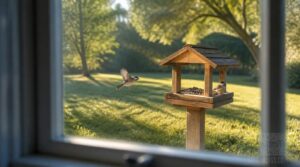
If you want the sweet spot, eight feet is it. That’s far enough for a safe flight path, giving birds room to slow down before landing, yet close enough that you still get great observation balance from your window.
Eight feet also gives you easy maintenance access for refills and cleaning, all while cutting collision risk and keeping visitation reliability steady day after day.
Why Window Distance Matters
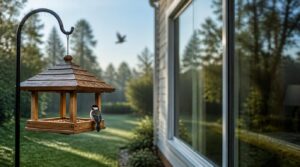
If you’ve ever heard awful thump against your window, you already know distance isn’t just some random number that biologists like to argue about. There’s real science behind why a few feet can mean the difference between a bird flying safely past and one hitting the glass full force.
Let’s walk through exactly what’s happening out there so you understand why placement matters so much.
Reflections Confuse Birds
Ever notice how birds fly straight at a window like there’s nothing there? That’s because they can’t tell glass from sky, trees, or water — they’re seeing pure habitat illusion.
Your window might reflect:
- Open sky
- Nearby trees
- Houseplants
- Even UV light patterns birds can see but you can’t
This confusion causes depth perception errors and, during migration, disrupts the visual cues birds rely on to navigate safely.
Speed Increases Collision Force
Physics doesn’t care that a bird only weighs an ounce. Kinetic energy scales with speed squared, so a bird flying twice as fast hits four times harder, and that split-second deceleration against glass creates a force spike no small body can absorb.
Kinetic energy scales with speed squared, so a bird flying twice as fast hits four times harder
Distance is what buys birds room to slow down before momentum turns a near-miss into a fatal window collision.
Stunned Birds Face Predators
A dazed bird on the ground isn’t just hurt, it’s an easy target. Stunned bird vulnerability leaves it unable to spot the usual visual threat cues that trigger flight, so predators exploit that window using ambush tactics.
Post-collision recovery takes precious seconds a hawk or cat won’t give. That’s why getting distance between window and bird feeders right matters so much for real avian safety, not just preventing bird collisions.
Houseplants Create False Habitat
Here’s a twist you might not expect: that leafy fern by your window can trick birds all on its own. Grouped houseplants create a visual barrier illusion, mimicking real understory growth, which adds to window collisions when paired with poor bird feeder placement.
Watch for humidity pocket risks and microclimate misperception near dense foliage, plus plant dust traps or soil pest attraction. Keep proper distance between window and bird feeders for true habitat safety.
Safer Window Feeder Options
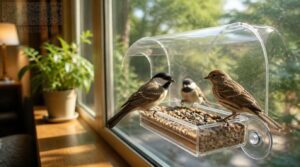
If you want birds at your window without the risk, close is actually better than far. Sticking a feeder right on the glass keeps birds moving too slow to get hurt if they do bump it. Here are a few window feeder setups worth trying.
Suction-cup Feeders
Suction-cup feeders stick right to the glass, which sounds risky but actually works in your favor—birds can’t build up deadly speed over inches.
Look for BPA-free plastic and a silicone cup rated for freezing temps. Check the seal weekly, clean feeding ports to stop seed clumping, and you’ve got a solid, low-strike window bird feeder.
Window Hummingbird Feeders
Hummingbirds practically demand close-up glass mounting, and a window bird feeder built for nectar delivers exactly that.
- Watch wing quivering inches from your face
- Refill nectar without a ladder
- Mount with strong suction for wind stability
- Choose bright red ports to attract more visitors
- Keep pets indoors and away from glass
This setup helps prevent window crashes while making window collisions far less likely.
Small Acrylic Trays
Not every window feeder needs to be a big rig. A small acrylic tray, suction-mounted right on the glass, works great for mealworms, seed, or fruit bits, and holds plenty without crowding.
Acrylic resists cracking and wipes clean easily. That clarity keeps your view sharp, and because it sits flush against the window, it keeps that critical bird feeder distance from window collisions at zero.
Secure Larger Feeders
If you’re going bigger than a suction tray, mounting matters. Use heavy-duty mounting rated for real weight, not just decorative brackets.
- Reinforced housing holds up to 20 lbs
- Poles rated for 50+ lbs static load
- Even weight distribution across ports
- Corrosion-resistant steel or coated aluminum
- Monthly bolt and bracket inspections
Sturdy setups prevent tipping, deter predators, and keep your bird feeder placement safe from window collisions long-term.
Benefits of Close Placement
Once bolted down, a close-mounted feeder pays you back daily. Immediate viewing through the glass, short flight paths that spare small birds from open sky, easy refill access, and reduced seed scatter below.
That closeness also boosts enhanced bird comfort, since visitors feel less exposed. Smart bird feeder placement this near the pane genuinely helps prevent bird strikes, cutting down window collisions overall.
Bird-Proof Nearby Glass
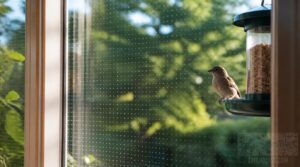
Even with your feeder placed just right, the glass itself still needs some work if you want to keep birds safe. Distance alone won’t stop a bird from mistaking a reflection for open sky or a leafy yard. Here are a few simple ways to make that window easier for birds to see.
Exterior Tape Grids
Tape works like a visual barrier for birds, spaced 6 to 12 inches apart in a grid pattern across the glass. Use weatherproof, UV-resistant materials so colorful tape holds up through rain and sun.
Cover most of the window for real protection against window collisions—this simple step goes a long way toward preventing window crashes.
Closely Spaced Decals
Decals work best when spaced close together, no more than 4 inches vertically and 2 inches horizontally—getting the decal spacing right matters more than size. Choose UV-resistant vinyl, 2-4 mil thick, for lasting durability.
Keep pattern alignment consistent using grid backing, and clean decal surfaces monthly with mild soap. This creates real visual barriers for birds, preventing window crashes effectively.
Window Screens
A screen mounted on the outside of your window is one of the simplest fixes out there, since it physically breaks up the reflection instead of just decorating it. External screens block reflections entirely, letting birds see a solid barrier.
Choose aluminum-framed fiberglass mesh for durability, and clean it every few weeks with mild soap so pests and dust don’t build up.
One-way Films
One-way films turn your window into a mirror from outside, so birds see reflection instead of a clear flight path through to your yard.
They use micro-prisms to cut transparency while keeping indoor light levels up, cutting heat gain and UV rays too.
Applied properly, they:
- Reduce glare
- Block reflections
- Add impact protection
Temporary Soap Patterns
Grab a bar of soap and get scrubbing right on the glass, because this trick costs nothing and works fast for bird collision prevention.
| Design Style | Effect |
|---|---|
| Geometric tessellations | Breaks reflections evenly |
| Floral symmetry | Softens harsh glare |
| Abstract swirls | Mimics motion, deters flight |
| Holiday motifs | Seasonal, festive coverage |
| Layered carving | Adds depth, more visibility |
Rinse off and redo it seasonally.
Place Feeders for Safer Visits

Getting the distance right is only half the job, since where you place that feeder matters just as much for keeping birds safe. A good spot gives them cover, keeps predators away, and stays clean enough to prevent disease. Here’s what to think about when picking the perfect location.
Nearby Shrubs for Cover
Think of shrubs as your birds’ emergency exit, always within reach. Plant a layered mix—low, mid, and tall—in staggered rows near feeders, giving quick escape routes from hawks and cats alike.
Native viburnum or junipers work great, offering seasonal cover, berries, and better soil health through mulching. This layered habitat management approach keeps visits safer while supporting local wildlife corridors.
Avoid Cat Access
Those escape shrubs won’t help much if a cat’s already waiting nearby, so block cat access at the source. Install a tall baby gate or vertical barrier with small gaps at doorways—cats can’t squeeze through, you still can.
Add motion-activated lights and scent deterrents around the feeding zone.
A cat patio elsewhere keeps hunting instincts satisfied without threatening your birds’ safety.
Reduce Crowding Risks
Once your yard is cat-safe, the next danger is birds crowding one single spot. Space multiple feeders at least 8 feet apart to prevent flocking bottlenecks, and keep the window-to-feeder distance consistent across each one.
Rotate locations during migration, and split resources across microclimates so no single feeder becomes a concentration risk. Watch peak traffic times, and adjust placement before crowding turns into panic—and panic turns into window strikes.
Clean Feeders Regularly
Spacing feeders out only solves half the problem—dirty feeders spread disease just as fast as crowding does.
Wash surfaces every two weeks with warm water, and switch to weekly during hot, humid stretches when mold grows fast. Use 1 part bleach to 9 parts water for disinfection, rinse well, and always air dry before refilling.
Clean feeding stations mean healthier birds.
Choose Stable Locations
Where you put a feeder matters as much as how clean it stays. Pick a spot with open ground clearance, away from wind corridors and predator ambush zones like dense brush or low fences.
- Sturdy pole with solid mounting hardware
- Clear sightline from nearby shrubs
- No overhanging branches (check seasonally)
- 8 feet from windows, stable footing
Seasonal branch maintenance keeps flight paths clear year-round, reducing bird-window collisions and strikes.
Frequently Asked Questions (FAQs)
What is the 5 7 9 rule for bird feeders?
It’s all about location, location, location: the 5-7-9 rule sets feeder height at 5 feet, structure distance at 7 feet, and window distance at 9 feet, optimizing safety buffers while minimizing collision speeds and predator leaps.
How far away should a bird feeder be from a window?
Keep feeders under 3 feet or beyond 30 feet from windows—never in the 3-to-10-foot danger zone where birds hit lethal speed zones. This avoids fatal collision impact physics while giving birds clear navigational flight paths around glass.
Is it okay to put a bird feeder on a window?
Yes—direct glass feeding works well when you choose a durable suction cup feeder. Impact speed physics favor this setup since birds never build momentum before landing, drastically preventing bird injury and cutting down on window collisions altogether.
Is my bird feeder too close to my house?
Too close and too far both cause habitat illusion dangers—that’s the paradox. Under 3 feet limits speed; beyond 30 feet gives clear flight paths. The real danger zone sits between, where birds reach lethal impact speeds before correcting course.
What time of day sees the most bird strikes?
Dawn foraging activity drives most strikes, with midday and dusk migration adding smaller peaks. Rising temperatures boost flight speed, and morning light visibility, while helpful, still coincides with heavy bird movement near windows and feeders.
Can male birds injure themselves attacking reflections repeatedly?
Testosterone-driven aggression can absolutely lead to real harm—repeated strikes cause beak injuries, feather loss, and fatigue.
Territorial males exhaust themselves in these window reflection battles, sometimes for weeks, risking dehydration and worse from constant bird-window collisions against their own image.
How high should tube feeders hang for safety?
Picture a feeder riding shoulder-high, not too low, not out of reach: 5 to 6 feet hits the sweet spot, deterring cats and squirrels while keeping small birds perching comfortably and letting you refill without hauling out a ladder.
Do platform feeders near the ground reduce collisions?
Yes—ground proximity limits speed and lowers collision force, since birds approach from underbrush routes at low levels, causing reduced vertical drops during impact.
This low-level approach naturally lowers bird mortality rates near glass compared to elevated feeders.
Conclusion
Test the theory yourself: watch your yard for a week, and you’ll see birds veer toward glass exactly where distance falls short. That’s not bad luck; it’s math playing out in real time.
Get your bird feeder distance from window right, either tight against the glass or well beyond that danger zone, and you’ll turn near misses into safe landings. Your feeder becomes what it should be: a place of nourishment, not a hidden trap waiting for wings.
- https://duncraft.com/blogs/birding-tips/bird-feeder-placement-guide-attract-more-birds-stop-squirrels-and-prevent-window-collisions
- https://www.cnet.com/home/yard-and-outdoors/dont-know-where-put-your-bird-feeder-what-wildlife-expert-recommends
- https://www.fws.gov/library/collections/bird-friendly-home-toolkit
- https://southernstates.com/blogs/how-to-library/best-locations-for-a-bird-feeder
- https://www.flap.org/our-blog/how-can-i-feed-birds-safely