This site is supported by our readers. We may earn a commission, at no cost to you, if you purchase through links.
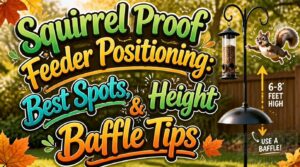
Watch a squirrel long enough, and you’ll swear it studied physics. That acrobat can launch from a fence post, clear six feet of open air, and land square on a "squirrel proof" feeder like it planned the jump in advance. Most feeders fail not because the design is weak, but because the spot they’re hung in gives squirrels every advantage: a nearby branch, a low pole, a fence within leaping distance.
Real squirrel proof feeder positioning fixes what hardware alone can’t. Get the distance, height, and clearance right, and even the boldest squirrel hits a dead end. Here’s exactly where to hang your feeders so the birds eat in peace.
Table Of Contents
Key Takeaways
- Keep feeders 7–10 feet from trees, fences, and shrubs, and at least 12 feet from branches, since squirrels can leap surprising distances from any nearby launch point.
- Mount feeders around 5 feet above the ground with roughly 9 feet of overhead clearance to block both climbing and aerial jumps.
- Pair smart positioning with hardware like weight-activated ports, 4-foot-high baffles at least 15 inches wide, and smooth metal poles instead of wood for maximum squirrel resistance.
- Balance squirrel-proofing with bird comfort by keeping feeders within 3 feet of windows to prevent collisions, near protective shrubs for cover, and clear of clutter so birds can spot predators easily.
Best Squirrel Proof Feeder Positioning Tips
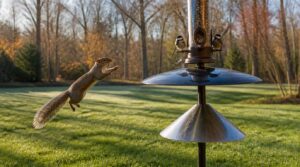
Getting your feeder spot right isn’t about luck; it’s about thinking like a squirrel and outsmarting its next move.
Once you’ve picked a squirrel-proof spot, pairing it with a bird house with easy-clean access keeps maintenance simple and your feathered visitors coming back.
A few smart habits around placement can mean the difference between a feeder squirrels ignore and one they treat as a personal buffet. Here are five positioning tips that’ll help you claim the upper hand right from the start.
Start With Open Space
Picture your yard like a wide-open circle where every guest gets a voice, not a cramped corner where squirrels sneak in unnoticed.
Clear the clutter around your bird feeder placement—open ground beats crowded tree branches and foliage every time. This creates a true squirrelproof zone, giving birds room to spot trouble early and feed without stress, protecting bird safety while inviting steady, relaxed visits.
Avoid Squirrel Launch Points
Squirrels are gymnasts at heart, so launch point distance matters more than most folks realize. Keep your squirrelproof pole 10 feet from trees or vertical structures, since a running leap easily covers less.
Trim overhanging branches and foliage—they’re free launch pads. Clear nearby fences too. You can also install squirrel-proof baffles to block climbing animals. Following these jumping distance rules turns your bird feeder placement from buffet to fortress.
Prioritize Bird Visibility
Once launch points are covered, give your birds a clear stage to perform on. Unobstructed approach paths and open sky overhead help them spot food and danger alike, while trimmed sightlines cut predator shadows fast.
- Face feeders toward open area, not dense brush
- Angle perches for direct approach
- Reduce morning glare with smart orientation
- Keep sky visibility wide for quick escapes
Check Access From All Sides
Good sightlines mean nothing if you’ve only checked one side. Walk a full circle around your feeding station, inspecting approach routes and mapping squirrel paths from every angle—north, south, east, west.
Look for overhanging branches within 8 to 12 feet, then confirm your baffle or dome guards each exposed side equally. Sneaky squirrels find the one gap you missed.
Adjust Placement Seasonally
Rarely do feeder setups stay perfect year-round, so seasonal adjustments matter. Raise feeders 12 to 18 inches in windy winters for windbreak protection, and shift toward temperature-driven elevation as conditions change.
In spring, align with solar angles and migration timing for better visibility. Come fall, tighten seasonal predator defense by adding baffles—keeping your squirrelproof bird feeders and feeder poles effective through every stretch of the calendar.
Ideal Feeder Height and Clearance

Getting the spot right is only half the battle, since height and clearance decide whether squirrels can actually reach your feeder at all. Squirrels are surprisingly gifted jumpers and climbers, so a few feet in the wrong direction can undo all your hard work.
Here’s exactly how much space you need in every direction to keep them grounded and frustrated.
Five Feet Above Ground
Five feet marks the sweet spot for Ideal Squirrel Clearance, giving you easy refill access while keeping seed off damp ground.
- Works with standard shepherd hooks
- Reduces ground moisture splashing
- Eases Maintenance Access Ease
- Fits most feeder poles
- Works with baffle add-ons
This height preserves seed quality without ladders, balancing squirrel control with everyday convenience for your feeding station setup.
Seven to Ten Feet Away
Think of seven to ten feet as your leap distance buffer, the sweet spot that ruins a squirrel’s run-up angle before it even reaches the feeder.
This gap disrupts launch points from trees or fences while opening a predator visibility corridor, so birds keep clear escape routes and sightlines. Clear the space of stepping stones, and your feeding station setup stays both squirrel-resistant and genuinely bird-friendly.
Nine Feet Overhead Clearance
Squirrels don’t just climb, they parachute from above, so aerial access blocking matters as much as ground-level defense.
Keep roofs, branches, and gutters at least nine feet above your squirrelproof feeder to maintain proper vertical safety zones. This overhead obstacle removal stops daring leaps from above.
Check seasonally for growing limbs that creep into this zone. Combined with a solid baffle or dome, you’ve built real height compliance into your bird feeder placement guide.
Twelve Feet From Branches
Ever watched a squirrel treat a tree limb like a diving board? That’s exactly why branch launch pads deserve a hard limit.
Keep hanging feeders twelve feet from any branch or limb, cutting off jump routes entirely. This squirrel jump mitigation trick also reduces seasonal branch movement in windy months, protecting your squirrelproof feeder’s flight corridors so birds can approach without foliage-tangled interruptions.
Remove Nearby Stepping Stones
That flat rock by the pole? It’s a squirrel staircase in disguise.
That innocent flat rock beside your feeder pole is really a squirrel’s staircase in disguise
Launch pad prevention means clearing an eight-foot exclusion zone around your squirrel proof bird feeder—no loose stones, no compacted soil paths.
- Swap stones for gravel or mulch (unstable footing)
- Add a barrier between decorative rocks and the base
- Patrol monthly for new flat rocks
- Disrupt every sneaky squirrel path
Where Birds Feel Safest Feeding
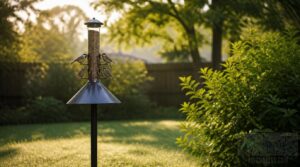
Keeping squirrels out is only half the job, since birds also need to feel comfortable enough to actually stick around and eat. A feeder that’s technically squirrel-proof won’t do much good if it sits in a spot that makes chickadees and finches nervous.
Here’s what to look for when picking a location your feathered visitors will trust.
Near Protective Shrubs
Under the right cover, birds relax and feed instead of scanning constantly for danger. Place dense evergreens or thorny deterrent species near feeders—close enough for quick escapes, far enough to avoid squirrel launch pads.
| Benefit | Distance | Result |
|---|---|---|
| Wind protection | 3-5 ft | Comfortable perching |
| Insect prey | Nearby | Extra food source |
| Escape routes | Open gaps | Safer feeding |
Clear Predator Sightlines
That cover only works if you can still see danger coming. Trim vegetation within 12 feet, keeping tree branches and foliage low so shadows don’t hide a stalking cat.
- Open ground between shrub and feeder
- No dense hedges blocking view
- Short grass beneath the pole
- Pruned branches overhead
- Two clear escape angles for quick flight
Safe Window Distance
Good sightlines mean nothing if birds still slam into glass. Window collision prevention comes down to distance: place feeders within 3 feet of windows, not farther. That short range keeps impact speed low, cutting glass strike risk if a startled bird flushes.
Skip window-mounted feeders farther out, and add decals for extra avian safety—small choices that keep your feeding station truly bird-friendly.
Low-stress Feeding Zones
Distance from glass keeps birds safe, but calm surroundings keep them fed. Minimizing human disturbance near your squirrel proof bird feeder matters as much as placement in an open area.
- Watching a startled flock scatter over gravel that shifts underfoot
- Seeing birds skip meals near flickering porch lights
- Losing regulars to moldy, spoiled seed
- Hearing lawnmowers drown out warning calls
Stable ground surfaces and consistent lighting prevent food aversion near tree branches and foliage.
Open but Not Exposed
Think of it as a bird’s front porch: open enough to see trouble coming, tucked enough to feel held. Strategic concealment near low shrub borders offers natural cover without blocking flight paths.
| Element | Purpose | Distance |
|---|---|---|
| Open sky | Spot hawks | Unobstructed |
| Low shrubs | Escape cover | 5-10 ft |
| Ground view | Predator ambush prevention | Clear |
Visual threat reduction keeps your bird feeder placement guide honest—safety and access, side by side.
Baffles and Pole Placement
Getting the spot right only solves half the puzzle, since squirrels can still shimmy right up an unprotected pole. That’s where baffles and pole choice come in, acting as your feeder’s last line of defense. Here’s what actually keeps those furry acrobats grounded.
Four-foot Baffle Height
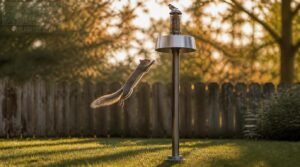
Height is where the real squirrel math happens. Set your baffle at 4 feet, and you’re forcing predators into a longer, exhausting jump arc they usually can’t complete.
Effective positioning a squirrel proof bird feeder means:
- mounting on a straight pole
- anchoring the base firmly
- checking alignment after storms
Inspect seasonally for ice or loose fittings—stability keeps this deterrent technique working year-round.
Fifteen-inch Baffle Width
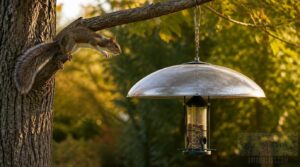
Fifteen inches isn’t arbitrary—that width creates a wide dead zone squirrels must cross, disrupting their favorite short, direct leaps toward the seed.
Wider baffles also mean better wind stability and sturdier material durability against chewing.
Just leave 6 inches of installation clearance beyond the feeder edge, so your squirrel resistant feeder rotates freely without snagging branches.
Smooth Metal Poles
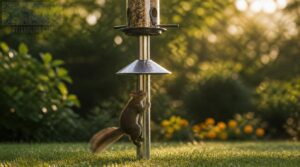
Ever watch a squirrel scale a wooden post like it’s nothing? That’s why smooth metal poles beat wood for pest prevention every time.
Chrome offers durability and easy cleaning; stainless resists corrosion in rain; brass grips better in heat; powder coating adds texture without sacrificing slickness. Skip silicone sleeves here—they add grip, the opposite of what your baffle device and squirrelproof bird feeders need to keep hanging feeders and weight sensitive feeders squirrel-free.
Cone Versus Cylinder Baffles
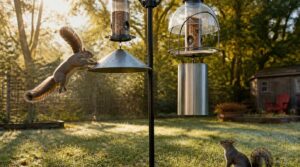
Cone or cylinder—does shape really matter for your baffle device? It does. Cones create outward turbulence, pushing squirrels off before they grip, while cylinders offer steadier, uniform coverage with fewer surface buildup risks. Cylinders also win on installation tolerance, forgiving imperfect mounting.
Pair either with weight-sensitive feeders or dome-enclosed designs, and moat guards, for well-rounded squirrelproofing that blocks every angle of attack.
Spinning Pole Options
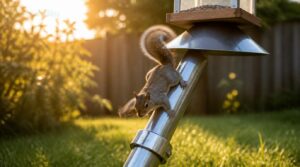
Picture a squirrel sprinting up your pole, only to hit a pole that spins right out from under its paws. That’s the magic of spinning mechanisms.
- Aluminum vs Steel: lighter setup, tougher grip
- Torque Collar Mechanics locks static mode instantly
- Manual Spin Initiation needs no motor
- Ceiling Mount Stability keeps wobble away
- Pairs great with any squirrelresistant feeder
Top 8 Squirrel Proof Feeders
Positioning only gets you so far if the feeder itself opens the door to trouble. Pair smart placement with hardware built to outsmart squirrels, and you’ll rarely lose seed to uninvited guests. Here are eight feeders worth putting on that pole of yours.
1. Brome Squirrel Buster Plus Feeder
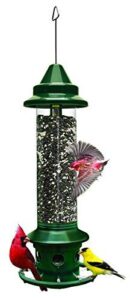
Brome Squirrel Buster Plus earns its spot at the top thanks to a weight-activated shroud that drops shut the instant a squirrel—or a hefty bird—lands on it. You can adjust the spring tension yourself, setting the exact threshold that welcomes cardinals while locking out bushy-tailed thieves.
With six ports and a 5.1-pound seed capacity, it feeds plenty without daily refills. The chew-proof, UV-stabilized plastic holds up outdoors for years, though you’ll need a separate pole adaptor since it’s sold apart from the unit.
| Best For | Homeowners with backyard squirrel problems who want a durable, high-capacity feeder that keeps seed flowing to songbirds without constant refills. |
|---|---|
| Weight Activation | Yes – shroud |
| Squirrel Deterrent Type | Spring-loaded portal closure |
| Seed Capacity | 5.1 lb |
| Material | UV plastic |
| Easy Cleaning | Yes – dishwasher safe |
| Perches | Six ports |
| Additional Features |
|
- Weight-activated shroud with an adjustable spring lets you customize exactly which birds get access
- Chew-proof, UV-stabilized plastic construction stands up to weather and squirrel damage for years
- 5.1-lb capacity across six ports means fewer refills, even with a busy feeding station
- Pole adaptor isn’t included, so you’ll need to buy one separately for pole mounting
- The full feeder is heavy and needs a sturdy pole or mount to avoid sagging over time
- Six ports can drain fast during high-traffic feeding periods, sometimes requiring a port to be covered to slow things down
2. Squirrel Proof Metal Bird Feeder
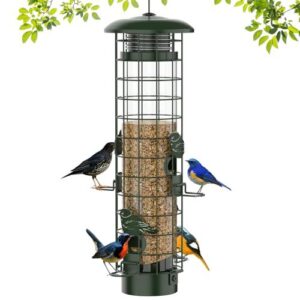
If plastic feels too flimsy, this one’s your answer. Its all-metal build with a chew-resistant coating stops squirrels from gnawing their way in, while welded seams (not rivets) remove the weak spots they’d normally pry apart.
The 3.9" × 15.7" mesh design holds 3 pounds of seed and gives finches, chickadees, and cardinals plenty of perch room. A removable lower section makes cleaning simple, though wet seed can clog it if you skip regular refills.
| Best For | Backyard bird lovers who want to feed finches, chickadees, and cardinals without squirrels crashing the party. |
|---|---|
| Weight Activation | No |
| Squirrel Deterrent Type | Metal mesh barrier |
| Seed Capacity | 3 lb |
| Material | Metal |
| Easy Cleaning | Yes – removable section |
| Perches | Multiple perches |
| Additional Features |
|
- Heavy-duty metal mesh construction keeps squirrels out and holds up better than plastic
- Removable lower section makes cleaning and refilling quick and easy
- Multiple perches let several small songbirds feed comfortably at once
- Determined raccoons or squirrels with access to nearby branches may still get in
- Strong winds or heavier animals can knock the feeder down
- Wet seed can clog the bottom section if it’s not cleaned regularly
3. Perky-Pet Squirrel Proof Bird Feeder
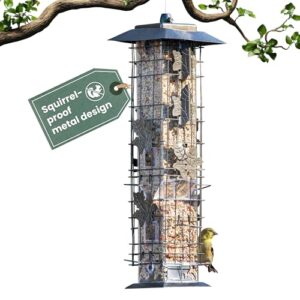
Metal chewing at the ports doesn’t stand a chance against this one’s weight-activated perch system, which slams feeding access shut the instant a squirrel’s heft lands on it. Powder-coated construction shrugs off rust and rough weather alike.
At 19 inches tall with a clear reservoir, you’ll spot low seed levels at a glance. Just keep it out of harsh sun, since the plastic chamber can degrade with prolonged UV exposure over time.
| Best For | Backyard bird enthusiasts who are tired of squirrels raiding the feeder and want a low-maintenance, all-weather option that keeps seed protected and easy to monitor. |
|---|---|
| Weight Activation | Yes – perches |
| Squirrel Deterrent Type | Weight-activated ports |
| Seed Capacity | Not specified |
| Material | Metal and plastic |
| Easy Cleaning | Moderate |
| Perches | U-shaped perches |
| Additional Features |
|
- Weight-activated perches shut down feeding ports the moment a squirrel climbs on, keeping seed for the birds
- Powder-coated metal build stands up to rust and rough weather year-round
- Clear reservoir makes it easy to check seed levels at a glance
- Plastic reservoir can oxidize or degrade with prolonged sun exposure
- Persistent squirrels may gnaw on metal parts trying to get in
- Small crossbar assembly can be a bit fiddly to handle during refills
4. Squirrel Buster Standard Bird Feeder
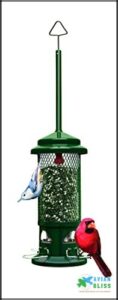
If powder-coated steel isn’t your priority, this compact model earns its keep through a weight-adjustable spring mechanism that shuts feeding ports the instant a squirrel lands. The wire mesh shroud slides down over the ports, blocking access while birds keep dining undisturbed nearby.
Holding about 1.3 pounds of seed, it’s built for smaller branches and tighter spaces. Chew-proof housing and a quick-reset design mean less fussing, and you’ll appreciate how easily it tailors weight sensitivity to your local bird crowd.
| Best For | This feeder is best for owners of small-to-medium birds who have limited outdoor space, like a balcony or porch, and want a squirrel-proof feeder without dealing with tools or hardware. |
|---|---|
| Weight Activation | Yes – perches |
| Squirrel Deterrent Type | Weight-sensitive ports |
| Seed Capacity | 0.75 qt |
| Material | High-impact plastic |
| Easy Cleaning | Yes – tool-free |
| Perches | Four perches |
| Additional Features |
|
- Weight-sensitive perches automatically close feeding ports to keep squirrels and larger animals from stealing seed
- Tool-free assembly and cleaning make upkeep quick and hassle-free
- Backed by a lifetime warranty, plus adjustable spring tension to suit different bird species
- Small 0.75 qt seed reservoir means frequent refilling, often every 1–2 days in busy birdyards
- Larger feeding ports can lead to seed spillage, which may attract ground-feeding critters
- Seed mixes with big fragments, like dried fruit, can clog the feed tube, so seed choice matters
5. Legacy Squirrel-Proof Bird Feeder
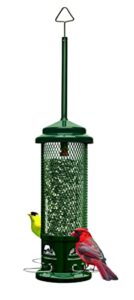
Chew-proof and built to last, this one leans on a weight-adjustable spring mechanism that snaps the shroud shut the second a squirrel climbs aboard. It holds 2.6 pounds of sunflower or safflower seed, with a vented tube keeping things fresh in humid weather.
At 2.7 pounds, it’s hefty for flimsy poles, so mount it securely. Four metal perches welcome clinging and perching birds alike, and tool-free assembly makes cleaning genuinely painless.
| Best For | Bird lovers who want to keep squirrels out of the seed and attract a wider variety of wild birds, like woodpeckers and nuthatches. |
|---|---|
| Weight Activation | Yes – shroud |
| Squirrel Deterrent Type | Weight-sensitive shroud |
| Seed Capacity | 2.6 lb |
| Material | Metal and plastic |
| Easy Cleaning | Yes – tool-free |
| Perches | Four perches |
| Additional Features |
|
- Weight-sensitive shroud automatically blocks squirrels while letting birds feed freely
- Tool-free assembly makes hand cleaning and regular maintenance quick and easy
- Four sturdy metal perches accommodate both perching birds and larger clinging species
- At 2.7 pounds, it may be too heavy for small or flimsy poles and trellises
- Only suited for sunflower or safflower seed, so it won’t work well with larger seed varieties
- The weight-adjustable spring needs careful calibration, since incorrect settings can let squirrels sneak through
6. Squirrel Buster Classic Feeder
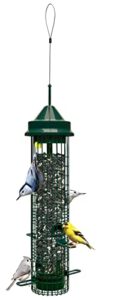
This one’s earned its reputation the old-fashioned way: through decades of squirrels trying (and failing) to outsmart it. The weight-activated mechanism shuts all four ports the instant a heavier critter lands, while the wire mesh shroud shrugs off chewing attempts entirely.
Seed capacity runs 1.4 to 2.4 pounds depending on the model, and that Seed Tube Ventilation System keeps things dry even on muggy days. A lifetime guarantee backs it against squirrel damage, which tells you something about how confident the maker is.
| Best For | Backyard bird lovers who are tired of losing seed to squirrels and want a low-maintenance feeder that handles multiple birds at once. |
|---|---|
| Weight Activation | Yes – shroud |
| Squirrel Deterrent Type | Weight-activated shroud |
| Seed Capacity | 2.4 lb |
| Material | Metal and plastic |
| Easy Cleaning | Yes – tool-free |
| Perches | Four staggered ports |
| Additional Features |
|
- Weight-activated ports shut out squirrels and other heavy critters automatically
- Chew-proof metal mesh and impact-resistant plastic hold up to years of gnawing attempts
- Four staggered ports let several birds feed at once without crowding
- Needs to hang high enough that squirrels can’t reach it from below or nearby jumps
- Long, open design could still attract bears or unusually tall squirrels
- Lower ports stop working once the seed level drops too far
7. Squirrel‑Proof Bird Feeder with Funnel
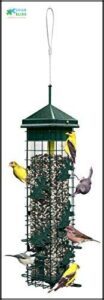
Gravity does the heavy lifting on this design, using a built-in seed funnel that redirects seed away from ports whenever a heavier animal tips the balance. Birds keep feeding uninterrupted while squirrels get nothing but frustration.
The funnel also catches spilled seed and channels it back into the reservoir, cutting waste and refill trips. Calibrated opening size keeps larger critters out entirely, and smooth interior surfaces prevent clogging even with standard sunflower or mixed blends—no specialty seed required.
| Best For | Gardeners who want to feed small to medium perching birds and clingers like woodpeckers and nuthatches without losing seed to squirrels. |
|---|---|
| Weight Activation | Yes – shroud |
| Squirrel Deterrent Type | Weight-activated shroud |
| Seed Capacity | 3.4 lb |
| Material | RoxResin and metal |
| Easy Cleaning | Yes – tool-free |
| Perches | Small/medium ports |
| Additional Features |
|
- Weight-activated shroud and funnel design keep squirrels out while letting birds feed without interruption
- Tool-free assembly makes filling and cleaning quick and easy
- Chew-proof metal construction and spring-loaded rod stand up to persistent critters
- 3.4-pound seed capacity means frequent refills in busy gardens
- Not suitable for larger birds like cardinals
- Some squirrels may eventually find ways around the shroud over time
8. Weight Activated Metal Bird Feeder
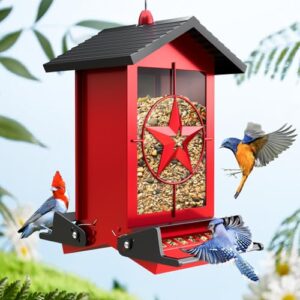
Think of this feeder as a tiny bouncer at your bird buffet’s door. Weight-activated perches sense the difference between a chickadee and a chunky squirrel, sealing feeding ports the instant that threshold’s crossed.
The heavy-duty powder-coated metal body shrugs off chewing and weather alike, while stainless fasteners resist rust for years outdoors. A clear polycarbonate window lets you check seed levels at a glance—no guessing, no lifting the lid. Simple, sturdy, and built to outlast persistent backyard raiders.
| Best For | backyard birdwatchers—beginner or experienced—who want to attract cardinals, blue jays, and finches while keeping squirrels and pests out of the seed. |
|---|---|
| Weight Activation | Yes – perches |
| Squirrel Deterrent Type | Weight-activated dual perches |
| Seed Capacity | 5 lb |
| Material | Powder-coated metal |
| Easy Cleaning | Yes – removable lid |
| Perches | Dual perches |
| Additional Features |
|
- Weight-activated dual perches automatically close feeding ports when squirrels or heavier pests climb on
- Durable, all-weather build with a chew-resistant powder-coated metal body and locking lid for year-round outdoor use
- Clear polycarbonate window makes checking seed levels quick and easy, with refills needed only about every two weeks
- No feeder is completely squirrel-proof, so persistent squirrels may still find ways to get at the seed
- Requires regular manual cleaning and rinsing to keep it in good condition
- 5 lb seed capacity may mean more frequent refills for larger flocks or high-traffic feeding spots
Positioning by Feeder Type
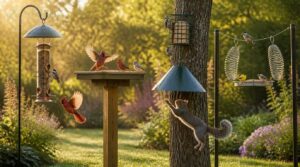
Not every feeder hangs the same way, and that matters more than you might think when squirrels are on the prowl. Tube feeders, platforms, suet cages, and hanging stations each call for their own placement game plan to stay squirrel-free.
Here’s how to position each type so birds eat easy and squirrels walk away hungry.
Tube Feeder Placement
Tube feeders work best hung 5 to 8 feet up, high enough to dodge ground predators yet still reachable for finches and chickadees.
Keep them within 10 feet of shrubs for quick escape routes, spaced 6 to 10 feet apart if you’re running multiple units, and tilted away from prevailing winds to stop seed spoilage. Pair with a squirrel-proof baffle and weight-sensitive perches for solid protection.
Platform Feeder Placement
Wobbly trays spill more seed than they serve, so anchor your platform on a sturdy pole or wall bracket that won’t tilt in wind.
Mount the surface 5 to 6 feet up, spaced 15-30 feet from other feeders. Pick a sunlit spot with partial shade to fight moisture and spoilage, and angle it slightly downward so rain runs off instead of pooling.
Suet Feeder Placement
Suet feeders bring a different wrinkle than platforms since the food itself melts. Mount yours 5 to 8 feet up, at least 10 feet from tree trunks, in partial shade to prevent the block from turning into a greasy mess on hot days.
Keep clear bird flight paths nearby for quick escapes, and rotate placement seasonally, shifting toward shade during heat waves to stall melting.
Caged Feeder Placement
Caged feeders work best at 4 to 6 feet high, keeping the wire mesh cage 10 to 15 feet from windows to prevent strikes.
Align with prevailing winds to cut spillage, and leave predator sightlines clear.
- Mount metal mesh feeders on smooth poles
- Avoid nearby shrubs or fences
- Rotate placement seasonally
- Check latch security often
Hanging Feeder Spacing
Once your latches are secure, spacing matters just as much. Keep hanging feeders 12 feet from tree branches and foliage, in open areas squirrels can’t launch from.
| Feeder Type | Spacing Rule | Why |
|---|---|---|
| Seed | 3-4 ft apart | Seed Competition Spacing |
| Nectar | 15 ft away | Hummingbird Nectar Separation |
| Mixed heights | Vary 4-8 ft | Multi-height Placement |
Rotate seasonally, and mind wind stability too.
Placement Mistakes That Invite Squirrels
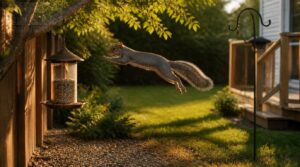
Even the best feeder can turn into a squirrel buffet if it’s set up wrong. Small oversights in placement, ones you might not even think twice about, often give squirrels exactly the access they’re looking for. Let’s look at the most common mistakes so you know exactly what to avoid.
Too Close to Trees
That shady spot under your oak tree might look cozy, but it’s basically a squirrel superhighway. Tree Launch Hazards turn nearby branches into springboards, letting squirrels leap straight to your feeder.
Dense foliage also creates Predator Concealment Risks and messy Debris Accumulation Issues. Add Shadow Pattern Shifts from Seasonal Foliage Impact, and birds grow wary. For real squirrel-proof bird feeder success, keep your setup clear of overhanging cover.
Low Hanging Feeders
Why do low hanging feeders backfire? Sitting just 3 to 4 feet up, they’re squirrel-friendly buffet tables, plus ground moisture invites mold. Watch for:
- Easy squirrel jumps
- Soggy, spoiled seed
- Messy spillage zones
- Weak predator visibility
Choose weight sensitive feeders raised past 3.5 feet, and stick to quick, low-level cleaning routines for easy refilling.
Nearby Fences or Decks
Right beside a fence or deck rail, squirrels get a running start you never see coming. Corner Ambush Routes form where fence lines meet, giving squirrels a launch pad straight to your feeder. Watch for Railing Gap Safety, too — wide gaps invite climbers.
Deck shade also breeds Deck Moisture Risks, spoiling seed. For any bird feeder placement guide, keep feeders 7-10 feet clear.
Shrubs as Launch Pads
That leafy shrub tucked beside your feeder pole? It’s basically a squirrel springboard. Shrubbery escape routes and dense branches give squirrels grip and momentum, launching them straight onto your feeder.
Even a modest three-foot shrub within jumping range undoes your squirrelproofing bird feeders efforts entirely. For a garden bird sanctuary that actually deters rodents, keep shrubs 7-10 feet back, saving predator concealment benefits for birds elsewhere in the yard.
Unprotected Wooden Posts
That untreated wooden post holding up your feeder is a double threat: squirrels grip rough wood easily, and soil moisture rot sets in within 3-7 years underground. Fungal decay weakens the base, eventually causing structural failure.
Swap wood for smooth metal poles or add post sleeves and gravel backfill—smart physical barriers that boost post durability while making your squirrelproof bird feeder setup truly squirrel-proof.
Frequently Asked Questions (FAQs)
Does feeder color or material attract more squirrels?
Both play a role, but material matters more long-term. Color contrast effects spark curiosity from a distance, while metal durability benefits and material chewing resistance decide whether squirrels stick around.
A shiny finish attraction fades fast once your squirrel resistant feeder proves too tough to crack.
Can squirrels chew through plastic feeder ports over time?
The tougher the plastic looks, the faster a determined squirrel proves otherwise. Yes, they’ll chew through it—plastic port durability varies by hardness, but metal sleeves resist gnawing far longer, preventing seed spoilage and costly feeder replacements down the road.
How often should birdseed be refilled to avoid spoilage?
Aim to refresh seed every three to seven days, tightening to three to five in hot climates. Watch for mold, clumping, or musty odor, and use covered feeders plus airtight storage to keep seed dry and appealing.
What time of day are squirrels most active?
Squirrels hit dawn foraging peaks within 30 minutes of sunrise, then surge again during twilight activity windows before sunset. Midday rest periods offer a quieter stretch, so scheduling your squirrel resistant feeder checks then reduces run-ins during backyard birdwatching.
Conclusion
A determined squirrel can leap ten feet horizontally and drop five feet vertically, clearing distances most feeders never account for. That’s why guesswork fails and math wins.
Nail the numbers—height, distance, clearance—and squirrel proof feeder positioning turns your yard into a fortress no acrobat can crack. Pair smart placement with a quality baffle, and you won’t just slow squirrels down; you’ll send them looking elsewhere entirely. Your birds finally get to eat in peace.
- https://birdsnap.com/blogs/news/the-ultimate-guide-to-squirrel-proofing-your-bird
- https://www.instructables.com/Squirrel-Proof-Bird-Feeder
- https://www.vakiav.com/blogs/vakiav-backyard-birding-101-guide/day-2-of-the-birding-guide-placement-power-the-secrets-to-optimal-feeder-placement
- https://dianarambles.com/diy-squirrel-baffle
- https://www.perkypet.com/advice/squirrels-101/squirrel-proofing-101/location-of-feeders