This site is supported by our readers. We may earn a commission, at no cost to you, if you purchase through links.
I spent three mornings staring at an empty birdhouse before a bluebird finally checked it out. She circled twice, peeked inside, and left. My camera missed all of it because I’d mounted it at the wrong angle.
That’s the thing about nesting boxes for nature photography: the box matters as much as the bird. Entrance size, camera resolution, night vision range, even the screws holding it together all decide whether you catch real moments or just empty footage.
Get the setup right, and you’ll capture nesting season like never before.
Table Of Contents
- Key Takeaways
- Choose a Photography Nest Box
- Top 5 Nest Photography Camera Options
- Install Your Nest Box Camera
- Photograph Nesting Birds Responsibly
- Frequently Asked Questions (FAQs)
- What are the disadvantages of nest boxes?
- What can I use instead of a nesting box?
- Do wild birds actually use birdhouses?
- How to make simple nesting boxes?
- How much does a nest box camera typically cost?
- Can I move the camera once birds start nesting?
- Will camera noise or lights scare away birds?
- How long do nest box cameras last outdoors?
- Do I need permits to install a nest camera?
- Conclusion
Key Takeaways
- Matching your nest box’s entrance size and height to your target bird species boosts your chances of real nesting activity.
- Camera features like resolution, night vision range, and solar power all decide whether you capture real moments or just empty footage.
- Placing your camera at the right angle and height, then securing weatherproof power and WiFi, makes the setup actually work in the field.
- Protecting nesting birds means minimizing visits, using motion-triggered recording, and adding predator guards so your gear never stresses out the animals you’re watching.
Choose a Photography Nest Box
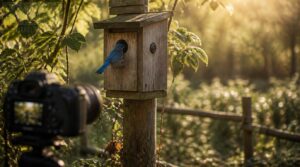
Picking the right nest box makes all the difference for great photos. You’ll want to think about the birds you hope to attract, plus the camera features that fit your goals. Here’s what to look for before you buy.
For guidance on matching entrance hole size and box placement to species like bluebirds or wrens, this guide to choosing nesting boxes for backyard birds breaks down what actually matters before you buy.
Match Cavity-Nesting Bird Species
Before buying any camera box, figure out who you’re hoping to attract. House wrens like tiny 1.25 inch entrances, while bluebirds need 1.5 inch holes mounted 4–6 meters up. Chickadees settle for shallow, mossy cups. Match the hole size and habitat to your target species, and you’ll boost your odds of real nesting activity.
For proper nest box placement, consider species-specific height and orientation guidelines.
Compare Camera Resolution
Once you’ve matched the box to your bird, look at what’s recording the action.
Megapixel count isn’t everything — sensor size and lens quality matter just as much. Options range from a 5MP HD sensor to full 4K HD video, or 2K HD video for tighter budgets. Higher pixel density sharpens cropped shots, and good image processing keeps detail clean, especially with AI bird species recognition built in.
Check Night Vision Capabilities
Resolution only tells half the story. Once the sun goes down, infrared LEDs take over, lighting the nest without disturbing sleeping chicks.
Look for:
- Night vision range of 5-10 meters
- Adjustable IR sensitivity settings
- Motion-triggered alerts that save battery life
Some cameras even use thermal imaging basics for heat-based detection. Good weather resistance keeps those infrared LEDs working through damp, chilly nights.
Select Reliable Power Options
Those infrared LEDs still need juice, especially on long, cloudy nights.
Look for a solar-powered system around 10-20 watts, paired with a rechargeable battery near 4000mAh. Bigger 10,000mAh banks help during dim stretches. Keep USB backup charging handy, and check for weatherproof power components. WiFi connectivity plus motion detection should run smoothly without draining your setup fast.
Prioritize Weatherproof Materials
Rain and sun will wreck a cheap box fast. Look for weatherproof cedar wood or weatherproof plywood, both naturally durable. Check for an IP66 rating on electronics, or IP54 at minimum.
Good sealant durability, solid finish longevity, and proper insulation effectiveness all matter. Moisture control and fastener weather resistance keep your solar powered setup running through every season.
Top 5 Nest Photography Camera Options
Now that you know what to look for, let’s look at real options. Each one brings something different to the table, from solar power to AI bird recognition. Here are five nest cameras worth your attention.
If you’re shopping for a parent or grandparent, our guide to bird watching cameras designed for seniors highlights easy setup and simple app controls worth considering.
1. Whitehorse Cedar Bird House With Camera
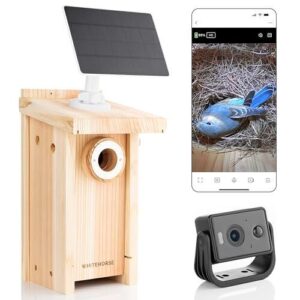
Want a nest box that feels like real cedar, not plastic pretending to be cedar? The Whitehorse comes built from 100% FSC western cedar, so it holds up outside for years.
Inside, a 4MP camera shoots 2K HD video, sharp enough to catch feather detail. Infrared night vision lets you watch after dark. A 32GB card stores hours of footage, and the removable battery recharges easily. Its floor fits Eastern Bluebirds and similar cavity nesters perfectly.
| Best For | Backyard bird lovers and nature enthusiasts who want to attract Eastern Bluebirds, Tree Swallows, Titmice, Wrens, and Chickadees while watching the action through a built-in WiFi camera. |
|---|---|
| Camera | WiFi Camera |
| Power Source | Solar Charging |
| Material | Cedar Wood |
| Weatherproofing | Weatherproof Design |
| Mobile App | WiFi App Access |
| Predator Guard | Stainless Steel Guard |
| Additional Features |
|
- Sturdy 3/4" thick cedar construction with a stainless-steel entry guard and wooden predator guard for lasting protection
- Weatherproof design with angled vents and a recessed door/floor keeps rain and moisture out
- Solar-powered WiFi camera lets you enjoy remote birdwatching over multiple days without constant recharging
- The door locking screw can strip with repeated use, sometimes needing repositioning or extra reinforcement
- The WiFi camera only works on the network it’s originally set up on, so it can’t roam between connections
- Some users have noticed roof warping or a stiff door-release pin over time
2. Bird House Camera with Solar Power
If you’d rather skip battery changes every month, this style of box makes sense. A small 5 to 20 watt solar panel feeds a rechargeable pack, usually 5000 to 10000 mAh, keeping power flowing from dawn to dusk.
The camera streams 1080p with digital zoom up to 4x, and a 110 to 140 degree lens covers the whole nest floor. IP65 to IP66 housings shrug off rain. Footage saves to a microSD card, up to 128GB.
| Best For | This solar-powered bird house camera is best for birdwatching enthusiasts and families who want an easy, low-maintenance way to observe nesting and hatching activity in real time. |
|---|---|
| Camera | 2K HD Camera |
| Power Source | Solar Powered |
| Material | Cedar Wood |
| Weatherproofing | Waterproof Coating |
| Mobile App | Multi-User App |
| Predator Guard | Waterproof Fixings |
| Additional Features |
|
- Solar charging with intelligent sleep mode means no monthly battery swaps, and the setup keeps power flowing from dawn to dusk
- 2K HD wide-angle camera with night vision and a wide 110 to 140 degree lens captures the entire nest floor, day or night
- Multi-user app sharing and a bundled 32GB SD card make it simple to save and share bird activity with family and friends
- Some buyers have run into structural durability issues, including a fragile wooden camera cradle prone to breaking during unpacking
- The camera only works with 2.4GHz Wi-Fi, so homes without that network option may run into setup headaches
- Reviews are mixed on long-term weather resistance and app pairing, especially for Android users on the Tris Home App
3. Smart Solar Birdhouse with AI Camera
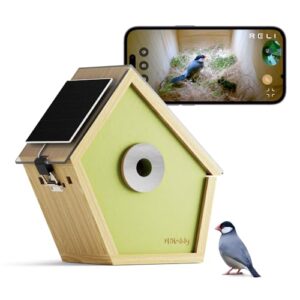
This box brings real brainpower to your backyard. Its AI camera can recognize over 1000 bird species, tagging visitors automatically as they come and go.
Power comes from a 7800mAh battery paired with a solar panel, so cloudy days won’t leave you in the dark. The pine wood build includes drainage and ventilation, keeping nests dry and healthy.
You’ll also get time-lapse photography, perfect for watching a nest grow from eggs to fledglings without staring at your phone all day.
| Best For | Backyard birdwatchers and nature-loving families who want an up-close, tech-assisted view of nesting birds without disturbing them. |
|---|---|
| Camera | AI Camera |
| Power Source | Solar + 7800mAh Battery |
| Material | Pine Wood |
| Weatherproofing | Ventilated Drainage |
| Mobile App | App Alerts |
| Predator Guard | Interchangeable Entrances |
| Additional Features |
|
- AI camera identifies over 1000 bird species automatically
- Solar-assisted 7800mAh battery keeps it running without constant charging
- Time-lapse feature captures the whole nesting cycle hands-free
- Solar panel attachment to the roof can be unreliable
- App connectivity issues like slow performance and disconnections have been reported
- Wood exterior may fade or crack with prolonged outdoor exposure
4. Hibird 4K Smart Bird Feeder Camera
This one’s built for detail hunters. The Hibird records true 4K video at 30 fps, backed by a Sony-based 8MP sensor and 32MP still shots.
Dual-band WiFi (2.4G/5G) keeps your stream stable, even with a router across the yard. AI recognition covers thousands of species, flagging visitors in under half a second.
Solar charging and a 3000mAh battery handle cloudy stretches fine. Just skip third-party USB-C cables, they’re known to cause charging headaches here.
| Best For | This camera is a great fit for backyard birdwatchers who want crisp 4K detail and smart species alerts without paying for a subscription just to get started. |
|---|---|
| Camera | 4K Camera |
| Power Source | Solar + 3000mAh Battery |
| Material | N/A (Camera Unit) |
| Weatherproofing | IP66 Waterproof |
| Mobile App | Mobile App Notifications |
| Predator Guard | Iron Mounting Base |
| Additional Features |
|
- True 4K/30fps video plus a 32MP still sensor make for seriously detailed shots and playback
- Solar panel and 3000mAh battery keep it running outdoors with minimal maintenance
- AI identification for over 10,000 species with under 0.5s trigger speed, sent straight to your phone
- No night vision, so it’s not useful for after-dark monitoring
- Non-removable battery and memory mean the device has a hard limit on its lifespan
- WiFi can get flaky if the camera sits far from your router, and only the included USB-C cable charges reliably
5. Birdfy Nest Duo Smart Bird House
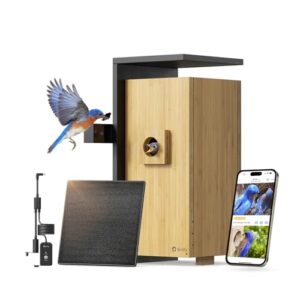
Two cameras, two stories. The Birdfy Nest Duo shows inside nest activity and outside arrivals at once, both in 1080p.
Bamboo housing keeps things natural, and a 5W solar panel with 9,000mAh battery controls long cloudy stretches. IP66 protection shrugs off rain and dust.
Four entrance sizes, from 0.9 to 2.0 inches, mean you can invite specific species in. Just know the AI species ID isn’t perfect, and the bamboo interior may need light sanding for better grip.
| Best For | Bird enthusiasts and families who want an up-close, hands-off view of nesting activity while supporting backyard conservation efforts. |
|---|---|
| Camera | Dual 2MP Cameras |
| Power Source | Solar + 9000mAh Battery |
| Material | Bamboo |
| Weatherproofing | IP66 Weather Resistant |
| Mobile App | Birdfy App |
| Predator Guard | Metal Predator Guards |
| Additional Features |
|
- Dual cameras capture both inside and outside nest views with audio, all powered reliably by solar and battery for all-day use
- Weatherproof (IP66) bamboo housing with four customizable entrance sizes lets you target specific bird species
- Remote controller and app connectivity let you adjust settings without disturbing the birds
- AI-based bird and nesting stage detection has been reported as inaccurate by users
- The bamboo interior can be too slick for some birds to grip, often requiring sanding or modification
- The exterior metal latch may not fully deter persistent predators like raccoons
Install Your Nest Box Camera
Picking the camera was the easy part. Now you need to get it working right in the field. Here’s how to install it step by step, from placement to power.
Choose a Safe Location
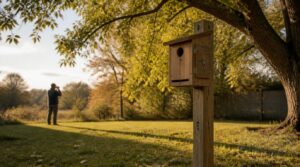
Before you grab a ladder, walk your yard like a scout. Choose a safe location with shelter from wind and rain, some distance from human traffic, and clear predator distance from fences or trunks.
Look for weatherproof cedar wood boxes with open vents and drainage holes, plus a cleanout door for easy maintenance access. Balance sun and shade for good microclimate comfort.
Set The Correct Height
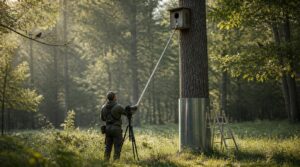
Height decides how safe and visible your nest box camera turns out to be.
Mount most boxes 6 to 10 meters high for bluebirds and chickadees, or 3 to 5 meters in suburban yards. Go higher, 12 to 15 meters, in open habitats for predator avoidance.
Add predator guards below 3 meters, and always check the cleanout door stays reachable.
Adjust The Camera Angle
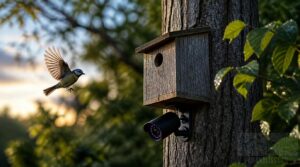
Getting the box high enough means nothing if the lens points the wrong way.
Tilt down slightly for nest visibility, cutting glare off the lid. Pan slowly for bird tracking without startling parents. Fine-tune tilt in 1-2 degree moves and adjust field of view for the cavity.
- Adjust for glare control
- Use infrared LEDs for night checks
- Enable motion detection
- Try AI bird recognition
- Confirm 360-degree view coverage
Secure Power and WiFi
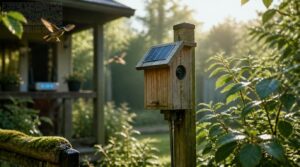
Once the angle looks right, power and signal keep it running.
Solar charging with a 4000mAh battery covers most sunny days without a hitch. For WiFi, stick close to your router since 2.4GHz WiFi needs a strong signal to avoid dropped clips.
Choose an IP66 rating for weatherproofing, and set a strong password for network security.
Test Alerts and Storage
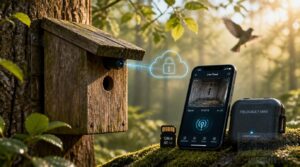
Before the birds move in, run a full test. Trigger motion detection and confirm your alerts reach both email and app within seconds.
Check that clips save to your SD card and cloud storage without gaps. Confirm encryption is active for privacy, and review storage retention settings so old footage clears out on schedule.
Photograph Nesting Birds Responsibly
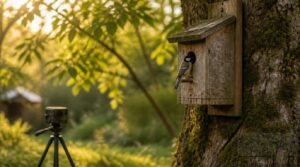
Your camera is set up and running. Now comes the part that matters most: respecting the birds you’re watching. Here are five simple habits to keep your nest box safe, healthy, and stress-free all season long.
Respecting the birds you’re watching matters more than any camera setting, so let your equipment do the work and keep visits rare
Minimize Visits and Disturbance
Every visit near a nest box adds stress, even a quiet one. That’s why a remote viewing point matters so much.
Skip daily checkups. Let your camera do the watching, and save hands-on visits for non-breeding season checks only.
A concealed camera housing keeps your gear out of sight, so birds settle in without feeling watched.
Use Motion-Triggered Recording
Skip round-the-clock recording. Motion-triggered recording saves storage and battery by capturing only real activity.
Set sensitivity zones around the entrance, not swaying branches, cutting false positives from wind. Solar powered systems with 4K HD video and night vision keep footage sharp day or night. Add pre and post buffers so you never miss the moment a bird arrives.
Add Safe Predator Protection
Raccoons are clever climbers, so a predator baffle installation below your box stops them cold. Match your entrance hole sizing to your target species, keeping bigger predators out entirely.
Add mesh over vent openings, tamper-resistant hardware on the housing, and maintain ground clearance around the base. Weatherproof plywood and weather-resistant electronics round out solid, predator-resistant nesting for reliable outdoor surveillance.
Maintain Ventilation and Drainage
A stuffy box stresses chicks fast. Vent slot design near the top and bottom keeps air moving without drafts hitting the nest.
Sloped floors and a drainage hole placement near the base stop puddling. Weatherproof plywood and IP54 protection resist moisture, while microSD cards stay safe and dry inside.
Condensation prevention matters most after rainy nights.
Clean After Nesting Season
The season’s over, but your job isn’t quite done. Once fledglings leave for good, pull out old nest material to cut down on parasites and mold.
Scrub the interior with mild soap, then rinse well. For droppings, a 1:10 bleach solution disinfects safely. Wear gloves, check for damage, and let it dry before storing your camera gear again.
Frequently Asked Questions (FAQs)
What are the disadvantages of nest boxes?
Humidity buildup, mold, and mismatched cavity sizes can drive birds away. Add predator risks, ongoing maintenance, and cost considerations for weatherproof electronics, and you’ll see why placement and predator guards matter so much for real success.
What can I use instead of a nesting box?
Not every yard needs a box. Try open nesting platforms, ground nest patches, or artificial ledges. Add predator guards and natural wood perches, then fit any spot with a nest box camera for easy monitoring.
Do wild birds actually use birdhouses?
Yes, real birds do move in. Bluebirds, chickadees, and wrens readily use properly sized boxes, especially with good placement near trees or water. Occupancy depends on entrance size, ventilation, and local competition from other cavity nesters.
How to make simple nesting boxes?
Think of it as building a cozy cabin for tiny tenants. Pick untreated natural wood, drill a snug 25-32mm hole, add drainage, mount 2-4 meters high, then clean each season once chicks fledge.
How much does a nest box camera typically cost?
Basic models like a Bird House with Camera Wireless Solar Powered run $60- Mid-range picks (WIWACAM WiFi Bird Box Camera) hit $120- Premium options like Birdfy’s 2026 version or JCS Wildlife’s Barred Owl box can reach $
Can I move the camera once birds start nesting?
Tempting, but hold off. Nest disturbance during active incubation can cause abandonment. Legally and ethically, wait until fledging. Rely on remote adjustment or long-range monitoring instead of touching the box directly.
Will camera noise or lights scare away birds?
Loud or sudden noise can spook nesting birds, but low, steady sound rarely bothers them. Stick with infrared night vision for minimal glow, keep camera sound levels natural, and rely on motion detection instead of constant lighting.
How long do nest box cameras last outdoors?
Forever, if you never touch it? Not quite. Expect 4 to 6 years in mild weather, less near coastal salt spray or intense UV. Weatherproof seals, solar power durability, and regular checks keep night vision and motion detection working season after season.
Do I need permits to install a nest camera?
Often, yes. Federal law requires a Migratory Bird Permit near protected nests, while state, municipal, or private property rules may add their own permit application steps, exemptions, or fees for your nesting box placement and wildlife observation setup.
Conclusion
Good things come to those who wait, but good footage comes to those who prepare. That bluebird taught me more than any manual could.
Setting up nesting boxes for nature photography rewards patience with proof: real behavior, real moments, caught clean. Get the angle right. Get the height right. Then step back and let nature do the rest.
Your empty footage days are over.