This site is supported by our readers. We may earn a commission, at no cost to you, if you purchase through links.
You spot movement in the canopy, raise your binoculars, and by the time you focus, the warbler’s gone. That half-second lag costs more birds than bad luck ever does. Most of it traces back to gear mismatched to the job: too much magnification shaking in your hands, a narrow field of view that loses fast-moving wings, or glass that turns dawn light into a gray blur.
The best binocular features for spotting birds aren’t about spec-sheet bragging rights. They’re specific, measurable choices — exit pupil size, close focus distance, coating quality — that decide whether you get a clean look or a fleeting silhouette. Get them right, and every walk in the woods sharpens.
Table Of Contents
- Key Takeaways
- Best Magnification and Objective Lens Size
- Optical Features for Sharper Bird Details
- Field of View and Close Focus
- Comfort and Durability for Field Birding
- Best Features for Every Birding Budget
- Top 8 Binoculars With Birding Features
- 1. Swarovski NL Pure 8×32 Green Binoculars
- 2. Zeiss Victory SF 10×32 Birdwatching Binoculars
- 3. Celestron TrailSeeker ED 8×42 Binoculars
- 4. Nikon Aculon A211 10×50 Binoculars Bundle
- 5. Nikon Monarch HG 8x42mm Binoculars
- 6. Kowa YF II 6×30 Waterproof Binocular
- 7. Celestron Nature DX 12×56 Binoculars
- 8. Hawke Frontier ED X 8×42 Binocular Grey
- Frequently Asked Questions (FAQs)
- What type of spotting scope is best for birding?
- Is 8×42 or 10×42 better for birding?
- How to spot birds with binoculars?
- Are binoculars better than spotting scopes for birding?
- Do binoculars work well for glasses wearers?
- How do I clean binocular lenses properly?
- Can binoculars be used for stargazing too?
- What binocular strap style prevents neck strain?
- How often should binoculars be professionally serviced?
- Conclusion
Key Takeaways
- 8×42 binoculars hit the sweet spot for most birders, offering a wide field of view, steady handheld images, and enough light-gathering power without the extra weight of larger objective lenses.
- Exit pupil size (objective lens divided by magnification) determines low-light performance, so an 8×42’s 5.25mm exit pupil is ideal for dawn, dusk, and shadowy conditions.
- Optical extras like ED glass, phase-corrected prisms, and dielectric coatings make a real difference in color accuracy and brightness, with ED glass and phase correction becoming available once you move into the $400-$550 mid-range.
- A wide field of view (1,200-1,400 feet at 1,000 yards for 8x models) and a close focus distance of 6-8 feet matter just as much as magnification for tracking fast-moving birds and studying nearby ones in detail.
Best Magnification and Objective Lens Size
Magnification and objective lens size sound like simple numbers, but they shape everything about how you see birds in the field. Get the combination right, and you’ll gather more light, hold a steadier image, and spot movement faster than you’d expect. Here’s what actually matters when you’re weighing your options.
Once you’ve settled on the right optics, pairing them with a stable tripod setup for spotting scopes makes all that extra magnification actually usable in the field.
Why 8×42 Suits Most Birders
Ask any veteran birder why they carry 8×42 binoculars, and you’ll hear the same answer: balance. This magnification power pairs with a 42mm objective lens size for strong light gathering ability without weighing you down.
Perks include:
- Wide field of view for tracking flight
- Steady, shake-resistant image
- Close focus capability
- All-day ergonomic comfort
Trying binoculars before purchase is strongly recommended due to subjective fit, as highlighted in the Cornell Lab binocular review.
When 10x Magnification Helps
Sometimes 8×42 isn’t enough. If you’re picking out feather detail on distant warblers or confirming a beak marking across a marsh, 10x pulls that texture into focus.
| Task | 10x Advantage |
|---|---|
| Distant species recognition | Reveals plumage patterns |
| Flight pattern analysis | Sharper wing proportions |
| Habitat target spotting | Cuts through clutter |
Objective Size Versus Carry Weight
That extra reach in magnification comes with a trade-off: bigger objective lenses gather more light but add real weight, since diameter and mass scale together. A 42mm front end weighs noticeably more than a 32mm one.
For long field sessions, 8×42 hits the sweet spot, while compact 8×25 designs cut weight 25-45% for easier portability.
Exit Pupil for Low Light
Weight aside, what really matters at dawn is exit pupil: divide objective by magnification (42/8 = 5.25mm), close to your dilated eye pupil. This eye pupil alignment maximizes brightness without vignetting.
- Birds emerging from shadowy brush
- Soft pre-sunrise color on plumage
- Owls active at dusk
Good light transmission and coatings matter too—exit pupil alone doesn’t guarantee low light performance.
Avoiding Excessive Magnification Shake
Once you push past 10x, hand tremor becomes obvious fast—that’s why tripods enter the picture for anything higher.
For handheld stability, tuck elbows in, keep a relaxed grip, and let your stance form a stable triangle. Brace against a tree or rest elbows on a rail when tracking moving subjects; slow, steady breathing helps too.
Optical Features for Sharper Bird Details
Getting the right magnification and objective size only gets you halfway to a sharp, bright view. What happens inside the barrels, the glass, the coatings, the prisms, matters just as much for how birds actually look through the eyepiece. Here’s what to look for when comparing the optical guts of any binocular you’re considering.
Fully Multi-Coated Lens Benefits
Every air-to-glass surface matters. Fully multicoated lenses push light transmission near 99%, giving you brighter, punchier views at dawn or dusk.
That coating stack cuts glare and internal reflections, sharpening contrast against foliage or open sky while improving color accuracy on plumage details.
You’ll also notice better edge-to-edge sharpness and moisture resistance, keeping optical clarity consistent through wet mornings in the field.
ED Glass and Color Accuracy
Chase a bright-plumed warbler through backlit leaves and you’ll see why ED glass matters: it curbs chromatic aberration, delivering true color rendering and sharp edge clarity.
Benefits include:
- Reduced purple fringing on high-contrast feathers
- Stable hue accuracy from dawn to dusk
- Sharper feather detail accuracy
Paired with fully multicoated lenses, color fidelity holds steady across shifting light.
Phase-Corrected Roof Prisms
Ever notice a faint double image in cheaper roof-prism models? That’s what phase-corrected coatings fix, aligning light phase across both prism paths with precise edge tolerance.
| Without Phase Correction | With Phase Correction |
|---|---|
| Hazy, low-contrast plumage | Crisp feather detail |
| Uneven brightness | Balanced light symmetry |
| Cheaper BAK4 prisms | Dielectric-coated phase-corrected BAK4 prisms |
Manufacturing precision here justifies premium pricing.
Dielectric Coatings for Brightness
Think of dielectric coatings as mirrors within mirrors, layering thin films to boost reflectivity enhancement past 99%. This dramatically raises light transmission and image brightness at dawn or dusk.
- Nanometer-level layer thickness precision
- Spectral performance tuning across wavelengths
- Environmental stability against temperature swings
Manufacturing uniformity keeps quality consistent, so your lens coatings deliver reliable brightness season after season.
Field of View and Close Focus
Magnification and glass quality only get you so far if you can’t actually find the bird in your view or study one perched close by.
Field of view and close focus determine how easily you track fast-moving flocks and how much detail you catch on subjects just a few feet away.
Here’s what to look for on both fronts.
Wide Views for Flying Birds

A warbler doesn’t wait for you to find it. Wide field of view turns frantic scanning into smooth panning, letting you track birds mid-flight instead of losing them at the edges.
| Field of View | Apparent Angle | Best Use |
|---|---|---|
| 420 ft | Wide | Flight tracking |
| 390 ft | Moderate | Mixed habitat |
| 350 ft | Narrow | Static perches |
Minimum Field of View

So what counts as "wide" in practice? For 8x binoculars, aim for a minimum field of view around 1,200 to 1,400 feet at 1,000 yards.
Anything narrower slows habitat scanning and makes fast, flitting species harder to reacquire. Field testing shows this width also allows wideangle viewing in low light, when peripheral detail matters most for spotting movement.
Close Focus for Nearby Birds
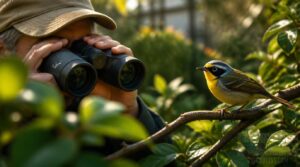
A wide field of view helps you scan open sky, but backyard birding happens up close. Look for a close focus distance of 6 to 8 feet, some models hit 5, to catch feather texture, eye rings, and beak shape.
Pair that with responsive focus wheel control and solid eye relief adjustment, and nearby birds snap into detail fast.
Depth of Field Across Habitats

Habitat changes how you use focus, too. Grasslands and mountains reward deep depth of field, keeping foreground rocks and distant peaks sharp together. Wetlands and forests need flexible aperture control, since reeds, branches, and waterfowl sit at different distances. Urban settings often call for focus stacking. Match your close focus distance and field of view to terrain, and bird identification gets noticeably easier.
Comfort and Durability for Field Birding

Great optics won’t matter much if the binoculars feel awkward in your hands after an hour on the trail. Comfort and build quality determine whether you’ll actually reach for them on your next outing, rain or shine. Here’s what to check before you buy.
Balanced Weight and Secure Grip
Lift a pair one-handed before buying—if it dips toward the objective lenses, your wrist pays for it by hour two. Look for weight centered near the hinge, magnesium alloy chassis, and rubber armor with real texture.
That grip texture keeps binoculars steady in damp weather, so weather resistance and secure handling work together, not against each other.
Adjustable Eyecups and Eye Relief
If you wear glasses, eye relief decides whether you see the full frame or a tunnel. Twist-up eyecups with 12 to 15mm of eye relief fix that, clicking into set spots so the field of view stays consistent.
Many models integrate diopter adjustment into the same twist, and cups are user serviceable when they wear out.
Waterproof and Fogproof Construction
Since dawn birding means dew and sudden rain, waterproof construction matters. O-ring seals block moisture at every joint, tested against specific immersion depths, while nitrogen-purged chambers stop internal fogging across a -20°C to 60°C range.
Check for a stated IPX rating (IPX7 for full dunks) and don’t skip seal maintenance, since damaged gaskets undermine even quality fog proofing.
Rubber Armor for Protection
A branch snags your barrel, a rock meets your grip during a scramble, that’s when rubber armor earns its keep. This layer offers real impact absorption, dissipating shock instead of transmitting it to the prisms inside.
You’ll notice better grip enhancement in damp conditions, plus:
- Textured surfaces resisting slips
- Contoured panels hugging your hands
- Weather resistance against UV and moisture
- Balanced weight distribution
- Ergonomic fit during long sits
Smooth Focus Wheel Control
A warbler flits between branches, gone in seconds. Focus wheel responsiveness decides whether you catch it. A quarter-turn shifts focus smoothly; ribbed edges grip gloved fingers.
| Feature | Why It Matters |
|---|---|
| Precision helix | Smooth tracking |
| 120–180° travel | Fast focus speed |
| Low-friction gears | Quiet, close focus ready |
| Diopter isolation | Stable adjustments |
| Sealed bearings | Durability, ergonomic feel |
Best Features for Every Birding Budget
Your budget shapes which features you can prioritize, but it doesn’t have to shape your enjoyment of birding. Whether you’re spending under $100 or well over $1,000, certain specs matter more than others at each price point. Here’s what to look for and expect as you move up the price ladder.
Essential Features Under $100
Sixty bucks buys more birding power than you’d think. Look for fully multi-coated lenses, basic phase correction, and standard roof prisms.
- Waterproof, rubber-armored build
- 2.5m close focus
- 120m field of view
- Bundled case and strap
Entry-level ED glass is rare here, but decent value for money still exists if you shop smart.
Mid-Range Features Worth Prioritizing
Here’s where the real jump happens. In the $400–$550 range, you get ED glass and phase-corrected coatings working together, cutting purple fringing and sharpening edges noticeably.
Look for dielectric coatings boosting brightness, plus waterproof seals and ergonomic design for grip.
Combined, these features deliver optical performance that rivals binoculars costing twice as much.
Premium Upgrades Worth Paying For
Above $2,000, you’re paying for fluorite-enhanced ED glass and dielectric-coated, phase-corrected BAK-4 prisms—Swarovski NL Pure territory.
Think of it like flying business class: airport lounge access, priority boarding, and in-flight service upgrades don’t change your destination, but they change how you arrive.
Premium upgrades are like flying business class: they won’t change your destination, only how you arrive
Similarly, premium optical performance won’t add species to your list, but it delivers sharper, brighter views with less eye fatigue after hours afield.
Comparing Price and Optical Value
Value isn’t just about manufacturers suggested retail price—it’s optical performance per dollar spent.
- Under $150: basic coatings, fixed close focus
- $400–$550: ED glass, phase correction (Hawke Frontier ED X)
- $2,000+: fluorite ED, dielectric prisms
- Sweet spot: mid-range models balancing lens quality and cost
Long-term investment worth favors consistent edge-to-edge sharpness over flashy specs alone.
Top 8 Binoculars With Birding Features
You’ve read about the specs that matter, so now it’s time to see them in action. Each of these eight models pairs specific features, magnification, glass quality, build, with a real price tag, spanning budget picks to premium glass. Here’s how they stack up against each other.
1. Swarovski NL Pure 8×32 Green Binoculars
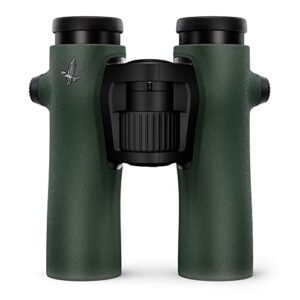
If you birdwatch enough seasons, you start craving a binocular that disappears in your hands. That’s what the Swarovski NL Pure 8×32 delivers, with SWAROVISION optics and fluoride-containing HD glass keeping colors true and fringing gone.
Its 8x magnification pairs with a genuinely wide field of view for tracking flitting warblers, while phase-corrected prisms sharpen contrast edge to edge.
At $2,799, it’s an investment, but for birders chasing mastery, the ergonomic grip and forehead-rest compatibility make long sessions feel easy.
| Best For | Serious birdwatchers and wildlife observers who want a lightweight, premium binocular for tracking fast-moving subjects during long viewing sessions. |
|---|---|
| Magnification | 8x |
| Objective Lens | 32mm |
| Field of View | 492 ft/1000yd |
| Weight | 24.7 oz |
| Lens Coating | SWAROVISION |
| Close Focus | N/A |
| Additional Features |
|
- Wide 492 ft field of view makes it easy to track fast, flitting birds
- SWAROVISION technology delivers sharp, true-to-life color and clarity
- Ergonomic, lightweight design (24.7 oz) reduces fatigue during extended use
- Premium $2,799 price tag puts it out of reach for casual users
- Forehead rest is not included, despite some listings suggesting otherwise
- Plastic forehead rest, if purchased separately, may feel less durable than metal options
2. Zeiss Victory SF 10×32 Birdwatching Binoculars
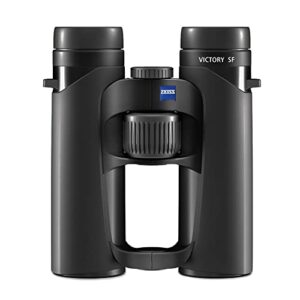
Not everyone wants that Swarovski price tag, but the Zeiss Victory SF 10×32 gives you serious glass for less. Its Ultra FL fluoride lenses cut chromatic aberration while pushing light transmission near 90%, so colors stay true even at dusk.
The open-bridge magnesium body keeps weight manageable, and a 130-meter field of view at 1,000 meters works well for active flocks. Close focus down to 1.95 meters lets you study details most 10x binoculars can’t touch.
| Best For | Serious birdwatchers who want top-tier optical clarity and a lightweight build for long sessions in the field, without paying flagship-premium prices. |
|---|---|
| Magnification | 10x |
| Objective Lens | 32mm |
| Field of View | 120-155m/1000m |
| Weight | 3.8 lbs |
| Lens Coating | ZEISS T Multi-Layer |
| Close Focus | N/A |
| Additional Features |
|
- SCHOTT fluoride glass and ZEISS T multi-layer coating deliver about 90% light transmission for sharp, true-to-life color
- Wide 120–155 m field of view at 1,000 m makes it easier to spot quick bird movements in dense cover
- Lightweight at 3.8 lbs with a SmartFocus triple-link bridge for fast, precise, ergonomic focusing
- Premium price point that may not suit casual or budget-minded users
- 32 mm objective lens lets in less light than larger models, which can limit performance in very low-light conditions
- Needs careful handling and storage to protect optical alignment and coating quality over time
3. Celestron TrailSeeker ED 8×42 Binoculars
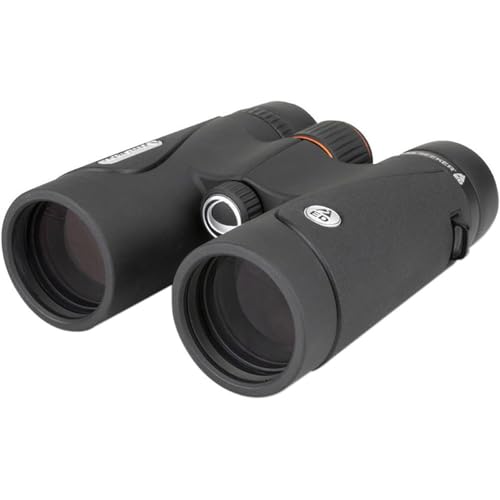
Sitting comfortably in mid-range territory, the TrailSeoder… let’s call it what it is: a workhorse. ED glass tames chromatic aberration, while phase-corrected BaK-4 prisms and dielectric coatings keep contrast crisp even in flat light.
At 8×42, you’re getting a 5.2mm exit pupil and roughly 425 feet of field of view—wide enough for tracking restless flocks. Close focus lands around 6-7 feet, and the magnesium housing stays nitrogen-purged and waterproof. Reliable performance without premium pricing.
| Best For | Birdwatchers, hunters, and outdoor enthusiasts who want bright, color-accurate optics for day-use observation without paying premium prices. |
|---|---|
| Magnification | 8x |
| Objective Lens | 42mm |
| Field of View | 425 ft/1000yd |
| Weight | 1.5 lbs |
| Lens Coating | Phase-Coated BaK-4 |
| Close Focus | 6-7 ft |
| Additional Features |
|
- ED glass and phase-coated BaK-4 prisms deliver sharp, high-contrast, true-to-life images even in low light
- Waterproof, nitrogen-purged housing with rubber armor holds up well to weather and accidental impact
- Twist-up eyecups, ergonomic focus knobs, and tripod compatibility make it comfortable for extended viewing sessions
- At 1.5 lbs, it can feel bulky for overnight hikes or long-distance carry
- Achieving optimal focus may take extra fiddling for users without perfect vision
- The lens caps tend to flip down during use, so you’ll need to reposition them occasionally
4. Nikon Aculon A211 10×50 Binoculars Bundle
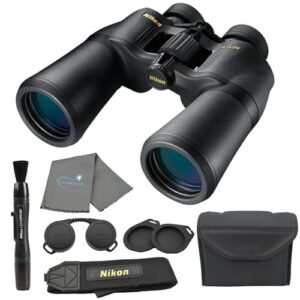
If budget’s your main concern, the Aculon A211 10×50 delivers real value. You get 50mm objective lenses, BaK4 prisms, and multicoated aspherical eyepieces for under $150—rare at this price point.
Field of view runs 341 feet at 1,000 yards, tighter than pricier models, and close focus sits at 23 feet, so forget photographing nearby songbirds. It’s not waterproof or fogproof either. Still, for hikers and casual birders wanting bright, stable 10x views without breaking the bank, it earns its keep.
| Best For | Budget-conscious hikers and casual birders who want bright, stable 10x views without spending a fortune. |
|---|---|
| Magnification | 10x |
| Objective Lens | 50mm |
| Field of View | 341 ft/1000yd |
| Weight | N/A |
| Lens Coating | Multicoated Eco-Glass |
| Close Focus | 23 ft |
| Additional Features |
|
- Affordable price point under $150 with quality BaK4 prisms and multicoated aspherical lenses
- Bright, clear images even in low light, great for dawn-to-dusk viewing
- Comfortable, ergonomic design suited for extended outdoor use
- Not waterproof or fogproof, so it’s a poor match for rain or humid conditions
- Narrower field of view compared to higher-end models
- Close focus distance of 23 feet makes it unsuitable for photographing nearby wildlife
5. Nikon Monarch HG 8x42mm Binoculars
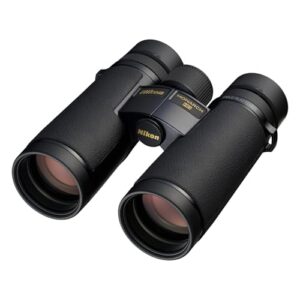
Step up from entry-level and you’ll feel the difference immediately with the Monarch HG 8×42. Its Field Flattener Lens System delivers edge-to-edge sharpness, while ED glass and phase-corrected prisms sharpen color and contrast. A magnesium alloy body keeps weight practical, and locking diopter control holds your focus setting steady all day.
Field of view runs 330 feet at 1,000 yards, close focus at 6.6 feet. It’s pricier territory, but for serious birders, that optical clarity earns its keep.
| Best For | Serious birdwatchers and wildlife enthusiasts who want premium, distortion-free optics for extended outdoor use. |
|---|---|
| Magnification | 8x |
| Objective Lens | 42mm |
| Field of View | 330 ft/1000yd |
| Weight | 1.5 lbs |
| Lens Coating | Fully Multilayer-Coated |
| Close Focus | 6.6 ft |
| Additional Features |
|
- Field Flattener Lens System delivers edge-to-edge sharpness across the entire field of view
- ED glass and phase-corrected prisms produce sharp color and contrast, even in low light
- Waterproof, fogproof magnesium alloy body handles rugged, wet, or high-altitude conditions with ease
- Premium price of $1,086.95 puts it out of reach for casual users
- Some users report hinges loosening over time, which can affect barrel alignment
- The semi-hard case lacks padding and a belt loop, making it less convenient to carry
6. Kowa YF II 6×30 Waterproof Binocular
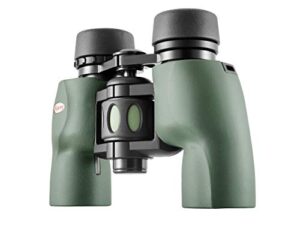
Lower magnification isn’t a compromise here, it’s the whole point. The Kowa YF II 6×30 uses a Porro prism design for a wide, three-dimensional image, with 8.2 degrees of field (430 feet at 1,000 yards) and a forgiving 5.0mm exit pupil.
Eye relief runs long at 18-20mm, so eyeglass wearers get full comfort. Waterproof, nitrogen-purged, and BaK-4 glass with phase correction round it out. Close focus sits at 16.5 feet, better suited for scanning skies than backyard details.
| Best For | birdwatchers, eyeglass wearers, and anyone observing from moving platforms like boats or tree stands who values a wide field of view over high magnification. |
|---|---|
| Magnification | 6x |
| Objective Lens | 30mm |
| Field of View | 430 ft/1000yd |
| Weight | 16 oz |
| Lens Coating | Phase-Corrected Multi-Coat |
| Close Focus | 16.5 ft |
| Additional Features |
|
- Long 18mm eye relief makes for comfortable viewing without removing glasses
- Wide 8.2-degree field of view and large depth of field allow for quick target acquisition in dynamic settings
- Waterproof, fogproof, nitrogen-purged construction with phase-corrected lenses holds up in all weather conditions
- 16.5-foot minimum close focus distance makes it unsuitable for close-range observation
- Improperly converged barrels can cause crescenting or vignetting at close distances
- Objective lens caps aren’t attached and the included carrying case is flimsy, so both may need replacing
7. Celestron Nature DX 12×56 Binoculars
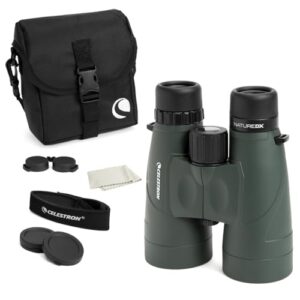
Twelve power and a 56mm objective make the Nature DX a reach-extender for distant shorebirds and raptors, with phase-coated BaK-4 prisms and full multi-coating keeping images bright despite that extra magnification. Field of view narrows to 289 feet at 1,000 yards, so panning on fast fliers takes practice.
Close focus lands at 9.8 feet, and the waterproof, nitrogen-purged housing controls rough weather fine. At 2.5 lbs, plan on a tripod for sessions past 20 minutes.
| Best For | Birders and wildlife watchers who need serious reach for distant shorebirds and raptors and don’t mind pairing that extra magnification with a tripod. |
|---|---|
| Magnification | 12x |
| Objective Lens | 56mm |
| Field of View | 289 ft/1000yd |
| Weight | 2.5 lbs |
| Lens Coating | Fully Multi-Coated BaK-4 |
| Close Focus | 9.8 ft |
| Additional Features |
|
- Bright, sharp images thanks to phase-coated BaK-4 prisms and full multi-coating
- Rugged, waterproof, and fogproof housing holds up to rain, snow, and rough handling
- Close focus of 9.8 feet and twist-up eyecups make it comfortable for eyeglass wearers
- Narrow 5.5° field of view makes tracking fast-moving subjects tricky
- At 2.5 lbs, handheld use gets tiring, and sessions past 20 minutes really call for a tripod
- Some users report trouble getting sharp focus across the entire field of view
8. Hawke Frontier ED X 8×42 Binocular Grey
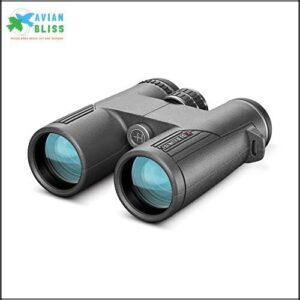
Back to standard 8×42 territory, and the Frontier ED X earns its keep with ED glass and dielectric-coated, phase-corrected prisms that most binoculars twice the price still skip. Field of view holds at 330 feet, close focus at 6.6 feet.
The magnesium chassis keeps weight reasonable while rubber armor grips well in cold, wet hands. Nitrogen purging and O-ring seals handle IPX7-rated weather without complaint, and that 5.0/5 value rating isn’t marketing fluff, it’s earned.
| Best For | Birdwatchers and outdoor enthusiasts who want bright, sharp, wide-field views for wildlife spotting, hiking, or dawn-to-dusk use. |
|---|---|
| Magnification | 8x |
| Objective Lens | 42mm |
| Field of View | 330 ft/1000yd |
| Weight | 692 g |
| Lens Coating | Dielectric Phase-Corrected |
| Close Focus | 6.6 ft |
| Additional Features |
|
- ED glass and phase-corrected, dielectric-coated BAK-4 prisms deliver crisp, high-contrast images
- Nitrogen-filled, O-ring sealed construction offers reliable IPX7 waterproof and fogproof performance
- Magnesium alloy chassis keeps weight manageable while staying durable and corrosion-resistant
- Some users notice a white halo from internal reflections in the lower field of view
- Heavier build may call for a harness during extended use
- Model-specific tethered lens caps and occasional packaging mix-ups add minor inconvenience
Frequently Asked Questions (FAQs)
What type of spotting scope is best for birding?
An 8×42 spotting scope balances handheld stability with strong magnification for distant birds, while a 50mm objective gathers enough dawn and dusk light for reliable identification without weighing down your pack.
Is 8×42 or 10×42 better for birding?
For most birders, 8×42 wins — steadier images, wider field of view, and easier flock scanning. Choose 10×42 only when you need closer detail on distant, stationary birds and don’t mind extra hand shake.
How to spot birds with binoculars?
Does wide-angle scanning actually beat zooming straight in? It does: scan tree lines first, then adjust your diopter, sweep smoothly through hedgerows and water edges, and use movement, shape, and song together to confirm species.
Are binoculars better than spotting scopes for birding?
For most outings, yes—binoculars win on portability and speed, offering wide fields of view for locating birds. Scopes shine for distant, stationary viewing at 20x-60x, but they demand a tripod, sacrificing the quick, natural handheld tracking birders rely on daily.
Do binoculars work well for glasses wearers?
Four-eyed viewing doesn’t have to mean a squeezed picture. Look for 16mm or more eye relief and twist-up eyecups; together they preserve full edge-to-edge clarity and prevent the dreaded blackout ring while you’re wearing prescription lenses.
How do I clean binocular lenses properly?
Blow off loose dust first, then wipe with a microfiber cloth dampened in lens solution, using gentle circular motions from center outward. Never spray cleaner directly on glass, and finish dry to avoid streaks or coating damage.
Can binoculars be used for stargazing too?
Yes—your bird binoculars can pull double duty under the stars. An 8×42 pair delivers bright Moon views and star clusters, though dedicated astronomy models with larger objective lenses gather more light for deeper sky sessions.
What binocular strap style prevents neck strain?
A two-point strap style beats a standard neck strap, transferring weight to your shoulders and chest instead of one narrow band. Look for a wide, padded strap with an adjustable sternum strap to keep binoculars steady against your chest during long walks.
How often should binoculars be professionally serviced?
Like a knight rarely oiling armor that’s never seen battle, you don’t need annual servicing unless something’s wrong. Watch for misalignment, sticky focus wheels, or fogging, then get it checked, usually €150–500 for premium models.
Conclusion
People assume bigger lenses always win, but that theory falls apart once you’re holding 10x50s with tired arms at hour three.
The best binocular features for spotting birds aren’t the flashiest ones; they’re the ones matched to your hands, your habitat, your patience. A sharp 8×42 with good glass beats an oversized pair gathering dust in a closet. Choose specs that fit how you actually bird, and every outing rewards you with clearer, faster views.