This site is supported by our readers. We may earn a commission, at no cost to you, if you purchase through links.

Some birds didn’t get the memo about blending in. The Palm Cockatoo rocks a jet-black mohawk so dramatic, it looks like it showed up to a punk concert—then stayed for the biology lecture.
Crests like these aren’t just for show, though that’s a big part of it. These feather structures evolved over millions of years to intimidate rivals, attract mates, and signal moods faster than any chirp could.
From the lacy blue crown of New Guinea’s Victoria Crowned Pigeon to the blazing orange fan of South America’s Cock-of-the-Rock, birds with mohawks span every continent and ecosystem on Earth—and each one has a story worth knowing.
Table Of Contents
- Key Takeaways
- Birds With Mohawks: a Complete Species Guide
- Most Striking Birds With Mohawks Around The World
- Palm Cockatoo – The Rock Star of Australian Parrots
- Victoria Crowned Pigeon – Regal Blue Crest of New Guinea
- Golden Pheasant – Ornamental Gold and Red Crest of China
- Eurasian Hoopoe – Fan-Shaped Crest Across Europe and Asia
- Red-Crested Turaco – Copper-Pigmented Mohawk of Angola
- Pileated Woodpecker – Flaming Red Crest of North American Forests
- Grey Crowned Crane – Tall Yellow Crown of African Wetlands
- Great Curassow – Bold Mohawk of Tropical American Forests
- Sulphur-Crested Cockatoo – Bright Yellow Fan Crest of Australia
- Guianan Cock-of-the-Rock – Vivid Orange Mohawk of South America
- Habitats and Global Distribution of Crested Birds
- How Birds Use Their Mohawks: Key Functions
- Conservation Status of Birds With Mohawks
- Frequently Asked Questions (FAQs)
- What birds have mohawks?
- Why do some birds use Mohawks?
- Are Mohawks good looking birds?
- How do Mohawk birds get their name?
- Do birds Rock a Mohawk?
- What does a Mohawk look like on a bird?
- Where Do Royal Flycatchers Live?
- What Is The Bird With A Yellow Mohawk?
- What Bird Has An Orange Mohawk?
- What is a bird with a mohawk called?
- Conclusion
Key Takeaways
- Bird crests aren’t just flashy accessories — they’re multitasking tools that handle everything from flirting, to scaring off rivals, to regulating head temperature.
- Some crested birds are genuinely one-of-a-kind, like the Red-Crested Turaco, which produces a copper-based pigment called turacorubrum that exists nowhere else in the animal kingdom.
- These mohawked birds show up on every continent and in every habitat, from Australian backyards to New Guinea rainforests, proving nature has a pretty consistent obsession with dramatic headwear.
- Several iconic crested species — including the Philippine Eagle and Yellow-Crested Cockatoo — are critically endangered, with habitat loss, hunting, and the illegal pet trade hitting them all at once.
Birds With Mohawks: a Complete Species Guide
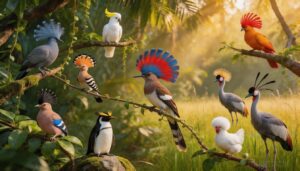
Some birds take their hairstyles very seriously — and honestly, we respect it. Crests aren’t just for show; they’re communication tools, courtship weapons, and identity markers all in one tidy tuft of feathers.
From mood signals to full-on courtship drama, crested birds pack a lot of personality — much like the bold, quirky species featured among backyard birds of New Mexico.
Here are some of the most impressive mohawk-sporting birds you’ll find across the globe.
What Are Avian Crests and Mohawks?
Ever wonder what’s actually going on with a bird’s mohawk?
Avian crests are ornamental feather structures grown from specialized feather tracts on the skull.
Their Crest Feather Structure involves stiffened, tightly packed plumes — shaped by Crest Development Genetics and refined through sexual selection.
Molt Timing, Sexual Dimorphism, and Pigment Mechanisms all influence how bold or subtle the crest display behavior looks across species.
Evolutionary Purpose of Mohawk Feathers in Birds
So why did birds evolve a mohawk in the first place? It turns out nature had several reasons:
- Sexual Selection – Bright crests signal genetic quality, boosting mating success.
- Intraspecific Signaling – Raised feathers communicate dominance or submission instantly.
- Predator Deterrence – A sudden crest erection can startle threats.
- Thermoregulation Benefits – Crest feathers help regulate head temperature seasonally.
Research highlights the role of erectile feather function in rapid crest display.
Evolutionary adaptation of feather crests is genuinely multitasking at its finest.
Diversity of Crest Shapes, Colors, and Sizes Across Species
Not every mohawk is created equal. Crest morphology diversity across bird families is genuinely wild — Structural Crest Forms range from a single spiky plume to broad fan-like ornamental crests in bird species.
Chromatic Crest Spectrum stretches from muted grays to copper-based reds.
Dimensional Crest Scaling follows Biogeographic Crest Trends, with tropical birds rocking the boldest looks.
Gendered Crest Differences? Totally common — males usually win that contest.
Most Striking Birds With Mohawks Around The World
Some birds just stop you in your tracks, and these ten are proof.
From dense rainforests to open wetlands, crested species around the world have evolved some seriously impressive headgear. Here’s a look at the most striking mohawked birds you need to know about.
Palm Cockatoo – The Rock Star of Australian Parrots
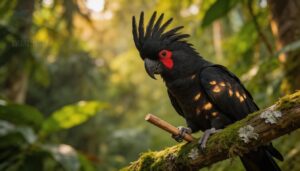
Meet the Palm Cockatoo (Probosciger aterrimus) — basically the Keith Moon of the bird world. This glossy black parrot from New Guinea and northern Australia grows up to 60 cm and sports an ornamental crest that rises like a living mohawk when excited.
- Tool Use: Males drum hollow trees with sticks — rare parrot behavior
- Vocal Repertoire: Rich, varied calls used in courtship and bonding
- Nesting Habits: Slow breeders, raising just one chick every few years
- Dietary Specializations: That powerful bill cracks pandanus nuts that most birds can’t touch
- Population Trends: Near Threatened due to deforestation and the illegal pet trade
Victoria Crowned Pigeon – Regal Blue Crest of New Guinea

If the Palm Cockatoo is punk rock, the Victoria Crowned Pigeon (Goura victoria) is straight-up royalty. That blue lace crest — a circular fan of stiff, white-tipped feathers — sits on its head like a crown nobody else earned.
Spotting one in the wild feels almost impossible, but local birding guides for rare species point to protected reserves where this living crown jewel still reigns.
Native to northern New Guinea‘s lowland rainforests, this bluish-gray beauty forages on the ground for fallen fruits, moving in small family groups rarely above 3,000 feet.
Golden Pheasant – Ornamental Gold and Red Crest of China
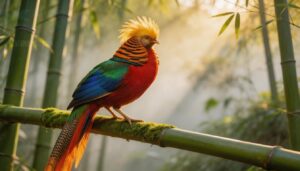
If there’s a bird that looks like it got dressed for a festival and never left, it’s the Golden Pheasant (Chrysolophus pictus). Sexual dimorphism is on full display here — males rock a blazing gold crest, scarlet body, and cape-like orange ruff; females stay earth‑toned for camouflage.
Native to China’s bamboo thicket foraging grounds, introduced populations now roam Europe too.
Conservation status? Least Concern — thankfully.
Eurasian Hoopoe – Fan-Shaped Crest Across Europe and Asia
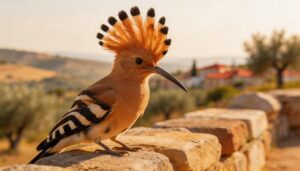
The Eurasian Hoopoe (Upupa epops) doesn’t just have a mohawk — it deploys one. When startled or excited, that fan-shaped crest snaps open like a tiny crown, dark-tipped feathers fanning wide against warm cinnamon plumage.
You’ll spot this bird across Europe, Asia, and North Africa, probing bare ground with its curved beak. Pure rock-star energy, honestly.
Red-Crested Turaco – Copper-Pigmented Mohawk of Angola
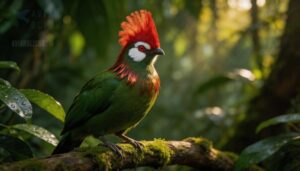
If you want a bird that’s chemically unique, the RedCrested Turaco (Tauraco erythrolophus) wins easily.
Its blazing mohawk owes its color to turacorubrum — real copper-based feather pigments found nowhere else in the animal kingdom. That crest sits 6–9 cm tall above the Angolan forest canopy, stays vivid year‑round regardless of molt timing, and doubles as a social flocking dynamics signal during mating displays.
The Red-Crested Turaco’s blazing mohawk is pigmented by turacorubrum, a copper-based color found nowhere else in the animal kingdom
Pileated Woodpecker – Flaming Red Crest of North American Forests
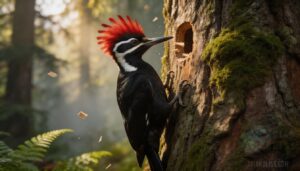
Meet the Pileated Woodpecker — basically the punk rocker of North American forests. That flaming red mohawk runs from forehead to nape, and it’s not just for looks.
Crest color function ties directly into avian communication through feather displays, signaling everything from courtship to territorial warnings. Add in rhythmic drumming behavior, a clever ant foraging strategy, and nesting cavity creation that other species literally move into afterward — this bird earns its crest.
Grey Crowned Crane – Tall Yellow Crown of African Wetlands
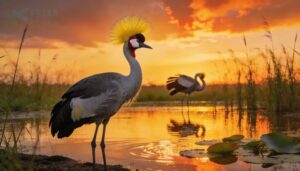
If a bird could wear a crown and actually pull it off, it’s the Grey Crowned Crane. That stiff yellow mohawk sitting atop its head isn’t decorative fluff — it’s a crest function powerhouse, used in courtship dances that involve full-on synchronized bowing and wing-flapping.
- Wetland hydrology impact directly shapes nesting site selection — shallow floodplains and marshes are non-negotiable.
- Vocal communication patterns include loud, resonant calls that carry across open savannas.
- Agricultural encroachment has squeezed wetland habitats, pushing conservation status of crested birds like this one toward Near Threatened.
- Migration dispersal follows seasonal water availability across Kenya, Uganda, and South Africa.
Great Curassow – Bold Mohawk of Tropical American Forests
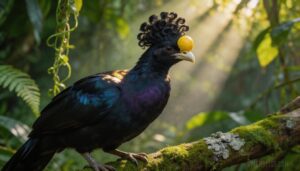
From dancing cranes to a bird that looks like it runs a rainforest biker gang — the Great Curassow (Crax rubra) fits right in.
That bold, curly mohawk sits front and center on a glossy blue-black body, making it unmistakable on the forest floor from Mexico to Ecuador.
| Feature | Detail |
|---|---|
| Lifespan and Longevity | Up to 20–25 years wild |
| Ground Foraging Techniques | Scratches leaf litter for fallen fruit |
| Nest Construction Preferences | Tree fork nests, dense foliage cover |
| Seed Dispersar Impact | Spreads seeds, supporting forest regeneration |
Sadly, habitat loss hits this Vulnerable species hard.
Sulphur-Crested Cockatoo – Bright Yellow Fan Crest of Australia
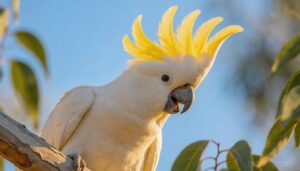
If the Great Curassow rules the rainforest floor, the Sulphur-crested Cockatoo (Cacatua galerita) owns the Australian skyline — and your neighbor’s backyard.
That bright yellow mohawk fans out like a punk badge, central to avian communication through feather displays and the role of crests in mating rituals.
- Urban Adaptation — thrives in city parks and suburban gardens
- Longevity Records — lives 70–100 years in captivity
- Vocal Mimicry — copies human speech with surprising accuracy
- Seed Cracking — powerful bill splits tough nuts effortlessly
- Social Flocking — forms hundreds-strong flocks during nonbreeding seasons
Guianan Cock-of-the-Rock – Vivid Orange Mohawk of South America
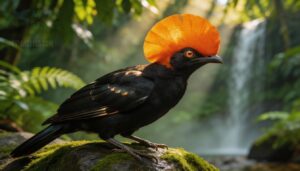
If the Sulphur-crested Cockatoo is Australia’s showoff, the Guianan Cock-of-the-Rock (Rupicola rupicola) is South America’s answer — and honestly, it might win. That vivid orange mohawk is a masterclass in sexual selection, with male crest size dwarfing female crest variation dramatically.
At riverine lek sites, males flash their bird plumage coloration — black body, blazing crest — while surviving on a fruit-insect diet.
Juvenile plumage? Much duller.
Nature’s still loading.
Habitats and Global Distribution of Crested Birds
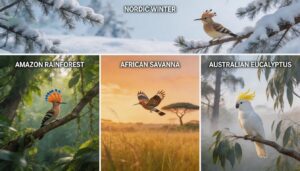
Crested birds don’t stick to one corner of the planet — they’ve claimed just about every habitat you can think of. From dense rainforests to your own backyard, these mohawked species have spread out in some pretty surprising ways.
Here’s a look at where they actually live.
Tropical Rainforests – Palm Cockatoo, Great Curassow, and Turacos
Tropical rainforests are basically the VIP lounge for crested birds. Three standouts rule the canopy:
- Palm Cockatoo – Nesting cavity competition is fierce; these black rockers claim hollow trees in northern Australia’s dense rainforests.
- Great Curassow – Thrives in undisturbed lowland forests, where rainforest fragmentation impact hits hardest.
- Red-crested Turaco – Its mutualistic plant relationships and seed dispersal roles actively regenerate African forests.
Temperate Woodlands – Pileated Woodpecker and Tufted Titmouse
Temperate woodlands have their own pair of mohawk-sporting regulars.
Pileated Woodpecker is hard to miss — that flaming red crest towers above its black body while it hammers out rectangular holes through cavity excavation, hunting carpenter ants.
Nearby, Tufted Titmouse raises its little gray crest when alarmed, joins mixed-species flocking in winter, and quietly practices food caching to stay fed through the cold.
African Grasslands and Savannas – Grey Crowned Crane and Helmetshrikes
Africa’s savannas don’t mess around concerning mohawks.
The Grey Crowned Crane rocks a golden crown above wetlands from Uganda to South Africa, using wetland foraging strategies to balance life between marsh and grassland — a perfect example of savanna habitat connectivity. Nearby, the White-Crested Helmetshrike coordinates avian communication through feather displays alongside sharp helmetshrike vocalizations that echo through the brush.
Urban and Suburban Environments – Northern Cardinal and Blue Jay
You don’t have to travel far to spot a mo hawk — sometimes they’re just outside your kitchen window.
The Northern Cardinal’s vivid red crest and the Blue Jay’s bold blue plume thrive in suburban yards, using bird communication signals to claim territory and attract mates.
Their feeder preferences, nesting height choices, and winter food strategies make both species surprisingly savvy urban survivors who’ve mastered human interaction.
How Birds Use Their Mohawks: Key Functions
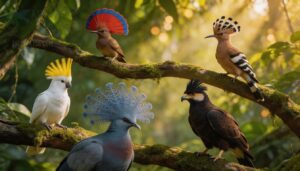
That wild crest on a bird’s head isn’t just for looks — it’s doing real work. Birds use their mohawks the way we use facial expressions, body language, and even fashion, all rolled into one.
Here’s a breakdown of the key ways these feathered hairstyles actually function in the wild.
Courtship Displays and Mate Attraction
That mohawk isn’t just for looks — it’s a full-on mating pitch. Avian crest morphology plays a direct role in sexual selection, with males leaning on visual signaling and crest color signaling to say "pick me" without uttering a word.
- Synchronized feather flicks paired with head tilts flash the brightest plumage right at eye level.
- Vocal song pairing amplifies the display — crests rise as songs crescendo.
- Dance flight displays and gift giving behaviors seal the deal.
Territorial Defense and Rival Intimidation
When a rival shows up uninvited, that crest goes from decoration to weapon — fast.
Crest Puffing Displays inflate a bird’s apparent size instantly, and Wing Spread Threats paired with head elevation push the visual signaling even further.
Dawn Patrol Behavior kicks in early, when territory disputes peak.
| Defense Tactic | What It Does |
|---|---|
| Crest Puffing Displays | Inflates visible size to intimidate rivals |
| Wing Spread Threats | Raises body silhouette, signals ownership |
| Acoustic Escalation Tactics | Loud calls travel far, deter intruders |
| Boundary Chase Strategies | Escorts rivals back across territory lines |
| Social signaling via crest | Communicates dominance without physical contact |
Avian crest morphology basically turns every feather into a warning sign.
Communicating Mood and Alertness Within Flocks
Think of a raised crest as a mood ring that actually works. Birds use their mohawk and surrounding body language — head orientation cues, posture alarm displays, even wingbeat signaling — to broadcast feelings across the whole flock instantly.
- Light-modulated communication shifts reliance between visual and vocal cues
- Density spacing cues tighten when threats appear
- Crest-driven social signaling keeps everyone synced without a single sound
Species and Individual Recognition at a Distance
Crests do double duty beyond mood signaling — they’re basically name tags. Each bird’s crest edge silhouette is unique enough that flock members recognize individuals from surprising distances.
UV crest patterns, invisible to us but vivid to other birds, sharpen that ID even further.
Combine those with vocal signature variation and habitat recognition cues, and you’ve got distance cue integration that rivals any facial recognition software.
Conservation Status of Birds With Mohawks
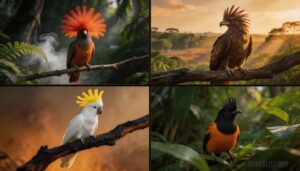
Not every bird with a mohawk has it easy out there. Some of these crested species are in real trouble — and the reasons why are worth knowing.
Here’s a look at where things stand for a few of the most iconic ones.
Critically Endangered – Philippine Eagle and Yellow-Crested Cockatoo
Two of the most at-risk endangered bird species are the Philippine Eagle (Pithecophaga jefferyi) and the Yellow-Crested Cockatoo — and honestly, their situations are heartbreaking.
Habitat loss from deforestation has gutted both populations.
The eagle faces prey depletion and nest site protection failures, while the cockatoo suffers from a genetic bottleneck fueled by illegal trade.
Community forestry and trade enforcement are now their best hope.
Vulnerable Species – Great Curassow and Crested Partridge
Step down from critically endangered, and you’ll find the Great Curassow and Crested Partridge holding on as vulnerable species—barely.
Habitat loss impact from deforestation, serious hunting pressure, and habitat fragmentation are shrinking their worlds fast.
Community conservation programs and legal protection help, but population monitoring still shows worrying declines.
Their bold crests deserve a future worth displaying.
Near Threatened – Victoria Crowned Pigeon
Victoria Crowned Pigeon (Goura victoria) sits at Near Threatened — one step safer, but don’t get too comfortable. Population trends show steady decline as the impact of habitat loss on bird populations bites hard.
fruit dependency makes breeding success fragile when forests shrink. Community engagement programs in New Guinea are helping, though climate impact keeps pressure real.
Primary Threats – Habitat Loss, Hunting, and The Illegal Pet Trade
Three big threats are hammering crested birds right now — and they often hit at the same time.
- Deforestation impact strips nesting sites and food sources overnight.
- Fragmentation effects trap small populations, cutting off genetic diversity.
- Poaching pressure spikes during breeding season, when birds are most visible.
- Pet trade demand pulls wild birds from their habitat for exotic pet trade collectors.
- Community livelihoods tied to wildlife harvesting keep illegal hunting alive.
Threats to vulnerable bird species worldwide rarely travel solo.
Conservation Efforts Protecting Crested Bird Populations
Good news does exist in this space. Protected Area Expansion now covers roughly 12 million hectares where crested birds live, breed, and (hopefully) thrive. Community Reserve Management brings local landowners into the solution.
Anti-Poaching Patrols cut illegal hunting by up to 40%. Captive Breeding Programs and Predator Control Strategies add extra layers of defense.
| Strategy | What It Does | Key Benefit |
|---|---|---|
| Protected Area Expansion | Secures critical habitat zones | Shields nesting populations |
| Anti-Poaching Patrols | Reduces illegal hunting pressure | Up to 40% fewer incidents |
| Captive Breeding Programs | Maintains genetic diversity | Aids reintroduction efforts |
Frequently Asked Questions (FAQs)
What birds have mohawks?
Quite a few birds rock a natural mohawk — think Palm Cockatoo, Golden Pheasant, Eurasian Hoopoe, Victoria Crowned Pigeon, and Red-Crested Turaco, each flaunting unique crest color pigments and impressive crest size variation.
Why do some birds use Mohawks?
Birds use their mohawk-style crests for visual signaling, mate attraction through bird plumage and sexual selection, territorial intimidation, predator confusion, and social hierarchy signaling — basically a built-in communication system sitting right on top of their heads.
Are Mohawks good looking birds?
Honestly? Yes — crests deliver vibrant color contrast and an elegant silhouette that’s hard to ignore.
That eye-catching plumage isn’t just pretty; it’s evolution’s calling card for mate attraction and visual signaling.
How do Mohawk birds get their name?
The name comes down to a simple visual analogy — that tall ridge of feathers looks exactly like the iconic mohawk hairstyle, so people just started calling it that.
Do birds Rock a Mohawk?
Yes, they absolutely do — and they’re pretty good at it.
A crest muscles let it raise or flatten that mohawk in seconds, flipping between "I’m impressed" and "back off" without saying a word.
What does a Mohawk look like on a bird?
A bird’s mohawk is a row of upright feathers running along the crown — think large crest, sleek black mohawk, or vivid yellow mohawk, shaped by feather morphology and often flashing iridescent coloration as a bold visual signal.
Where Do Royal Flycatchers Live?
The Royal Flycatcher lives across a lowland forest range stretching from southern Mexico to Bolivia.
It favors riparian habitat near streams, rarely exceeding 1,500 meters — a true creature of humid tropical corridors.
What Is The Bird With A Yellow Mohawk?
The Sulphur-crested Cockatoo tops the list. Native to Australian habitat across northern woodlands, its bright yellow crest fans up to 12 cm — basically nature’s most dramatic mood ring.
What Bird Has An Orange Mohawk?
The Guianan Cock-of-the-Rock owns that vivid orange crest.
Its mohawk sweeps from beak to crown, and males flash it during lekking behavior to win over females — visual signaling at its most theatrical.
What is a bird with a mohawk called?
A crested bird is the official term — "crested" being the scientific nod to any species sporting those bold, upright head feathers. Informally, "mohawk bird" works just fine in everyday conversation.
Conclusion
While birds with mohawks may seem like an oddity, they play an essential role in their ecosystems. These crested creatures aren’t just visually striking; they’re also key for seed dispersal, pollination, and pest control.
As you’ve seen, birds with mohawks span the globe, from the Palm Cockatoo’s punk-rock charm to the Victoria Crowned Pigeon’s regal elegance.
By appreciating these avian anomalies, you’ll obtain a richer insight into nature’s remarkable diversity and the importance of conservation efforts.