This site is supported by our readers. We may earn a commission, at no cost to you, if you purchase through links.
Florida hosts more than 500 bird species—a number that puts most states to shame and turns even a quick walk outside into an unexpected field encounter.
The osprey hovering over a retention pond, the roseate spoonbill wading through a tidal flat in shades of bubblegum pink, the mockingbird running through its catalog of stolen songs at two in the morning—none of it feels ordinary once you know what you’re looking at.
Whether you’re spotting common birds in Florida from your backyard feeder or scanning a coastal horizon through binoculars, this guide covers what you’ll find, where to look, and how to tell them apart.
Table Of Contents
- Key Takeaways
- Most Abundant Florida Backyard Birds
- Common Wetland and Marsh Birds
- Common Beach and Coastal Birds
- Common Raptors in Florida Skies
- Where to Spot Florida Birds
- Frequently Asked Questions (FAQs)
- What are the most common birds in the backyard in Florida?
- How do birds drink water when everything is frozen?
- What is Florida’s most common bird?
- What is the small sparrow-like bird in Florida?
- What is the GREY bird in Florida with a red beak?
- What is the most common backyard bird?
- What bird is only found in Florida?
- What are the 4 foot tall birds in Florida?
- What are the birds that look like chickens in Florida?
- What is the most common bird of prey in Florida?
- Conclusion
Key Takeaways
- Florida’s 500+ bird species span every habitat you can think of—from your backyard feeder to coastal marshes and Everglades wetlands—so you don’t have to travel far to see something remarkable.
- A handful of year-round residents like the Northern Cardinal, Northern Mockingbird, and Red-bellied Woodpecker will show up reliably once you set out the right seeds and a clean water source.
- Coastal and wetland species—Roseate Spoonbill, Wood Stork, Osprey, and Black Skimmer—depend on healthy, undisturbed habitats, so where you bird and how you behave there actually matter for conservation.
- The Florida Scrub Jay is the state’s only truly endemic bird, and its survival hinges on regular prescribed burns to maintain the scrub habitat it can’t live without.
Most Abundant Florida Backyard Birds
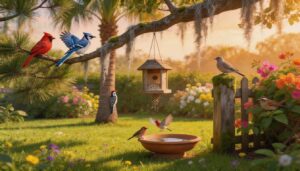
Florida’s backyard birds are surprisingly easy to get to know once you start paying attention. handful of species show up so reliably you’ll almost expect them by name.
From bold cardinals to cheerful blue jays, these backyard birds found across Florida are regulars you’ll start recognizing after just a few mornings outside.
Here are the ones you’re most likely to spot right outside your window.
Northern Cardinal
The Northern Cardinal is one of the most recognizable common backyard bird species in Florida. Here’s what makes it stand out:
- Male Plumage – Vivid red from head to tail, minus the black face mask
- Female Coloration – Warm brown with subtle red highlights on wings and tail
- Nesting Habitat – Dense shrubs or low trees, generally 1–4 meters up
- Diet Preferences – Sunflower, safflower, and millet seeds dominate; insects supplement during breeding
- Courtship Song – Males sing persistently to claim territory and attract mates
Habitat preferences for suburban Florida birds like cardinals make your backyard feeders a natural draw year‑round. The Northern Cardinal is a year‑round resident status across its range.
Mourning Dove
Another backyard bird species in Florida you’ll spot just as often is the Mourning Dove. Its soft gray-brown plumage and gentle cooing make it easy to identify.
This species shows impressive Urban Tolerance, thriving in yards, parks, and farms across the state. Watch its Feeding Behavior — it forages quietly on the ground, favoring millet and cracked corn at feeders.
Blue Jay
Unlike the quiet dove, the Blue Jay announces itself boldly — a flash of blue streaking across your yard with a sharp territorial call.
Watch its Crested Display shift with mood, raised when alert, flat when relaxed.
Blue Jays are Mimicry Behavior artists, imitating hawks to clear feeders. Their Acorn Caching habit quietly plants forests, while Social Banding keeps them connected year‑round.
Northern Mockingbird
Florida’s state bird since 1927, the Northern Mockingbird is a master of Vocal Mimicry — one bird, hundreds of voices.
Its Urban Adaptation makes it a familiar presence in suburban yards, coastal marshes, and wetland ecosystems alike.
Watch for these traits:
- Territorial Aggression year-round
- Seasonal Diet Shifts between insects and berries
- Distinctive Nesting Behavior in dense shrubs
- Continuous song even after dark
Red-bellied Woodpecker
The Red-bellied Woodpecker is a backyard birdwatching staple across Florida — and once you know its rolling, metallic call, you’ll spot it everywhere.
This species excels at urban adaptation, thriving in wooded suburbs alongside mature oaks and palms.
Watch for territorial drumming on dead snags, cavity nesting in natural hollows, and seasonal foraging shifts from insects to suet feeders in winter.
Carolina Wren
Carolina Wren punches way above its weight. At barely 14 centimeters, this bold backyard bird fills Florida’s suburban edges with a loud, repeating "teakettle" territorial song you’ll recognize instantly.
Its rich cinnamon back, white eyebrow stripe, and cocked tail make bird identification simple.
Cavity nesting and insect foraging keep it thriving through urban adaptation — a true year-round companion among backyard birds in Florida.
Tufted Titmouse
The Tufted Titmouse might be small, but it runs a tight operation.
This year-round resident bird of Florida brings cavity nesting, seed caching, and sharp vocal communication to your backyard — often leading mixed-species flocks through suburban trees.
Its "peter-peter-peter" call marks active territory defense.
Put out sunflower seeds, and you’ll quickly learn its feeding preferences among Florida backyard birds.
House Finch
The House Finch is a quiet constant at feeders across Florida. Males show seasonal plumage shifts — their rosy-red head brightens or fades depending on diet.
Their feeder preference runs toward seeds and small fruits year‑round, with dietary shifts toward insects during breeding. They’ll nest in your eaves or hanging planter without hesitation.
Urban song adaptation is real here — these birds literally retune their calls to cut through city noise.
Common Wetland and Marsh Birds
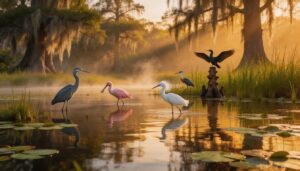
Florida’s wetlands and marshes are some of the best places in the state to watch birds up close. From slow-moving herons to flashy spoonbills, the variety here is hard to beat.
Here are eight wetland and marsh birds you’re most likely to encounter.
Great Blue Heron
Standing nearly a meter tall with blue-gray plumage and a sharp, patient gaze, the Great Blue Heron is hard to miss in Florida’s wetland ecosystems and coastal marshes.
Its feeding strategies — standing motionless, then striking with precision — make it a rewarding sight at birdwatching hotspots and Florida wildlife refuges.
Nesting colonies form in tall trees nearby, and plumage variations between juveniles and breeding adults are worth noting during seasonal movements.
White Ibis
The White Ibis is one of Florida’s most recognizable wetland birds, with snow-white plumage, black wingtips, and a curved reddish-orange bill shaped perfectly for probing mud — a prime example of feeding bill adaptations at work.
Seasonal color changes intensify during breeding colony dynamics, when faces and legs flush vivid orange-red.
You’ll spot them in coastal marshes, wetland ecosystems, and even urban canals.
Conservation status remains stable.
Snowy Egret
Another wetland gem you’ll notice right away is the Snowy Egret — pure white plumage, jet-black legs, and those unmistakable bright yellow feet.
Along coastal marshes and Everglades wildlife corridors, it actively stirs mud to flush prey, a foraging technique that sets it apart.
Breeding colonies nest in mangroves.
Plume hunting once devastated populations, but wetland ecosystem protections have brought this birdwatching hotspot favorite back strong.
Anhinga
Swap the Snowy Egret’s yellow feet for a dark, slender silhouette — meet the Anhinga. This wetland specialist is famous for its wing-drying ritual: wings spread wide on a tree perch after underwater spear hunting sessions in coastal marshes and mangrove habitats.
Monogamous breeding pairs nest high over water.
Your bird identification guide isn’t complete without it.
Wood Stork
Florida’s only native stork cuts a striking figure — bald dark head, white body, black‑tipped wings.
What makes the Wood Stork special is its bill probing forage technique: it feels for fish in shallow water rather than sight‑hunting.
- Hydrology dependent nesting peaks in March–April
- wetland habitats under 12 inches deep
- Population trend monitoring guides conservation efforts
- Wetland habitat management protects Everglades colonies
Roseate Spoonbill
From the Wood Stork’s muted tones, the Roseate Spoonbill swings to the opposite end of the color spectrum — unmistakably pink, almost unreal. Its plumage pigmentation comes directly from carotenoids in the crustaceans it eats. The spoon-shaped bill sweeps side to side through shallow wetland habitats, feeling for prey.
The Roseate Spoonbill earns its shocking pink from the crustaceans it sweeps up, one spoonful at a time
| Feature | Detail |
|---|---|
| Bill Shape | Flat, spoon-shaped, up to 7 inches |
| Plumage Color | Pink deepening with age and diet |
| Nesting Style | Colonial nesting in mangroves |
| Habitat | Coastal marsh, tidal flats |
| Behavior | Seasonal migration along Gulf Coast |
A top pick in any birdwatching guide for Florida, spoonbills rank among the most rewarding birdwatching destinations in the Sunshine State — especially in South Florida estuaries.
Limpkin
The Limpkin is one of Florida’s most distinctive wetland birds — and once you hear its haunting nocturnal vocalizations echoing across a marsh at dusk, you won’t forget it.
This specialist’s apple snail diet shapes where you’ll find it: shallow wetland habitats with dense vegetation for nest site selection.
Hit birdwatching hotspots like the Everglades to spot this year-round resident.
Common Gallinule
Meet the Common Gallinule — a bold, easy-to-identify wetland bird thanks to its striking plumage identification markers: red-and-yellow bill, slate-gray body, and white flank stripe. It’s a fixture in wetland bird communities in the Everglades.
Watch for these foraging behaviors:
- Walking on floating vegetation
- Picking insects from water surfaces
- Swimming beneath submerged plants
- Digging mud for invertebrates
Common Beach and Coastal Birds
Florida’s coastline is home to some of the most recognizable birds you’ll spot the moment you hit the beach. From bold pelicans cruising just above the waves to tiny sanderlings chasing the surf, each species has its own personality and niche.
Here are the coastal birds you’re most likely to encounter along Florida’s shores.
Brown Pelican
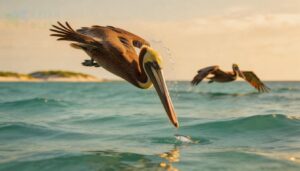
The brown pelican is hard to miss — a large coastal shorebird with a 6-to-7-foot wingspan and that unmistakable throat pouch. Watch for its signature plunge diving from height, hitting the water like a feathered dart.
Breeding colonies nest on isolated islands, while wave-slope soaring helps them conserve energy between feeding runs.
This bird identification guide, essential, deserves a spot on every Florida birdwatching list.
Laughing Gull
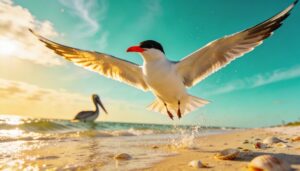
That raucous laughter, cutting across the beach? That’s the laughing gull announcing itself. Florida’s most familiar coastal shorebird, it thrives where humans gather — a true opportunist built for busy shorelines.
Here’s what makes it distinctive:
- Colony size can reach tens of thousands of nesting pairs
- Nest site selection favors barrier islands and salt marsh edges
- Beach foraging includes fish, crabs, and stolen pelican meals
- Human food dependence is real — landfills and harbors are prime stops
Royal Tern
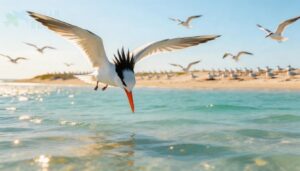
The Royal Tern is hard to miss — that bold orange-red bill cuts through any coastal scene. Watch for its seasonal plumage shift: a sharp black crest in breeding season, white-flecked crown otherwise.
Its plunge diving tactics are precise, targeting menhaden and mullet over bays and barrier islands. Breeding colony dynamics pack thousands of pairs onto coastal island habitat, making population monitoring efforts both challenging and essential.
American Oystercatcher
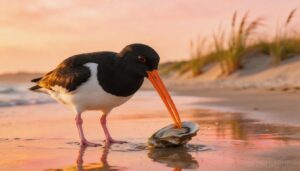
Few coastal shorebirds announce themselves as boldly as the American Oystercatcher — that flame‑orange bill is unmistakable.
You’ll spot this species working tidal flats and barrier beaches, where shellfish foraging drives its daily routine. It pries open oysters and clams with surgical precision.
Beach nesting makes it vulnerable to human disturbance and climate threats, while seasonal migration patterns shift birds between Atlantic and Gulf estuaries.
Double-crested Cormorant
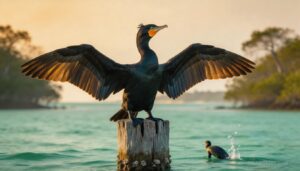
Where the Oystercatcher works on shellfish by force, the Double-crested Cormorant takes a quieter approach — slipping underwater and chasing fish with webbed-foot precision.
You’ll recognize it by that classic wing-drying pose: arms spread wide on a dock or rock.
Colony nesting, migration patterns along coasts, and fish predation have made it controversial in aquaculture circles, but it’s a Florida staple.
Sanderling
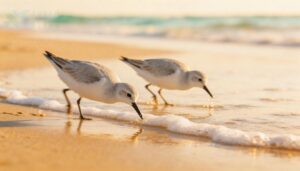
Few beach birds match the Sanderling’s wave-chasing foraging energy — it’s that pale, darting shorebird sprinting the surf line like it’s late for something.
Here’s what defines it:
- Arctic breeding sites far north of Florida
- Shoreline migration timing peaking in fall and spring
- Tidal diet shifts between crustaceans and bivalves
- Sand-scrape nesting on open tundra
Watch the waterline.
Willet
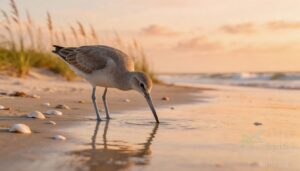
Where the Sanderling races the waves, the Willet holds its ground — a stocky, confident shorebird you’ll recognize the moment it spreads its wings and flashes that bold black-and-white stripe.
| Feature | Details |
|---|---|
| Identification Features | Gray-brown, white belly, long gray-blue legs, 33–41 cm |
| Nesting Habitat | Ground scrapes near coastal marsh grasses |
| Migration Timing | Spring: March–May; Fall: July–October |
| Foraging Techniques | Bill-probing mud for crustaceans and marine worms |
Coastal shorebird feeding behavior like this makes the Willet a reliable sighting on Florida’s Gulf beaches.
Black Skimmer
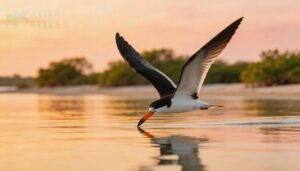
Few birds stop you in your tracks like the Black Skimmer. That mismatched bill — lower mandible longer than the upper — isn’t a flaw; it’s precision engineering for skimming foraging technique across shallow coastal lagoons.
Its coastal nesting habitat includes bare sandy beaches where colony disturbance impacts remain a real threat. Conservation strategies like nest monitoring help protect this striking species year‑round.
Common Raptors in Florida Skies
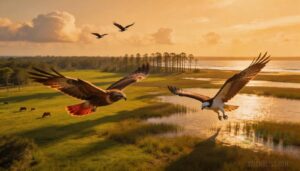
Florida’s skies belong to some of the most impressive hunters on the continent, and you don’t have to venture far to see them. From coastlines to cattle pastures, raptors show up in nearly every corner of the state.
Here are birds of prey you’re most likely to spot overhead.
Osprey
Few raptors master the hunt like the Osprey. This fish-diving specialist hovers above Florida’s waterways, then plunges feet-first — nostrils sealed, reversible toes ready to grip slippery prey.
You’ll spot nesting platforms along coastal shores and inland lakes, reused season after season.
Territorial displays keep rivals away during breeding.
Migration routes stretch to South America, though Florida’s stable populations face ongoing conservation challenges from habitat loss.
Red-shouldered Hawk
Walk a shaded river trail in Florida and you’ll likely hear the Red-shouldered Hawk before you see it — a sharp, repeating whistle cutting through the canopy.
This raptor species favors bottomland hardwood forests and riparian zones as its core habitat preferences.
It hunts amphibians, reptiles, and crayfish using patient perch-and-drop hunting techniques, and reuses nest sites across seasons, raising conservation concerns as mature forest habitat shrinks.
Bald Eagle
Few sights stop you in your tracks like a Bald Eagle soaring over a Florida lake. This iconic raptor species in Florida boasts exceptional vision acuity — spotting fish from hundreds of feet up — then diving with precision.
Their nesting architecture is equally impressive: massive stick nests, reused for decades near water. Conservation efforts have helped Florida sustain over 1,500 breeding pairs.
Black Vulture
Don’t overlook the Black Vulture — one of Florida’s most underrated raptor species.
Riding thermals on broad, white-tipped wings, it patrols everything from coastal marshes to urban yards. Its scavenger behavior actively removes disease-carrying carrion before it spreads.
You’ll spot urban nesting sites under bridges and in hollow trees. Watch for kleptoparasitism dynamics — they’ll boldly steal meals from larger birds without hesitation.
Crested Caracara
The Crested Caracara isn’t your typical sky hunter — it walks.
This large falcon stalks open fields and roadsides on long yellow legs, using ground foraging tactics more like a crow than a hawk. Its scavenger morphology — bare orange face, hooked bill — makes it built for tearing into carrion fast.
- Thrives in urban edge habitat, farmland, and open grassland
- Practices bonking social behavior at carcasses, feeding alongside vultures
- Builds stick nests through tree nesting in palms and cypress
- Found near birdwatching hotspots across central and south Florida
American Kestrel
Don’t let its small size fool you — the American Kestrel packs serious hunting skills into a sparrow-sized frame. You’ll spot this bird perched on power lines or practicing hover hunting above open fields, scanning for grasshoppers and mice.
Males show striking plumage dimorphism, with slate-blue wings contrasting rusty backs.
Urban nesting in nest boxes aids winter bird migration into Florida, making it a must-know in any bird identification guide for Florida.
Snail Kite
The Snail Kite takes specialization to another level. While the kestrel hunts whatever moves, this wetland bird commits entirely to one thing — snail prey.
Its specialized bill, sharply hooked at the tip, is built for prying apple snails from their shells. You’ll find it patrolling freshwater marshes in the Everglades, where conservation efforts protect the wetland habitat that these birds absolutely depend on.
Swallow-tailed Kite
If the Snail Kite owns the marsh, the Swallow-tailed Kite owns the sky. Its identification markings alone stop you cold — white head and underparts set against jet-black wings, with that deeply forked tail cutting a silhouette unlike anything else in Florida’s air.
- Flight Techniques: Glides effortlessly, snatching prey mid-air without landing
- Habitat Preferences: Cypress swamps, slash pine wetlands, and coastal breeding colonies
- Migration Patterns: Breeds in Florida, then travels to South America each winter
Where to Spot Florida Birds
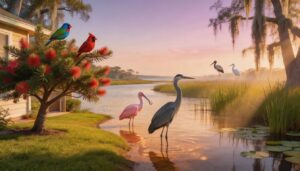
Florida isn’t short on great birding spots — the real challenge is knowing where to start. Whether you’re chasing spoonbills through the Everglades or spotting warblers from your own backyard, the state offers something for every skill level.
Here are the best places to find Florida’s most iconic birds.
North Florida Pine Forests
North Florida’s pine forests reward patient birders. The fire regime here—burns every one to three years—keeps the canopy open and the understory groundcover thick with wiregrass, which is exactly what Red-cockaded Woodpeckers and Florida Scrub-Jays need.
Longleaf pine regeneration depends on that same fire cycle. Gopher tortoise burrows shelter dozens of species nearby.
The timber-wildlife balance makes these forests surprisingly rich birding ground.
Central Florida Lakes and Suburbs
Swap pines for lake edges, and the birding changes fast. Central Florida’s suburban lakes draw Limpkins, Great Blue Herons, and Anhingas year-round — all benefiting from stormwater retention ponds and shoreline vegetation that quietly manage water quality.
Suburban habitat connectivity here is underrated.
Paddling out for lake recreation access often puts you closer to these common bird species of Florida than any trail will.
South Florida Wetlands
Few places on Earth pack this much life into one landscape. South Florida’s wetlands — shaped by Seasonal Flood Pulses and Hydrological Restoration efforts inside Everglades National Park — host Wood Stork and Roseate Spoonbill year-round.
Mangrove Buffer Zones shield critical nesting areas, while Peat Soil Carbon sustains the marsh floor beneath your feet.
Invasive Melaleuca Management keeps native habitat intact, making every visit genuinely rewarding.
Gulf Coast Beaches
Gulf Coast beaches reward patient birdwatchers with impressive species diversity. Dune vegetation like sea oats anchors foredunes where coastal breeding colonies of Royal Terns and Black Skimmers nest.
Wrack ecology along the tide line feeds Sanderlings and Willets.
Beach erosion and human recreation impact sea turtle nesting zones, making mindful visits essential.
- Brown Pelicans plunge-diving offshore
- Sanderlings chasing retreating waves
- Black Skimmers skimming glassy shallows
- American Oystercatchers probing exposed shells
Everglades National Park
Few places on Earth match the Everglades for sheer birdwatching density. Spanning 1.5 million acres, its sawgrass marshes and mangrove ecosystem shelter remarkable wetland bird communities in the Everglades — Wood Storks, Snail Kites, and Anhingas among them.
water flow restoration and fire management protect endangered species while supporting ornithological research. Walk the Anhinga Trail and you’ll understand why this tops every Florida bird species list.
Merritt Island National Wildlife Refuge
Merritt Island National Wildlife Refuge sits on Florida’s Space Coast, covering roughly 140,000 acres of impressive habitat mosaic — salt marshes, freshwater impoundments, coastal dunes, and hardwood hammocks side by side.
Its NASA Partnership makes it genuinely one-of-a-kind.
Over 330 bird species use it, making migratory bird monitoring here important for endangered species protection.
Dawn visits reward you most.
Corkscrew Swamp Sanctuary
Corkscrew Swamp Sanctuary is unlike anywhere else in Florida — its 2.25-mile Boardwalk Habitat Tour winds through old-growth Cypress stands, topping 130 feet, ancient trees supporting impressive Bird Species Diversity in Florida.
Here’s what essential for your list:
- Wetland Hydrology shapes bird movement seasonally
- Invasive Species Control protects prime Habitat preferences for Florida birds
- Limpkins and Wood Storks feed in open marsh zones
- Educational Programs run during peak birdwatching tourism season
- Wetland ecosystems here rival the Everglades for wading bird density
Backyard Feeders and Bird Baths
Your own backyard can be one of Florida’s best birdwatching spots with the right setup. Smart Feeder Placement — 10 to 15 feet from windows — cuts collision risk.
Seed Selection drives who visits: safflower draws cardinals, nyjer attracts finches. Water Maintenance keeps baths clean and mosquito‑free.
Add Predator Protection guards on poles, and your bird feeding stations become a year‑round refuge.
| Feature | Recommendation | Benefit |
|---|---|---|
| Feeder Placement | 10–15 ft from windows | Reduces window strikes |
| Seed Selection | Safflower, nyjer, sunflower | Targets specific species |
| Water Maintenance | Clean every 2–3 days | Prevents disease, deters mosquitoes |
Frequently Asked Questions (FAQs)
What are the most common birds in the backyard in Florida?
Florida’s backyard birds could fill a field guide twice over. Your feeders attract year-round favorites like the Northern Cardinal, Mourning Dove, Blue Jay, Northern Mockingbird, and Red-bellied Woodpecker daily.
How do birds drink water when everything is frozen?
When everything freezes over, birds rely on heated bird baths, ice edge foraging, sun-warmed puddles, and metabolic water generation from food.
Some even resort to snow licking as a short-term fix.
What is Florida’s most common bird?
When all’s said and done, the Northern Mockingbird holds Florida’s top spot — the official state bird since
It turns up in nearly every yard, suburb, and roadside shrub across the state.
What is the small sparrow-like bird in Florida?
The most common small sparrow-like bird you’ll spot in Florida yards is the House Sparrow — a chunky, seed-eating resident with a gray crown and chestnut back that thrives in urban habitat year‑round.
What is the GREY bird in Florida with a red beak?
Spot a grey bird with a red beak? It’s likely a Juvenile Night Heron. Red-billed Tropicbird sightings are rare. Misidentification pitfalls are common — always cross-check your field guide.
What is the most common backyard bird?
The Northern Cardinal tops the list.
A year-round resident bird of Florida, it’s the backyard birdwatching guide’s favorite — showing strong habitat adaptation to shrubs and feeders, with seeds as its clear feeder preference.
What bird is only found in Florida?
The Florida Scrub Jay is the only bird found exclusively in Florida.
It relies on scrub habitat, fire, and cooperative breeding to survive, with genetic isolation and conservation threats, making prescribed burning essential to its future.
What are the 4 foot tall birds in Florida?
Ever wonder what’s wading through that marsh, like it owns the place?
Great Blue Heron, Wood Stork, and Great Egret all hit that four-foot height range, with plumage variations setting each one apart.
What are the birds that look like chickens in Florida?
Some chicken-like ground dwellers you’ll spot in Florida include the Northern Bobwhite, Common Gallinule, and feral chickens roaming cities like Key West — all sharing that familiar plump silhouette and ground-foraging behavior.
What is the most common bird of prey in Florida?
The Red-shouldered Hawk holds that title.
You’ll spot it along woodland edges and suburban yards more than any other raptor — a true sign of Urban Adaptation and stable Population Trends across the state.
Conclusion
Familiar faces flit through Florida’s feathered landscape. As you explore state’s diverse habitats, you’ll discover a world of winged wonders.
backyard bird feeders to coastal wetlands, common birds in Florida are a joy to behold.
Keep your binoculars handy and your curiosity sharp.
With this guide, you’re equipped to identify and appreciate the region’s impressive avifauna.
Happy birding, and may your future encounters be filled with fascinating sights and sounds.
- https://www.allaboutbirds.org/guide/Black-bellied_Whistling-Duck/maps-range
- https://www.allaboutbirds.cornell.edu/guide/American_Oystercatcher
- https://www.fws.gov/species/bald-eagle-haliaeetus-leucocephalus
- https://www.audubon.org/field-guide/bird/blue-jay
- https://en.wikipedia.org/wiki/Northern_cardinal