This site is supported by our readers. We may earn a commission, at no cost to you, if you purchase through links.
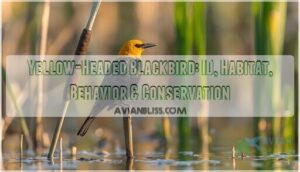
You spot a flash of gold against dark reeds, and for a second, you think you’ve stumbled on something rare. But that unmistakable yellow hood paired with a jet-black body belongs to the yellow-headed blackbird—a bird that doesn’t blend in, even when it tries.
These bold marsh dwellers stake out wetlands across western North America, where males defend territories with grating calls that sound more like rusty hinges than songbirds. Their bright plumage makes identification easy, but understanding where they nest, how they behave, and why their populations shift requires a closer look at the marshes they call home.
Table Of Contents
- Key Takeaways
- Yellow-headed Blackbird Identification
- Habitat and Geographic Range
- Behavior and Vocalizations
- Breeding and Life Cycle
- Conservation Status and Threats
- Frequently Asked Questions (FAQs)
- Where do yellow-headed blackbirds live?
- What kind of bird has a black head and yellow body?
- What does a female Yellow-headed Blackbird look like?
- What does a Yellow-headed Blackbird symbolize?
- How rare are yellow-headed blackbirds?
- Where can I find a yellow-headed blackbird?
- Is a yellow-headed blackbird the same as a yellow hooded blackbird?
- What does a female yellow-headed blackbird look like?
- Do they form long-term monogamous relationships with their mates?
- Are they known to engage in any unique mating rituals?
- Conclusion
Key Takeaways
- You’ll spot yellow-headed blackbirds by their unmistakable bright yellow hoods and black bodies in freshwater marshes across western North America, where males defend cattail territories with harsh, mechanical calls during breeding season.
- These birds nest exclusively in wetlands with tall emergent vegetation like cattails and bulrushes, weaving suspended nests 0.5 to 2.5 meters above water, then migrate south to agricultural fields in winter following major river corridors.
- Males arrive first to claim prime marsh territories through aggressive displays and complex vocalizations, with females evaluating both song quality and territory resources before selecting mates in a polygamous breeding system.
- Though currently listed as Least Concern, yellow-headed blackbirds face mounting threats from wetland loss, agricultural runoff, and climate-driven shifts in water regimes that fragment their core breeding habitats across their range.
Yellow-headed Blackbird Identification
You can’t miss a yellow-headed blackbird once you know what to look for. These striking birds stand out in wetlands and farm fields with features that make identification straightforward.
Their bright yellow heads and black bodies make them one of the most distinctive yellow birds in North Carolina wetland habitats during migration season.
Here’s what you need to know to confidently pick them out from other blackbirds.
Key Physical Characteristics
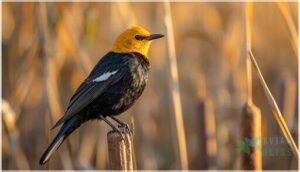
You’ll recognize the Yellow-headed Blackbird by its striking yellow head and black body—a bold contrast that makes identification easy. Males show bright yellow extending from the crown to the upper breast. The conical bill is thick and dark, built for cracking seeds.
Their stout body spans 8 to 10 inches with white wing patches visible in flight. Feather patterns and plumage variations shift with age and sex.
Male, Female, and Juvenile Plumage
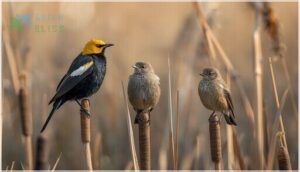
Males flaunt a bright yellow head and glossy black body with white wing patches—plumage variation that sets them apart.
Females wear olive-brown feathers with duller yellow tones, blending into wetland cover. Juveniles mirror adult females in muted color patterns and lack bold contrast.
Molt cycles refresh feathers annually, sharpening the species identification cues you’ll rely on. These color differences play essential roles in bird plumage patterns that provide camouflage, signaling, and even thermoregulation for the species.
Size and Field Marks
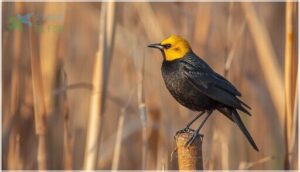
You’ll spot this bird at 8 to 10 inches long with a 15-inch wingspan—comparable to a robin. The large head features a sharply pointed conical bill, perfect for cracking seeds. Body proportions lean stout and sturdy.
Watch for head markings that glow yellow against black plumage patterns, making yellowheaded blackbird identification straightforward. Feather colors shift subtly with light, revealing faint iridescence that ornithology field guides often mention in avian biology descriptions.
Similar Species Comparison
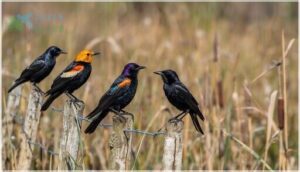
You can tell yellowheaded blackbirds apart from other blackbirds by comparing these four species:
- Redwinged blackbird shows red shoulder patches with tan edging
- Common grackle displays iridescent purple-green plumage patterns and slimmer beak shapes
- Brewers blackbird lacks yellow feather colors entirely
- Meadowlarks feature song variations and V-shaped breast bands
Species distinguishment becomes easy once you note head coloration.
Habitat and Geographic Range
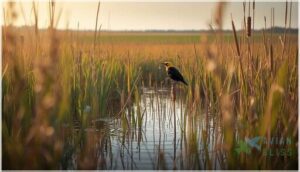
You’ll find yellow-headed blackbirds across a surprisingly wide stretch of North America, though they’re picky about where they settle. These birds split their year between two very different landscapes—marshy wetlands for breeding and open agricultural lands for winter.
Here’s where to look for them depending on the season and what kind of habitat draws them in.
Once you spot them, identifying sparrow species by their markings and calls helps you confirm which ones frequent your area throughout the year.
Breeding and Nesting Habitats
You’ll find yellow-headed blackbirds claiming breeding territories in freshwater marshes where cattails and bulrushes rise above open water. Nest site selection hinges on tall emergent vegetation that shields nests from predators while keeping foraging grounds close.
These wetland ecology specialists weave nests from aquatic plants, suspending them 0.5 to 2.5 meters above water. Habitat fragmentation threatens these wildlife habitat conservation priorities. Researchers have identified several major nest structure types across bird species, each with unique adaptations to environmental pressures.
| Vegetation Type | Nest Height Range | Key Advantage |
|---|---|---|
| Cattails | 0.5–2.5 meters | Predator concealment |
| Bulrushes | 1–2 meters | Stable nest support |
| Reed beds | 0.5–2 meters | Foraging access |
| Tall grasses | 0.5–1.5 meters | Wind protection |
| Wet ditches | 0.5–1 meter | Supplementary sites |
Wintering Locations
When winter rolls in, yellowheaded blackbirds migrate south along river corridors like the Mississippi and Rio Grande, trading cattail marshes for open farmland.
You’ll spot massive roosting sites in wetlands and agricultural fields across the southern U.S. and northern Mexico. These flocking behavior hotspots shift with crop harvests and water availability, reflecting habitat selection tied to seed-rich diets and predator avoidance.
Distribution Across North America
From the Mississippi River westward, this North American bird species distribution stretches across central boreal forests to western prairies during breeding season. You’ll track migration patterns as flocks move between northern breeding grounds and southern wintering zones, following river valleys and wetland habitats.
Population dynamics shift with drought cycles, while geographic range edges contract and expand across prairie potholes and marshy complexes that anchor their seasonal movements.
Preferred Wetland and Field Environments
You’ll spot Yellow-Headed Blackbirds thriving where freshwater wetlands meet open feeding zones. Wetland ecology shapes their survival through precise habitat features:
- Cattail marshes with standing water 6-18 inches deep anchor nest colonies above predators
- Dense reed beds screen nests while offering nearby foraging in wet meadows
- Flooded agricultural margins boost insect prey during breeding peaks
- Groundwater-fed wetlands maintain water quality and stable levels through nesting season
Habitat restoration targeting cattails directly enhances breeding success.
Behavior and Vocalizations
You’ll notice yellow-headed blackbirds are anything but shy in their daily routines. Their social habits shift dramatically between breeding season and winter, and they aren’t subtle about defending what’s theirs.
Here’s what you need to know about how these birds behave, feed, and communicate in the wild.
Flocking and Social Structure
You’ll see yellow-headed blackbirds move as one living wave across fields and marshes. Group coordination emerges from simple rules where each bird reacts to its nearest neighbors, aligning speed and direction within milliseconds.
Social hierarchy shifts fluidly with no fixed leader. Collective behavior spreads through the flock like ripples, with peripheral individuals influencing core members during turns and foraging decisions.
Breeding and Territorial Displays
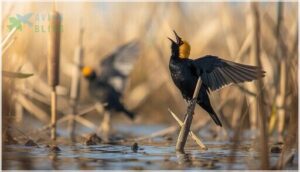
Males defend breeding grounds with wing flashes and tail fans that reveal sharp contrast plumage, warning rivals through visual intensity. You’ll witness courtship rituals where aerial flights showcase muscular power while ground circling precedes nest guarding.
Territorial defense peaks at dawn when boundary disputes erupt into beak snapping and rapid head shakes. Pair bonding strengthens through synchronized boundary patrols, with mates answering each other’s territorial calls to reinforce shared ownership.
Foraging Habits and Diet
You’ll find these birds probing cattails and gleaning beetles from reeds, then hopping across wetland margins in loose flocks. Their dietary adaptations shift with seasons—insect pursuit dominates breeding months while seed preferences emerge in fall.
Foraging strategies include scratching ground vegetation and peeling berries for quick energy. Watch them turn leaf undersides to access hidden caterpillars, demonstrating avian diet flexibility that enables their demanding lifestyle.
Distinctive Calls and Songs
Listen beyond their bright plumage—acoustic signals reveal territorial intent and breeding readiness.
Yellow-headed blackbird vocalizations include:
- Sharp two-note calls rising in pitch across 0.25 seconds per note
- Courtship trills exceeding 8 notes per syllable in 0.6-second bursts
- High-pitched alarm chips warning colony mates of danger
Call variations assist bird species identification while demonstrating vocal learning across song patterns essential for avian behavior studies.
Breeding and Life Cycle
You’ll find yellow-headed blackbirds follow a distinct breeding cycle tied closely to wetland conditions. Males arrive first to claim territories, then engage in courtship displays that set the stage for nesting.
Understanding their reproductive behavior reveals how these birds balance polygamy, nest building, and raising young in marsh environments.
Courtship and Mating Behavior
You’ll witness male yellow-headed blackbirds transform wetlands into arenas of competition during breeding season. Males claim prime territories through aggressive wing snaps and rapid dives, defending boundaries with bubbly, buzzy vocal signals. Courtship displays include wing flashes, throat-raising postures, and vertical flights that showcase stamina.
Females evaluate song complexity and territory quality before mate selection, sometimes receiving food gifts that strengthen pair bonding.
| Courtship Element | Male Behavior |
|---|---|
| Territorial Defense | Wing snaps, low dives, boundary patrols |
| Vocal Signals | Bubbly trills, buzzy notes, complex songs |
| Visual Displays | Wing flashes, throat patches, vertical flights |
| Provisioning | Small invertebrates, seed offerings |
| Pair Bonding | Repeated displays, nest site inspections |
Nest Construction and Placement
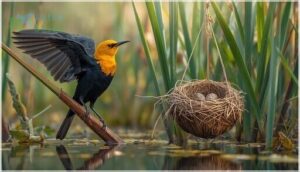
After pair bonds form, you’ll see females tackle the real labor of nest architecture. They weave wet cattails and reeds into hanging basket structures, suspended one to three meters above water for camouflage and predator defense.
Material selection focuses on damp vegetation that locks into place. Males gather coarse grasses while females shape the deep cup, lining it with soft fibers that insulate eggs in dense marsh vegetation.
Egg Laying and Chick Development
Once you see three to five eggs laid in that woven basket, the countdown begins. Incubation tips reveal females sit for 11 to 13 days at ideal warmth, regulating temperature through constant brooding.
Chick growth accelerates once hatching completes—fledgling care demands protein-rich insects as developing bodies strengthen. Avian biology drives this rapid transformation:
- Hatchlings emerge blind and featherless
- Primaries sprout by day seven
- Flight-ready juveniles leave nests within two weeks
Breeding and nesting habits showcase nature’s efficiency in marshland ecosystems.
Parental Roles and Brooding
Both adults share parental care duties, though females brood longer while males extend foraging trips. Cooperative breeding boosts nestling growth through synchronized feeding strategies—adults balance brooding patterns with ambient temperature and chick hunger cues.
This partnership strengthens avian biology and behavior across wetland colonies.
| Role | Female | Male |
|---|---|---|
| Brooding | Extended sessions, warmth regulation | Shorter intervals, shared incubation |
| Feeding | High-frequency provisioning | Longer foraging trips for insects |
| Defense | Nest guarding, chick protection | Territory patrol, predator deterrence |
Shared vigilance accelerates nestling growth and improves fledgling survival in dense marsh vegetation.
Conservation Status and Threats
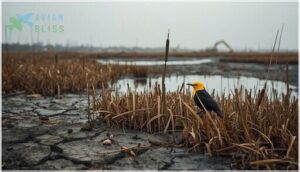
The yellow-headed blackbird holds a status of Least Concern on the IUCN Red List, but that doesn’t mean it’s free from trouble.
Wetland loss, climate shifts, and human activity are changing where and how these birds survive. Here’s what you need to know about the challenges they face and what’s being done to protect them.
Population Trends and Distribution Changes
Yellow-headed blackbird population trends show surprising demographic shifts across North America. You’ll notice their relative abundance has changed in recent decades, with declines in eastern range areas while western populations remain stable.
Migration patterns and range dynamics reflect these population shifts, particularly as climate change alters geographic expansion zones. Their distribution concentrates most heavily where wetland habitats persist across western and central regions.
Habitat Loss and Environmental Risks
When freshwater marshes vanish, you’re watching a slow-motion disaster unfold.
Losing freshwater marshes means witnessing the slow collapse of a once-thriving ecosystem
Habitat fragmentation and wetland degradation slice breeding grounds into isolated patches.
Pollution effects from agricultural runoff poison insect prey, while climate shifts alter water regimes and nesting timing.
Urban sprawl erases foraging fields, and ecosystem disruption from invasive plants reduces food diversity.
These environmental conservation challenges threaten the species’ long-term survival across its range.
Conservation Efforts and Protection
You’ll find refuge in Wildlife Refuges and protected marshes where less than 10 percent of core habitat sits beyond safeguards.
Conservation Laws prohibit disturbance during breeding, while Habitat Restoration rebuilds native reed beds and water regimes.
Ecosystem Management through monitoring programs tracks survival and population shifts.
Species Preservation efforts connect wetland corridors, ensuring ecological conservation efforts and habitat preservation sustain long-term wildlife conservation goals.
Human Impacts and Future Outlook
You’re watching habitat fragmentation carve away wetlands while pollution effects from pesticides thin insect prey your blackbirds need. Climate change shifts migration timing, creating mismatches with food peaks.
Human disturbance from roads and recreation fractures colonies. Yet conservation policies and ecosystem management can reverse these trends.
Wildlife conservation hinges on habitat preservation—protecting marshes safeguards conservation status for generations ahead.
Frequently Asked Questions (FAQs)
Where do yellow-headed blackbirds live?
You’ll spot these striking birds where water meets wild—cattail marshes, reed-choked wetlands, and open farm fields across western North America.
They breed in freshwater ecosystems from Canada’s prairies down through mountain meadows.
What kind of bird has a black head and yellow body?
You’re likely thinking of the yellow-headed blackbird, where males flip the script—sporting glossy black bodies with bright yellow heads and breasts, not black heads.
Females show brownish-gray plumage with paler yellow coloring.
What does a female Yellow-headed Blackbird look like?
You’ll notice females sport dull brownish-gray bodies with pale yellow on the throat and upper breast—not the bold saffron males flaunt.
They’re smaller, with a subtle yellow eyebrow stripe and dark bill.
What does a Yellow-headed Blackbird symbolize?
Yellow-headed Blackbirds carry Symbolic Meaning in Native American folklore, representing resilience and Nature Connection.
Their Cultural Significance links Bird Spirituality to wetland health, making them an Environmental Icon for Wildlife Conservation and Ecology efforts.
How rare are yellow-headed blackbirds?
They’re not exactly flying off into extinction’s sunset, but these bold marsh dwellers face real pressures.
Currently listed as Least Concern by IUCN, yellow-headed blackbirds show localized declines from habitat loss and pesticide exposure.
Where can I find a yellow-headed blackbird?
You’ll find them in freshwater wetlands with cattails and bulrush during summer breeding, especially across prairie marshes from the Dakotas to Montana.
In agricultural areas and field habitats during winter migration.
Is a yellow-headed blackbird the same as a yellow hooded blackbird?
Ever confused two birds with similar names? The yellow-headed blackbird (Xanthocephalus xanthocephalus) and yellow-hooded blackbird are distinct species.
They differ in genus, range, and plumage differences—key identification tips for proper bird species taxonomy.
What does a female yellow-headed blackbird look like?
You’ll spot her brownish-gray body with a pale yellow throat and eyebrow stripe. She’s smaller than males, with subtle white wing patches visible in flight—perfect camouflage among wetland reeds.
Do they form long-term monogamous relationships with their mates?
In terms of settling down, these wetland dwellers surprise many bird watchers.
Yellow-headed blackbirds form pair bonds that last through breeding seasons.
Mates often return to the same territory together year after year.
Are they known to engage in any unique mating rituals?
Males flash their bright yellow heads while performing upright postures and wing flicks from exposed perches.
They sing sharp whistles at dawn, combining visual signals with vocalizations to attract females and defend breeding territories.
Conclusion
For a bird that wears a dazzling gold hood, the yellow-headed blackbird remains surprisingly overlooked outside its marsh strongholds.
Its future hinges on wetlands most people never visit and conservation efforts few celebrate.
Yet these bold vocalists persist where habitat holds, staking territories in cattails and proving that survival doesn’t require subtlety.
If you protect the marshes, you protect the spectacle—even if nobody’s watching.