This site is supported by our readers. We may earn a commission, at no cost to you, if you purchase through links.
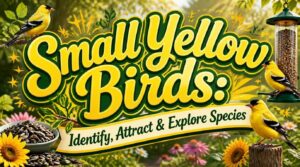
A flash of yellow darting through your backyard might stop you mid-coffee. That small, bright bird clinging to your feeder isn’t random—it belongs to a surprisingly diverse group of species, each with distinct markings, habits, and preferred habitats.
The American Goldfinch alone transforms from olive-drab in winter to electric yellow by spring, a seasonal shift that confuses even seasoned watchers. Small yellow birds range from wetland singers to pine forest specialists, and knowing what separates them changes how you see every backyard visit.
From identifying field marks to setting up the right feeder, there’s more to these birds than their color.
Table Of Contents
- Key Takeaways
- Common Small Yellow Birds
- How to Identify Yellow Birds
- Yellow Warblers and Lookalikes
- Habitats, Diets, and Migration
- Attracting Small Yellow Birds
- Frequently Asked Questions (FAQs)
- What birds are yellow?
- Are there Yellow Birds in North America?
- Are there Yellow Birds in your backyard?
- What do yellow birds look like?
- What is a yellowthroat bird?
- Where can I find information about small yellow birds?
- What is a small yellow bird that looks like a finch?
- What do you call a little yellow bird?
- What is the most common yellow bird?
- What small bird looks like a goldfinch?
- Conclusion
Key Takeaways
- The American Goldfinch, Yellow Warbler, Common Yellowthroat, Lesser Goldfinch, and Pine Warbler each occupy distinct habitats—from pine forests to marsh edges—so knowing where you are helps you narrow down what you’re seeing.
- Field marks like beak shape, wing bars, facial masks, and tail movement are your fastest shortcuts to a confident ID without needing a field guide in hand.
- Small yellow birds follow seasonal plumage cycles, meaning the dull olive bird at your winter feeder and the electric yellow one in May can be the exact same species.
- A few simple backyard changes—nyjer feeders, native plants, clean water, and no pesticides—can reliably attract multiple yellow bird species across seasons.
Common Small Yellow Birds
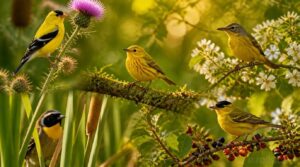
Some small yellow birds are easy to spot once you know what to look for. Others blend in just enough to keep things interesting. Here are five species worth knowing.
If you’re birding in the Midwest, this guide to yellow birds in Illinois covers the local species you’re most likely to encounter.
American Goldfinch
The American Goldfinch is one of North America’s most recognizable small songbirds. Males wear bright yellow plumage with a black cap and wings during breeding season, though both sexes fade to duller tones in winter.
Listen for its bouncy "po-ta-to-chip" flight call overhead — a reliable field mark even before you spot one. To attract them, offer feeders containing sunflower seeds or nyjer.
Yellow Warbler
The Yellow Warbler is one of those small yellow birds you’ll spot near stream edges and willow thickets. Males show chestnut streaks on the chest during breeding season, while females are paler. Its cheerful "sweet, sweet, I’m so sweet" song is a reliable backyard giveaway.
Watch for brown-headed cowbird parasitism near wetlands, which can reduce nest success.
Common Yellowthroat
Where the Yellow Warbler favors open streamside willows, the Common Yellowthroat prefers to stay hidden — lurking low in dense marsh tangles and brushy wetland edges.
The male’s bold black facial mask, stretching from beak to neck, makes him one of the most recognizable masked songbirds in North America. Females are browner, lacking that striking mask entirely.
Key field marks to watch for:
- Wheezy "witchety-witchety" song carrying through cattails and wet thickets
- Olive-brown upperparts with vivid yellow throat and chest
- Compact size of 4.5 to 5.5 inches, with a short rounded tail
- Skulking, low-to-the-ground foraging behavior through dense vegetation
- Sharp contact call used to signal alarm near the nest
Both parents share nest duties, raising 3 to 5 eggs in a cup-shaped nest built close to the ground from grasses and plant fibers.
Lesser Goldfinch
If the Common Yellowthroat is a bird that hides, the Lesser Goldfinch thrives in plain sight. This compact finch — one of the smallest true finches in North America at just 3.5 to 4.3 inches — shows a bright yellow body and crisp white wing bars that make backyard birding identification surprisingly straightforward once you know what to look for.
Pine Warbler
Few small yellow birds are as tied to one habitat as the Pine Warbler. True to its name, it nests, forages, and sings almost exclusively within pine forest habitat — longleaf, loblolly, and slash pines included.
Unlike many migratory warblers, its year-round behavior means you can spot it in southeastern pine stands any month, making it a rewarding find for backyard birding enthusiasts near wooded edges.
How to Identify Yellow Birds
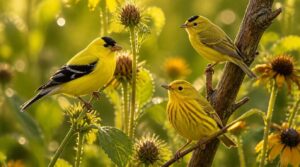
Spotting a yellow bird is one thing — knowing exactly what you’re looking at is another. Luckily, a few key features can help you tell species apart in seconds. Here’s what to look for.
Pay close attention to the upperparts — male rose-breasted grosbeak plumage patterns shift noticeably as birds approach their first breeding season.
Size and Body Shape
Size is one of your sharpest tools in bird identification. Most small yellow birds — warblers, goldfinches — measure just 4.3 to 5.5 inches with a body mass under 0.7 ounces. Look for these three shape cues:
- A compact silhouette with a rounded chest
- Short tail length relative to body
- A proportional beak suited to their diet
Wing Bars and Masks
Two small details — wing bars and facial masks — can reveal an ID faster than you’d think. Wing bars are horizontal color bands created by the tips of the wing covert feathers, cutting across darker flight feathers.
The American Goldfinch shows two pale bars in summer; the Yellow Warbler displays softer, olive-yellow contrast bars, while the Common Yellowthroat lacks strong wing bars entirely, relying instead on its bold black mask.
Beak Shape
A bird’s beak tells you almost everything about what it eats — and that’s your shortcut to a confident ID.
Conical beaks, stout and deep, belong to seed lovers like the American Goldfinch, built to crack husks with minimal effort. Slender, pointed beaks signal insect hunters like the Yellow Warbler, designed for precise, darting strikes.
Tail Movement
Watch a bird’s tail — it’s narrating the moment in real time.
Tail elevation signals readiness to move, often paired with a raised posture. Tail flick communication alerts nearby songbirds before takeoff. The American Goldfinch wags its tail rapidly mid-flight for balance, while the Palm Warbler’s rhythmic tail-pumping motion is one of the most reliable birding field marks you’ll spot in the field.
Seasonal Plumage
Seasonal plumage isn’t static — it shifts with the calendar. Many small yellow birds undergo prebreeding molt in spring, trading cryptic winter camouflage for vibrant yellow plumage timed to courtship displays.
Juvenile development adds another layer: first-year males often show muted feather coloration before acquiring full breeding plumage by their second spring. Longer daylight hours trigger these hormonal changes, so early spring usually reveals the brightest, most striking color patterns.
Yellow Warblers and Lookalikes
Yellow Warblers are easy to love, but they’re also surprisingly easy to mix up with a handful of close relatives. Once you know what to look for, telling them apart becomes one of the more satisfying puzzles birding has to offer. Here are five species worth learning if you want to sharpen your eye.
Magnolia Warbler
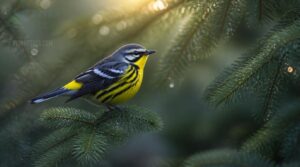
The Magnolia Warbler is one of the more striking small yellow birds you’ll encounter during migration. Its vibrant yellow plumage contrasts boldly with black streaking across the breast. Watch for its yellow rump and tail-fanning foraging behavior low in conifers.
It breeds across boreal spruce forests and winters in Central America and the Caribbean.
Nashville Warbler
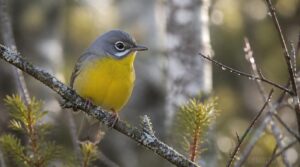
Unlike the Magnolia’s bold streaking, the Nashville Warbler offers something quieter — a gray head, bold white eye ring, and clean yellow underparts that reward a patient eye.
During breeding season, males sing a two-part phrase that almost sounds like "Nash-ville." They hover mid-air during courtship and winter across Central America after nesting in shrubby northern forests.
Palm Warbler
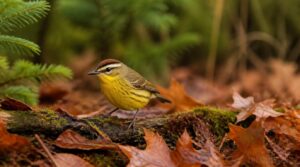
The Palm Warbler is one of those small yellow birds that rewards a slower, ground-level look. It forages mostly on the ground, walking through leaf litter while doing its signature tail bobbing — a constant, rhythmic dip that makes it easy to spot. Bright yellow plumage lines the underparts, while a rusty crown cap and pale eyebrow stripe complete the look.
This bird breeds in boreal forests across Canada, nesting low in boggy, evergreen-edged terrain. Come winter, it migrates to the southeastern U.S. and Caribbean. Its buzzy, flat-toned song — a simple trill of repeated syllables — carries a quiet persistence that matches its unhurried, ground-hugging habits.
Wilson’s Warbler
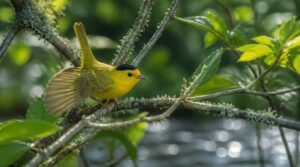
Where the Palm Warbler stays low and ground-bound, Wilson’s Warbler brings the action up into the shrubs. Bright yellow underparts and a sharp black cap on the male make this one of the most recognizable small yellow birds in the thicket.
- Breeding song: a rapid, high-pitched series from low perches
- Nest construction: tucked in shrubs near water, low to the ground
- Winter diet: shifts toward berries alongside its usual insects
- Vagrant sightings: rarely, it turns up in Europe
For birdwatching enthusiasts, Wilson’s Warbler rewards patience. Watch for its long tail flicking as it gleans insects from leaves — an energetic, restless forager. During migration, it moves through all lower 48 states, making backyard stops possible in spring and fall.
Yellow-Rumped Warbler
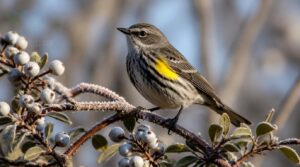
The Yellow-Rumped Warbler is one of the most adaptable small yellow birds you’ll encounter. That vivid yellow rump patch flashes unmistakably in flight.
It forages everywhere — canopy to ground — and visits backyard feeders for suet during migration. Unlike many warblers, it survives winter farther north by digesting waxy bayberry fruit.
Habitats, Diets, and Migration
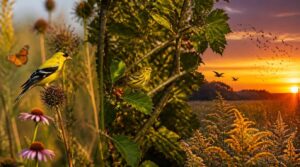
Small yellow birds don’t all live in the same places or eat the same things — and that variety is part of what makes them so fascinating to watch. Where a bird calls home shapes everything from what it eats to when it travels. Here’s a closer look at the key factors that define their world.
Where a small yellow bird calls home shapes everything it eats, and everywhere it travels
Backyard Feeders
Setting up a backyard feeder is one of the easiest ways to bring small yellow birds — like the American Goldfinch and Yellow Warbler — right to your window.
- Use tube feeders with nyjer seed for finches
- Mount feeders 5–6 feet above ground
- Place feeders 10–15 feet apart to reduce competition
- Use weight-activated squirrel baffles
- Clean feeders every two weeks with diluted vinegar
Wetlands and Forests
Some of the most rewarding birdwatching happens far from a feeder. Forested wetlands offer small yellow birds — especially the Prothonotary Warbler — nesting sites in flooded tree hollows, while canopy shade keeps water cool enough to sustain the insects they depend on. These ecosystems also filter nutrients from runoff, quietly maintaining the habitat quality that brings birds back season after season.
Seeds and Berries
Not every small yellow bird is chasing bugs. The American Goldfinch is famously seed-loving, drawn to nyjer and sunflower at backyard feeders year-round. Many species also rely on berries, whose seeds vary in size and carry fatty acids that support energy needs.
- Berry seeds aid avian diet through essential oils and nutrients
- Seed size variation influences which birds can consume and disperse them
- Bright yellow plumage often signals birds feeding in open, berry-rich shrubs
Insects and Caterpillars
While seeds sustain many species year-round, insect hunting drives much of the diet for small yellow birds during breeding season. Yellow Warblers actively forage for caterpillars — larvae packed with protein that fuel rapid nestling growth.
These caterpillars display impressive caterpillar camouflage, mimicking twigs or leaves, yet experienced foragers still locate them with precision across dense bird habitats.
Spring Migration Patterns
Spring is when small yellow birds take flight across entire continents, riding tailwinds north along coastal flyway routes. Many warblers reach eastern North America by April, timing arrivals with insect emergences.
Birdwatchers watching this green wave surfing will notice birds surfing northward vegetation flush, refueling at stopover sites before pushing onward to breeding grounds.
Attracting Small Yellow Birds
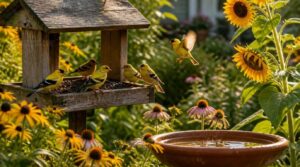
Getting small yellow birds to visit your yard doesn’t take much — just a few thoughtful changes can make a real difference. The good news is that goldfinches, warblers, and their yellow-feathered cousins are pretty easy to please once you know what they’re looking for.
Here are five simple ways to make your outdoor space one they’ll keep coming back to.
Offer Nyjer Seed
Stocking a Nyjer seed feeder is one of the most reliable ways to draw American Goldfinches into your backyard. This tiny, oil-rich seed delivers high energy from fats, making it especially valuable for small, seed-loving birds during winter.
Place feeders 5 to 15 feet from cover, keep seed dry in an airtight container, and refresh it every few months.
Plant Native Flowers
Nyjer seed pulls in goldfinches fast, but pairing your feeder with native blooms takes things further. Native flowers support pollinator habitat and offer natural foraging opportunities for small yellow birds beyond the feeder.
- Plant coneflowers for late-season seed heads
- Use black-eyed Susans for midseason color and insects
- Add native grasses for structure and ground cover
Soil health natives establish easily and cut water use noticeably once rooted.
Add Clean Water
Native blooms bring foraging value, but clean water seals the deal. Small yellow birds need reliable hydration year-round, and your backyard setup matters more than you’d think.
Water Dish Placement affects who shows up. Keep dishes away from feeders to reduce disease transfer, and raise them to deter ground pests.
| Water Tip | Why It Matters |
|---|---|
| Seasonal Water Management | Refresh daily in heat; insulate in winter |
| Winter Water Solutions | Use shallow insulated basins to prevent freezing |
| Bird Bath Maintenance | Sanitize weekly with diluted bleach, rinse thoroughly |
| Water Quality Testing | Watch for discoloration, odor, or algae |
| Birding Guide tip | Multiple sources reduce crowding during migration |
Shallow dishes — 1.5 to 2 inches deep — keep small birds safe from drowning. Change stagnant water daily to block mosquito breeding.
Avoid Yard Pesticides
Clean water keeps birds healthy, but pesticide-free lawn practices keep them alive. Chemicals used for lawn pests don’t stay put — they drift, run off, and end up in the very habitats small yellow birds depend on.
Here’s what to swap in instead:
- Use neem oil or insecticidal soap for targeted, low-toxicity pest control
- Encourage beneficial insect habitat by planting native borders that attract lady beetles and lacewings naturally
- Practice water runoff prevention by watering slowly and using mulch over herbicides
A solid organic pest management approach — combined with a native plant buffer around garden beds — reduces chemical drift greatly.
Your backyard becomes part of genuine wildlife conservation when you let natural systems do the heavy lifting.
Provide Shrubby Cover
Think of shrubby cover as your backyard’s living room — a place where small yellow birds feel genuinely at home. A well-planned shrub layer design mixing evergreen and deciduous species gives year-round shelter, food, and safe perching spots.
Aim for a height range of 6–12 feet, and connect patches to create corridors that support movement across your garden.
Frequently Asked Questions (FAQs)
What birds are yellow?
Many avian species wear yellow like a badge of identity. The American Goldfinch, Yellow Warbler, Common Yellowthroat, Lesser Goldfinch, and Pine Warbler are among the most recognizable bright yellow plumage songbirds you’ll encounter.
Are there Yellow Birds in North America?
Yes, North America hosts dozens of yellow bird species year-round. From the Yellow Warbler to the Eastern Meadowlark, vibrant yellow plumage appears across forests, wetlands, and open fields throughout the continent.
Are there Yellow Birds in your backyard?
Birdwatchers sometimes joke that a single feeder can turn your backyard into a battlefield of color. Species like the Yellow Warbler, Yellow-rumped Warbler, and Common Yellowthroat visit more often than you’d expect.
What do yellow birds look like?
Yellow birds commonly display bright yellow feathers across the face, chest, and underparts, often paired with olive green backs or black wings. Many show distinctive eye stripes, colorful crown patches, or subtle plumage variations depending on species and season.
What is a yellowthroat bird?
The common yellowthroat is a small olive-and-yellow warbler known for its bold black mask and the unmistakable witchety witchety song it sings from dense marshes and wetland thickets across North America.
Where can I find information about small yellow birds?
You can find rich information through field guides, online bird databases, and mobile apps like Merlin. Citizen science platforms and regional birding forums also offer reliable, community-driven insights for identifying avian species across seasons.
What is a small yellow bird that looks like a finch?
Like a drop of sunlight perched on a branch, the American Goldfinch fits the bill perfectly — a finch-like yellow songbird measuring 4–5 inches, with a seed-focused diet and bold breeding plumage.
What do you call a little yellow bird?
People call them by many names — "wild canary," "butter bird," or simply by species: Yellow Warbler, Common Yellowthroat, or American Goldfinch. The nickname often depends on where you are.
What is the most common yellow bird?
The American Goldfinch is North America’s most widely reported yellow bird, with year-round presence across much of the continental United States and strong representation in citizen science sighting data.
What small bird looks like a goldfinch?
The bird that fools you most is the one you’re sure you know. Lesser Goldfinch shares the goldfinch’s bright yellow plumage and black cap, but look closer — its back runs darker green.
Conclusion
For something so easy to overlook, small yellow birds have a notable way of rewriting your entire morning. The irony is that the bird you quickly dismissed as "just another yellow one" might be a Pine Warbler, a Yellow Warbler, or a goldfinch in mid-molt—each a distinct species carrying its own story.
Set up the right feeder, plant native flowers, skip the pesticides, and watch your backyard quietly become something genuinely worth stopping for.
- https://www.birdfy.com/blogs/blogs/a-guide-to-30-yellow-birds-in-the-world
- https://www.lyricbirdfood.com/birding-hub/basics/5-yellow-backyard-birds-you-should-know
- https://nationalzoo.si.edu/animals/american-yellow-warbler
- https://www.allaboutbirds.org/guide/Northern_Yellow_Warbler/id
- https://www.birdsandblooms.com/birding/yellow-warbler-vs-goldfinch