This site is supported by our readers. We may earn a commission, at no cost to you, if you purchase through links.
 You’ll recognize a female cowbird by her plain brown plumage, stocky build, and thick, pointed bill—she’s basically the sneaky neighbor who never returns your borrowed tools.
These brood parasites don’t build nests but instead lay their eggs in other birds’ homes, forcing unsuspecting host parents to raise cowbird chicks. You’ll often spot them following cattle or grazing animals, flicking their tails as they hunt for insects and scout potential nest targets.
Unlike flashy males with their glossy black feathers, females stay under the radar with their understated brown coloring that helps them blend into grasslands and farm areas. Their master manipulation skills become even more fascinating when you understand the full scope of their deceptive parenting strategy, which involves brood parasites and clever use of host parents.
Table Of Contents
- Key Takeaways
- Female Cowbird Identification
- Recognizing Female Cowbird Vs. Female Red-winged Blackbird
- Understanding Cowbirds’ Invasive Status
- The Aggressiveness of Brown-headed Cowbirds
- Distinguishing Male and Female Brown-headed Cowbirds
- Appearance of Female Brown-headed Cowbirds
- Size and Behavior Differences in Female Brown-headed Cowbirds
- Calls and Singing of Female Brown-headed Cowbirds
- Nesting and Feeding Habits of Female Brown-headed Cowbirds
- Similar Birds to Female Brown-headed Cowbirds
- Frequently Asked Questions (FAQs)
- What is a female cowbird?
- What does a cowbird look like?
- Why are female cowbirds less visible than males?
- How do you know if a cowbird is male or female?
- Why are female cowbirds difficult to spot?
- Do young cowbirds prefer females?
- What does a female cowbird look like?
- Are cowbirds good or bad?
- Do cowbirds mate for life?
- Why are Brown-headed Cowbirds a threat?
- Conclusion
Key Takeaways
- You’ll identify female cowbirds by their plain brown plumage, stocky build, and thick sparrow-like bills that help them forage on the ground near cattle
- You’ll witness their sneaky brood parasitism behavior as they don’t build nests but instead lay up to 40 eggs per season in other birds’ homes, forcing host parents to raise cowbird chicks
- You’ll distinguish them from similar brown birds like female red-winged blackbirds by their unmarked coloring, shorter bills, and preference for open grasslands rather than wetland areas
- You’ll understand they’re considered invasive despite being native because their parasitic tactics harm over 220 host species, contributing to songbird population declines through aggressive "mafia" behavior when their eggs are rejected
Female Cowbird Identification
You can spot female cowbirds by their plain brown plumage and thick, sparrow-like bills that help them forage on the ground.
These sneaky birds won’t build their own nests—instead, they’ll quietly watch other birds to find the perfect target for their egg-laying schemes.
Physical Characteristics

Beyond her plain appearance lies remarkable adaptability—the female cowbird’s understated brown plumage conceals her parasitic prowess.
Here’s what makes her unique:
- Size of a sparrow with stocky, compact build
- Unmarked brown coloration across wings and back
- Brown head slightly lighter than body feathers
- Thick, conical bill morphology for ground foraging
- Plumage variations show subtle streaking on belly
- Some may seek cowbird plumage products.
Behavior

These secretive birds master the art of deception through careful host selection and strategic egg laying.
Female cowbirds exhibit fascinating social interactions while practicing avian brood parasitism.
Their foraging habits include following livestock to catch disturbed insects.
Watch for their stealthy nest parasitism behavior as they monitor potential hosts.
To assist with identifying these birds, one can find various products for female cowbird identification.
| Behavior Type | Description | Timing |
|---|---|---|
| Host Surveillance | Silently watches nests from distance | Early morning hours |
| Egg Removal | Takes host eggs before laying own | During host absence |
| Strategic Laying | Places single egg per nest | Peak breeding season |
| Foraging Tactics | Follows cattle for insects | Throughout day |
| Territory Roaming | Covers large areas seeking nests | Spring to summer |
Habitat

You’ll discover female cowbirds across diverse grassland, farmland, and pastures throughout open country.
Their range expansion follows urban adaptation patterns, with habitat loss driving them into new territories.
These adaptable birds thrive from sea level to moderate elevations, where climate influence shapes their distribution across North America’s changing landscapes.
Recognizing Female Cowbird Vs. Female Red-winged Blackbird

When you’re trying to tell these brown birds apart, focus on key differences that’ll save you from confusion.
Female cowbirds and female red-winged blackbirds share similar habitats but have distinct features once you know what to look for.
| Feature | Female Cowbird | Female Red-winged Blackbird |
|---|---|---|
| Bill Shape | Short, thick, sparrow-like | Longer, more pointed |
| Plumage Comparison | Plain dusty brown, unmarked | Heavily streaked with buff |
| Size Discrepancies | 6.3-7.9 inches | 6.7-9.1 inches |
| Habitat Overlap | Open fields, near livestock | Wetlands, marshes |
| Vocal Differences | Harsh chatter call | Sharp "check" notes |
The brownheaded cowbird female’s uniform coloring makes cowbird identification easier—she lacks the bold streaking you’ll see on red-winged blackbird females.
Those interested in attracting red-winged blackbirds can find a variety of bird-related products online.
These similar bird species often confuse beginning birders, but remembering that female cowbirds prefer following cattle while red-winged blackbirds stick to marshy areas helps with accurate bird identification.
Understanding Cowbirds’ Invasive Status
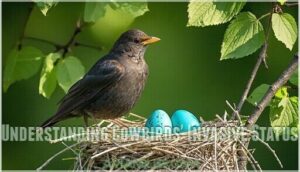
Brown-headed cowbirds earned their invasive status through a clever trick that’s wreaking havoc on native birds.
These parasitic birds don’t build nests—instead, females sneak into other species’ homes and lay up to 40 eggs per season.
This brood parasitism forces unsuspecting host parents to raise cowbird chicks, often at the expense of their own young.
Range expansion has made things worse.
Originally following bison herds across the Great Plains, cowbirds now exploit habitat alteration from farming and development.
They’ve spread coast-to-coast, parasitizing over 220 host species.
When cowbirds target smaller songbirds like vireos and wood thrushes, the host impact is devastating—reduced breeding success and population declines follow.
Conservation concerns are mounting as cowbird behavior includes "mafia tactics"—destroying host nests when their eggs get rejected.
Their actions contribute to endangered species decline.
Though native to North America, these brownheaded cowbird populations function like invasives, disrupting ecosystems they historically didn’t occupy.
Understanding this unique threat helps wildlife managers protect vulnerable songbird species.
The Aggressiveness of Brown-headed Cowbirds
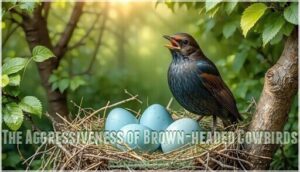
Understanding cowbird behavior reveals shocking tactics that’ll make you rethink these "innocent" birds.
Female cowbirds don’t just lay eggs in other nests—they wage psychological warfare on their hosts.
Female cowbirds turn nest invasion into calculated psychological warfare against unsuspecting host parents.
When hosts reject cowbird eggs, these parasites return for revenge, destroying entire broods in retaliatory attacks.
Here’s how cowbirds dominate through aggression:
- Host Egg Removal: Females deliberately destroy host eggs before laying their own, eliminating competition
- Nest Raiding: Failed parasitism triggers "mafia behavior"—cowbirds return to ransack nests 56% of the time
- Chick Outcompeting: Cowbird nestlings grow faster and beg louder, monopolizing food from foster parents
- Brood Dominance: Their aggressive begging often leads to host chicks starving or increased predation risk
- Parasitic Pressure: This brood parasitism affects over 220 species, threatening native songbird populations
This nest invasion strategy isn’t random—it’s calculated survival behavior that’s devastatingly effective.
The cowbird’s reliance on other birds’ nests is a key aspect of their reproductive strategy.
Distinguishing Male and Female Brown-headed Cowbirds
Looking at these distinctive backyard visitors, you’ll notice stark plumage differences between sexes.
Male cowbirds sport glossy black bodies with rich brown coloration on their heads, while females wear plain gray-brown plumage that’s uniformly dull.
The size comparison reveals males are slightly larger, measuring 7.5-8.7 inches versus females at 6.3-7.9 inches.
| Feature | Male | Female |
|---|---|---|
| Head Color | Rich brown | Gray-brown |
| Body Plumage | Glossy black | Plain brown |
| Size | 7.5-8.7 inches | 6.3-7.9 inches |
| Bill Morphology | Thick, conical | Short, stout |
| Juvenile Markings | Similar to adult | Light streaking |
Female differences include their sparrow-like bills and subtle streaking on juveniles.
Males display more during courtship, while females focus on scouting host nests.
These clear distinctions help you identify both sexes in your yard.
Appearance of Female Brown-headed Cowbirds
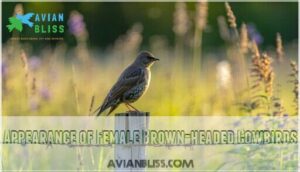
After identifying males by their striking black plumage and brown heads, you’ll find female Brown-headed Cowbirds (Molothrus ater) present a completely different appearance.
These sneaky brood parasites sport understated dusty brown plumage that’s surprisingly effective camouflage. You won’t spot any flashy colors here – their entire body displays uniform grayish-brown feathers without the male’s glossy sheen.
Female Plumage characteristics make identification straightforward once you know what to look for:
- Plain brown coloring across wings, back, and tail with no distinctive markings
- Lighter brown underparts and head with subtle streaking on the belly
- Dark, sparrow-like conical bill perfectly adapted for ground foraging
- Juvenile Markings often show more pronounced streaking before first molt
Regional Differences in Color Variations exist, with some populations appearing slightly grayer while others lean toward warmer brown tones. Molting Patterns don’t dramatically change their bird appearance – they maintain consistent female differences throughout the year, making year-round identification reliable for this persistent brood parasite.
Size and Behavior Differences in Female Brown-headed Cowbirds
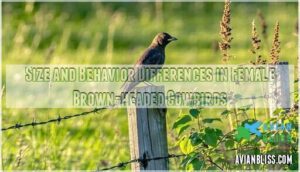
You’ll spot female Molothrus ater measuring 6.3 to 7.9 inches with plain brown plumage that helps them blend seamlessly into grasslands and forest edges.
Female cowbirds master the art of deception with their understated brown camouflage and secretive nest-watching behavior.
Their Roaming Range spans vast territories as these brood parasites search for unsuspecting hosts. Female cowbird behavior centers on strategic surveillance—they’ll perch quietly, watching other birds build nests before striking with precision timing.
| Characteristic | Female Details |
|---|---|
| Egg Size | 0.7-1.0 inches long, whitish with brown spots |
| Laying Frequency | Up to 40 eggs per season, one per host nest |
| Host Impact | Parasitizes over 220 bird species successfully |
| Foraging Success | Ground-walking technique near livestock for insects |
| Brownheaded Cowbird Range | Covers entire continental United States and southern Canada |
Their bird behavior differs markedly from nest-building species. Instead of maternal care, they’ve mastered the art of deception. You’ll witness them removing host eggs before depositing their own, ensuring their offspring get prime real estate. This calculated approach makes female cowbirds remarkably successful brood parasites in North American ecosystems.
Calls and Singing of Female Brown-headed Cowbirds
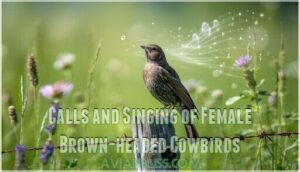
Beyond their size differences, female vocalizations set these birds apart from males.
You’ll hear their distinctive chatter call – a rapid series of rattling notes that sounds like marbles shaking in a jar.
Unlike the male’s gurgling song, females produce softer whistles and clicks, especially when scouting host nests.
Regional dialects exist among cowbird populations, with chatter variations differing slightly across geographic areas.
Call development begins early, with young females learning these sounds from adults during their first summer.
The song function serves multiple purposes: communicating with mates, coordinating brood parasitism activities, and maintaining flock cohesion.
Their brood parasitism impacts host species populations.
Listen for their bird vocalizations near cattle or open fields where they forage.
These bird songs might seem understated compared to flashy songbirds, but they’re perfectly adapted for stealth.
Their quiet communication style helps them avoid detection while they secretly observe potential host species, making their parasitic lifestyle remarkably successful.
Nesting and Feeding Habits of Female Brown-headed Cowbirds
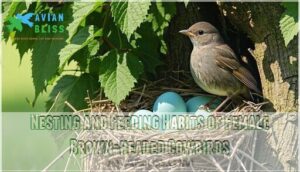
Female cowbirds break all traditional parenting rules with their sneaky brood parasitism strategy.
Unlike most birds, they don’t waste time building nests or caring for their young.
Here’s how their unique approach works:
- Host Selection: Female cowbirds scout for active nests, watching other birds’ building patterns and timing their egg laying perfectly.
- Egg Laying: Each female deposits up to 40 cowbird eggs per season across different host species’ nests, sometimes removing the original eggs first.
- Diet Composition: Their thick bills crack seeds efficiently while they forage on the ground, supplemented by insects stirred up by grazing cattle.
- Foraging Behavior: You’ll spot them following livestock herds, capitalizing on disturbed insects and scattered grain in open areas.
This nest parasitism affects over 220 host species, with cowbird eggs often hatching earlier than their nestmates, giving the young cowbirds a competitive advantage for food and space.
Similar Birds to Female Brown-headed Cowbirds
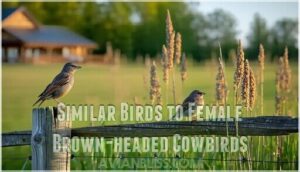
When you’re out in the field, distinguishing female cowbirds from their lookalikes can feel like solving a puzzle. Several species share similar female plumage patterns, making sparrow identification and finch comparison essential skills.
Female House Sparrows display lighter streaking and more delicate builds than cowbirds. Their social flocking behavior differs substantially from cowbirds’ solitary nest-hunting missions. Juvenile birds of various species also create identification challenges, especially during molting seasons.
| Feature | Female Cowbird | Similar Species |
|---|---|---|
| Bill Shape | Thick, conical | Pointed (Red-winged) or smaller (sparrows) |
| Behavior | Solitary nest-watching | Flocking or territorial |
| Streaking | Minimal belly streaks | Heavy underpart streaking |
Female Red-winged Blackbirds show heavier underpart streaking and pointed bills. Unlike cowbirds practicing egg mimicry, these host species build their own nests and tend their young. Understanding these differences helps protect native birds from cowbird parasitism, as cowbirds strategically target host species whose bird eggs match their own cowbird eggs.
Frequently Asked Questions (FAQs)
What is a female cowbird?
You’ll recognize a female cowbird by her plain brown plumage and sparrow-like bill.
She’s a brood parasite who sneakily lays eggs in other birds’ nests, letting unsuspecting foster parents raise her chicks.
What does a cowbird look like?
You’ll spot cowbirds by their distinct sexual dimorphism: males display glossy black bodies with rich brown heads, while females wear plain dusty brown plumage with darker bills resembling sparrows.
Why are female cowbirds less visible than males?
You’ll find them blending seamlessly into their surroundings with plain dusty brown plumage that acts like natural camouflage.
Unlike flashy males, they’re built for stealth missions, sneaking around to spy on other birds’ nests.
How do you know if a cowbird is male or female?
Males show glossy black bodies with brown heads, while females display plain brown plumage throughout.
You’ll notice males are larger and more colorful, making identification straightforward when comparing their contrasting appearances.
Why are female cowbirds difficult to spot?
You’ll struggle to identify these brown birds because their plain, dusty plumage camouflages perfectly with grasslands and fields where they forage, making them nearly invisible among cattle.
Do young cowbirds prefer females?
Young cowbirds don’t show preference for females over males.
They’ll approach any adult bird that feeds them, regardless of gender.
These crafty chicks focus purely on getting food from their unsuspecting foster parents.
What does a female cowbird look like?
Weighing just 3-6 ounces, you’ll spot a female cowbird by her plain dusty brown plumage, dark sparrow-like bill, and thin belly streaking—perfectly camouflaged for her sneaky egg-laying missions.
Are cowbirds good or bad?
Cowbirds aren’t inherently good or bad—they’re just following their natural survival strategy.
You’ll find they’re controversial because their brood parasitism harms some songbird populations, but they’re also part of nature’s complex ecosystem balance, which includes being part of nature’s balance.
Do cowbirds mate for life?
No, you’ll find cowbirds don’t mate for life like some birds do.
These free-spirited wanderers practice seasonal mating, where males compete for females during breeding season but don’t form lasting pair bonds that continue year after year.
Why are Brown-headed Cowbirds a threat?
They’re a threat because they practice brood parasitism—laying eggs in other birds’ nests.
This behavior destroys the eggs and young of smaller songbirds and has been implicated in the decline of several endangered species.
Conclusion
Picture a master of disguise moving silently through tall grass, brown feathers camouflaging her every step as she searches for the perfect victim.
Now you’ve mastered identifying the female cowbird and understanding her parasitic lifestyle. You’ll spot her stocky build, thick bill, and tail-flicking behavior near cattle or in open grasslands.
Remember, she’s not building nests but scouting other birds’ homes for her egg-laying scheme. Watch for her subtle movements and brown coloring—she’s nature’s ultimate freeloader, leaving host parents to raise her young.
She’s a bird that has adapted to be a successful freeloader, and her behavior is worth noting, as she takes advantage of other birds to raise her offspring, showcasing a very distinct and parasitic approach to parenting.
- https://ourhabitatgarden.org/home/creatures/invaders/native/cowbirds/
- https://www.cabidigitallibrary.org/doi/full/10.1079/cabicompendium.75200
- https://research.fs.usda.gov/treesearch/46274
- https://wfujournaloflawandpolicy.org/racketeers-of-the-bird-world-the-ecological-impact-of-the-brown-headed-cowbird/
- https://pmc.ncbi.nlm.nih.gov/articles/PMC1838626/