
This site is supported by our readers. We may earn a commission, at no cost to you, if you purchase through links.

Flamingos spend their lives standing in water that would blister most animals alive — hypersaline lakes so caustic they corrode metal equipment left near the shoreline. Yet millions of flamingos colonize these hostile environments not despite the toxicity, but because of it.
The biology behind that paradox runs deeper than most people expect. These birds filter-feed with an inverted skull, pump their tongue like a piston 20 times per second, and derive their famous pink coloration entirely from what they eat — strip the diet, and the color fades. Grey flamingo chicks hatch with no pink whatsoever.
What looks like nature’s most decorative bird is, underneath the spectacle, one of its most precisely engineered ones.
Table Of Contents
- Key Takeaways
- What Are Flamingos?
- Where Do Flamingos Live?
- How Flamingos Eat
- Why Flamingos Are Pink
- Flamingo Behavior and Breeding
- Frequently Asked Questions (FAQs)
- What are 5 facts about flamingos?
- Are flamingos LGBTQ?
- What is a flock of flamingos called?
- Do flamingos mate for life?
- What are 5 interesting facts about flamingos?
- What animal changes color when it eats shrimp?
- What information do I need to apply for Flamingo learning?
- What is Flamingo fares?
- How tall is a flamingo?
- What do flamingos symbolize?
- Conclusion
Key Takeaways
- Flamingos don’t just tolerate toxic hypersaline lakes — they’ve turned that hostile chemistry into their personal VIP lounge, thriving where every other species taps out.
- Your pink flamingo is basically what you’d get if a biological engineer designed a bird around an inverted skull, a piston tongue firing 20 times per second, and a diet that doubles as body paint.
- That iconic color isn’t built in — strip the carotenoid-rich algae and shrimp from their diet, and flamingos fade to grey, which is exactly how every chick hatches.
- These birds can clock 30–40 wild years (and 60+ in captivity), raising one chick per season on blood-red crop milk while living in colonies so massive they hit a million strong.
What Are Flamingos?
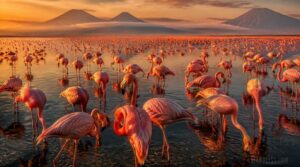
Flamingos are among the most recognizable birds on the planet, but there’s far more going on beneath those pink feathers than most people realize.
Despite their striking appearance, flamingos are surprisingly resilient survivors — and their flight abilities play a bigger role in that survival than you’d expect.
They belong to a specialized family all their own, with six distinct species spread across continents and some surprisingly bold biological tricks up their sleeve. Here’s what sets them apart from every other wading bird out there.
Flamingo Family Classification
Flamingos belong to the family Phoenicopteridae, slotted within the order Phoenicopteriformes — a lineage so distinct that scientists spent decades arguing about where it actually fit. Recent molecular and morphological analyses resolved that debate by linking flamingos closely to grebes, grouping both within a clade called Mirandornithes.
Three genera — Phoenicopterus, Phoeniconaias, and Phoenicoparrus — account for all six living species. Their vibrant pink coloration comes from carotenoid pigments found in their diet.
Six Living Species
Six species form the order Phoenicopteriformes: the Greater Flamingo, ranging across Africa, Europe, and South Asia; plus the Lesser, Chilean, James’s, Andean, and American Flamingo, which spans the Caribbean and coastal South America.
Species size variations are significant, from 0.9 to 1.5 meters. The Andean flamingo inhabits high-altitude saline lakes in Peru and Bolivia — extreme terrain even by avian biology standards.
Wading Bird Traits
Beyond species diversity, what unites flamingos with other wading birds runs deeper than pink plumage — it’s a shared morphological blueprint refined for wetland life.
Long legs and stable tarsal joints keep the body clear of water while foraging, and beak sensitivity allows prey detection in murky shallows. Water-repellent feathering and foraging stealth — slow, deliberate movement — complete the picture.
Key Physical Features
That wading blueprint is underpinned by striking structural adaptations. Hollow bones reduce weight to between 2 and 3.5 kilograms, while 19 cervical vertebrae grant the neck astonishing rotational range.
Key morphological traits:
- Backward-bending ankle joints, often mistaken for knees
- Black flight feathers spanning up to 165 centimeters
- Pink plumage derived from dietary carotenoids
- Webbed feet stabilizing movement across soft substrates
Flamingo Lifespan Basics
Survival past the first two or three years marks a turning point — juvenile mortality drops sharply once chicks reach independence.
After that, wild individuals usually live 30 to 40 years, while captive flamingos, shielded from predators and nutritional deficits, routinely exceed 60. The oldest documented individual reached at least 83 years in a managed setting, a lifespan shaped entirely by diet, habitat stability, and veterinary oversight.
Where Do Flamingos Live?

Flamingos aren’t picky about geography — they’ve claimed territory across Africa, Asia, Europe, and South America with equal confidence. What they are picky about is the type of water they call home, and it’s not exactly your average lakeside resort. Here’s a look at the specific habitats where flamingos actually thrive.
Seasonal shifts shape their movements too — flooding and drought patterns that drive flamingo dispersal mirror the same forces that push many wading birds toward or away from reliable feeding grounds.
Global Distribution
Flamingos don’t pick one continent and call it home — they’re spread across Africa, Asia, Europe, and South America, threading through wetland ecosystems wherever saline conditions allow.
Their global habitat range mirrors the kind of multimodal spread any logistics network would envy, shaped by regional demand patterns for food, climate, and nesting ground rather than trade routes.
Salt Lakes and Lagoons
Salt lakes aren’t accidents — they form in endorheic basins, where water flows in but never out, concentrating salts until conditions turn hypersaline.
Halophilic microorganisms colonize these chemical extremes, seeding the food web that sustains massive flocks. Flamingos thrive here precisely because most species can’t.
The salinity balance is delicate: too much evaporation, too little inflow, and the habitat collapses.
Estuaries and Mudflats
Estuaries offer something salt lakes don’t — constant renewal. Tidal cycles flush nutrients through muddy clay sediments, sustaining the invertebrate food webs that flamingos exploit during low-tide foraging windows.
These coastal habitat connectivity zones link open water to wetland interiors, but rising seas increasingly threaten their intertidal balance, compressing the productive mudflat margins that wetland birds like flamingos depend on.
Seasonal Movement Patterns
Seasonal shifts drive flamingo migration triggers — water levels, salinity crashes, and prey abundance — pushing flocks toward reliable wetlands with almost clockwork precision.
Breeding season pulls colonies to sheltered saline lakes, while post-breeding dispersal scatters adults outward as competition intensifies. Droughts accelerate relocation entirely; wet seasons open patchwork feeding grounds across flooded lowlands, briefly expanding where these wetland birds roam.
Habitat Selection Factors
Picking a home isn’t random. Flamingos zero in on shallow alkaline or saline lakes — ideally 15–35 centimeters deep — where food density peaks and predators struggle to approach undetected. Turbidity matters too; clearer water helps them spot prey patches faster.
- Salinity drives the menu — brackish to hypersaline conditions fuel algae and brine shrimp blooms
- Water depth controls access — too deep, and filter feeding collapses entirely
- Remote margins mean survival — low predator pressure keeps colonies nesting undisturbed
How Flamingos Eat
Flamingos don’t eat like any bird you’ve seen at a backyard feeder — their whole approach is genuinely strange, and it works brilliantly. Everything from the shape of their bill to the way they hold their head is built around one surprisingly efficient system. Here’s exactly how that feeding process breaks down.
Upside-down Filter Feeding
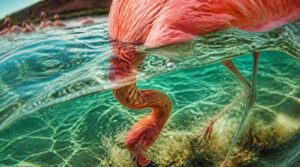
Flipping their heads underwater isn’t a quirk — it’s precision engineering. Your flamingo drives its S-curved neck downward, bill angled to skim shallows under 20 cm deep. Webbed feet stomp sediment loose, exposing aquatic organisms and invertebrates. Rapid beak clapping creates von Kármán vortices — sheet-like water tornadoes — that trap prey before the tongue pumps filtrate through lamellae up to 20 times per second.
| Feeding Mechanism | Function |
|---|---|
| Inverted head posture | Sets bill to filter shallow water |
| Tongue pumping action | Cycles water through lamellae filtration |
| Webbed foot stomping | Stirs sediment to expose invertebrates |
| Von Kármán vortices | Traps prey via water tornado effect |
| S-curved neck | Adjusts reach across varying water depths |
Specialized Bill Structure
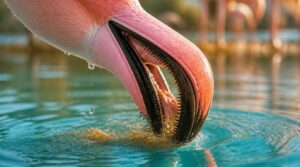
The bill itself is the real engineering marvel. The upper mandible acts as a lid over the trough-shaped lower jaw, while rows of bristled lamellae mesh to filter water:
- Lamellae filtering captures aquatic organisms and invertebrates
- The tongue piston action cycles filtrate 20 times per second
- Von Kármán vortices concentrate prey through rapid beak clapping
Few filter feeding systems match this level of mechanical precision.
Algae and Shrimp Diet
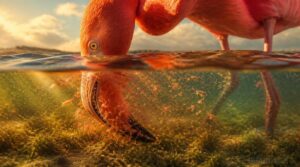
What fuels that precision filter-feeding apparatus? Primarily carotenoid-rich algae and crustaceans — brine shrimp, diatoms, insect larvae, and aquatic seeds extracted from alkaline shallows.
Macroalgae species help with digestibility and transfer essential fatty acids like EPA and DHA directly into tissue. The same carotenoid pigments absorbed from algae and shrimp don’t just nourish — they color.
Tongue Pumping Action
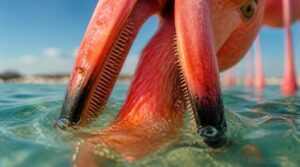
The tongue operates as a biological piston, driving water through the bill up to 20 times per second. Precise tongue muscle coordination between extrinsic and internal muscles shapes the oral cavity, maximizing bolus propulsion mechanics with each pulse.
What this rapid swallowing motor control achieves:
- Near-frictionless fluid cycling
- Elastic energy stored, then released
- Zero wasted pump strokes
- Astonishing avian physiology efficiency
Feeding in Shallow Water
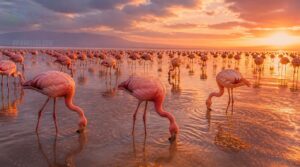
Flamingos target water depths of 5–15 cm, where brine shrimp, copepods, and algal filaments concentrate near the surface. Sediment-rich mudflats flush carotenoid-packed crustaceans directly into the filtering bill with minimal effort.
Group foraging at dawn and dusk amplifies prey detection in turbid conditions, while coordinated wading stirs sediments, keeping organic matter suspended and accessible across the entire flock simultaneously.
Why Flamingos Are Pink
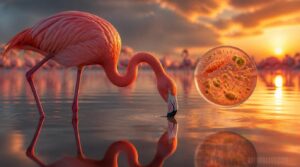
That head-turning pink isn’t a fashion choice — it’s biology doing the heavy lifting. A flamingo’s color comes entirely from what it eats, and a few key factors determine just how vivid that plumage gets. Here’s what’s actually driving the pink from the inside out:
Carotenoid Pigment Sources
Pink isn’t something you’re born with — and for flamingos, that’s literally true. Carotenoid pigments occur in blue-green algae and brine shrimp, concentrated across aquatic food webs. Microalgae like Haematococcus pluvialis produce algal astaxanthin under stress conditions, while crustaceans accumulate carotenoids directly from phytoplankton.
Dietary lipid absorption boosts bioavailability — fat-rich meals increase total carotenoid uptake a lot. No pigment consumed, no pink.
Diet and Feather Color
Color intensity tracks directly with carotenoid absorption efficiency — the more algae and crustaceans consumed, the deeper the saturation locked into growing feathers during molt.
Keratin pigment buildup happens only while feathers develop; once mature, color is fixed. Dietary fat accelerates uptake, while zooplankton-rich lakes shift plumage toward vivid orange-red tones across entire colonies.
Grey Flamingo Chicks
Hatchlings arrive grey, weighing 40 to 50 grams — wobbly, pale, and nothing like their vivid parents. Chick growth rates are steep; weight doubles within the first week. Three milestones define this grey phase:
- Beak curves for filter feeding by week two
- Juvenile feathering replaces down within 6–12 weeks
- Subadults enter crèches, where avian social learning shapes animal behavior
This biological adaptation takes years, not days.
Color Changes During Parenting
Parenting costs flamingos their vivid color. As adults divert carotenoid pigments into crop milk — that protein-rich, blood-red secretion fed to chicks — their plumage fades noticeably. This pigment allocation trade-off is biology being brutally efficient. Hormone-driven shifts during breeding alter how birds deposit beta-carotene into feathers. Once chicks fledge and dietary carotenoid intake rebounds, bird coloration gradually returns to full saturation.
Flamingos sacrifice their vivid pink to nourish their chicks, then slowly reclaim it
| Parenting Stage | Plumage Effect |
|---|---|
| Active chick feeding | Pale, muted pink tones |
| Crop milk production | Significant carotenoid loss |
| Carotenoid dietary stress | Duller, washed-out hues |
| Post-fledging recovery | Color gradually deepens |
| Chick independence | Vibrant pink restored |
Courtship Color Enhancement
When breeding season arrives, flamingos basically turn up their own color saturation. Pigment deposition into feathers intensifies as carotenoid intake peaks, producing richer, more vivid hues that signal fitness to potential mates. Brighter individuals attract more attention — color is the CV.
Flamingos even rub uropygial gland secretions across plumage during courtship, actively enhancing visual impact before displays begin.
Flamingo Behavior and Breeding
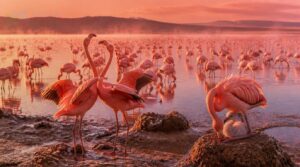
Flamingos don’t just look great — they live that way too. From massive, rule-breaking colonies to surprisingly loyal friendships and dramatic courtship rituals, their social lives are anything but ordinary. Here’s what you need to know about how flamingos behave, bond, and bring new life into the world.
Colony Life and Flamboyances
Flamingos rarely go it alone. They gather in colonies called flamboyances, ranging from a handful of birds to over one million — numbers that shift as conditions change and groups relocate toward better feeding grounds.
Juveniles learn foraging cues by shadowing older birds, while dominance hierarchies stay fluid, influencing resource access far more than mating. Collective vigilance keeps predators at bay for everyone.
Social Bonds and Friendships
Within those flamboyances, bonds run surprisingly deep. Pairs form long-term friendships — male-male, female-female, or mixed — strengthened through:
- Mutual grooming exchanges
- Reciprocal foraging aid
- Conflict resolution rituals
- Shared microcrèches for chicks
- Social learning from trusted allies
These ties shape who warns whom, who feeds together, and who influences avian courtship when the breeding season arrives.
Synchronized Courtship Displays
Those social bonds don’t just persist — they ignite. When breeding season peaks, flamingos shift into synchronized courtship displays that mix movement, sound, and color into one unified performance.
Necks rise, bills dip, and feet tap in rhythm with low, boom-like calls, creating multimodal display mechanics where visual and acoustic signals back each other up simultaneously. Displays intensify wherever competition clusters.
Mud Mound Nests
Once the courtship spectacle winds down, pairs get to work on something far more grounded — literally.
Flamingos construct volcano-shaped mud mounds, layering mud, plant fibers, and small stones into raised cones that insulate eggs from heat and floodwater. The thick outer walls deter ground predators and resist weather. Stable nests get reused across seasons, with birds patching damage between clutches to preserve structural integrity.
Eggs, Chicks, and Crop Milk
Each nest holds a single egg — 52 to 60 grams — incubated by both parents for 28 to 31 days. Hatchlings emerge grey and downy, entirely dependent on adults.
Crop milk fills that gap: a thick, blood-red esophageal secretion dense with protein, fat, and immune factors, regurgitated directly into chick bills multiple times daily until solid food gradually takes over.
Frequently Asked Questions (FAQs)
What are 5 facts about flamingos?
These birds stand up to five feet tall, feed upside-down, and get their pink color entirely from their diet. They form colonies of millions, raise one chick per season, and balance on one leg to conserve heat.
Are flamingos LGBTQ?
Same-sex pair bonds appear across countless species — that’s evolutionary biology, not a human label.
Flamingos form enduring same-sex partnerships and sometimes co-parent raised chicks, reflecting diverse mating systems science recognizes without borrowing human identity frameworks.
What is a flock of flamingos called?
Fire travels in waves, and language borrows from it. A group of flamingos is called a flamboyance — from French flambe, meaning flame — reflecting vivid coloration. Older terms include stand and colony.
Do flamingos mate for life?
Lifelong loyalty sounds romantic, but flamingos practice serial monogamy — pairing faithfully within a single breeding season, then potentially selecting a new mate when the next reproductive cycle begins.
What are 5 interesting facts about flamingos?
Nature’s wildest waders rewrite the rulebook. Hollow bones aid flight; dietary pigmentation colors grey chicks pink.
They generate von Kármán vortices while feeding, balance one-legged to conserve energy, and nest in volcano-shaped mud mounds.
What animal changes color when it eats shrimp?
Flamingos turn pink by eating shrimp. Astaxanthin, a carotenoid pigment, absorbs into feathers through dietary pigmentation. Without enough shrimp or carotenoids, pink fades to grey — color is purely nutritional, not genetic.
What information do I need to apply for Flamingo learning?
To apply for Flamingo Learning, you’ll need valid ID, proof of your education role, an institutional email, employment verification, and signed data consent forms confirming eligibility with your district.
What is Flamingo fares?
Flamingo Fares is Tampa Bay’s regional smart card and mobile app transit system, letting riders pay across multiple agencies with automatic fare capping — so you never overpay, no matter how often you ride.
How tall is a flamingo?
Standing 8 to 5 meters tall, depending on species, these wading birds range from chest- to chin-height on most adults. Leg length, not body mass, drives that striking silhouette.
What do flamingos symbolize?
Pink — earned through biological pigments, not vanity — has long read as a cultural symbol of beauty and vitality. For flamingos, this bird species’ body coloration doubles as shorthand for balance, community, and strength across art and tradition.
Conclusion
A single flamingo colony can contain over a million birds, making them one of Earth’s most concentrated wildlife spectacles. That density isn’t coincidence — it’s survival math. Flamingos thrive precisely where other species can’t, turning hostile chemistry into competitive advantage.
Their pink feathers, inverted skull, and piston tongue aren’t decorative quirks; they’re engineering solutions refined across millions of years. Once you understand the biology, you don’t just see a flamingo differently — you see what genuine adaptation actually looks like.
- https://nationalzoo.si.edu/animals/news/why-are-flamingos-pink-and-other-flamingo-facts
- https://www.pbs.org/wnet/nature/blog/flamingo-fact-sheet
- https://seaworld.org/animals/all-about/flamingos/characteristics
- https://reidparkzoo.org/flamingos-use-their-beaks-to-filter-their-food
- https://www.houstonzoo.org/blog/march-flamingos-look-flamingo-dating