This site is supported by our readers. We may earn a commission, at no cost to you, if you purchase through links.
Pigeons don’t stumble onto your bird feeder by accident. They scout, they remember, and once they find a reliable food source, they return every single day—often with friends. What starts as one or two birds on the lawn can turn into a flock of twenty within a week, crowding out the finches, sparrows, and chickadees you actually set the feeder up for.
The most standard feeders are practically designed for pigeons. Wide platforms, generous perches, and spilled seed on the ground below—it’s an open invitation. Switching to the right feeder design, seed type, and a few targeted deterrents can shift the balance fast, turning your garden back into a sanctuary for the small birds worth watching.
Table Of Contents
- Key Takeaways
- Why Pigeons Target Bird Feeders
- Choose Pigeon-Proof Bird Feeder Designs
- Select Birdseed That Deters Pigeons
- Prevent Pigeon Access to Spilled Seed
- Use Effective Pigeon Deterrent Methods
- Maintain a Pigeon-Free Bird Feeding Area
- Frequently Asked Questions (FAQs)
- How do I keep pigeons away from my bird food?
- How do you keep pigeons out of a trash can?
- How to keep pigeons from returning to your garden?
- How do you deter pigeons?
- How do you keep pigeons away but not other birds?
- How do you keep pigeons out of bird feeders?
- How do I keep pigeons away from my bird table?
- How to lure pigeons away from bird feeders?
- Should I buy a pigeon-proof bird feeder?
- Do pigeons eat ground feeders?
- Conclusion
Key Takeaways
- Switching to caged, weight-activated, or tube feeders with short perches blocks pigeons but lets songbirds feed safely.
- Using safflower and nyjer seeds keeps pigeons uninterested while attracting finches, chickadees, and cardinals.
- Cleaning up spilled seed, adding catch trays, and limiting ground feeding stop pigeons from flocking under your feeders.
- Combining visual deterrents, scent barriers, and regular feeder maintenance cut pigeon visits by over 80 percent.
Why Pigeons Target Bird Feeders
Pigeons aren’t just visiting your feeder by chance — wired to find easy, reliable food, and your garden checks every box.
Your garden’s mix of seeds and grains hits every note on their natural pigeon food checklist, making it basically impossible for them to look the other way.
Understanding what draws them in is the first step to pushing them out.
Here’s what’s working in their favor.
Pigeon Feeding Habits
Pigeons show up hungry and ready to take over. Morning foraging peaks when flocks arrive early, pecking in groups and crowding out smaller birds.
Each bird puts away up to 50 grams of food daily, and they won’t leave until it’s gone. Understanding this group pecking behavior is your first step toward choosing the right pigeon-proof feeders and pigeon deterrent methods.
Common Attractants in Your Garden
Your garden may be sending open invitations without you realizing it.
Spilled seed under feeders, Standing Water in birdbaths, and Fruit Debris from fallen apples or berry bushes all signal “free meal here.”
Open Garbage bins and Sheltered Roosts in dense hedges make the problem worse.
Fix these attractants first, and your pigeon problem shrinks fast before you even touch birdseed or seed selection.
Understanding their opportunistic feeding habits can help you choose less attractive seed options.
How Pigeons Outcompete Small Birds
Even after fixing your garden’s attractants, you’ll still face a tougher challenge: pigeons are built to win at feeders. Their size dominance alone is staggering — they weigh 10 to 15 times more than a sparrow.
Add flocking pressure from groups of 50, aggressive pecking, and rapid consumption that empties feeders in minutes, and small garden birds don’t stand a chance without pigeon-proof feeders.
Using ground feeder cages can protect small birds while blocking pigeons.
Choose Pigeon-Proof Bird Feeder Designs
The right feeder design is your first real line of defense against pigeons. Some feeders are built specifically to shut large birds out while still welcoming the smaller ones you actually want.
Here are the designs worth knowing about.
Caged Feeders for Large Bird Exclusion
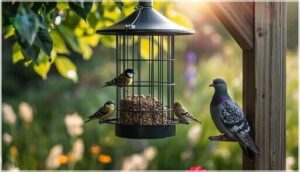
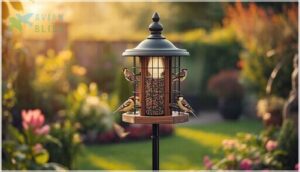
Caged feeders are one of the most reliable pigeon control methods you can use. A protective cage with bar spacing around 1.5 inches lets chickadees, finches, and sparrows slip right through — while blocking pigeons completely.
Look for heavy-gauge, powder-coated steel for real material durability outdoors. Most designs disassemble easily for cleaning, so bird feeder maintenance stays simple.
Solid cost efficiency and excellent results.
Ultrasonic repellent devices are a great example — keeping squirrels away from bird feeders without harming birds or breaking the bank.
Hanging and Tube Feeders With Short Perches
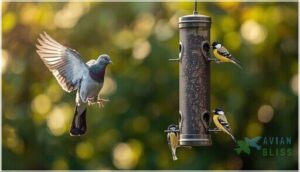
Tube feeders with short perches are quietly excellent pigeon deterrents. Perch Length Optimization matters more than most people realize — pigeons balance poorly on anything under 2 inches, while finches and chickadees grip those narrow rods with ease. Combine Narrow Port Design (1–1.5 inch openings) with Tube Material Choice in weather-resistant metal or clear plastic, and you’ve built a natural barrier.
- Ports under 1 inch wide block pigeon beaks entirely
- Short perches under 2 inches send pigeons elsewhere fast
- Swivel Suspension Mechanics make hanging feeders sway, disrupting pigeon landings by nearly 70%
- Metal ports resist pecking damage that plastic can’t handle
Position your hanging feeders at least 5 feet up and 10 feet from nearby ledges. That combination of height, movement, and pigeonproof feeders design gives smaller songbirds a fair shot every time.
Weight-Activated and Mesh Feeders
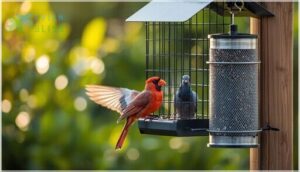
Weight-activated feeders solve your pigeon problem through a simple Port Closure Mechanism — the moment a heavy bird lands, a spring‑loaded shroud drops over every seed opening.
Adjust the Spring Tension Adjustment to allow cardinals but block pigeons.
Mesh cages with a Mesh Gap Size around 1 centimeter work just as well.
Both use Durability Materials like powder‑coated steel.
Keep up a basic Maintenance Routine, and these pigeon‑proof feeders stay reliable for years.
Avoiding Platform and Tray-Style Feeders
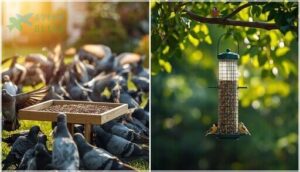
Platform and tray feeders are basically a welcome mat for pigeons. Their broad, flat surfaces suit a pigeon’s ground-feeding style perfectly — a whole flock can land and clear the tray in minutes.
Switching to hanging feeders, cage feeders with tight cage mesh size, and slim tube ports removes that advantage entirely. Prioritize minimal flat surfaces, and pigeons will quickly lose interest.
Select Birdseed That Deters Pigeons
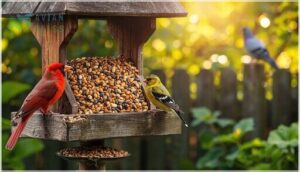
What you put in your feeder matters just as much as the feeder itself. Pigeons are picky in their own way — there are seeds they love and seeds they’ll ignore entirely.
Here’s how to use that to your advantage.
Seeds Pigeons Dislike (Safflower, Nyjer)
Two seeds do most of the heavy lifting in pigeon control: safflower and nyjer. Pigeons generally ignore both, which gives you a real bitter seed advantage and fine seed exclusion built right into your feeder setup. Here’s why they work:
- Safflower seeds have a hard shell deterrent that makes them tough and unrewarding for pigeons to crack.
- Nyjer seeds are tiny — pigeons can’t handle them efficiently, so they move on.
- Both deliver a strong songbird preference boost, drawing cardinals, finches, and chickadees instead.
- Switching to these pigeon-resistant seeds makes your feeder a low-energy grain choice, pigeons simply skip.
Most pigeon visits drop off within one to two weeks of making the switch.
Bird Foods to Avoid (Corn, Wheat, Millet)
Some birdseed is basically a pigeon invitation. Corn blends, wheat fillers, and millet spikes are high-carb grains pigeons recognize instantly — and cheap seed mixes are loaded with them.
| Food to Avoid | Why It Attracts Pigeons |
|---|---|
| Cracked corn | Quick energy, easy to grab |
| Wheat kernels | Daily flock fuel |
| White millet | Scatters, creates ground buffets |
| Mixed grain blends | Bulk fillers pigeons love |
Skip these, and your feeder stops being pigeon-proofed against itself.
Attracting Songbirds With Selective Mixes
The right birdseed mix works like a guest list — it lets songbirds in and keeps pigeons out.
A Sunflower-Nyjer Blend or Safflower-Rich Mix built on High-Oil Seed Ratios attracts finches, chickadees, and nuthatches to your bird feeders while boring pigeons completely. Add Peanut-Fruit Enhancements for woodpeckers.
Make Seasonal Seed Adjustments as bird populations shift, and your garden birds will thrive on these pigeon-resistant seeds year‑round.
Prevent Pigeon Access to Spilled Seed
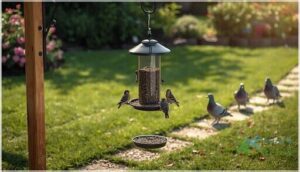
Even the best pigeon-proof feeder won’t help much if seeds keep piling up on the ground beneath it.
Spilled seed is basically a free buffet, and pigeons will find it fast.
Here are a few simple ways to cut off that ground-level food source.
Using Seed Catch Trays
Adding seed catchers directly under your bird feeders is one of the simplest pigeon deterrents you can use. These trays intercept dropped seed before it hits the ground, cutting off the easy foraging that pigeons rely on.
Look for a drainage design with mesh or holes to keep seed dry. Integration with baffles boosts results further. Tray placement tips, material durability, and a basic cleaning routine keep everything working long‑term.
Regular Cleanup and Maintenance
Trays catch a lot, but they’re not the whole job.
Wash your feeder every two weeks — weekly when it’s wet or busy.
A 10% bleach soak kills mold before pigeons catch the smell of easy, spoiled seed.
Sweep ground debris monthly, check seals regularly, and scrub ports with a bottle brush.
Consistent bird feeder maintenance removes every reason pigeons have to linger.
Minimizing Ground Feeding
Even with trays doing their part, ground itself matters. Fill your bird feeder with just one day’s worth of seed — daily seed portioning means less scatter, less waste, less pigeon interest.
Position feeders with wind protection strategies in mind, since prevailing winds blow seed sideways fast. Lay coarse gravel underneath, adjust feeder height to 5–6 feet, and pigeons lose their easiest buffet.
Use Effective Pigeon Deterrent Methods
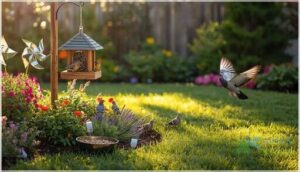
Sometimes the feeder setup alone isn’t enough to send pigeons packing. That’s where deterrents come in — simple additions that make your yard feel unwelcoming to them. Here are four methods worth trying, from shiny objects to scent-based solutions.
Reflective and Shiny Object Deterrents
Pigeons dislike unpredictable light — and that’s your advantage.
Hang old CDs or reflective tape at varied Reflective Tape Angles so flashes hit from multiple directions. Practice Shiny CD Mobility by shifting their placements weekly.
Use Holographic Disc Rotation and smart Pinwheel Placement around feeders, and tether Mylar Balloon Heights above and below eye level.
These visual deterrents, including reflective rods, consistently discourage pigeon approaches.
Ultrasonic and Motion-Activated Repellers
Sound-based pigeon deterrents can fill gaps that visual tricks miss.
Ultrasonic repellent devices emit frequencies above pigeon hearing range — a real Frequency Range Limits problem — so pair them with motion‑activated sprinklers for better results.
Coverage Placement Tips: aim units directly at feeders within 15–20 feet.
Solar Power Considerations matter too; shaded spots cut runtime.
Adjust Sprinkler Activation Settings toward main approach paths, and always check Safety for Pets before installing.
Deterring With Plants and Scents
Your garden itself can work as a pigeon deterrent.
A Peppermint Herb Border around feeder poles, a Marigold Scent Barrier at the base, or a Lavender Aromatic Ring within one meter all tap into pigeons’ smell sensitivity.
Add Eucalyptus Oil Pads on nearby posts and a Cayenne Ground Sprinkle along approach paths.
These wildlife-friendly gardening touches support solid pigeon control without harming songbirds.
Combining Multiple Deterrents for Best Results
Layering your pigeon deterrents is where real results happen. Combining a caged feeder, safflower seed, and catch trays as your core strategy can cut pigeon visits by over 80 percent.
Combine a caged feeder, safflower seed, and catch trays to cut pigeon visits by over 80 percent
Follow a Gradual Implementation Plan — one change every few days — so songbirds adjust comfortably. Rotate visual deterrents and ultrasonic repellent devices seasonally, track your Behavior Monitoring Metrics, and this Budget‑Friendly Combination keeps working long‑term.
Maintain a Pigeon-Free Bird Feeding Area
Getting pigeons to leave is one thing — keeping them gone takes a bit of ongoing attention.
The good news is that a few smart habits go a long way.
Here’s what actually works regarding placement, timing, and staying one step ahead.
Adjusting Feeder Placement
Where you hang your feeder matters more than most people think. Small shifts in placement can cut pigeon visits dramatically.
- Hang feeders 5–6 feet high on smooth poles with baffle integration below and above
- Keep tree spacing at least 4 feet out, with window orientation beyond 30 feet from glass
- Maintain pole distance from ledges and rooftops where pigeons stage their approach
Regulating Feeding Times
Pigeons are creatures of habit — feed them on a random schedule and they’ll test your garden all day.
Instead, create fixed daily intervals: fill feeders during dawn feeding windows when songbirds are most active, then follow an afternoon refill schedule around 4 p.m.
Synchronizing with songbird activity keeps smaller birds fed first.
Seasonal timing adjustments matter too — shift windows earlier in summer as sunrise creeps forward.
Monitoring and Adapting Strategies
Keep a simple visit log — note flock size, timing, and weather correlation each day. Run seed mix trials one swap at a time so you know exactly what’s working.
Score each deterrent from 1 to 5, adjust feeder height when needed, and rotate reflective items monthly.
Small, steady tweaks like these turn reactive bird feeding strategies into reliable, long-term garden wildlife management.
Frequently Asked Questions (FAQs)
How do I keep pigeons away from my bird food?
most reliable pigeon control combines bird feeder design, smart seed choices, and consistent bird deterrents.
Switch to caged or weight-activated feeders, use safflower or nyjer seed, and clean up spilled seed daily.
How do you keep pigeons out of a trash can?
Secure your trash can with a tight-fitting or locking lid.
Double-bag food waste to cut odors, keep the area swept clean, and position cans away from ledges where pigeons like to roost.
How to keep pigeons from returning to your garden?
Consistency is your best tool.
pigeon deterrent methods like feeder height adjustments, removing water sources, and smart garden layout changes. predator perches and seasonal timing tweaks for lasting bird feeder protection.
How do you deter pigeons?
Picture your garden as a fortress.
Use pigeon deterrents like predator decoys, wind chimes, water sprays, scented oils, ultrasonic bird repellers, and bird repellents together for reliable pigeon control that keeps your feeding area pigeonproofed.
How do you keep pigeons away but not other birds?
Use cage-style feeders, pigeon resistant seeds like safflower and nyjer, and smart feeder height placement. Pigeons struggle with narrow perch size and weight-activated ports, while small songbirds pass through easily.
How do you keep pigeons out of bird feeders?
Switch to weight-activated feeders, use caged designs, and choose nyjer or safflower seed. Clean up spilled seed daily. Pigeons lose interest fast when easy meals disappear.
How do I keep pigeons away from my bird table?
Swap your open table for a caged or weight-activated feeder, clean up spilled seed daily, and hang reflective deterrents nearby. Those three steps cut pigeon visits dramatically.
How to lure pigeons away from bird feeders?
Sometimes the smartest pigeon control method is giving them their own table. A dedicated pigeon station with grain decoy trays, placed 10–15 meters away, lures them off your main feeders fast.
Should I buy a pigeon-proof bird feeder?
Yes — if pigeons empty your feeder every day or two, a pigeon-proof model pays for itself fast. Better seed access, less waste, and more songbirds make the cost-benefit analysis simple.
Do pigeons eat ground feeders?
Pigeons are natural ground feeders. They’ll zero in on any spilled seed beneath your bird feeders fast. That seed spill impact is real — expect a flock within days.
Conclusion
What’s the real secret to knowing how to keep pigeons away from bird feeders for good? It’s not one dramatic fix—it’s layering small, smart changes until your garden stops working for them.
Swap the feeder, change the seed, clean up spilled grain, and add a deterrent or two.
Pigeons are persistent, but they’re also practical. Give them nothing easy to come back for, and they’ll move on.
Your songbirds will notice the difference quickly.
- https://www.vivara.ie/bird-feeders/pigeon-proof-bird-feeders
- https://www.birdfood.co.uk/bird-feeders/pigeon-proof-bird-feeders
- https://www.beakybites.co.uk/blog/pigeon-proof-feeders-how-to-protect-your-bird-feeders
- https://birdpact.com/learn/how-to-keep-pigeons-away-from-bird-feeders/
- https://kennedywildbirdfood.co.uk/blog/how-to-protect-your-bird-feeders-from-pigeons