This site is supported by our readers. We may earn a commission, at no cost to you, if you purchase through links.
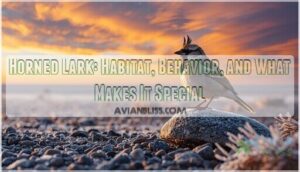
Most people walk right past the horned lark without a second glance—a small, sparrow-sized bird picking through a gravel shoulder or a plowed field, easy to dismiss as "just another brown bird." That’s a mistake.
This is North America’s only true native lark, a species that breeds everywhere from Arctic tundra to Mexican highlands, and somehow thrives in the landscapes most birds abandon entirely.
Those tiny black "horns" on its head aren’t decorative—they’re a field mark as distinctive as a fingerprint. Once you learn to spot one, you’ll start noticing them everywhere you once saw nothing.
Table Of Contents
- Key Takeaways
- What is a Horned Lark?
- Identifying Horned Larks
- Horned Lark Habitat and Range
- Diet, Foraging, and Behavior
- Breeding, Nesting, and Conservation
- Frequently Asked Questions (FAQs)
- Are Horned Larks rare?
- Where do Horned Larks live?
- Where can I see Horned Lark?
- What is the meaning of Horned Lark?
- Is a horned lark a sparrow?
- What is the difference between horned lark and meadowlark?
- Do Horned Larks sing?
- How do Horned Larks interact with humans?
- What are common predators of Horned Larks?
- Do Horned Larks have unique behaviors in winter?
- Conclusion
Key Takeaways
- The Horned Lark is North America’s only native true lark (Eremophila alpestris), with over 40 subspecies spanning Arctic tundra to desert flats — making it one of the most adaptable songbirds on the planet.
- Those tiny black feather tufts on its head, a bold black mask, and a clean chest band make it surprisingly easy to identify once you know what you’re looking for.
- Despite a global population of 140 million, North American numbers have dropped roughly 70% since 1966, driven by habitat loss, agricultural expansion, and climate disruption — so "common" doesn’t mean "safe."
- They’re ground birds through and through — walking (not hopping) to forage, nesting in bare-soil scrapes, and shifting their diet from seeds in winter to protein-rich insects come breeding season.
What is a Horned Lark?
The Horned Lark is one of those birds that rewards a second look — small, ground-hugging, and easy to overlook until you notice that bold face pattern staring back at you.
Once airborne, its pointed wings and long rounded tail create a surprisingly graceful silhouette — a stark contrast to its ground-level foraging style.
It’s the only true lark native to North America, and it carries a surprising amount of story in that compact frame.
Here’s what you need to know to get acquainted with this exceptional little bird.
Species Overview and Classification
Meet Eremophila alpestris — a bird species with deeper roots than most people realize. In ornithology, genus placement tells a story, and this one’s fascinating:
- Genus Eremophila, introduced in 1828, contains just two species
- Species classification places it firmly in family Alaudidae
- Evolutionary history traces back nearly a million years
Taxonomy debates still simmer, with genetic studies suggesting up to six distinct clades. The Horned Lark’s songbird species characteristics are essential to understanding its behavior and habitat.
Origin of The Name and Bird of The Year Recognition
The name says it all, really. Those tiny black feather tufts on the head — raised like little horns when the bird gets excited — inspired the English name, while Europeans call the same species "shore lark" for its coastal wintering habits.
The American Birding Association made it 2026 Bird of the Year, a nod to both its exceptional adaptability and urgent conservation needs. Audubon estimates 140 million individuals worldwide, yet populations keep shrinking. The species’ decline is largely due to habitat loss issues, which necessitates conservation efforts.
Comparison to Other Lark Species
What sets the Horned Lark apart from other larks isn’t just one thing — it’s everything combined. Most larks stay confined to Africa, Europe, or Asia, but this species ranges across multiple continents, showing striking habitat diversity.
Its bold black mask and breast band make bird species identification straightforward compared to streakier relatives. Migration patterns, behavioral traits, and phylogenetic analysis all confirm it’s genuinely one of a kind.
Identifying Horned Larks
Spotting a Horned Lark in the field is easier than you might think — once you know what to look for.
These birds have a handful of really distinctive features that set them apart from everything else scratching around in an open field. Here’s what to pay attention to.
Size and Shape Compared to Other Birds
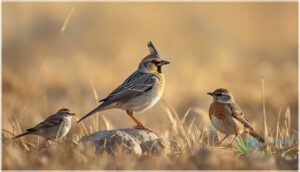
A Horned Lark sits somewhere between a sparrow and a robin in size — about 16 to 20 cm long, with a low-profile body built for ground life. Its pointed wing shape and long wingspan give it a sleek silhouette in flight.
Its streamlined build carries it efficiently across open terrain, much like the Hepatic Tanager’s bold coloring and habitat preferences reflect how a bird’s form follows its environment.
Compared to most bird species, its leg length is short but sturdy, and its beak size is delightfully compact — perfect for seed-picking.
Distinctive Head Pattern and “Horns”
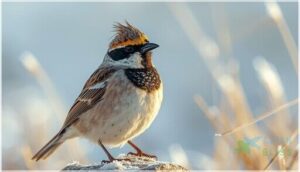
That bold head pattern is honestly what stops you mid-step on a winter walk. The black mask cuts sharply from bill to cheek, and a matching chest band separates the throat from the white belly below. Then there are the feather tufts — tiny raised horns in the head plumage that flicker up when the bird gets alert.
Key facial markings to know:
- Black mask: runs from the bill through the eye, curving downward
- Horn structure: short feather tufts, just 5–10 mm, on the rear crown
- Chest band: a clean black stripe across the upper breast
- White belly: stark contrast beneath the dark chest band
- Face color: yellow in eastern birds, white in Arctic subspecies
Male, Female, and Juvenile Differences
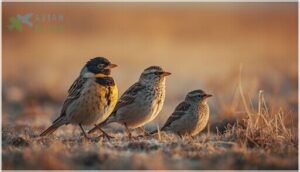
Males bring the drama — sharper black markings, bolder facial contrast, and slightly heavier frames averaging 32 grams versus a female’s 30.6. Female colors run softer, with gray tones softening the mask.
Juveniles look like a rough draft: streaky, spotted, and maskless.
These plumage variation and size differences reflect distinct gender roles, with behavioral traits like aerial courtship reserved entirely for male adults.
Subspecies and Regional Variations
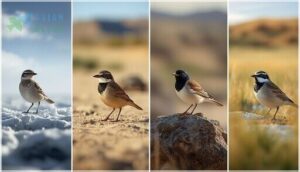
Forty subspecies — that’s the Horned Lark’s secret to thriving almost everywhere. Arctic Adaptations show up in paler tundra forms, while Desert Features produce sandier birds that blend into Arizona’s arid soils. Island Variations, like the darker insularis off California’s coast, reflect true Genetic Diversity shaped by isolation.
These Regional Traits aren’t just cosmetic — they trace habitat and distribution shifts across bird migration patterns over thousands of years.
Horned Lark Habitat and Range
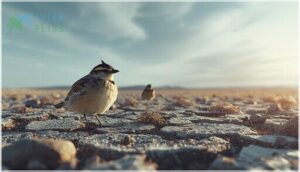
Horned larks aren’t picky about where they live — as long as there’s open ground and not a tree in sight. Their range stretches across an impressive chunk of the planet, from Arctic tundra to desert flats to cornfields in the American heartland.
Here’s a closer look at the kinds of places you’ll find them, where they show up around the world, and how they shift with the seasons.
Preferred Open and Treeless Environments
If a bird could design its dream home, it’d look nothing like yours — no roof, no walls, no trees in sight.
Horned Larks thrive in open habitats where the sky meets bare earth: grasslands, fields, meadows, tundra habitats, coastal dunes, and agricultural lands. They favor sparse vegetation under two inches tall, with exposed soil perfect for open ground foraging.
Think wide-open freedom, minimal clutter.
North American and Global Distribution
Few birds claim the Northern Hemisphere quite like the Horned Lark does. Its global range stretches from Arctic Alaska through North America, across Europe and Asia, and down into North Africa — a Holarctic distribution reflecting impressive habitat expansion over time.
- Breeds from Arctic tundra to Mexico’s central highlands
- Geographic isolation shaped ~42 subspecies across distinct regions
- Population dynamics shift dramatically between seasons, especially along migration corridors
Seasonal Habitat Shifts and Migration Patterns
Come October, Horned Larks don’t stick around to tough out the cold alone. Northern populations push southward along well-worn migration routes, trading breeding territories for open wintering grounds — barren fields, roadsides, feedlots — wherever bare ground peeks through snow.
Their flocking behavior kicks into full gear, sometimes mixing hundreds of birds together. High-elevation breeders simply slide downslope, a quiet altitudinal movement that keeps them fed all winter.
Diet, Foraging, and Behavior
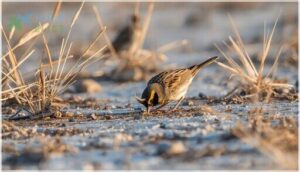
Horned Larks are surprisingly busy little birds once you start watching how they actually live their days. From the way they work a field for food to how fiercely they’ll defend their patch of open ground, their behavior tells you a lot about who they’re.
Here’s a closer look at what drives them.
Ground Foraging Techniques
Watch a Horned Lark work a field and you’ll see a ground-dwelling bird that has foraging strategies down to an art. Rather than hopping, it walks with quick, deliberate steps—a ground locomotion style built for efficiency.
Visual scanning keeps its head tilted, locking onto seeds against uneven soil. It lingers in micro-patch exploration zones—tractor furrows, hoof prints—where avian ecology meets pure instinct. Seed detection, moment by moment.
Seasonal Diet: Seeds, Insects, and More
What a Horned Lark eats shifts dramatically with the seasons. In winter, seed variations dominate—foxtail, pigweed, spilled grain from stubble fields.
Come spring, insect sources take over, with beetles and caterpillars meeting serious nutrient requirements for breeding. These dietary adaptations are foraging strategies written in biology: more protein when it matters most, more seeds when insects disappear.
Social and Territorial Behaviors
Once the breeding season kicks in, the Horned Lark transforms from a flock-friendly forager into a fierce defender of open ground. These bird behavior patterns are worth knowing:
- Males stake out Breeding Territories weeks before nesting begins
- Territorial Displays include steep aerial song flights and direct charges at rivals
- Agonistic Interactions can escalate into wing-striking ground fights
- Flocking Behavior returns completely once breeding ends
- Winter flocks show loose Social Hierarchies, often mixing with longspurs and buntings
Vocalizations and Song
After all that territorial posturing, the Horned Lark has a softer side worth hearing. Males climb up to 800 feet and deliver tinkling, high-pitched song patterns mid-flight before folding their wings into a steep dive.
Their melodic structure follows a recognizable sequence — tsip tsip tsee didididi — while ground calls stay soft and lisping. These acoustic signals are genuinely useful for bird identification in open fields.
Breeding, Nesting, and Conservation
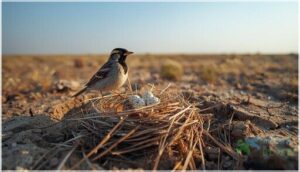
Regarding raising the upcoming cohort, horned larks have a system that’s quietly fascinating. Everything from where they build their nests to how they protect their young tells you something real about how resilient these birds are.
Here’s a closer look at what their breeding season actually looks like, and why their future is worth paying attention to.
Ground Nesting and Reproductive Strategies
Few nesting songbirds put as much thought into real estate as the Horned Lark. This ground-dwelling bird makes every nest site selection count — picking bare, open ground, sometimes digging a small scrape beside a grass tuft or stone.
Females weave tight grass cups low against the soil, relying on egg camouflage to outsmart predators. With breeding seasons stretching months long, nest predation remains the biggest threat to reproductive success.
Parental Care and Fledgling Development
Once the eggs hatch, both parents shift into full care mode. The female manages most brooding — keeping chicks warm during those first fragile days — while the male focuses on feeding and defense. Here’s how Horned Lark chick development unfolds:
- Days 1–3: Nestling growth is rapid; brooding behavior keeps body heat steady
- Days 4–7: Fledgling care intensifies as insect deliveries increase
- Days 8–10: Parental defense ramps up near exposed ground
- Weeks 2–4: Full independence kicks in
Population Trends and Conservation Status
The numbers don’t lie — and for Horned Larks, they’re sobering. Decline rates across North America hit roughly 70% between 1966 and 2015, averaging about 2.5% lost every single year.
Horned Lark populations have plummeted 70% since 1966, losing roughly 2.5% of their numbers every single year
| Region | Trend | Period |
|---|---|---|
| North America | −70% overall | 1966–2015 |
| New York | −40.2% abundance | 2012–2022 |
| Ontario | +2.8% annually | Since 1966 |
| Streaked subspecies | ~1,400 individuals | Current estimate |
| Global population | 140M+ total | Present day |
IUCN status remains Least Concern globally, yet conservation efforts and species protection for vulnerable subspecies — especially the Threatened Streaked Horned Lark — stay critically important in ongoing wildlife conservation and bird conservation work.
Impact of Habitat Loss and Climate Change
Habitat loss and climate change are squeezing Horned Larks from both ends. Agricultural expansion, infrastructure sprawl, and habitat fragmentation have stripped away the open ground they depend on. Meanwhile, climate shifts disrupt nesting timing and flood ground nests during stronger storms.
These forces throw ecological balance off-kilter, making species migration increasingly difficult. Meaningful conservation efforts and habitat preservation aren’t optional — they’re urgent.
Frequently Asked Questions (FAQs)
Are Horned Larks rare?
Not exactly rare — over 140 million exist worldwide — but populations have dropped 62% since Habitat loss and agricultural shifts drive this decline, earning serious attention despite their Least Concern conservation status.
Where do Horned Larks live?
Horned Larks thrive anywhere open and treeless—grasslands, fields, tundra, coasts, and alpine meadows. Their geographic range spans the entire Northern Hemisphere, from Arctic shores to desert flats.
Where can I see Horned Lark?
Flat, open fields and windswept coasts are your best bets. Scan harvested farmland, airport grasslands, and sandy shorelines—especially in winter—for these ground-hugging birds walking across bare soil.
What is the meaning of Horned Lark?
The name "Horned Lark" reflects both Species Identity and Symbolic Meaning — tiny black feather tufts resembling horns crown the male’s head, perfectly capturing this open-country songbird’s wild, wind-swept character.
Is a horned lark a sparrow?
No, it’s not. Despite the sparrow-sized build, a horned lark belongs to family Alaudidae — true larks — while sparrows fall under Passerellidae. Different families, clear species distinction.
What is the difference between horned lark and meadowlark?
Though they share a name, these are two entirely different bird species families.
Meadowlarks flash bold yellow with a V-shaped breast band, while Horned Larks wear subtle brown upperparts and white underparts with a sleek black mask.
Do Horned Larks sing?
Yes — and beautifully so. Horned Larks are true songbirds, weaving high, tinkling melodies across open fields. Their melodic structure and sonic behavior rival any backyard singer you’ve heard.
How do Horned Larks interact with humans?
Horned Larks tolerate human presence surprisingly well, often foraging along roadsides and farmland edges. Thoughtful habitat management and conservation efforts help guarantee these open-country birds thrive near us.
What are common predators of Horned Larks?
Life’s rough when you’re small and ground-level. Raccoon attacks, fox predation, swooping kestrels, and sneaky weasels all threaten nesting sites, making habitat and conservation efforts critical for Horned Lark survival.
Do Horned Larks have unique behaviors in winter?
Winter brings out some surprisingly clever survival tricks. Horned Lark flocks roam snowy fields together, dig seeds from frozen ground, and males even sing on mild days — cold adaptations that keep this ground-dwelling bird thriving.
Conclusion
The world doesn’t shrink what it can’t accommodate—it simply overlooks it. That’s exactly what most people do with the horned lark, walking past one of nature’s most quietly extraordinary birds without a second thought.
But now you know what those tiny horns mean, where to look, and why this scrappy little bird outlasts far more celebrated species.
The next time a brown bird flickers across a bare field, you’ll stop. You’ll look. And you’ll know.