This site is supported by our readers. We may earn a commission, at no cost to you, if you purchase through links.
If you catch a flash of bronze glinting in a grassy field, you’re probably looking at a bronzed cowbird.
These birds don’t just blend into the background—they shape it, leaving their mark on songbird communities and the landscape itself.
With sturdy bodies, shifting iridescent feathers, and a reputation for stealthy nest invasions, bronzed cowbirds have mastered the art of adaptation.
Whether you’re watching them forage among cattle or noticing the subtle red in their eyes, understanding their habits and impact reveals a world where every detail matters.
Their story starts with identification but stretches far into ecology and conservation.
Table Of Contents
- Key Takeaways
- Identifying The Bronzed Cowbird
- Range and Preferred Habitats
- Diet and Foraging Behavior
- Brood Parasitism and Reproduction
- Conservation Status and Ecological Impact
- Frequently Asked Questions (FAQs)
- Are bronzed cowbirds parasitic?
- What is the difference between bronze and Brown-headed Cowbirds?
- Should you shoot cowbirds?
- Where do bronzed cowbirds live?
- Are cowbirds good to have around?
- What birds reject cowbird eggs?
- Why don’t cowbirds raise their own babies?
- Are grackles and cowbirds the same thing?
- What is a flock of cowbirds called?
- Why put a potato in the bird feeder?
- Conclusion
Key Takeaways
- Bronzed cowbirds are sturdy, iridescent birds known for laying their eggs in other species’ nests, which often ** local songbird populations.
- You’ll spot them across the southwestern United States through Central America, thriving in open fields, pastures, and even urban areas thanks to their adaptable nature.
- Their diet shifts with the seasons, relying on seeds and insects, and they often forage alongside livestock to take advantage of disturbed food sources.
- Conservation efforts focus on managing their impact as brood parasites, since their spread can disrupt ecosystem balance and reduce biodiversity among native birds.
Identifying The Bronzed Cowbird
Spotting a Bronzed Cowbird in the field takes a sharp eye, but once you know what to look for, it gets a lot easier.
Males sport that distinctive bronzy-green sheen — check out this Bronzed Cowbird field identification guide to compare key markings side by side.
From its stocky build and curved bill to those striking red eyes, this bird has some telling features worth knowing.
Here’s what to pay attention to when you’re trying to make a confident ID.
Physical Characteristics and Size
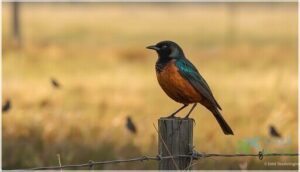
When you observe Molothrus aeneus, notice its strong Body Mass and compact frame. The Bronzed Cowbird stands out with thick Bill Morphology, short Tail Proportions, and sturdy Leg Structure.
Males display a pronounced Neck Ruff, giving a bull‑necked appearance.
At about 20 cm, their Bronzed body and Bluegreen wings, alongside subtle Red eyes, mark their distinctive silhouette.
Its brood parasite behavior influences many host species.
Plumage and Eye Color Variations
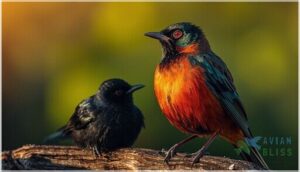
The iridescent sheen shifts dramatically with light — in full sun, Molothrus aeneus blazes with a bronzed body and blue‑green wings; in shade, it reads nearly plain black. Molting plumage patterns dull this gloss briefly each late summer.
Those striking red eyes? Seasonal eye color means males show them during breeding, then fade to brown. Age‑related feather gloss distinguishes juveniles from polished adults.
The bronzed cowbird’s blazing red eyes are a key identification feature.
Male Vs. Female Differences
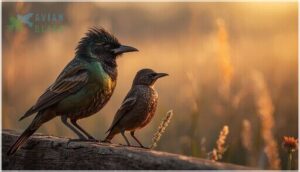
When you’re sorting Bronzed Cowbirds in the field, watch for weight disparity and bill morphology—males are bulkier, with thicker bills and pronounced neck ruff size that creates a hunched display posture.
Their vocal repertoire is broader, echoing across habitats.
Females look sleeker, with longer bills and subdued calls, blending easily with other blackbirds in your bird identification efforts.
Juvenile Appearance and Development
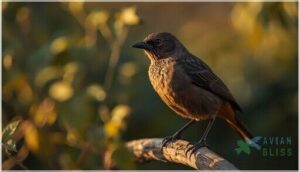
If you’re tracking Bronzed Cowbird juveniles after sorting adults, you’ll notice their brownish gray plumage with subtle scaling, not the glossy bronze of mature males.
Dark irises start the eye‑color maturation, shifting red as they age.
Host nest dependency shapes early development, while fledgling flight skills and the molting timeline mark their gradual shift toward adult species classification.
- Juvenile plumage scaling
- Eye color maturation
- Fledgling flight skills
- Molting timeline
- Host nest dependency
Range and Preferred Habitats
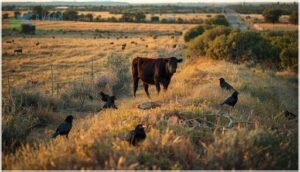
Bronzed cowbirds cover a surprising range of landscapes, from wide-open fields to dense thickets.
Their adaptability mirrors the richness found across diverse Amazon bird habitats, where fragmented landscapes and seasonal resource pulses shape which species thrive where.
Their ability to adapt means you’ll find them in both wild and human-shaped spaces. Let’s look at where these birds make themselves at home.
Geographical Distribution in The Americas
Curious how far a Bronzed Cowbird can roam? You’ll find its Northern range limits in the Southwest—Arizona and Texas—while the Southern range edge hugs coastal Colombia.
Subspecies distribution traces Mexico’s mainland, bypassing Baja. Elevation preferences keep them below 1,500 meters, favoring coastal over inland sites.
Range maps reveal a continuous corridor through Central America, linking diverse habitats across continents.
Common Habitats and Ecosystems
Across open fields and pastures, the Bronzed Cowbird thrives where grassland foraging is easy and livestock stir up seeds.
You’ll spot them in brush and scrubland perches, shifting between edge woodland use and riparian corridors.
Desert arroyo shelters offer shade and feeding sites, while agricultural areas and semi-open habitats shape their habitat and ecology throughout their range.
Adaptation to Urban and Rural Areas
If you look closely, you’ll see the Bronzed Cowbird weaving between urban edge foraging and agricultural field use, shifting from suburban roosting sites to rural pastures with livestock association. Their flexibility lets them exploit Human‑provided food, adapting habitat and ecology for survival.
This adaptability complicates bird species identification and underscores the importance of habitat preservation for brood parasite management.
Seasonal Migration Patterns
Have you noticed how migration patterns shape the bronzed cowbird’s story? Migration distance varies—northern breeders travel south after post‑breeding departure, while South Texas populations stay put.
Age‑specific timing means adults lead the pre‑breeding arrival. Winter vagrancy brings wanderers to Florida, expanding the range.
These seasonal shifts reveal the intricate relationship between habitat and ecology.
- Pre‑breeding Arrival
- Post‑breeding Departure
- Winter Vagrancy
Diet and Foraging Behavior
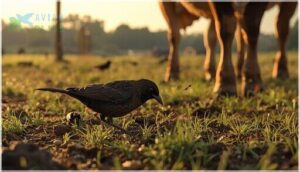
What a Bronzed Cowbird eats and how it finds food can tell you a lot about its place in the landscape.
You’ll notice some patterns in what they prefer, how they search, and how their habits shift with the seasons.
Let’s take a closer look at the main features of their diet and foraging behavior.
Primary Food Sources
You might wonder how the bronzed cowbird thrives in such varied landscapes.
Your answer lies in its flexible avian diet and nutrition: seeds are the staple, showing a marked Seed Preference, while Insect Types—like beetles and caterpillars—provide protein.
Snail Calcium aids egg-laying, and Berries Occurrence is rare.
Human Feeders offer supplemental foods, broadening their dietary options.
Foraging Techniques and Feeding Habits
Ever watched a bronzed cowbird shuffle‑strut through a pasture? Its feeding habits reveal a clever mix: Ground Foraging Walks uncover insects and seeds, Flock Foraging Dynamics boost efficiency and safety, and Livestock Association Feeding exploits disturbed prey.
You’ll also find them using the Grain Stripping Method and Backyard Feeder Visits—each technique matches their avian diet and habitat distribution.
- Ground Foraging Walks
- Flock Foraging Dynamics
- Livestock Association Feeding
Seasonal Diet Changes
Bronzed Cowbird shifts from winter grain reliance to a summer insect surge, your understanding of their diet becomes a tapestry woven with regional crop influence and human feeder usage.
Calcium snail intake peaks during breeding and nesting habits, matching migration patterns.
Habitat and distribution guide these seasonal changes, echoing the adaptability that keeps this species thriving year‑round.
Interactions With Livestock
As seasonal diet shifts echo through farmland and feedlots, you’ll see Cowbirds weaving among cattle, using cattle‑associated foraging to snatch insects and grain. Their feedlot grain use and pasture habitat preference anchor them in open country.
Tick removal behavior, although less frequent, highlights their direct interaction with livestock.
Mixed‑species flocking amplifies their presence, shaping habitat preservation conversations.
Brood Parasitism and Reproduction
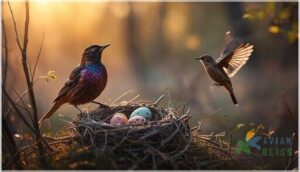
Regarding raising their young, Bronzed Cowbirds take a different path from most birds you know.
Their approach centers on laying eggs in the nests of other species, leaving the hard work to unsuspecting hosts.
Here’s what you need to know about their unique breeding tactics and the ripple effects on other birds.
Brood Parasitism Strategies
While you observe the Bronzed Cowbird’s nesting habits, you’ll notice a complex brood parasitism strategy shaped by egg-laying timing just before sunrise, egg puncturing tactics that reduce host clutch size, and nest surveillance behavior involving high perches.
Female territoriality ensures reliable host access, and multiple parasitism dynamics—several females using the same nest—highlight their ecological impact within avian ecology.
Host Species Selection
Not every nest will do. The Bronzed Cowbird is surprisingly selective, factoring in host body size, nest accessibility, and host rearing capacity before committing. Geographic host assemblage shapes local choices too — in southern Texas, hooded orioles are frequent targets.
Key host selection factors:
- Mid-sized species (20–30 g+) preferred
- Open cup nests in shrubs or trees
- High host abundance cues, like song density
- Insect-rich diets that sustain fast-growing chicks
Breeding Season and Mating Displays
When the breeding season kicks off mid‑March in Texas, the Bronzed Cowbird‘s courtship becomes a fascinating study in avian biology. Males perform ground puffing — ruffling feathers into rounded silhouettes — alongside aerial displays, hovering helicopter‑like just feet off the ground.
| Display Type | Key Action | Timing |
|---|---|---|
| Ground Puffing | Feathers fluffed, bill down | Early season |
| Aerial Displays | Hovering 2–3 feet up | Peak courtship |
| Vocal Courtship | Wheezy whistles and squeaks | Throughout season |
| Egg‑Laying Patterns | Nearly one egg daily | March–August |
This brood parasite’s courtship timing ensures eggs arrive when host nests are ready.
Impact on Host Bird Populations
The Bronzed Cowbird’s impact runs deeper than a stolen nest. Through nest space competition and egg piercing damage, host pairs lose eggs before hatching even begins.
Surviving host chicks then face the chick feeding burden of competing with a faster-growing brood parasite.
Population decline trends in species like the Hooded Oriole reflect this pressure directly.
As habitat expansion effects push this bird into new territory, avian conservation efforts and careful species identification become essential tools for bird conservation.
Conservation Status and Ecological Impact

The Bronzed Cowbird holds a Least Concern status globally, but that label doesn’t tell the whole story.
Its parasitic habits create real ripple effects across ecosystems, putting pressure on host species that can’t always keep up. Here’s a closer look at what’s actually happening on the ground.
Current Population Trends
Did you know Texas density spikes reveal just how adaptable this species can be? Your understanding grows when you consider:
- Winter range shifts southward, except for year‑round South Texas residents
- Agricultural expansion impact, fueling local abundance
- Population growth rate remains mostly stable, with survey methodology changes refining estimates
- Conservation status holds at “Least Concern,” yet bird conservation and habitat preservation remain key for maintaining balance
Effects on Ecosystems and Other Birds
The ripple effects of host nest decline stretch far beyond a single nest.
When parasitic birds suppress songbird communities, insect population surges can follow, since fewer insect‑eating birds mean less natural pest control.
Seed dispersal alteration reshapes plant growth along riparian corridors, and habitat fragmentation impacts deepens these losses.
| Effect | Result |
|---|---|
| Songbird community shift | Fewer orioles, more nonhosts |
| Habitat preservation gaps | Accelerated ecological imbalance |
Conservation Measures and Challenges
Conservation doesn’t come cheap — and with brood parasites like the bronzed cowbird, it gets complicated fast. Legal protection under the Migratory Bird Treaty Act means control programs require special permits, even when host species management demands action.
Monitoring gaps across Central America leave wildlife conservation efforts working half‑blind.
- Habitat preservation reduces cowbird-favorable edge zones
- Targeted avian conservation efforts protect vulnerable host colonies
- Land‑use policy shapes long‑term conservation status outcomes
Role in Biodiversity and Ecosystem Balance
Think of this bird as a quiet thread woven through the fabric of an ecosystem.
Through seed dispersal and insect regulation, it nudges ecological balance in ways that ripple outward. Its ground-foraging trophic linking connects soil invertebrates to plant communities, while habitat connectivity across open and edge landscapes makes it a genuine biodiversity indicator — one worth keeping central to avian conservation efforts and biodiversity conservation strategies alike.
The Bronzed Cowbird quietly threads through ecosystems, linking soil to sky as a true biodiversity indicator
Frequently Asked Questions (FAQs)
Are bronzed cowbirds parasitic?
Yes, cowbirds are parasitic.
Breeding habits of birds rarely get stranger — through egg mimicry and precise reproductive timing, they hijack other species’ nests, creating parasitic impact that shapes population dynamics and drives avian conservation efforts.
What is the difference between bronze and Brown-headed Cowbirds?
The Brown-headed Cowbird displays a brown head with iridescent black plumage, while Bronzed Cowbirds show full glossy green-bronze coloring and distinctive red eyes — a key marker in bird species identification.
Should you shoot cowbirds?
Shooting cowbirds is like using a sledgehammer to crack a nut—legal considerations, ethical concerns, safety risks, and bird species identification all matter.
Nonlethal alternatives and wildlife management practices usually offer better conservation biology outcomes for avian diet and host impact.
Where do bronzed cowbirds live?
You’ll find these birds across the Southwest—Arizona, Texas, and into Mexico—favoring grassland grain fields, canyon roosting sites, coastal prairie edges, and riparian corridor use.
They adapt well to suburban feeder clusters and varied habitat types.
Are cowbirds good to have around?
Like a double-edged sword, cowbirds offer modest pest control benefits through their avian diet and seed predation impact, but their brood parasitism intensifies host bird competition.
Habitat management tips and legal control options shape wildlife conservation and ecological roles of birds.
What birds reject cowbird eggs?
Several birds reject cowbird eggs through egg ejection, egg burial, or nest desertion.
American Robins, Gray Catbirds, and Northern Mockingbirds are strong rejecters, with host size influence playing a key role in bird behavior.
Why don’t cowbirds raise their own babies?
Have you ever wondered cowbirds skip raising their own chicks?
Their strategy hinges on maximizing egg output and mobility advantage, exploiting hosts’ parental energy, and optimizing reproductive timing—traits shaped by ornithology, bird behavior, and ecological roles of birds.
Are grackles and cowbirds the same thing?
Grackles and cowbirds aren’t the same bird species; ornithology confirms their taxonomic distinction.
You’ll spot plumage differences, eye color contrast, and tail length variation, and cowbirds practice brood parasitism while grackles build their own nests—a clear behavioral divide.
What is a flock of cowbirds called?
Much like a tapestry woven from many threads, the standard flock term for cowbirds is simply “flock.” Alternative names or historical terminology don’t exist, even in ornithology research.
Bird watching tips note mixed-species flocks as regional variations.
Why put a potato in the bird feeder?
Plain cooked potato offers birds a quick energy boost — pure starch that fuels flight and foraging fast.
It’s a winter calorie supplement, drawing ground foragers like a magnet to your feeder.
Conclusion
Investigate the truth of a theory: when a bronzed cowbird enters a habitat, the balance shifts in ways both visible and hidden.
You’ll notice the subtle interplay—host species adapting, ecosystems responding, and food webs recalibrating. Their iridescent presence signals a landscape in flux, shaped by evolutionary strategies and ecological demands.
Understanding these birds isn’t just about identification; it’s about recognizing their role as agents of change, woven into the fabric of avian communities and the broader environment.