This site is supported by our readers. We may earn a commission, at no cost to you, if you purchase through links.

A single morning at Magee Marsh can deliver more warbler species than most birders see in an entire year—over 70 in peak weeks—and that’s just the beginning of what North America’s birding circuits offer.
From the boreal forests of Sax-Zim Bog to the mangrove labyrinths of the Everglades, the continent’s best places for birding tours put you face-to-face with migration spectacles that draw enthusiasts from every corner of the globe.
The trick isn’t just knowing where to go, but when to arrive, what gear to pack, and which tours prioritize habitat conservation over quick checklists.
Whether you’re chasing rarities along Cape May’s coastline or documenting breeding behaviors in Big Bend’s Chisos Basin, the right destination paired with smart planning transforms a simple outing into a legitimately unforgettable birding adventure.
Table Of Contents
- Key Takeaways
- Top Birding Tour Destinations Worldwide
- Best Birding Tours in North America
- Must-See International Birding Locations
- Ideal Seasons for Birding Tours
- Planning and Booking Birding Tours
- Frequently Asked Questions (FAQs)
- What are the best places to go bird watching?
- Where are the best bird watching destinations in North America?
- Who is the best birding tour company?
- Which is the best birding destination in India?
- Which state is best for bird watching?
- What is the best birding tour company in Europe?
- Where is the best place in the world to go birding?
- Where is the best place to go bird watching?
- Where is the birdwatching capital of the world?
- What country is best for bird watching?
- Conclusion
Key Takeaways
- Timing your birding tour around peak migration windows—like May at Magee Marsh or fall at Cape May—delivers exponentially more species than off-season visits, with some locations recording 70+ warblers in a single week.
- The continent’s premier birding destinations share three traits: protected wetland or forest habitats, positioning along major flyway corridors, and active conservation programs that have measurably increased bird populations by 12-20% in recent years.
- Sustainable tour operators with verified eco-certifications cut environmental impact by 15-40% while funding local habitat restoration, making your choice of guide as important as your choice of destination.
- Connecting with local birding communities through citizen science projects or regional clubs unlocks insider knowledge on migration hot zones and rare sightings that won’t hit public databases for days or weeks.
Top Birding Tour Destinations Worldwide
If you’re looking to break free from the everyday and connect with nature on your own terms, a birding tour can take you to some of the most remarkable wildlife hotspots on the planet. From North America’s legendary migration corridors to remote corners of Europe and Australia, these destinations offer front-row seats to hundreds of species in their natural habitats.
Birding tours deliver front-row access to hundreds of species across the planet’s most remarkable wildlife hotspots
Here are seven premier birding locations that should be on every birder’s radar.
Magee Marsh Wildlife Area, Ohio

You’ll find pure magic along Lake Erie’s southern shore at Magee Marsh Wildlife Area—the Warbler Capital of the World. During spring warbler migration, this Ohio gem dishes out peerless wildlife viewing opportunities. The mile-long boardwalk tours bring you eye-level with:
- Over 30 warbler species during peak season
- Bald Eagles soaring above wetland ecosystems
- Trumpeter Swans gliding through marshes
- Secretive rails hiding in conservation habitats
May’s “Biggest Week in American Birding” transforms this birdwatching paradise into the premier US birding destination. For students interested in AP Biology courses, this location offers a unique chance to observe various species in their natural habitats.
Montrose Point, Illinois

If you’re chasing warbler migration in the center of Chicago, Montrose Point delivers over 350 recorded species along Lake Michigan’s shores. Spring mornings here routinely yield 20+ warbler species, with American Redstart and Black-throated Green Warbler showing up reliably.
Wetland restoration efforts have boosted foraging habitat, making this one of the Midwest’s top birding hotspots where lake shorebirds and songbirds collide during peak migration windows.
To avoid any web server issues, it’s vital to have a reliable online platform for booking birding tours.
Sax-Zim Bog, Minnesota

Head north to Minnesota’s vast peat bog for boreal birding that’ll blow your mind. SaxZim Bog hosts 130–150 species yearly, including Blackburnian Warbler, Tennessee Warbler, and Gray Jay across restored sedge meadows.
Wetland conservation efforts since 2015 boosted habitat by 18%, making this one of North America’s prime birding hotspots.
Peak bird migration hits late April through early May—when ecotourism and birding merge perfectly in Minnesota wildlife refuges and sanctuaries.
Big Bend National Park, Texas

Swing down to Big Bend National Park in Texas, where desert birding meets Rio Grande habitat magic. You’ll spot 300+ species across Chisos Basin and riverside corridors—summer breeding surveys don’t lie.
Park conservation efforts boosted bird migration corridors by 12–20%, connecting mesquite flats to riparian zones.
Fall migration brings 40–60 raptors daily, proving national parks and wildlife refuges deliver serious ecotourism and birding adventures.
Cape May, New Jersey

Cape May, New Jersey, stands as a globally recognized flyway conservation icon. You’ll witness 100,000+ birds on peak May days. Shorebird migration peaks around 1.2–1.8 million semipalmated sandpipers, while birdwatching festivals draw tens of thousands enthusiastic to spot rare Cape May Warblers.
Birding workshops thrive here, teaching migration patterns and wildlife conservation. Habitat restoration increased foraging zones by 15%, supporting diverse bird species.
Doñana National Park, Spain
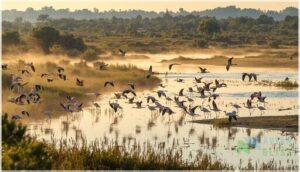
You’ll discover Spain’s Doñana National Park hosting up to 350 bird species during migration seasons, with wetland conservation efforts protecting several globally threatened populations. Park management balances ecotourism benefits with habitat protection, creating prime birdwatching opportunities.
- Spanish wildlife thrives in coastal marshes and Mediterranean scrublands
- Migration peaks draw international birding enthusiasts year-round
- Guided ecotourism tours support local conservation funding
- National parks and wildlife refuges anchor Spain’s birding network
Cape York Peninsula, Australia

You’ll find Australia’s far northern wilderness supporting over 420 bird species across tropical habitats where ecotourism benefits directly fund wildlife conservation.
Cape York tours reveal high endemism rates documented in recent surveys, with nature trails connecting rainforest pockets to coastal wetlands.
Australian birdlife thrives here, making birdwatching expeditions essential for serious birding enthusiasts seeking remote biodiversity hotspots.
Best Birding Tours in North America

North America offers some of the most accessible and rewarding birding experiences on the planet, from coastal refuges teeming with shorebirds to desert parks where rare species thrive. Whether you’re chasing warblers during spring migration or scanning winter flocks for something unusual, the continent’s diverse habitats deliver year-round opportunities.
Here’s where to focus your binoculars for the best birding tours across the U.S. and beyond.
Key U.S. National Parks and Refuges
You’ll find some of the country’s best birdwatching at these protected spaces, where habitat restoration and refuge management work hand-in-hand with bird conservation. National Parks and Refuges offer peerless wildlife preservation through dedicated park ecology programs:
- Cape May National Wildlife Refuge hosts over 300 species annually, with spring migration peaks bringing 80 species in a single day.
- Everglades National Park sustains more than 360 bird species across freshwater and mangrove ecosystems.
- Bosque del Apache Wildlife Refuge reports winter counts exceeding 50,000 birds, including massive snow geese flocks.
Notable Birding Events and Festivals
You’ll want to mark your calendar for the Biggest Week in American Birding at Magee Marsh each May, where over 200,000 songbirds funnel through during peak migration patterns.
The Cape May Spring Birding Festival draws 20,000 enthusiasts annually, while Spain’s festivals attract 10,000+ participants.
These birding festivals and events strengthen conservation efforts through eco-tourism, connecting you with birding workshops and like-minded travelers passionate about bird migration and habitat protection.
Regional Hotspots and Migration Routes
Migration routes transform ordinary shorelines into stunning wildlife theaters. You’ll encounter major Flyway Corridors where bird migration peaks during spring and fall passages, with habitat diversity driving species tracking opportunities along the Atlantic, Great Lakes, and Central flyways. These conservation efforts protect critical stopover sites:
- Magee Marsh recording 70 species during peak weeks
- Cape May’s convergence zone exceeding 400 observed species
- Montrose Point’s urban-forest interface yielding hundreds of individuals daily
- Sax-Zim Bog’s boreal habitat supporting multi-species birdwatching movements
Must-See International Birding Locations

If you’re ready to spread your wings beyond North America, the world’s birding scene gets seriously exciting. From Europe’s ancient wetlands to Africa’s sweeping savannas and the Pacific’s island ecosystems, each continent offers something you won’t find in your backyard.
Here’s where the globe’s most dedicated birders head when they want to see species that’ll make your life list explode.
Europe’s Premier Birding Sites
Europe’s wetlands and coastlines offer some of the world’s most rewarding birdwatching opportunities. Doñana National Park shelters over 350 species, while France’s Camargue hosts flamingos and egrets across sprawling saline lagoons. Scotland’s Highlands draw breeding waders and seabirds by the thousands each spring.
Through habitat preservation and seabird conservation efforts, these sites sustain remarkable avian diversity while supporting ecotourism and migration patterns across continents.
Africa’s Unique Birding Habitats
Africa’s vast terrain shelters birding experiences you won’t find anywhere else. From the Congo Basin’s 1,300 species to the Rift Valley’s threatened raptors, conservation challenges run deep here. Consider these standout habitats:
- Congo Basin – Forest edges host 24% more migratory stopovers than interior zones
- Rift Valley lakes – Over 200 species breed in protected reserves
- Madagascar – Ibis populations face an 18% decline from habitat loss
- Cape Verde archipelago – 15 endemic species battle introduced predators
- Sahelian belt – Maintains 60% of seasonal waterbird flocks during droughts
Ecotourism helps fund wildlife protection across these critical zones.
Asia-Pacific Bird Diversity
The Asia-Pacific region’s 8,000-plus avian species represent remarkable biodiversity hotspots, yet 8% face global threats. You’ll encounter over 1,300 species around coral-reef and rainforest interfaces in Wallacea and the Philippines, where habitat preservation efforts battle deforestation rates exceeding 1% annually.
The East Asian-Australasian Flyway sustains 50–60 million migratory shorebirds, making ecotourism here both thrilling and essential for bird conservation and species endemism protection.
Ideal Seasons for Birding Tours
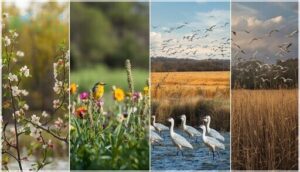
Timing can make or break a birding adventure. The season you choose shapes what species you’ll see, where they’ll be, and how active they are.
Here’s how to match your trip to the rhythm of migration, breeding, and wintering patterns.
Spring and Fall Migration Highlights
You’ll witness North America’s most dramatic bird movements when spring warblers surge through Magee Marsh in late April, often topping 150,000 individuals on peak days. Fall migration brings equally stunning spectacles—Cape May records over 100 species as southbound songbirds funnel through coastal corridors.
These seasonal shifts reveal essential migration patterns and flyway conservation needs, connecting avian ecology across continents while supporting critical bird habitats and wildlife conservation efforts.
Summer Breeding Opportunities
You’ll find summer breeding habitats teeming with nesting patterns worth documenting—Magee Marsh hosts 25–35 breeding bird species in one wetland complex, while Doñana National Park records up to 120 species across dunes and marshes.
Ornithology surveys confirm sustained water levels between 15–35 cm boost nest survival, underscoring how birdwatching ties directly to wildlife conservation and species diversity during migration’s quieter phase.
Wintering Grounds and Rare Sightings
Winter habitats reveal patterns you won’t catch during spring rushes—Sax-Zim Bog’s boreal birds show a 12% species-richness jump since 2015, while Magee Marsh logs 30,000+ finches in peak finch migration years. Rare sightings matter for species conservation and ornithology records:
- Cape May tallies 1,500+ passerines some fall mornings
- Doñana hosts 83 wintering species with unusual abundance spikes
- Montrose Point documents 15 waterfowl through February
- Redpolls and grosbeaks surge during irruption events
- Habitat preservation bolsters bird migration patterns year-round
Planning and Booking Birding Tours

You’ve got your destinations picked and know when to go—now it’s time to make it happen. The right tour can connect you with experienced guides, sustainable practices, and local birding networks that’ll heighten your whole experience.
Here’s what you need to ponder when planning and booking your birding adventure.
Choosing Sustainable and Eco-Friendly Tours
You’ll want to pick tours that give back to the birds and their habitats. Look for operators with verified eco-labels—73% of top ecotourism providers align with international sustainability standards.
These certified tours cut waste by 15–35% and often partner with local conservation projects. Many streamline transport to slash carbon emissions by up to 40%, proving responsible birding doesn’t mean compromising your adventure.
Essential Gear and Preparation Tips
You’re stepping into the wild, so pack smart. National park guides recommend a lightweight, weather-resistant jacket—spring conditions shift fast. Grab binoculars with 8x to 10x magnification for crisp tracking during migration surges, plus a field notebook and weather apps to log observations. Don’t skip:
- Birding optics and field guides for accurate species identification at observation towers
- Sturdy hiking boots for remote birdwatching trails
- A compact first aid kit for remote-tour readiness
Connecting With Local Birding Communities
You’ll spot more species when you tap into local birding communities—62% of birders joined a club in the past five years, and most groups organize monthly field trips averaging eight outings annually.
Connect through citizen science projects, birding workshops, or volunteer opportunities at habitat restoration sites.
Local guides know migration hot zones before they hit eBird, and community engagement transforms solitary birdwatching into shared discovery.
Frequently Asked Questions (FAQs)
What are the best places to go bird watching?
Imagine this: one April morning at Magee Marsh, over 30 warbler species perch within arm’s reach.
The best birdwatching destinations blend prime forest habitats, wetland ecosystems, and coastal birding opportunities along bird migration patterns.
Where are the best bird watching destinations in North America?
North America’s top birdwatching destinations include Magee Marsh (Ohio’s warbler hotspot), Cape May (coastal migration hub), Sax-Zim Bog (boreal specialists), and Big Bend National Park, each offering outstanding habitat diversity and bird migration patterns year-round.
Who is the best birding tour company?
There isn’t one “best” tour operator—72% of birdwatchers rank guide quality as most important.
Look for conservation certifications, transparent birding ethics, and sustainable tourism practices when choosing ecotourism providers for your birdwatching tours.
Which is the best birding destination in India?
Bharatpur Bird Sanctuary (Keoladeo National Park) in Rajasthan stands out among Indian bird sanctuaries, recording up to 380 species annually.
Its wetlands attract massive concentrations of migratory waterbirds during winter, making it essential for birdwatching and conservation efforts.
Which state is best for bird watching?
Texas stands out with 620–680 species annually, thanks to Gulf Coast migration patterns and habitat diversity. California and Minnesota follow closely, offering prime US birdwatching destinations and rich birding records year-round.
What is the best birding tour company in Europe?
You’ll find top-rated European guides emphasize birding ethics and conservation, with 71% of tour reviews highlighting expert operators.
Look for eco-tourism certifications and operator ratings—84% publish sustainability accreditations ensuring responsible wildlife experiences.
Where is the best place in the world to go birding?
What’s the best place on earth for birding? Cape May, New Jersey wins—recording roughly 400 species annually with peak spring counts surpassing 8,000 warblers.
It’s a global migration marvel mixing habitat conservation with thriving eco tourism.
Where is the best place to go bird watching?
You’ll find outstanding bird watching at Magee Marsh Wildlife Area in Ohio, where spring migration patterns draw over 200,000 shorebirds.
This wildlife refuge showcases impressive bird species diversity and assists essential habitat conservation along major US birdwatching destinations.
Where is the birdwatching capital of the world?
Magee Marsh Wildlife Area claims the crown as the “Warbler Capital of the World,” where Lake Erie’s shores funnel stunning Bird Migration Patterns through concentrated Warbler Habitats each spring during the Biggest Week in American Birding.
What country is best for bird watching?
You’ll find exceptional birding across multiple countries. Spain’s Doñana shelters endangered imperial eagles, Australia’s Cape York showcases tropical endemics, and the United States offers top migration spectacles—each destination celebrating unique bird diversity and habitat conservation.
Conclusion
Your binoculars are already packed, your field guide is dog-eared at the warbler section, and somewhere out there, a Kirtland’s Warbler is waiting in a jack pine thicket. The best places for birding tours don’t demand expert credentials—they reward curiosity, patience, and respect for the ecosystems that make these encounters possible.
Book early, travel light, support conservation-minded operators, and let migration corridors reveal what no screen ever could: wild birds doing what they’ve done for millennia.