This site is supported by our readers. We may earn a commission, at no cost to you, if you purchase through links.
A raven perched outside a cabin in rural Alaska once greeted researchers each morning with a phrase so close to "hello there" that new visitors routinely looked around for another person. That bird wasn’t reading from a script—it had absorbed the sound through months of casual human contact and reproduced it with enough fidelity to fool untrained ears.
Whether that counts as talking, though, depends entirely on what you mean by the word.
Ravens occupy a genuinely strange position in the animal kingdom: anatomically limited in ways that blur human speech, yet cognitively sharp enough to use sound with deliberate social purpose.
Understanding what a raven’s voice actually does—and doesn’t do—reshapes how you hear every call, croak, and uncanny whisper that comes from these birds.
Table Of Contents
- Key Takeaways
- Can Ravens Talk Like Humans?
- How Ravens Make Sounds
- What Ravens Say Naturally
- How Ravens Mimic Human Speech
- Why Ravens Copy Words
- Captive Vs Wild Ravens
- Ravens Vs Parrots
- Limits of Raven “Talking”
- What Raven Vocalization Means
- Frequently Asked Questions (FAQs)
- Can Ravens mimic human speech?
- Can a raven talk?
- Can Ravens talk like parrots?
- Can a raven form words and talk?
- Do ravens have the ability to talk?
- Can a raven really say "nevermore"?
- Can you teach ravens to speak?
- Can you train a raven to talk?
- How do people react to Joe the talking raven?
- Can a raven talk like a parrot?
- Conclusion
Key Takeaways
- Ravens can genuinely mimic human words and short phrases, but their syrinx anatomy pushes every sound toward a deep, guttural quality that limits vowel and consonant clarity compared to parrots.
- Mimicry isn’t random noise — ravens copy sounds deliberately, driven by social bonding, attention‑seeking, and the feedback loop that forms between a bird and the humans it spends time with.
- Captive ravens consistently outperform wild ones in vocal repertoire size, because regular human interaction, environmental enrichment, and individual temperament all work together to sharpen imitation.
- Impressive as it is, raven "talking" stops well short of language — they can’t sequence words with grammar, reference past or future events, or use sound symbolically the way humans do.
Can Ravens Talk Like Humans?

If you’ve ever heard a raven say "hello" and done a double-take, you’re not alone. Whether that counts as "talking" depends on what you actually mean by the word.
Here’s what the science says about ravens and mimicry, and how their voices land on human ears.
Their mimicry is so convincing that researchers studying raven and crow vocal differences have documented ravens fooling even experienced birders with near-perfect human speech.
What “talking” Means in Birds
When you hear a bird "talk", what’s actually happening? True talking involves semantic content, intentionality cues, and deliberate information transfer — not just sound repetition. In birds, vocal mimicry and avian vocal learning reveal impressive social cognition and emotional expression, but they don’t equal human language. Consider what bird communication genuinely encompasses:
- Contextual signaling tied to specific threats or rewards
- Emotional expression through pitch and rhythm variation
- Speech imitation in birds driven by social bonding
- Cognitive abilities behind imitation, not mere reflex
- Information transfer that guides flock behavior in real time
Birds also use soft low-amplitude contact calls to maintain spatial cohesion within flocks.
Whether Ravens Can Mimic Words
Ravens can mimic human speech — and that’s not folklore. Captive ravens have reproduced dozens of words and short phrases, drawing on auditory memory capacity built through repeated listening.
Vocal imitation follows a clear mimicry learning curve, shaped by human interaction frequency and environmental sound richness. Individual personality influence matters too; some birds copy readily, others rarely try.
| Factor | Effect on Mimicry | Example |
|---|---|---|
| Human Interaction Frequency | Expands word repertoire | Daily speech exposure |
| Environmental Sound Richness | Broadens vocal range | Multi-sound environments |
| Individual Personality Influence | Determines effort and clarity | Bold vs. reserved birds |
How Raven Speech Sounds to People
What you actually hear when a raven imitates human language is raspy, resonant, and oddly compelling. Raven vocal mimicry of human speech carries a cadence and rhythm that your brain instinctively pattern-matches to conversation, even when intelligibility factors fall short of clarity.
- Perceived Timbre — deep, guttural, unlike typical human vowels
- Cadence and Rhythm — conversational pacing that triggers listener familiarity
- Intelligibility Factors — clearer with prolonged human interaction
- Emotional Resonance — listeners often sense personality behind the imitation
- Vocal Plasticity — individual birds vary considerably in mimicry precision
How Ravens Make Sounds
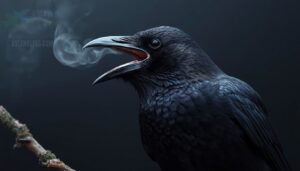
To understand why ravens sound the way they do, you have to look at the machinery behind the voice. It’s not magic — it’s anatomy, airflow, and some surprisingly complex muscle control.
Here’s what’s actually happening when a raven opens its beak.
The Raven Syrinx Explained
The syrinx sits at the tracheal bifurcation — not in the throat like a mammalian larynx, but deeper, where the trachea splits into two bronchi.
What makes this anatomy impressive is Half‑Syrinx Independence: each side operates autonomously, with Muscle Tension Modulation controlling labia position across both chambers.
This Dual Syrinx Halves arrangement gives ravens their distinctively broad vocal range and supports vocal learning and vocal mimicry in captive ravens.
Airflow, Membranes, and Pitch Control
Once air moves through the syrinx, everything changes. Airflow Velocity Effects drive Pressure-Driven Pitch Shifts by altering how fast air crosses the syringeal membranes — small pressure adjustments produce surprisingly large tonal leaps. Membrane Tension Modulation via the syringeal muscles fine‑tunes each note, while Subglottal Pressure Dynamics stabilize output.
Harmonic Enrichment Mechanisms layer complexity into each call:
- Airflow velocity shapes pitch directly
- Membrane tension raises or lowers frequency
- Subglottal pressure steadies the tone
- Turbulent pockets generate rich harmonics
- Paired membranes enable rapid pitch transitions
Why Ravens Sound Deep and Resonant
What you’re hearing when raven calls isn’t just a voice — it’s a carefully tuned instrument.
Chest Resonators and Air Sac Amplification boost lower harmonics, while Thick Tissue Damping around the throat and syrinx suppresses higher overtones.
Vocal Tract Length lowers resonant frequencies, and Environmental Echo Boost from canyon walls extends those deep gurgling croaks into something almost architectural.
The result is a specialized organ producing deep, rough, guttural vocalization.
What Ravens Say Naturally

Before a raven ever hears a human voice, it already has plenty to say. Their natural vocal repertoire is surprisingly rich, covering everything from sharp alarms to territorial declarations to calls that coordinate an entire flock.
These sounds are just the beginning—ravens also display remarkable bird intelligence and problem-solving skills that make their communication even more purposeful and complex.
Here’s a closer look at the main categories that make up a raven’s everyday voice.
Common Raven Call Types
The common raven’s natural vocalizations are far richer than most people realize.
Its vocal repertoire spans distinct call types, each serving a precise social function:
- Non-Alarm Contact Calls — deep, resonant croaks that maintain group cohesion across distances
- Social Coordination Calls — rhythmic chatter bursts guiding cooperative foraging
- Territorial Defense calls — assertive guttural growls signaling dominance boundaries
- Juvenile Learning Calls — softer, exploratory sounds young ravens use while acquiring local dialects
Calls for Warning and Defense
When danger closes in, ravens don’t just panic — they communicate with striking precision. Predator-specific alarm calls distinguish aerial threats from ground predators, with high-pitched alarm calls cutting through forest noise for aerial threats, while deeper, raspy tones signal terrestrial ones.
Mobbing call coordination synchronizes group responses, and territorial threat signalling reinforces boundaries through dialectal threat variation.
This acoustic danger encoding reveals a defense system of impressive sophistication.
Calls for Food, Mates, and Territory
Ravens basically run three parallel communication channels at once.
Their Food Recruitment Calls — soft, rattle-like signals — draw flock members toward a discovered patch, while Patch Defense Calls escalate sharply when rivals encroach.
Mate Attraction Songs pair with physical displays, marking Territory Boundary Bark that asserts ownership.
This layered resource signaling reflects deep social cognition, with Seasonal Call Variation shifting repertoire priorities as breeding or foraging demands change.
Regional Vocal Differences in Ravens
Think of raven dialects as regional accents shaped by landscape itself.
Habitat-driven pitch and terrain-specific call timing mean mountain populations favor high-frequency warnings to carry sound across rugged terrain, while desert ravens use flatter, monotone calls.
This geographic call structure and population frequency variation produce acoustic variation that persists across generations — regional dialects and vocal variation in raven populations reflecting the environments that sculpted them.
How Ravens Mimic Human Speech
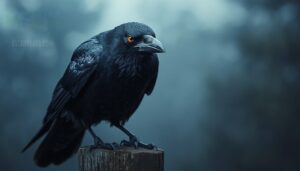
Ravens don’t just croak and caw — some of them actually say words back to you. The way they pull this off is more layered than you might expect, involving careful listening, repetition, and something closer to personality than instinct.
Here’s what’s actually happening when a raven starts sounding suspiciously human.
Repeating Words and Short Phrases
Captive ravens don’t just copy sounds randomly — they favor short, repeating phrases, a pattern that mirrors how emphasis repetition and rhythm reinforcement work in human communication. Vocal mimicry in captive ravens often begins with simple greetings like "Hello," repeated consistently until the sound anchors into memory.
memory cueing strengthens learned vocal mimicry over time, while social echoing reinforces bonds with familiar humans.
Learning Sounds by Listening
Listening is where it all begins. Young ravens absorb sounds through Social Auditory Modeling — watching, hearing, and internally cataloging what they encounter.
Acoustic Exposure Frequency directly shapes Auditory Memory Retention; the more often a raven hears a phrase, the deeper it encodes. Neural Auditory Plasticity makes early life especially critical, enabling Listening Driven Mimicry that forms the foundation of all learned vocal mimicry and social learning in captive ravens.
How Practice Improves Mimicry
Once auditory templates form, repetition takes over. Focused Listening shifts into active Motor Memory as the raven rehearses each sound through Chunked Repetition — breaking complex phrases into smaller units and rebuilding them progressively. Feedback Loops sharpen accuracy with each attempt, while Progressive Speed refines timing.
- Short, spaced sessions outperform marathon drills
- Consistent repetition stabilizes articulator coordination
- Social reinforcement accelerates Raven Vocal Learning in captivity
Why Some Individuals Copy Better
Not every raven mimics equally well — and temperament openness plays a bigger role than you might expect. Hand-raised individuals with high motivation levels and consistent social reinforcement develop stronger auditory memory for human phrases.
Practice frequency matters too, but curious, calm disposition unlocks the full potential of vocal mimicry in captive ravens, shaping how far each bird’s imitation actually goes.
Why Ravens Copy Words

Mimicry isn’t random — ravens copy words for real reasons rooted in their social lives and environment. Understanding what drives this behavior gets you closer to the intelligence behind the voice.
shapes a raven’s motivation to imitate.
Attention-seeking and Social Bonding
When a raven mimics your voice, it isn’t just playing tricks — it’s reaching out.
Playful call exchanges and vocal bonding rituals serve as social cohesion signals, reinforcing trust within the group. Attention-driven grooming often follows these vocal bids.
Through social learning in ravens, mimicry becomes currency: the bird that speaks gets noticed, and getting noticed strengthens bonds.
Response to Human Interaction
When you speak directly to a raven — holding eye contact, responding to its calls — you’re activating a feedback loop that sharpens its vocal learning. Body language mirroring and vocal timing adaptation signal your engagement, prompting clearer reward mimicry.
Ravens show stronger human voice familiarity with regular caregivers, adjusting call timing and attention cueing to match your rhythm, pace, and presence.
Effects of Captivity and Enrichment
Captivity reshapes vocal development in ways the wild simply can’t replicate. Environmental enrichment — puzzle feeders, climbing structures, rotating objects — directly facilitates raven vocal learning by boosting cognitive engagement and reducing stress-linked silence.
- Enrichment-Induced Play accelerates audio mimicry in captivity through sustained novelty.
- Reduced Stereotypic Behaviors free mental bandwidth for language-directed attention.
- Enhanced Immune Function correlates with stable, enriched housing conditions.
- Group Cohesion Enhancement through pair housing deepens social vocal exchange.
- Longer Lifespan Potential grows alongside consistent captive raven training and language exposure.
Impact of captivity on raven speech development is measurable — enriched individuals consistently build broader repertoires.
Influence of Age and Temperament
Age shapes a raven’s mimicry drive just as much as environment does. Juvenile vocal play peaks early, when bold temperaments push higher call frequency and faster imitation. Hand-raised birds exposed to captive training show the sharpest gains.
Stress‑induced chatter fades with maturity, and temperament consistency stabilizes vocal tempo over time — meaning the most talkative ravens aren’t always the youngest, just the most socially engaged.
Captive Vs Wild Ravens

Where a raven grows up changes everything about how it sounds. Captive birds, raised alongside humans, develop vocal habits that wild ravens almost never show.
Here’s what that difference actually looks like across four key areas.
Speech Mimicry in Captivity
Hand-raised ravens can genuinely mimic human speech — dozens of words, sometimes over 100. Human Voice Familiarity drives this: consistent Interaction Frequency with handlers accelerates Raven vocal learning considerably.
Enrichment Play Sessions and Positive Reinforcement Techniques sharpen audio mimicry in captivity, while Playback Training helps consolidate retention.
| Condition | Effect on Mimicry | Example Outcome |
|---|---|---|
| Daily interaction | Faster acquisition | Greetings learned within weeks |
| Enrichment sessions | Broader repertoire | Environmental sounds added |
| Positive reinforcement | Stronger retention | Words recalled months later |
Ravens can mimic human speech most reliably through structured captive training of talking birds.
Rare Mimicry in Wild Ravens
Wild ravens rarely mimic, but when they do, it stops you cold. Documented cases include cross-species alarm mimicry, mechanical noise copying, and environmental sound imitation — usually near high-traffic human areas.
Social foraging triggers and novelty-driven vocal play appear to motivate these rare episodes, linking raven vocal learning directly to social cognition and complex calls in corvids.
| Observed Behavior | Context |
|---|---|
| Cross-species alarm mimicry | Near mixed-species flocks |
| Mechanical noise copying | Urban and research sites |
| Human sound imitation | Frequent human contact zones |
| Small mammal squeak mimicry | Near food sources |
| Environmental sound imitation | Social gatherings |
How Environment Changes Vocal Behavior
The acoustic environment shapes what ravens learn and how they sound. Urban Noise Impact forces pitch elevation and call shortening, while Humidity Vocal Flexibility allows smoother phonation in wet conditions. Temperature Pitch Shifts alter preferred frequencies seasonally, influencing Seasonal Call Timing and Habitat Echo Effects near reflective surfaces.
| Environmental Factor | Vocal Response |
|---|---|
| Urban broadband noise | Higher pitch, shorter calls |
| Dense vegetation/echo | Stereotyped repertoires |
| Humid conditions | Smoother, more flexible phonation |
| Cold temperatures | Lower frequency, longer calls |
Human Exposure and Vocal Repertoire Size
How much a raven hears shapes how much it says. Urban Sound Influence and Human Proximity Effects consistently expand the raven vocal repertoire and mimicry range—exposure increases repertoire by introducing new phonemes through imitation learning.
Ravens already possess a vocabulary of up to 33 distinct nonmimicked vocalizations; adding sustained human language contact and auditory enrichment impact pushes that ceiling higher, especially during seasonal human interaction peaks.
| Exposure Type | Repertoire Effect |
|---|---|
| Urban daily contact | Broader mimicry range |
| Captive speech sessions | Faster word acquisition |
| Seasonal park proximity | Increased vocal activity |
| Minimal human contact | Smaller imitative vocabulary |
Ravens Vs Parrots
Ravens and parrots both mimic human speech, but they’re working with very different tools under the hood.
The gap between a crisp parrot phrase and a raven’s gravelly impression comes down to anatomy, learning style, and what each bird’s voice is actually built to do.
Here’s how they stack up across the details that matter most.
Differences in Vocal Anatomy

Both ravens (Corvus corax) and parrots rely on syrinx anatomy and sound production, but their vocal hardware differs meaningfully.
Raven’s syrinx dual sources allow complex tonal variation, while beak resonance shaping and tracheal column length determine timbre.
Laryngeal role reduction shifts control entirely to the syrinx, with neural syrinx coordination driving avian vocalization — yet their anatomical precision diverges sharply.
| Feature | Raven | Parrot |
|---|---|---|
| Syrinx Control | Dual independent sources | Highly precise musculature |
| Beak Function | Resonance shaping | Active articulation |
| Vocal Cord Flexibility | Strong, flexible vocal cords | Finer, more controlled |
Why Parrots Mimic More Clearly
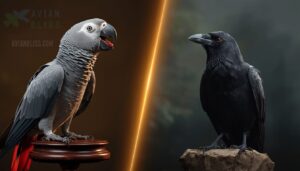
Parrots hold a clear anatomical edge. Their thick Tongue Musculature steers airflow with precision, carving consonant-like edges that ravens simply can’t replicate. Add Dual Syrinx Output — producing layered harmonics simultaneously — plus a solid Auditory Feedback Loop, and strong Cognitive Segmentation, and you understand why African Grey parrots mimic human speech so crisply.
Enriched Training accelerates this further.
| Advantage | Parrot |
|---|---|
| Tongue role | Active articulation |
| Syrinx output | Dual, simultaneous tones |
| Auditory feedback | Continuous self-correction |
| Cognitive segmentation | Breaks words into units |
| Enriched training response | Rapid vocabulary expansion |
Raven Mimicry Compared With Parrots

Both birds mimic, but their vocal imitation diverges sharply in quality and context. Ravens lean toward Environmental Echoes — barks, laughs, ambient sounds — while African Grey parrots nail crisp syllables through exceptional Vocal Flexibility and Training Methods tied to daily reinforcement.
Brain Size correlates with Cognitive abilities behind imitation, yet ravens prioritize novelty over precision in their Raven vocal learning.
| Feature | Raven | African Grey Parrot |
|---|---|---|
| Mimicry Timing | Situational, irregular | Consistent, rehearsed |
| Vocal Flexibility | Broad tonal range | Precise articulation |
| Comparison of raven and parrot vocal abilities | Deep, guttural imitation | Clear, human-like speech |
Which Bird “talks” Better

So which bird actually "talks" better? That depends on what you value.
Parrots dominate in Vocabulary Breadth and Mimicry Accuracy, their Vocal imitation producing human-like clarity that ravens simply can’t match anatomically.
Ravens, however, bring surprising Acoustic imitation depth — environmental sounds, laughs, barks — driven by sharp Cognitive abilities behind vocal imitation and strong Social Motivation.
Environmental Noise and a steeper Learning Curve limit raven output, but their Avian mimicry reveals a different kind of intelligence entirely.
| Feature | Raven | African Grey Parrot |
|---|---|---|
| Vocabulary Breadth | Dozens of sounds | 100–500+ words |
| Mimicry Accuracy | Guttural, approximate | Clear, precise |
| Learning Curve | Slower, irregular | Faster, consistent |
| Social Motivation | Bonding-driven | Reward-driven |
| Comparison of raven and parrot vocal abilities | Broad tonal range | Human-like articulation |
Limits of Raven “Talking”

Raven mimicry is genuinely impressive, but it does hit a wall — and that wall is mostly anatomical. The syrinx simply wasn’t built to carve out crisp vowels or sharp consonants, the way a human mouth can.
Here’s where raven "talking" starts to break down.
Why Raven Speech is Usually Guttural
That deep, gravelly quality you hear in raven speech isn’t accidental — it’s structural. Thick vocal folds, chest cavity resonance, and bilateral pitch modulation all push sound toward low frequency emphasis.
Turbulent airflow grit, generated as air forces through syringeal membranes, adds rasp to every utterance.
The anatomy and function of the avian syrinx simply favors this deep rough or guttural vocalization over crisp, clean tones — shaping raven vocal learning and vocal imitation from the start.
Limits of Clear Vowels and Consonants
Even when a raven nails a word, the phonetic edges stay blurry — and here’s why that’s unavoidable:
- Vowel Space Saturation limits how far the syrinx can stretch tonal separation without collapsing naturalness
- Consonant Aspiration Ceiling prevents crisp stop-release cues essential to human language
- Coarticulation Trade-offs blur boundaries between adjacent sounds in vocal imitation
- Spectral Contrast Limits reduce the acoustic signaling clarity your ear expects
- Auditory Perception Thresholds mean degraded consonants simply don’t register as intended phonemes
Vocal learning and mimicry can sharpen output, but anatomy writes the final boundary.
Word Clarity Versus True Speech
Word clarity and true speech aren’t the same target. A raven’s speech imitation in birds captures recognizable syllables, but phonemic distinction — the crisp vowel-to-vowel, consonant-to-consonant contrast your brain relies on for speech perception — rarely survives the syrinx’s anatomical ceiling.
True human language also depends on prosodic variation and contextual inference, dimensions where acoustic granularity and cognitive intelligence in birds, however impressive, don’t fully converge with avian mimicry.
What Ravens Cannot Do With Language
Mimicry impresses, but it stops well short of language. Here’s what ravens genuinely can’t do, no matter how rich their sound repertoire becomes:
- Abstract Syntax — Ravens don’t construct syntactic structure or sequence words with rule-based grammar.
- Temporal Reference — They can’t use language to reference past or future events.
- Complex Narrative — Logical reasoning, causal storytelling, and metaphorical usage remain beyond their neurobiological constraints on avian speech production.
- Species-specific communication stays context-bound, never evolving into true symbolic or propositional language.
What Raven Vocalization Means

Raven calls aren’t just noise — they’re a working language that holds their society together. Each sound carries weight, from settling dominance disputes to teaching younger birds the local dialect.
Raven calls are a working language — each sound settling disputes, passing down dialects, and binding society together
Here’s what that vocal complexity actually tells us about how ravens think, learn, and connect.
Communication in Raven Society
Ravens don’t just make noise — they’re running a full social network through sound. Their natural communication system encompasses Hierarchy Reinforcement Calls, Territory Boundary Exchanges, and Cooperative Mobbing Calls that coordinate group defense with impressive precision.
Kinship Vocal Signaling adjusts based on who’s listening, while Playful Vocal Interactions strengthen bonds between individuals.
Acoustic signaling for territory and mate attraction reflects a social structure underpinned by genuine cognitive abilities.
Social Learning and Dialects
sound itself becomes the thread that binds raven communities across generations. Juvenile Call Adoption happens naturally — young birds absorb dominant patterns through daily observation, reinforcing Social Bond Reinforcement within their group.
Cross‑Dialect Transmission shapes populations over time through three key pathways:
- Seasonal Repertoire Shifts introduce new calls as flocks merge at winter roosts
- Dominance Influence standardizes local variants when high-ranking birds set vocal tempo
- Immigrant ravens adopt Regional dialects to avoid social exclusion
Bird dialects aren’t accidental — they’re culturally transmitted.
Intelligence Linked to Vocal Mimicry
cultural transmission doesn’t happen by accident — it demands real cognitive horsepower. Problem Solving Flexibility and Auditory Working Memory underpin every imitation a raven produces, reflecting genuine Cognitive Social Learning rather than simple repetition.
Innovation Through Imitation ties directly to Memory Retention Span; ravens reproducing sounds heard weeks earlier demonstrate that the cognitive abilities behind imitation run surprisingly deep.
What Raven Calls Reveal About Behavior
Every call a raven makes functions as a behavioral fingerprint. Emotional arousal cues embedded in alarm sequences trigger predator mobbing synchronization across the group, while dominance hierarchy signaling shapes feeding access in real time.
Cooperative foraging coordination and seasonal vocal shifts further reflect the natural communication system of ravens as a whole — a behavioral ecology shaped by cognitive adaptation, regional dialects, and deep social interaction signals.
Frequently Asked Questions (FAQs)
Can Ravens mimic human speech?
Yes, ravens can produce imitations of human words, particularly short phrases, through acoustic feedback loops and vocal learning mechanisms shaped by repeated exposure and individual temperament.
Can a raven talk?
Ravens can produce imitations of human words through auditory memory and social modeling, though neurophysiological constraints limit clarity. Human interaction remains the strongest motivation factor driving this impressive vocal mimicry.
Can Ravens talk like parrots?
They can, but not quite as cleanly.
Where parrots excel through precise vocal anatomy, ravens lean on cognitive imitation and human-raven interaction to produce guttural, resonant mimicry shaped by cultural transmission and neurobiological differences.
Can a raven form words and talk?
The tongue has no bones, but it’s strong enough to break a heart.
A raven’s syrinx operates through neural control pathways that enable genuine word formation, yes — guttural, deep, but unmistakably deliberate.
Do ravens have the ability to talk?
They can, and the evidence is striking.
Vocal plasticity, shaped by memory retention and individual temperament, allows hand-raised and trained ravens in zoos to reproduce recognizable human words through repeated environmental enrichment and human interaction.
Can a raven really say "nevermore"?
Yes — raven can say "nevermore," though don’t expect Poe’s dramatic clarity.
What you’ll hear is a guttural, resonant approximation, shaped by syrinx anatomy and acoustic imitation refined through repeated human interaction.
Can you teach ravens to speak?
You can with patience. Training consistency and reward timing matter more than repetition alone.
A raven’s individual personality profile shapes how quickly it responds—some birds simply take to mimicry faster than others.
Can you train a raven to talk?
You can with the right approach.
Consistent training session frequency, positive reinforcement techniques, and environmental enrichment impact results substantially — though individual temperament effects and age-related learning capacity ultimately shape how far each raven goes.
How do people react to Joe the talking raven?
catch feelings fast — smiles, laughter, and visitor delight ripple through crowds the moment Joe speaks.
Social media buzz follows every clip, while superstitious awe colors comments, and staff observations confirm repeat requests never slow down.
Can a raven talk like a parrot?
Ravens can mimic words, but their syrinx flexibility limits vowel clarity compared to parrots.
Human interaction benefits their vocal learning capacity, though comparative speech acoustics reveal parrots still outperform ravens in precise articulation.
Conclusion
The raven’s voice, it seems, speaks volumes—even when the words aren’t quite right. Can ravens talk the way you do? Not really.
But what they can do is something perhaps more fascinating: deliberately shape sound to navigate relationships, signal intelligence, and occasionally fool a stranger into turning around. Their voices aren’t mimicking language so much as using it—selectively, purposefully, on their own terms. That distinction changes everything about how you listen.