This site is supported by our readers. We may earn a commission, at no cost to you, if you purchase through links.
By the time you finish reading this sentence, another bird species somewhere in the world has edged closer to extinction. The numbers aren’t just sobering—they’re staggering: global bird populations have plummeted by 14% since 1980, and some endangered bird types now survive on islands of fragmented habitat, their calls fading into silence.
You don’t need to be an ornithologist to sense the urgency; forests are shrinking, invasive predators are multiplying, and the wild is growing quieter each year. If you’re curious about which species are teetering on the brink and what’s fueling their decline, you’re about to see just how fragile—and extraordinary—these birds truly are.
Table Of Contents
Key Takeaways
- Global bird populations have dropped 14% since 1980, with habitat loss, climate change, and invasive species driving many to the brink of extinction.
- Critically endangered birds like the yellow-crested cockatoo, northern bald ibis, imperial woodpecker, and Bahama nuthatch now survive in tiny, fragmented habitats or are feared extinct.
- Major threats include illegal wildlife trade, rapid habitat destruction, invasive predators, pollution, and increasingly severe climate impacts that disrupt breeding and migration.
- Effective conservation relies on targeted recovery programs, international cooperation, habitat preservation, and active community and NGO involvement to prevent further losses.
Critically Endangered Bird Species
Some birds are hanging by a thread, with only a handful left in the wild. These critically endangered species face unique challenges that push them closer to the brink.
Here’s a closer look at the birds fighting for survival right now.
Yellow-Crested Cockatoo

The plight of the yellow-crested cockatoo is a stark warning. With only 1,200–2,000 individuals left, you’re witnessing a species teetering on the edge. Consider what’s at stake:
- Habitat Restoration is urgent.
- Bird Sanctuary protections are essential.
- Conservation Breeding offers hope.
- Wildlife Protection demands action.
Ecological Research drives effective Avian Conservation for these Endangered Birds. Effective conservation relies on thorough literature review processes to inform strategies.
Northern Bald Ibis

Now, shift your gaze to the Northern Bald Ibis—a species whose survival hinges on Habitat Preservation and strict Breeding Programs. With fewer than 1,000 wild individuals, these birds rely on protected Nesting Sites across Morocco and the Middle East.
Their Migration Patterns and Feeding Habits are disrupted by ongoing Threats to Bird Species, making Bird Conservation and accurate Conservation Status assessments more urgent than ever. Effective conservation requires access to reliable study resources online to inform strategic preservation efforts.
Imperial Amazon Parrot

If the Northern Bald Ibis’s story feels urgent, the Imperial Amazon Parrot’s reality is even starker. With as few as 1,000–2,000 individuals left, their Amazon Habitat faces relentless fragmentation. You’ll notice:
- Hurricane-ravaged forests disrupt Nesting Patterns
- Bird Migration routes shrink
- Feather Conservation becomes a daily struggle
Amazon parrots embody how Endangered Species and Extinction intertwine with Avian Conservation Efforts.
Imperial Woodpecker

If you think the Imperial Amazon Parrot’s numbers are grim, the Imperial Woodpecker’s story is even more sobering. This Endangered Species, once a keystone of Forest Ecology, faces near-total Extinction Risk. Habitat Destruction and Degradation erased its Woodpecker Habitat, leaving only rumors and memories.
Bird Conservation Efforts now hinge on understanding lost Bird Behavior and revisiting the Conservation Status of Bird Species worldwide.
Bahama Nuthatch

Disappearance echoes through the pine forests of Grand Bahama—your understanding of Bird Extinction deepens with the Bahama Nuthatch. Habitat Loss and invasive species have pushed this tiny songbird to the brink, its Conservation Status now believed extinct.
Species Research and Bird Conservation efforts have failed to locate survivors, highlighting the Ecological Impact and urgent Threats to Bird Populations worldwide.
Hooded Grebe

A story of survival unfolds with the Hooded Grebe—your window into the razor’s edge of extinction. Fewer than 2,000 remain, their fate tied to wetland conservation, breeding programs, and predator control.
Habitat loss and introduced species threaten every migration. As an endangered species, their bird conservation status demands bold action, or these unique grebes may vanish for good.
Endangered Birds and Their Habitats

Endangered birds aren’t just rare—they’re deeply tied to the places they call home. Each species relies on a unique habitat that shapes its survival.
Let’s look at where some of the world’s most threatened birds still hold on.
Amazon Parrots of The Caribbean
Ever wondered how Amazon parrots survive amid shrinking Caribbean habitats? Your curiosity is justified—these vibrant birds face relentless threats. Imagine:
- Frugivorous flocks dwindling as forest cover declines
- Parrot migration patterns disrupted by habitat fragmentation
- Island conservation teams racing against time
- Species research revealing new bird behaviors
- Wildlife preservation efforts struggling to keep endangered species from vanishing
Bird conservation here is a daily battle.
Kakapo of New Zealand
A nocturnal, flightless marvel—the Kakapo stands as New Zealand’s living paradox. Native habitat loss nearly pushed this endangered species to extinction, but conservation breeding now offers hope.
Kakapo diet, rich in native plants, shapes survival strategies.
Your support for avian conservation and wildlife preservation ensures bird species conservation isn’t just theory—it’s the lifeline for these unique survivors.
Maui Parrotbill of Hawaii
How fragile is Maui’s wild heart? The Maui parrotbill, one of Hawaii’s rarest Endangered Birds, clings to survival in shrinking forests. Habitat Restoration is your best hope for this species—threatened by Avian Diseases, invasive species, and climate shifts. Hawaiian Conservation efforts focus on:
- Predator control
- Disease management
- Native forest protection
- Bird Species Conservation research
Mangrove Finch of The Galápagos
How does a single bird reflect the fate of an entire island’s ecology? The mangrove finch, facing extinction, is battered by invasive predators and shrinking mangrove forests—key elements in Galapagos Ecology.
Your support for Habitat Restoration and Island Conservation is essential. Avian Research drives Finch Migration studies, shaping Wildlife Preservation and Protection strategies against mounting Threats to Endangered Birds.
Fruit Dove of Southeast Asia
As mangrove finches struggle, Fruit Doves in Southeast Asia face their own battles—deforestation and biodiversity loss drive dramatic dove population trends. You’ll see:
- Habitat Conservation efforts stalling amid rapid land clearing
- Fruit Dove Migration patterns shifting unpredictably
- Avian Disease Research revealing new threats
- Wildlife Preservation and Protection challenged by fragmented forests
Endangered birds need your voice in conservation efforts.
Major Threats Facing Endangered Birds
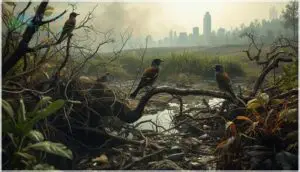
Endangered birds face a tangled web of threats that push them closer to the brink. Some dangers are obvious, while others creep in quietly and disrupt fragile habitats.
Here’s what you should know about the major risks these species face today.
Wildlife Trade and Trafficking
Through the tangled web of Wildlife Trade and Trafficking, endangered species face relentless threats—think Bird Poaching and Black Market Sales draining populations.
The Illegal Pet Trade and wildlife smuggling push rare parrots and cockatoos toward extinction, often slipping through gaps in Conservation Laws.
When enforcement falters, trafficking flourishes, accelerating species extinction and leaving conservationists scrambling to stem the tide.
Habitat Destruction and Degradation
If illegal trade cracks the foundation, Habitat Destruction finishes the job. Deforestation impacts bird populations by shrinking their living space, while land conversion carves up forests into fragments.
You see ecosystem disruption everywhere—wetlands drained, mangroves bulldozed, forests razed. This environmental degradation fuels biodiversity loss and leaves endangered birds stranded, their habitats vanishing faster than hope.
Invasive Species and Predation
Habitat destruction rarely acts alone—Invasive Species and unchecked predation compound the crisis for endangered species. On island ecosystems, native birds face relentless pressure from introduced predators like rats and cats, with breeding success plummeting by up to 70%.
Predator control and strong biosecurity measures offer hope, but without vigilance, biodiversity loss and ecosystem disruption will only accelerate.
Pollution and Environmental Toxins
Plastic Ingestion and Chemical Exposure aren’t just buzzwords—they’re daily threats to your favorite birds. Toxic Waste, Air Pollution, and Water Contamination drive environmental degradation and pollution, hitting sensitive species hard.
Mercury accumulation, pesticide runoff, and ecosystem disruption mean biodiversity loss isn’t abstract; it’s visible in declining populations and impaired habitats. You can’t ignore how pollution reshapes survival itself.
Climate Change Impact
Almost predictably, Sea Level Rise and Extreme Weather push bird colonies to the brink, forcing sudden Climate Migration and disrupting fragile breeding cycles. Temperature Shifts throw food webs off balance, while Ecosystem Disruption leaves endangered species scrambling for survival.
That’s the reality: Climate Change Impact isn’t just theory—it’s driving extinction, reshaping Biodiversity and Conservation Biology, and demanding urgent Ecological Conservation Efforts.
Conservation Status and Assessment

Understanding how we measure the risk faced by bird species is key to knowing which ones need urgent help. Let’s look at how conservation status is determined and what those labels actually mean.
Here’s what you should know about the main criteria and global trends.
IUCN Red List Criteria
How do you know which birds are teetering on the edge? The IUCN Red List Categories use rigorous Conservation Metrics—like population decline, range size, and extinction risk—to drive Species Assessment and Threat Evaluation.
Data Validation is essential: every Threatened Species, from Endangered to Critically Endangered, is scrutinized through these Conservation Biology standards to establish dependable, clear status assignments.
Critically Endangered Vs. Endangered
What separates a Critically Endangered bird from an Endangered one? It’s the razor’s edge of Extinction Risk—a steep drop in Population Trends, a vanishing range, and a dire Conservation Status. Here’s what sets them apart:
- Species Classification thresholds
- Threat Assessment severity
- Population collapse
- Habitat fragmentation
- Imminent Species Extinction without urgent Conservation Efforts
Global Bird Population Trends
Imagine a world where bird song fades—global bird populations have dropped 14% since 1980. Habitat fragmentation and climate shift effects drive this decline, especially among migratory and forest species.
Global bird populations have plummeted 14% since 1980, as habitat loss and climate change silence forests and migratory routes
Population decline rates spike in tropical regions, while avian disease impact and biodiversity loss push threatened species closer to extinction. Wildlife preservation and targeted conservation efforts are your lifeline for endangered species.
Key Conservation Efforts and Successes

Protecting endangered birds takes more than good intentions—it demands real action on several fronts. You’ll find that some approaches stand out for their impact and creativity.
Here’s a look at the conservation efforts making a difference right now.
Species Recovery Programs (e.g., Kakapo Recovery)
Did you know the Kakapo population soared from 50 to 252 through targeted Recovery Strategies and Population Management? That’s Conservation Biology in action.
Species Recovery Programs blend artificial incubation, genetic pairing, and hands-on monitoring. These efforts—essential to Endangered Species Protection—prove that Species Reintroduction and Wildlife Preservation aren’t just theory; they’re lifelines for birds teetering on the edge.
Habitat Preservation Initiatives
Building on species recovery, Habitat Preservation Initiatives anchor Ecological Conservation. Protected Areas now cover 17.2% of terrestrial habitats, buffering birds against Habitat Loss.
Strategic Conservation Planning—think Wildlife Corridors and large-scale Habitat Restoration—boosts Ecosystem Services and Biodiversity Conservation.
When you invest in these efforts, you’re not just saving land; you’re giving endangered birds a fighting chance for survival.
International Collaboration for Bird Protection
Preserving habitats is only half the battle—birds don’t recognize borders, and neither should conservation efforts. Global partnerships and international agreements, like the African-Eastern Atlantic Flyway initiative, coordinate cross-border conservation and joint research initiatives.
Transboundary cooperation strengthens wildlife management, aligning resources for endangered species and extinction prevention. This collaborative approach amplifies species protection and drives real biodiversity conservation worldwide.
Community and NGO Roles in Conservation
When borders blur, Community Engagement and NGO Partnerships become the backbone of real Wildlife Conservation. You’ll see Local Governance raising Conservation Funding, and Volunteer Management boosting Species Protection for Endangered Species and Extinction threats. Consider:
- Community-led monitoring spots habitat changes faster.
- Joint NGO strategies stretch every conservation dollar.
- Local guardians curb illegal trade—preserving Biodiversity where it matters most.
Frequently Asked Questions (FAQs)
How do birds adapt to shrinking habitats?
When habitats shrink, birds don’t just sit idle—they shift breeding times, broaden their diets, and rely on corridor creation to stay connected.
Yet, habitat fragmentation and edge effects often tip the scales toward Biodiversity Loss and Ecological Balance disruption.
What role do zoos play in bird conservation?
Zoos drive Bird Conservation Efforts through Zoo Breeding programs, Conservation Research, and Bird Rehabilitation. Captive Management bolsters endangered species’ survival, while Wildlife Education equips you to advocate for Biodiversity Preservation and smarter Wildlife Management Strategies—real lifelines for vulnerable bird populations.
How can individuals help protect endangered birds?
You can make a real difference for endangered species by installing Bird Friendly Windows, supporting Urban Conservation, joining Citizen Science projects, practicing ethical Eco Tourism, and engaging your community in Habitat Preservation and Restoration—every action strengthens Bird Conservation Efforts.
Are captive breeding programs effective for all species?
It’s ironic—captive breeding can save a species from extinction, yet sometimes undermines species adaptation and genetic diversity. Program evaluation shows successes like the California Condor, but for others, including the African Grey Parrot, release strategies often fall short.
What foods are harmful to endangered birds?
Toxic food sources like avocados, chocolate, salt, and processed sugars can cause bird poisoning and disrupt avian nutrition. For endangered feeding, even small dietary mistakes threaten conservation efforts, amplifying ecosystem disruption and biodiversity loss amid ongoing habitat destruction.
Conclusion
Imagine sending a telegram to warn future generations: the fate of endangered bird types is being decided right now, not in some distant era. Each vanished call is a thread lost from the world’s living tapestry, not just a statistic.
The choices you make—what you support, what you protect—echo far beyond your own lifetime. If we listen closely, these birds aren’t just fading; they’re asking whether we’ll answer before their voices are gone forever.