
This site is supported by our readers. We may earn a commission, at no cost to you, if you purchase through links.

A single pair of purple martins can return to the same gourd colony for years, provided the cavity dimensions, drainage, and predator guards meet their exacting requirements. Progne subis relies almost entirely on human-supplied housing east of the Rockies, which makes your choice of nesting structure a direct factor in regional population stability.
Not all gourds perform equally. Natural calabash shells regulate temperature differently than HDPE plastic, and a poorly placed entrance hole invites starlings to displace the very birds you’re trying to attract.
Choosing well means understanding cavity size, drainage, and mounting height before you ever hang a gourd—details that separate a thriving colony from an empty one.
Table Of Contents
- Key Takeaways
- Best Gourd Bird Houses for Purple Martins
- 1. Purple Martin Nesting Gourds
- 2. Classic gourd birdhouse nesting set
- 3. Purple Martin Natural Gourd Houses
- 4. Starling Resistant Purple Martin Gourd
- 5. Starling Resistant Purple Martin Gourds
- 6. Troyers Birds Paradise SuperGourd
- 7. Purple Martin Gourd Housing System
- 8. Purple Martin Gourd Birdhouse
- 9. Natural Gourd Martin House Kit
- 10. BestNest Plastic Purple Martin Gourds
- Natural Vs Plastic Martin Gourds
- Key Features to Compare
- Best Placement for Martin Gourds
- Gourd House Care Tips
- Frequently Asked Questions (FAQs)
- What are the best gourds for martin houses?
- Do purple martins prefer gourds or houses?
- What is one disadvantage of gourd birdhouses?
- What is the best housing for purple martins?
- What is the best gourd for purple martins?
- How do purple martins choose nesting sites?
- Can gourds be reused year after year?
- What materials deter predators from reaching nests?
- Do purple martins prefer natural or synthetic gourds?
- How does climate impact gourd birdhouse durability?
- Conclusion
Key Takeaways
- Cured natural gourds outperform plastic in thermal insulation and occupancy rates (often 100% vs. roughly 67% for conventional designs), though plastic offers easier maintenance and longer UV durability.
- Starling-resistant crescent entrance holes (about 1¼" high) or 2" round holes with templates are essential to keep competing birds out while letting martins pass freely.
- Proper placement matters as much as the gourd itself: mount 9–11 feet high with 8–10 feet of vertical clearance, at least 25 feet from trees, and within a quarter mile of water for foraging.
- Regular maintenance—including pre-season cleaning, post-nesting inspections, and moisture/mold control—is critical since purple martins rely almost entirely on human-supplied housing and often return to the same successful colony site for years.
Best Gourd Bird Houses for Purple Martins
Choosing the right gourd housing can make or break your colony’s nesting success, since martins respond strongly to cavity size, ventilation, and material.
Beyond the gourd itself, getting where to position your martin housing for sun and shade balance right keeps eggs and nestlings safe from overheating.
Whether you prefer naturally cured gourds or durable plastic alternatives, the right setup helps you attract and protect breeding pairs season after season. Here are ten options worth considering, each suited to different budgets, climates, and colony needs.
1. Purple Martin Nesting Gourds
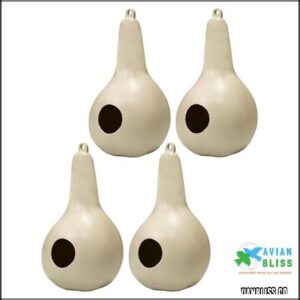
Purple martin nesting gourds remain the closest match to the cavities these birds relied on for centuries, long before aluminum housing existed. Hollow gourds offer better thermal insulation, staying cooler in summer and warmer in winter than metal alternatives.
Colonies housed in gourds often reach 100% occupancy, compared to roughly 67% for conventional designs. Properly cured, hard-shell gourds rival plywood in durability, lasting up to 30 years with the right preservative coatings—proof that this ancient nesting tradition still works remarkably well for modern colonies.
| Best For | This nesting gourd is best for purple martin landlords looking to expand an existing colony with a low-maintenance, easy-to-install housing option. |
|---|---|
| Material | Plastic |
| Color | Off-white |
| Drainage Hole | Yes |
| Target Species | Purple Martins |
| Mounting Method | Rack system |
| Access for Cleaning | Not specified |
| Additional Features |
|
- Off-white color reflects heat, keeping the interior cool during warm months
- Integrated drainage hole and durable plastic construction support a dry, long-lasting nesting environment
- Pre-drilled mounting holes allow for quick, secure installation on existing rack systems
- Only works with an existing rack system, so it’s not a standalone housing solution
- May cost more than other gourd options depending on current sales or promotions
- Plastic construction may not offer the same insulation benefits as traditional hard-shell gourds
2. Classic gourd birdhouse nesting set
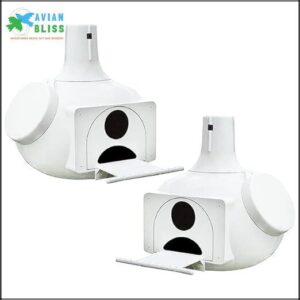
Two or more hollow gourds, joined or stacked together, make up the classic nesting set—a design that mimics the cavity clusters martins encountered in the wild. Each gourd holds its own chamber, usually 4 to 6 inches in diameter with 6 to 9 inches of internal length, giving birds room to turn without crowding.
Entrance holes are spaced to limit competition, and the whole set hangs together on a braided line or metal hardware, keeping cavity sizes uniform across the colony.
| Best For | This birdhouse set is best for bird enthusiasts looking to attract martins, bluebirds, or tree swallows with a low-maintenance, weather-ready nesting option. |
|---|---|
| Material | Plastic |
| Color | Not specified |
| Drainage Hole | Not specified |
| Target Species | Multiple species |
| Mounting Method | Rods or hooks |
| Access for Cleaning | Removable side cap |
| Additional Features |
|
- Adjustable entry panels make it easy to accommodate different bird species
- Removable side cap simplifies cleaning and monitoring nesting activity
- Weather-resistant molded plastic stands up to outdoor conditions while keeping the interior cool and dry
- Success attracting certain species, like purple martins, can vary
- Overall look may not appeal to everyone, since aesthetic preferences differ
- 8-inch chamber depth may feel limiting compared to traditional multi-gourd setups with longer internal space
3. Purple Martin Natural Gourd Houses
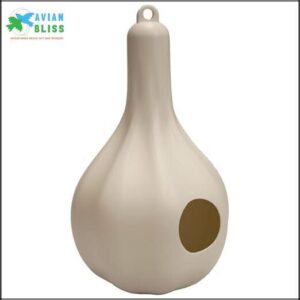
If you want the closest match to what martins nested in for centuries, single natural gourds deliver that authenticity. Look for at least 9 inches in diameter, with thick walls that resist cracking under sun and rain.
Crescent-shaped entrances cut at the midpoint allow easy adult access while keeping interior surfaces smooth. Trimmed stems and a small drainage hole at the base limit moisture buildup, while uniform curvature gives nestlings a roomy, naturally insulated cavity that stays cooler in summer than aluminum alternatives.
| Best For | Birders and hobbyists looking to start or grow a purple martin colony with an authentic, traditional gourd nesting setup. |
|---|---|
| Material | Plastic |
| Color | Natural gourd tan |
| Drainage Hole | Yes |
| Target Species | Purple Martins |
| Mounting Method | Pole system |
| Access for Cleaning | Not specified |
| Additional Features |
|
- Natural hollow gourd shape closely mimics the cavities martins have nested in historically
- Flattened base and integrated drainage hole help keep the interior stable and dry
- Pack of 4 makes it easy to begin or expand a colony at once
- Must be mounted on a larger housing rack or pole system to function
- Entry hole size and overall design may not suit every regional martin population
- Attraction success can vary depending on season and location
4. Starling Resistant Purple Martin Gourd
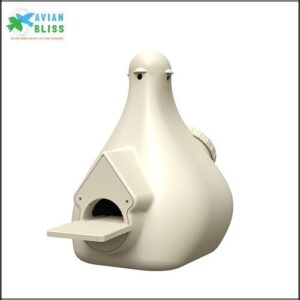
That natural cavity only stays predator-free if starlings can’t muscle in first, which is where the crescent-shaped entrance earns its keep. The doorway narrows at the bottom, letting martins slip through while blocking the stockier starling frame.
Look for reinforced lips around the opening, since sun and rain warp unprotected edges over time. A wider neck behind the entrance still gives adults room to maneuver once inside, preserving the roomy cavity martins need for brooding.
| Best For | Backyard bird enthusiasts and hobbyist conservationists who want to attract and protect nesting Purple Martins while keeping invasive starlings out. |
|---|---|
| Material | Plastic |
| Color | Beige |
| Drainage Hole | Not specified |
| Target Species | Purple Martins |
| Mounting Method | Pole/rack |
| Access for Cleaning | Removable back cap |
| Additional Features |
|
- Crescent-shaped entrance lets martins in while keeping bulkier starlings out
- Removable back cap makes nest checks and cleaning quick and easy
- Beige plastic construction resists weather damage and helps regulate internal temperature
- Starling resistance works best only when the porch attachment is added
- Designed specifically for Purple Martins, so it won’t suit other cavity-nesting birds
- At 3 pounds and over 16 inches long, it requires a sturdy pole or mount to install
5. Starling Resistant Purple Martin Gourds
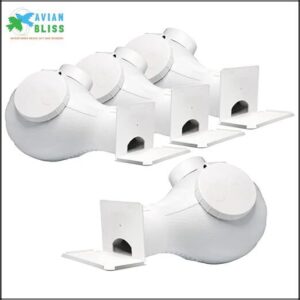
Buying a starling resistant gourd as a multi-pack changes how you defend an entire colony, not just one cavity. Crescent openings measuring 1 3/16 by 1 3/4 inches keep starlings out while martins pass through freely, and pairing several across a rack minimizes single pairs hogging every prime slot.
Look for swappable insert templates, since aluminum or PVC crescents flex to fit gourd curvature without retooling the whole unit. In heavy-pressure areas, this design alone can nearly eliminate starling intrusions colony-wide.
Pairing these inserts with a sturdy pulley system makes seasonal cleaning easy, a setup detailed in this guide to attracting purple martins with predator-resistant housing.
| Best For | Backyard bird enthusiasts looking to grow a purple martin colony while keeping starlings out of every cavity. |
|---|---|
| Material | Plastic |
| Color | White |
| Drainage Hole | Not specified |
| Target Species | Purple Martins |
| Mounting Method | Vertical or horizontal |
| Access for Cleaning | Threaded cap port |
| Additional Features |
|
- Crescent-shaped entrances let martins in while blocking starlings from invading nesting sites
- White textured plastic reflects sunlight to keep nestlings cool, and the threaded access port makes cleaning and maintenance easy
- Dual orientation mounting gives you flexibility to install vertically or horizontally depending on your setup
- Mounting hardware and hangers aren’t included, so you’ll need to budget for those separately
- The large, heavy profile and plastic fasteners may need metal bolt upgrades over time, especially with UV exposure
- Plastic fasteners can degrade in sunlight, which may mean extra maintenance down the road
6. Troyers Birds Paradise SuperGourd
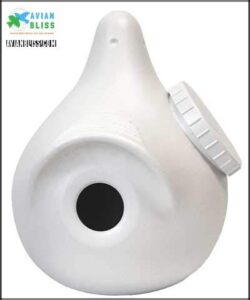
Few gourds pack as much engineering into one cavity as the SuperGourd, molded from UV-protected polyethylene that shrugs off seasons of sun without cracking. Starling-resistant crescent openings limit competitor access, while a 45-degree side port lets you check nests without disturbing incubating birds.
A built-in rain canopy and base drainage holes keep nestlings dry during storms, and the solid single-piece body prevents the rot that plagues jointed designs. White exteriors reflect heat, easing summer overheating risks.
| Best For | Purple martin landlords who want a low-maintenance, weather-tough gourd that keeps nestlings cool and makes inspections quick and easy. |
|---|---|
| Material | Plastic |
| Color | White |
| Drainage Hole | Yes (via canopy) |
| Target Species | Purple Martins |
| Mounting Method | Rack/pole |
| Access for Cleaning | Side access port |
| Additional Features |
|
- Durable single-piece molded plastic construction resists cracking and rot
- Built-in rain canopy and white finish protect nestlings from storms and summer heat
- Side access port makes nest checks simple without major disturbance
- Single-piece design limits modularity or part replacement if damaged
- Inspections require manual access through the side port each time
- 2-inch entry opening is sized specifically for purple martins, limiting use with other species
7. Purple Martin Gourd Housing System
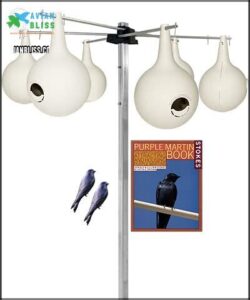
A complete colony starts with the right cavities, and this system delivers them as a rack-ready kit built around open flight space. Cavity diameters run 2½ to 3 inches, sized precisely for martins while excluding bulkier intruders.
Drainage holes at each base prevent rainwater pooling, and unpainted interiors preserve breathability that nestlings depend on during humid stretches. Spacing guidance—8 to 15 feet between gourds—reduces disease transmission and territorial disputes, making this kit a practical foundation for colony planning.
| Best For | Backyard bird enthusiasts who want a complete, ready-to-set-up system for attracting and housing purple martins. |
|---|---|
| Material | Plastic |
| Color | Ivory |
| Drainage Hole | Not specified |
| Target Species | Purple Martins |
| Mounting Method | Triangular pole bracket |
| Access for Cleaning | No easy-access cap |
| Additional Features |
|
- Comes as a full kit with gourds, mounting hardware, decoys, and a care guide, so there’s no need to buy parts separately
- Ivory plastic gourds help regulate temperature and keep nestlings cooler during warm weather
- Realistic decoys help draw martins to the housing, giving the colony a head start
- Some buyers report inconsistent assembly quality, with gourd halves that don’t fit together well
- Units may arrive with missing parts, hardware, or instructions, or with structural cracks
- No easy-access screw caps for cleaning, making it harder to maintain the nests after the season
8. Purple Martin Gourd Birdhouse
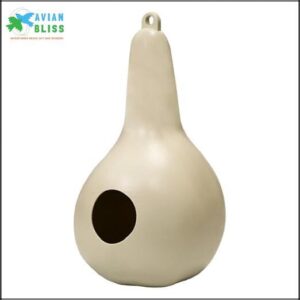
Off-white plastic, off-the-shelf simplicity — that’s the appeal here. This birdhouse skips natural curing entirely, offering a 2.25-inch entrance hole, base drainage, and a predrilled top hole for hanging, all in a 6.75-inch by 12.25-inch shell weighing just 2 lbs.
Interior space measures 6.5 by 6.5 inches, giving nestlings room to grow without the splitting risk that plagues some gourds. Just remember: a mounting rack isn’t included, so you’ll need that piece separately before installation day arrives.
| Best For | Backyard birdwatchers and purple martin enthusiasts who want a low-maintenance, easy-to-clean nesting option for habitat enhancement. |
|---|---|
| Material | Plastic |
| Color | Off-white |
| Drainage Hole | Yes |
| Target Species | Purple Martins |
| Mounting Method | Rack system |
| Access for Cleaning | Not specified |
| Additional Features |
|
- Spacious 6.5 x 6.5 inch interior allows for deeper, more comfortable nesting
- Durable plastic construction helps deter predators and keeps interior temperatures cooler in summer
- Lightweight at just 2 lbs, with a predrilled hanging hole and base drainage for easy setup and maintenance
- Mounting rack system is sold separately, adding an extra step and cost before installation
- Designed exclusively for purple martins, so it won’t suit other bird species
- Plastic material lacks the natural look and feel of traditional cured gourd birdhouses
9. Natural Gourd Martin House Kit
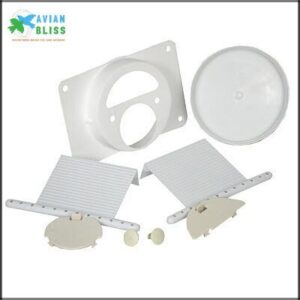
Skip the curing process entirely — this kit arrives ready to hang, gourds already dried, cleaned, and treated against mold. You get crescent entrance options sized for Purple Martins, plus a cleanout cylinder for post-season inspection, predrilled ventilation, and drainage holes built right in.
Cavity dimensions suit clutches of four to six eggs comfortably. Thick walls hold up against weather exposure, and mounting hardware comes included for wireline or crossbar setups, so you’re not hunting down extra parts before installation.
| Best For | Purple Martin enthusiasts who already have natural gourds and want an easy, ready-made way to turn them into a full martin colony setup. |
|---|---|
| Material | Plastic |
| Color | White |
| Drainage Hole | Not specified |
| Target Species | Purple Martins |
| Mounting Method | Gourd-dependent |
| Access for Cleaning | Door included |
| Additional Features |
|
- Comes with everything needed to assemble doors, perches, and porches in one kit
- Durable white plastic stands up well to outdoor weather conditions
- Includes 12 kits per pack, making it easy to build out a larger colony at once
- Does not include the natural gourds themselves, so you’ll need to source those separately
- Not usable as a standalone birdhouse without additional gourd components
- Limited to compatibility with specific gourd types like Big Bo, which may restrict flexibility
10. BestNest Plastic Purple Martin Gourds
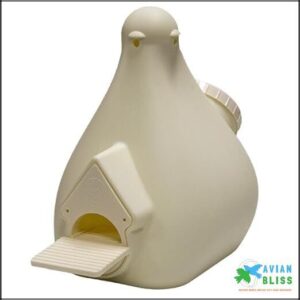
Beige isn’t an accident — BestNest formulated this color specifically to reflect heat while still reading as "natural" to nesting martins. The gourd’s blow-molded polyethylene shell features drainage holes and arched mounting openings, preventing water pooling that plagues lesser housing.
A removable back cap simplifies inspections without disturbing chicks. The crescent entry option requires manual porch installation but much better deters starling competition. At 20 pounds and 16.5 x 10 x 13.5 inches, it’s substantial enough for established colonies, with sun-regulating color keeping nestlings cooler through peak summer heat.
| Best For | Birders looking to establish or expand a large purple martin colony with durable, weather-resistant housing. |
|---|---|
| Material | Plastic |
| Color | Beige |
| Drainage Hole | Yes |
| Target Species | Purple Martins |
| Mounting Method | Pole/rack |
| Access for Cleaning | Removable back cap |
| Additional Features |
|
- Drainage holes and arched mounting openings prevent water pooling
- Removable back cap makes nest inspections and maintenance easy
- Beige color helps regulate temperature, keeping nestlings cool
- Crescent entry design requires manual porch installation
- Some birds may prefer white gourds over beige
- At 20 pounds, it’s heavy enough to make mounting a two-person job
Natural Vs Plastic Martin Gourds
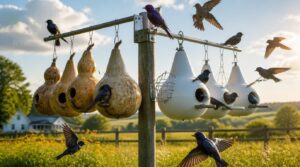
Choosing between natural and plastic gourds shapes how well your colony thrives, so the material you pick matters as much as the placement. Each option carries its own strengths and trade-offs, from how it experiences weather to how easily it keeps predators out. Here’s how the two compare across the factors that count most.
Durability and Weather Resistance
Rarely do colony managers realize how differently natural and synthetic gourds age outdoors. Hardshelled gourds, properly cured, rival plywood for material impact resistance but need recoating every few years for moisture barrier effectiveness. Plastic versions offer steadier UV coating longevity and thermal cycle stability. Selecting weather-resistant materials is essential to make sure the structural integrity of these bird houses against the elements.
| Material | Wind Load Strength |
|---|---|
| Natural gourd | Good, with reinforced struts |
| HDPE plastic | Excellent, flexes under gusts |
| Painted gourd | Moderate, chip-prone |
| Coated wood | Fair, 5-year rot resistance |
Ventilation and Insulation
Natural gourds excel at Thermal Stability, their hardshelled walls buffering nestlings from sudden swings far better than thin plastic. Good airflow depends on vent placement near the top, preventing condensation while avoiding drafts.
| Feature | Natural Gourd Advantage |
|---|---|
| Insulation | Cooler summers, warmer winters |
| Moisture management | Breathable shell reduces mold |
| Vent placement | Top venting aids rising air |
| Condensation | Minimized on inner walls |
Cleaning and Maintenance Ease
Cleaning chores reveal the real gap between materials. Natural gourd shells need gentle scrubbing with mild detergent, while plastic resists scratching entirely with just a damp cloth.
| Factor | Natural | Plastic |
|---|---|---|
| Interior scrub | Soft tools only | Any tool |
| Mold risk | Higher, porous | Lower, nonporous |
| Access ports | Removable caps | Snap panels |
Cleaning frequency depends on climate—wet regions demand mid-season wipe-downs for both types.
Predator and Pest Protection
Predators don’t care which material you choose—they care about access. Both gourds rely on proper entrance hole sizing (2.5–3.0 inches) to exclude raccoons and owls.
| Feature | Natural | Plastic |
|---|---|---|
| Hardware mounts | Drill-required | Pre-installed |
| Liner fit | Custom | Snap-in |
| Spike compatibility | Universal | Universal |
Mounting post spikes and internal nest liners work identically across both, supporting natural pest control regardless of shell type.
Long-term Value Comparison
What does "long-term value" actually mean for your colony? It’s not the sticker price—it’s replacement frequency costs over a decade of seasons.
| Factor | Natural Gourds | Plastic Gourds |
|---|---|---|
| Lifespan | Up to 30 years cured | UV-dependent |
| Maintenance | Annual curing/sealing | Minimal |
| Nesting Density ROI | Higher occupancy | Lower occupancy |
Durable mounting systems matter just as much as material choice for lasting value.
Key Features to Compare

Not all gourd housing is built the same, and the details matter more than you’d think once martins move in. A well-designed gourd protects chicks, keeps starlings out, and makes your job easier come cleaning season. Here are the five features worth checking before you buy.
Starling-resistant Entrance Holes
Starling-resistant entrance holes make or break a martin colony. Choose crescent-shaped openings (about 1¼" high) or 2" round holes fitted with aluminum templates—both block starlings while martins pass freely.
- Crescent cuts on gourds
- Round hole shields
- External tunnel ports
- UV-resistant aluminum trim
External tunnels add extra distance from predators. Precise calibration matters most—too tight, and martins struggle too.
Proper Gourd Cavity Size
Two measurements decide whether a gourd actually works: width and height. Internal diameter standards call for 1.75 to 2 inches, giving chicks room to turn without crowding eggs. Vertical clearance needs run 5.5 to 6.5 inches, preventing wing entanglement as nestlings grow.
| Dimension | Minimum | Purpose |
|---|---|---|
| Width | 1.75" | Egg protection space |
| Height | 5.5" | Movement room |
| Depth | 6–8" | Hatchling capacity |
Drainage and Ventilation Holes
A gourd that traps moisture becomes a death trap for chicks within days. Getting the hole placement right matters as much as size: vent holes sit high, drainage low, working together for humidity control and preventing mold growth.
A gourd that traps moisture becomes a death trap for chicks, so vents high and drainage low are what keep them alive
- 3-4 weep holes, base
- 1/4-3/8" vent holes
- Opposite-side spacing
- Screened openings
- Seasonal debris checks
Predator screen installation keeps wasps out without blocking airflow.
Access Ports for Cleaning
Why crawl inside a gourd every season when a 3-4 cm port does the job? Standard cleaning ports fit brushes and 10-20 mL syringes without full disassembly, placed near the cavity’s bottom third for flushing debris.
| Tool | Port Size | Use |
|---|---|---|
| Brush | 1.5-2mm bristle | Scrubbing |
| Syringe | 10-20mL | Flushing |
| Swab | Slim | Corners |
Seal durability prevents pest entry; log each cleaning date and agent used.
Mounting Rack Compatibility
A rack built for server equipment shares more with your martin colony than you’d think. Hole pattern types, whether square, round, or threaded, determine which mounting interface styles fit your gourd rack.
Check upright profile matching and bracket compatibility testing before buying, since rail depth adjustment varies by system. Mismatched racks cause instability—verify specs first.
Best Placement for Martin Gourds
Buying the right gourd is only half the job; where you hang it matters just as much to a martin’s survival and comfort. Purple martins are particular about their surroundings, and even a well-built gourd will sit empty if the setup around it isn’t right. Here’s what you need to get the placement right, point by point.
Open Flying Space

Why do martins ignore otherwise perfect gourds? Often it’s cramped airspace. Colonies need 8 to 10 feet of vertical clearance and 12 feet of horizontal room around each gourd for safe, collision-free flight passes.
Open corridors prevent bottlenecks during entry, while steady airflow curbs heat and humidity. Clear ground beneath—free of low branches—reduces predator ambush risk and keeps landing zones safe for fledglings.
Ideal Mounting Height
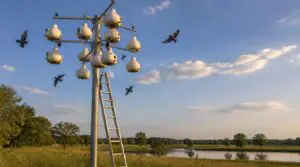
Height matters as much as airspace. Mount gourds 9 to 11 feet above ground, keeping entrances 6 to 7 feet up—high enough to deter raccoons and snakes, low enough for ladder access during cleaning.
In windy areas, favor 10 to 12 feet for stability. Many colony managers start at 9 feet, then raise gourds to 11 after the first nesting cycle to curb predation risk.
Distance From Trees

Trees nearby do more harm than good. Keep gourds at least 25 feet from large trunks, with 40 feet of open flying clearance to prevent collisions and ambush attacks from perched predators.
- Reduce shading that lowers cavity warmth
- Limit parasite spread from dense canopies
- Cut nighttime predator access via overhanging branches
Whether you’re hanging natural or ornamental gourds, distance protects sunlight exposure martins depend on for healthy fledging.
Nearby Water Sources

Open clearance solves half the equation; the other half is food. Place gourds within a quarter mile of a pond, reservoir, or river — reservoir insect abundance and riverbank foraging sites give colonies the aerial insects martins need.
Seasonal water fluctuations shift insect density, so colonies near stable aquatic habitat overlap fare best. Water quality matters too: cleaner systems sustain richer prey year-round.
Safe Colony Spacing

Sixty feet of open air between gourds isn’t arbitrary — it’s the minimum flight path clearance martins need to dodge collisions during dawn departures.
- Inter-colony territoriality: keep clusters 120 feet apart
- Predator buffer zones: 15 feet from heavy vegetation
- Nesting density management: vary entrance orientations
- Microclimate airflow spacing: 4 feet between rows
- Reassess yearly; add 10–20% room as colonies grow
Gourd House Care Tips

A well-placed gourd only earns its keep if you keep it in good shape year after year. Cured hard-shell gourds can last decades, but only with the right seasonal attention. Here’s what that care routine actually looks like, from first cleaning to winter storage.
Pre-season Cleaning Checklist
Before Martins return, give every gourd a thorough once-over: removing old debris, sanitizing interior cavities with a mild non-toxic solution, and inspecting shell integrity for cracks. Seal any breaks with wildlife-safe sealant.
Drying gourd surfaces completely afterward prevents mold and stops parasite buildup before it starts. Whether you’re working with dried gourds or plastic models, this checklist applies equally.
Nest Inspection Routine
Inspect within 24 hours of adult departure, logging date, weather, and nest material depth. Wear a glove, skip squeezing material, and keep lid-time under 20 seconds.
Watch for mold, mites, cracked shells, and predator scratch marks. Photograph cavity layouts each visit. Whether gourds are dried originals or ornamental crafts, documentation builds a reliable record protecting nestling health colony-wide.
Repainting Natural Gourds
A faded gourd loses its appeal fast, but a few hours of care restores it season after season.
- Wipe away old sealer gently before recoating
- Sand rough patches for better paint adhesion
- Use acrylic or milk paint on dried gourds
- Apply matte sealer in thin coats
- Store ornamental gourds away from direct sun
These sustainable crafts deserve refreshed color, protecting both birdhouses and the martins inside them.
Preventing Mold and Moisture
Moisture is the silent enemy of every gourd colony, quietly inviting mold long before you spot it.
Keep humidity between 30 and 50 percent, drill drainage holes at the cavity’s lowest point, and space gourds 2-3 inches apart for cross-ventilation. Check after heavy rain, vent briefly if condensation appears, and dry gourds below 12% moisture before reassembly each season.
Off-season Storage Tips
Empty gourds need just as much care as occupied ones. Clean and dry thoroughly, then store in breathable storage containers away from heating vents.
- Wipe with mild solution, air dry fully
- Bag in fabric or vented bins
- Maintain 50°F–70°F, 40–60% humidity
- Deter pests with cedar blocks
- Photograph and log each gourd
Good moisture control methods and seasonal inventory documentation make spring reassembly painless.
Frequently Asked Questions (FAQs)
What are the best gourds for martin houses?
Like medieval craftsmen choosing seasoned oak, you want bushel and bottle gourds at 120-180 days maturity. Thick shells, deep cavities, and rounded calabash shapes outperform thin-walled or dried gourds rushed to market before reaching true structural hardness.
Do purple martins prefer gourds or houses?
Given a choice, martins usually favor gourds, drawn by deeper interior space, better thermal insulation, and historical nesting patterns dating to colonial times—when Cucurbitaceae fruits, including bottle and ornamental gourds, predated manufactured birdhouses entirely as nesting cavities.
What is one disadvantage of gourd birdhouses?
Their tough rind invites trouble: predator access risks rise with raccoons gnawing through cavities, while moisture seeping into dried gourds encourages mold growth, and weathering causes cracking, making cleaning and sourcing consistent, hard-rinded fruits genuinely difficult year after year.
What is the best housing for purple martins?
Cured Lagenaria gourds outperform synthetic housing, offering better thermal insulation and natural ventilation.
Multi-compartment systems with starling-resistant holes, proper drainage, and 6–7 inch cavities support colony growth—combining durability nearing 30 years with the breathable comfort martins evolved alongside.
What is the best gourd for purple martins?
Choose round Lagenaria bottle gourds with at least a 10-inch diameter, thick cured shells, and proper curing to resist cracking. Round shapes outperform oblong ones for entry ease—grouping four or more encourages natural colony nesting behavior.
How do purple martins choose nesting sites?
Martins weigh open sightlines, insect-rich foraging grounds, and predator deterrence near human activity.
Cavity availability and site fidelity matter most—pairs often return to gourds, birdhouses, or vessels that succeeded before, favoring elevated, structurally sound options over ornamental or dried gourds alone.
Can gourds be reused year after year?
Yes, properly cured gourds can serve multiple seasons if gourd structural integrity remains intact. Sanitize with mild bleach, dry thoroughly, and store in cool, ventilated spaces.
Natural vs. plastic options differ: plastic resists mold longer, while dried gourds need vigilant moisture checks.
What materials deter predators from reaching nests?
Think of predators as climbers without a foothold: slick metal surfaces and smooth plastic barriers turn raccoon claws and snake scales into useless tools.
Non-porous material and UV stabilized coatings keep that predator-resistant texture intact for decades on guards and gourds alike.
Do purple martins prefer natural or synthetic gourds?
Studies and keeper reports lean toward natural gourds, citing better thermal buffering, irregular cavity shapes martins tolerate, and higher occupancy rates—sometimes 100%.
Synthetic versions offer durability and easy cleaning, but lack the natural resonance and insulation properties that boost nesting success.
How does climate impact gourd birdhouse durability?
Rain triggers moisture absorption that swells the shell, while UV exposure fades coatings; freeze-thaw cycles widen micro-cracks.
Daily temperature swings stress seams and finishes, and mold growth thrives in humid conditions, all shortening a cured gourd’s working life outdoors.
Conclusion
Every June, scouts return to the same skies their ancestors traced decades ago, searching for a cavity that fits. That instinct hasn’t changed; your housing must meet it halfway.
The best gourd bird houses for purple martins aren’t the flashiest ones on a shelf—they’re the ones with correct dimensions, sound drainage, and predator guards already proven in the field. Hang one with care, and you’re not just building a birdhouse. You’re extending an invitation decades in the making.
- https://www.smithfieldparksva.com/Faq.aspx?TID=21
- https://fieldreport.caes.uga.edu/publications/C977/purple-martins
- http://www.chuckspurplemartinpage.com/requirem.htm
- https://www.birdwatching.com/tips/purplemartins.html
- https://www.birdsandblooms.com/backyard-projects/diy-birdhouse/make-purple-martin-gourd-birdhouse