
This site is supported by our readers. We may earn a commission, at no cost to you, if you purchase through links.

Most nest boxes fail birds before a predator even arrives. The location, the pole, the height—small oversights stack up fast, and a raccoon or rat snake will find every one of them.
Across North America, nest box programs lose thousands of clutches each season to predators that were practically invited in by poor placement.
The good news: most of those losses are preventable. Predator-safe nesting box placement isn’t complicated, but it does require getting specific details right.
This guide walks you through exactly what works—site selection, mounting height, guard hardware, and the maintenance habits that keep boxes productive year after year.
Table Of Contents
Key Takeaways
- Where you place the box is your first defense — keep it 6–10 meters clear of branches, fences, and anything a raccoon can climb.
- Height and species match aren’t optional: bluebirds need 4–6 ft in open fields, wood ducks need 6–10 ft above water, and getting it wrong invites the wrong visitors.
- Smooth metal poles plus cone or stovepipe baffles physically stop climbers — no grip, no traction, no second chance.
- A safe box isn’t a one-time setup; check guards after every storm, trim new growth monthly, and clean boxes each fall before breeding season starts.
Choose a Predator-Safe Site

Where you put your nest box matters more than most people realize. The site itself is your first line of defense against predators.
Here’s what to get right before you drive a single stake into the ground.
Before you commit to a spot, brush up on bird feeder placement tips for every season and microclimate so you’re not relocating it a week later.
Keep Boxes Away From Low Fences, Branches, and Climbable Structures
Placement matters more than most people realize. Low fences, overhanging branches, and climbable structures like trellises are basically a free ladder for raccoons and squirrels.
Keep box isolated from anything within 6 meters. Remove low obstacles near the pole, and use elevated stands to raise the boxes away from easy reach.
prevent climbing access before it becomes a problem. Avoid fencing near the site, since unfenced tree boxes protect roots.
Leave a Clear Buffer Around The Nest Box
Once the climbable structures are gone, your next job is the buffer zone itself.
Keep a 6–10 metre clear ring around the box — no dense shrubs, no clutter. Ground clearance reduces scent management problems fast; bare, sunlit ground limits predator cover.
Trim vegetation back at least 2 metres from the entrance. Regular buffer zone monitoring catches new growth before it quietly becomes a predator highway.
Place Boxes Near The Target Bird’s Preferred Habitat
The buffer helps — but it only works if the box is actually in the right spot.
Habitat Edge Proximity matters more than most people think. Bluebirds want open fields; wrens need woodland margins.
Match Vegetation Structure and Foraging Route Access to your target species.
Seasonal Habitat Alignment and Microclimate Sunlight exposure seal the deal — morning sun, stable cover nearby.
Avoid Busy Predator Travel Routes and Hiding Spots
Habitat match sets the stage. Now think about who else uses that space.
Predators follow predictable routes — fences, trails, water edges. That’s Linear Feature Avoidance in practice.
Choose spots with Irregular Terrain Selection: uneven ground, shrub patches, broken sightlines. Thorny Barrier Placement near the approach works well.
Map seasonal movement, manage Trail Proximity, and you’ll quietly stack the odds in the birds’ favor.
Set The Right Height and Direction

Height and direction matter more than most people realize. A box that’s too low — or facing the wrong way — can undermine everything else you’ve done right.
Here’s what to get right before you mount anything.
Match Mounting Height to The Bird Species
Height isn’t a suggestion — it’s a survival factor. Placement matters — species-specific nest box requirements aren’t negotiable.
Mount bluebird boxes at 4–6 ft, wrens at 6–10 ft, and tree swallows at 6–15 ft. Wood ducks need 6–20 ft above water; owls prefer 12–20 ft.
Always mount on poles, not posts. Get the height right, and your predator guard works harder.
Face The Entrance East or Northeast
Direction matters more than most people think. Face the entrance east or northeast — never east or southeast. Morning Sun Benefits start the moment light hits the box: Dawn Activity Boost kicks in early, Microclimate Cooling keeps temps stable, and Predator Approach Angles stay exposed.
- Gradual warmth aids hatchling development
- Afternoon Heat Management reduces overheating risk
- Open sightlines discourage ambush predators
- Morning light simplifies predator guard inspection
Shield The Box From Prevailing Winds
Wind hits a poorly placed box like a cold hand reaching straight in. Block it with Windbreak Vegetation — dense shrubs 3–5 feet tall on the windward side create a Perimeter Buffer Zone that cuts gusts by up to 60%.
A Lattice Wind Wall filters turbulence without trapping heat. Add Entrance Hood Design with a 15–20 cm roof overhang and maintain Leeward Clearance Space so air dissipates cleanly.
Balance Morning Sun With Afternoon Shade
Think of your nest box as a tiny house — orientation controls the climate inside.
- East-facing entrances catch morning light timing without afternoon thermal stress
- Afternoon Heat Mitigation improves with shade structure placement from nearby trees
- Ventilation Sunlight Balance keeps the cavity 5–8°F cooler on hot days
- Seasonal Sun Adjustments account for shifting angles spring through fall
- Predator deterrence techniques for nest boxes by reducing heat signatures
Install Effective Predator Guards
A good location gets you halfway there — the right guards do the rest.
Raccoons, snakes, and squirrels are persistent, but they’re also predictable, and there are proven ways to stop each one. Here’s what actually works.
Use Smooth Metal Poles Instead of Wood Posts

Wood rots. Metal doesn’t. That’s really the whole argument.
Smooth metal poles give raccoons and snakes nothing to grip. No bark texture, no rough grain — just a surface that says "good luck". They won’t warp, they resist termites, and galvanized options offer serious corrosion longevity in wet or coastal spots. Aluminum stays rust-free and makes light weight installation easy for solo setups.
Smooth metal poles give raccoons and snakes nothing to grip — no bark, no grain, no second chance
| Pole Type | Key Benefit | Best Use |
|---|---|---|
| Galvanized Steel | Corrosion longevity 25+ years | Humid or coastal sites |
| Aluminum | Light weight installation | Remote or multi-box setups |
| Smooth Steel | Non-porous surface, predator mitigation | General metal pole mounting |
Cost-effective longevity seals the deal — metal pole mounting outlasts wood by two to four times with almost zero upkeep.
Add Cone or Stovepipe Baffles on Poles
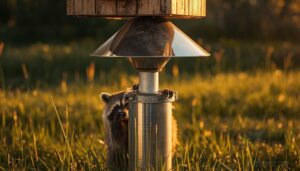
A smooth metal pole gets you halfway there — baffles close the deal. Cone baffles (8–12 inches cone diameter) and stovepipe length guards wrap the pole and physically stop climbers cold. Both work through simple physics: no grip, no traction.
- Cone baffles deflect raccoons and squirrels with a flared edge
- Stovepipe pole baffles use slick interior metal finish to deny footholds
- Secure mounting hardware with hose clamps; stick to an annual inspection schedule
Fit Entrance-hole Guards to Stop Enlargement
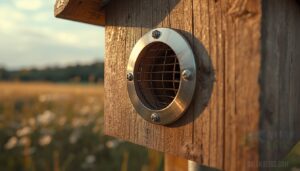
Baffles handle the pole — now protect the hole itself. metal predator guard is your next layer.
For a 1½-inch bluebird entrance, the outer guard diameter should reach at least 3½ inches. That’s your diameter specification doing real work. Match hole size 1⅛ for chickadees accordingly.
Use metal predator guards — they outlast plastic every season. Corrosion-resistant fasteners prevent loosening; flush clearance guidelines keep birds moving freely.
Use Snake Guards on Mounting Shafts
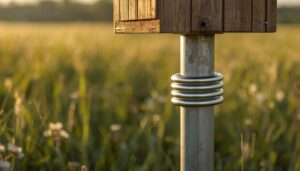
Snake guards close the gap that pole baffles can’t reach. Mount a cylindrical stainless steel or aluminum guard directly around the shaft — material choice matters here, since corrosion kills effectiveness fast.
Shaft diameter fit should be snug, with no gaps. Height clearance needs to clear nearby vegetation.
Use sealant application at joints, and keep routine cleaning on your schedule. Predator guard effectiveness depends on it.
Match Placement to Bird Species

Not every bird plays by the same rules. Where you put the box matters as much as how you build it.
Here’s how to place it right for the species you actually want.
Position Bluebird Boxes in Open Areas
Bluebirds thrive in open grasslands — that’s not an accident. They need high visibility locations to spot predators early. Place your box in a low grass surrounding, on a gentle slope placement, if possible, with minimal human disturbance nearby. Southern exposure avoidance matters too; east-facing entrances stay cooler.
For solid predator protection, follow these placement guidelines for cavity-nesting birds:
- Keep 25+ feet from trees or shrubs
- Use predator deterrence techniques for nest boxes, like metal baffles
- Mount at 5–6 feet in a clear, open field
Place Chickadee and Wren Boxes Near Suitable Cover
Unlike bluebirds, chickadees, and house wrens actually want cover nearby. Place their boxes 20–50 feet from shrubs or understory trees — close enough for quick escape, not so close that predators lurk underneath.
Thorny shrub planting beneath the box adds a natural predator guard. Think vertical vegetation layers, microhabitat complexity, and ground cover management, working together.
Seasonal cover adjustments keep your placement guidelines for cavity-nesting birds effective year‑round.
Set Tree Swallow Boxes Near Water or Marsh Edges
Tree Swallows live where flying insects are thick — think marsh edges, pond margins, and wetland meadows.
Mount boxes 3–4 meters high on smooth metal poles with predator guards, set back roughly 100 meters from the shoreline.
buffer dodges shoreline predator corridors and keeps edge vegetation management simple.
Face entrances east, monitor water levels seasonally, and you’ll nail placement guidelines for cavity-nesting birds every time.
Mount Wood Duck Boxes Above Water at Safe Heights
Wood ducks need boxes mounted 6–10 feet above the water surface — high enough to block most climbing predators, low enough for ducklings to safely leap out. Use a duck pole system with corrosion-resistant baffle material choice to handle wet conditions.
Water level monitoring matters year-round; seasonal height adjustment prevents flood resilience design failures. Face the entrance toward open water, keep sightlines clear for visual predator surveillance, and you’ll give every wood duck nest box a real shot at success.
Maintain a Safer Nest Box Site

Setting up your nest box is only half the job. Keeping it safe means staying on top of a few simple habits throughout the year.
Here’s what to check and when.
Inspect Baffles, Poles, and Guards After Storms
After every storm, walk your setup with fresh eyes. Start with a Baffle Damage Inspection — look for dents, gaps, or loose seals where cone or stovepipe pole baffles meet the shaft. Move to a Pole Corrosion Check, then a Guard Alignment Test on your predator guards and snake guards. Finish with a Hardware Tightness Review and Base Erosion Assessment.
predator deterrence techniques for nest boxes and predator mitigation strategies for nest boxes keep everything working.
Clean and Repair Boxes on a Seasonal Schedule
Skipping your Seasonal Cleaning Routine is like ignoring a slow leak — small neglect turns into real loss. Stick to an annual cleaning schedule between September and February, and follow a solid Box Inspection Checklist each time.
- Brush out debris; wipe interior with mild soap
- Air-dry completely before adding fresh nesting material
- Run through Interior Sanitization Steps using a 1:9 bleach solution
- Log every fix in your Repair Log Tracking notes
- Review your Material Maintenance Schedule every two to three years for exterior sealing
These maintenance and cleaning protocols for nest boxes keep your predator guards effective and your seasonal timing for installing and inspecting nest boxes sharp — giving birds a genuinely safe start.
Check for New Climbing Routes or Predator Access
Predators are problem-solvers. storm shifts your baffle; a vine creates a new ladder overnight. Walk the site monthly and scan for Vegetation Overgrowth creeping toward the pole. Use Trail Camera Monitoring and Footprint Tracking to catch what you miss at dusk. Log everything in your Predator Activity Logs.
| Check Type | What to Look For | Action |
|---|---|---|
| Seasonal Gap Scanning | Gaps around guards or baffles | Seal immediately |
| Trail Camera Monitoring | Nocturnal predator visits | Reposition predator baffles |
| Footprint Tracking | Tracks near pole base | Add predator exclusion layer |
| Vegetation Overgrowth | Branches reaching the box | Trim back 1 meter |
| Predator Activity Logs | Repeat access attempts | Upgrade predator protection |
Good predator deterrence isn’t set-and-forget — it’s a living system.
Monitor Occupancy Without Disturbing Active Nests
Checking in shouldn’t mean barging in. Use remote cameras, thermal imaging, or acoustic sensors to track activity without cracking open a box. Data loggers quietly record visits over time.
Night vision lets you verify occupancy after dark. Stick to weekly observation intervals during incubation — no daily drop-ins. Ethical watching tips and solid nest box monitoring protocols protect both your data and your birds.
Frequently Asked Questions (FAQs)
Where should you not put a bird box?
Don’t put a bird box near busy roads, under eaves, close to pet enclosures, near loud machinery, or in flood-prone areas. Those spots spell trouble fast for nesting birds.
Which predators are most dangerous to nesting birds?
Raccoons, domestic cats, and snakes top the danger list. Mammalian predators raid cavities with ease.
Aerial raptors take fledglings fast. Corvid attacks expose eggs.
Squirrels enlarge entrance holes. Snake predators strike quietly at night.
Should nest boxes be removed during winter months?
Don’t pull them down. Winter roosting benefits are real — birds use boxes as thermal shelters on cold nights.
Leave them up, but plan your winter cleaning schedule before spring breeding begins.
How does box color influence predator attraction?
Earth-tone paint acts as a predator deterrent. Bright or high-contrast finishes create glare that attracts predators fast.
Stick to camouflage color — muted browns and greens using non-toxic paint blend the box right into its surroundings.
Conclusion
A bluebird box mounted on a smooth metal pole, baffled at 4 feet, set 50 yards from treeline—that’s a nest that survives the season.
Predator safe nesting box placement isn’t guesswork. It’s a series of deliberate choices that stack in the birds’ favor. Get the site, height, and hardware right.
Check it after every storm. The birds do the rest. Give them a fair chance, and they’ll show up.