This site is supported by our readers. We may earn a commission, at no cost to you, if you purchase through links.
Stand at the edge of an Everglades canal at dawn and you’ll likely share the water with something prehistoric—a Great Blue Heron, nearly 4 feet tall, locked in perfect stillness as it waits to strike.
Florida hosts five major heron species, each adapted to a distinct niche across the state’s 11 million acres of wetlands, from inland freshwater marshes to Gulf‑facing mangrove swamps.
Knowing what separates a Tricolored Heron from a Little Blue, or why the Green Heron drops bait into the water like a tiny fisherman, makes every sighting richer—and Florida’s birding spots genuinely reward that kind of attention.
Table Of Contents
- Key Takeaways
- Florida Heron Species Overview
- How to Identify Florida Herons
- Where Herons Live in Florida
- Heron Behavior, Diet, and Nesting
- Best Florida Heron Watching Spots
- Frequently Asked Questions (FAQs)
- Did I see a crane or a heron?
- What birds are mistaken for herons?
- Is it rare to see a heron?
- Is the heron native to Florida?
- Can herons recognize individual human faces?
- How do herons react to extreme weather events?
- What are herons’ primary predators in Florida?
- How do herons interact with other bird species?
- Do herons migrate in groups or individually?
- How do herons build and maintain their nests?
- Conclusion
Key Takeaways
- Florida’s five resident heron species — Great Blue, Great Egret, Little Blue, Green, and Tricolored — each occupy a distinct niche across the state’s wetlands, from freshwater marshes to tidal flats, so knowing their habitat preferences is your fastest path to finding them.
- Size, plumage, and flight style are your three sharpest field ID tools: the Great Blue’s 7-foot wingspan and slow wingbeats look nothing like the Green Heron’s compact, shadowy crouch along a canal edge.
- The Green Heron stands out behaviorally — it’s one of the rare birds that deliberately drops bait onto the water to lure fish, a sign that tool use isn’t limited to mammals or corvids.
- Florida’s top heron hotspots — Everglades National Park, Merritt Island NWR, and Lake Apopka — reward early-morning visits with close, reliable sightings, especially in winter when wading bird activity peaks.
Florida Heron Species Overview
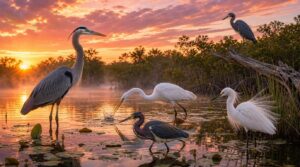
Florida is home to some of the most striking wading birds you’ll find anywhere in North America. Whether you’re scanning a quiet marsh at sunrise or watching from a boat along the coast, you’re likely sharing the water with at least one of five species that show up again and again. Here’s a closer look at each of them.
If you want to go deeper, this guide to Florida’s most iconic long-legged wading birds covers 18 species worth keeping on your radar.
Great Blue Heron
The Great Blue Heron is the largest heron you’ll find in Florida, standing about 1.2 meters tall with a wingspan stretching nearly two meters. Its blue-gray plumage, white face, and bold black eye stripe make it unmistakable, even from a distance. The species has an incubation period length of 25–30 days.
- Appears on 33% of winter checklists in Florida
- Thrives in freshwater marshes, mangrove shores, and tidal flats
- Global population estimated at 700,000 individuals
- Classified as Least Concern by conservation standards
- A reliable sighting at Merritt Island NWR year-round
Great Egret
If the Great Blue Heron is the commanding giant of Florida’s wetlands, the Great Egret is its elegant counterpart — all-white, sharp-billed, and impossible to miss.
| Feature | Detail | Season |
|---|---|---|
| Length | 90–100 cm | Year-round |
| Bill color | Bright yellow | Year-round |
| Back plumes | Long aigrettes | Breeding |
The aigrette display peaks March through July, when delicate back plumes fan out during courtship. You’ll spot it on 31.6% of summer checklists and 38% of winter ones across Florida’s freshwater and saltwater marshes alike.
Little Blue Heron
Switch from the all-white Great Egret to a bird that wears two completely different outfits depending on its age. Juvenile Little Blue Herons are entirely white, which trips up many beginners.
Adults shift to slate-blue with a maroon neck, about 24 inches long. They favor freshwater marshes but use coastal estuaries when needed, appearing on 21.4% of Florida summer checklists.
Green Heron
Now here’s a bird that plays the stealth game better than almost any other. The Green Heron (Butorides virescens) is small — just 16 to 18 inches long — but don’t let its size fool you. It hunts alone, often freezing motionless on a low branch above the water before striking with surprising speed.
- Weighs barely 8 to 9 ounces, yet feeds itself year-round across Florida’s wetlands
- One of the few birds known to drop bait onto the water to lure fish within reach
- Its compact, dark profile makes it easy to overlook along shaded canal edges
You’ll find it in freshwater marshes, mangrove edges, and suburban retention ponds. Nesting starts in spring, with 3 to 5 pale blue-green eggs per clutch and both parents sharing incubation duty for about 20 days.
Tricolored Heron
Unlike the Green Heron’s secretive crouch-and-wait style, the Tricolored Heron works in the open — stalking shallow coastal marsh edges with long, deliberate strides. At 26 to 30 inches with a 41–50 inch wingspan, it’s slender and fast.
Its remarkable speed and reach are shaped by a surprisingly compact frame — explore the full tricolored heron size and field identification guide to see how its proportions compare across similar wading birds.
That bold white belly stripe makes it one of Florida’s most recognizable wading birds, especially during breeding season near Merritt Island National Wildlife Refuge.
How to Identify Florida Herons
Once you know what to look for, telling Florida’s herons apart gets a lot easier. Each species carries its own set of clues — from body size and posture to leg color and how it moves through the air. Here are the key things to check when you’re out in the field.
Size and Shape Clues
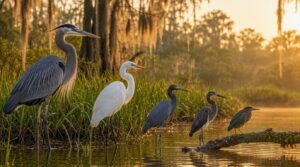
Size is your first real clue in the field.
The Great Blue Heron towers at 42–54 inches with a wingspan stretching nearly 7 feet — roughly the height of a tall person with arms spread wide. The Great Egret is slightly smaller.
The Little Blue and Tricolored Herons are mid-sized, while the Green Heron is compact at just 16–18 inches.
Plumage and Color Morphs
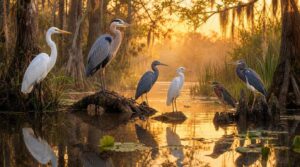
Once you know the size, color becomes your next shortcut. Plumage coloration separates species fast:
- Great Egret — all-white year-round, black legs, yellow bill
- Great Blue Heron — slate gray-blue, white throat, black eye stripe
- Little Blue Heron — blue-gray adult, white juvenile
- Green Heron — dark greenish back, chestnut neck
- Tricolored Heron — blue-gray with a white belly
Bills, Legs, and Feet
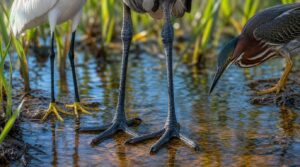
Look closely, and a heron’s bill, legs, and feet tell you almost everything. Sharp, pointed bills pierce fish with minimal splash — longer in larger species like the Great Blue Heron, compact in the Green Heron.
Bright yellow "golden slippers" instantly mark the Snowy Egret. Long legs keep bodies above water while anisodactyl toes grip slippery mud during patient, motionless stalking.
Flight Pattern Differences
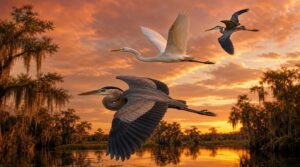
Watch a heron take flight, and the species often reveals itself before you can raise binoculars.
The Great Blue Heron cruises at 10–20 meters, beating slowly at 1.5–2.0 times per second, neck folded in a tight S-curve.
The Great Egret flies slightly higher with smoother, longer glides.
The Tricolored Heron, by contrast, mixes quick directional bursts with moderate arcs — restless and unpredictable compared to its larger cousins.
Herons Versus Egrets
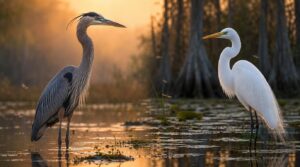
Here’s one of the trickier parts of wading bird identification: egrets are technically herons. The real difference is plumage — egrets are mostly white, while herons like the Great Blue show mottled gray-blue coloring.
Size matters too; the Great Blue stands nearly 48 inches tall, dwarfing the slimmer Great Egret. Same family, different field marks.
Where Herons Live in Florida

Florida herons aren’t picky — but they do have preferences. Each species has a tendency to stake out a specific type of wetland based on water depth, salinity, and available food. Here’s a look at the five key habitats where you’re most likely to find them.
Freshwater Marshes
Florida’s freshwater marshes are some of the best places to spot herons in Florida. Great Blue Heron and Great Egret both forage along flooded edges where hydric soil profiles stay saturated year-round.
Seasonal vegetation shifts expose shallow feeding zones, and the nutrient-filtering role these wetlands play keeps fish populations healthy — which means reliable hunting grounds for wading birds and active nesting colonies nearby.
Mangrove Swamps
Freshwater marshes give way to something wilder as you move coastward — the tangled, salt-tolerant world of mangrove swamps.
Great Blue Heron thrives here, stalking prey through the tidal root systems where juvenile fish and shrimp shelter.
Salinity fluctuations shape who eats what and when, making these mangrove nursery grounds surprisingly productive birding hotspots in Florida.
Tidal Flats
Step off the mangrove roots and onto something entirely different — tidal flats, broad sheltered zones where fine sediments settle as tidal currents slow.
At low tide, these exposed muddy surfaces become open-air buffets.
Great Egret and Tricolored Heron work the shallow edges, picking off crustaceans and small fish concentrated in runnels left behind by the retreating water.
Lakes, Ponds, and Canals
Move inland from the tidal flats, and you’ll find herons thriving just as well around lakes, ponds, and canals.
Little Blue Heron favors shallow ponds where aquatic vegetation crowds the edges, making fish and amphibians easy targets.
Florida’s vast canal networks provide habitat connectivity that links wetland habitats across the state.
- Great Blue Heron patrols open lake margins year-round
- Little Blue Heron hunts shallow, plant-rich pond edges
- Canals near Lake Okeechobee concentrate waterbirds seasonally
- Lake Apopka Restoration Area helps recovering freshwater marshes
Coastal Estuaries
Coastal estuaries are where Florida’s heron world truly opens up. Saltwater marshes and tidal flats deliver a constant supply of fish, crabs, and shrimp as tides cycle nutrients through the system. Tricolored Heron and Great Blue Heron work these edges daily.
| Habitat Feature | Heron Benefit |
|---|---|
| Tidal nutrient cycling | Concentrates prey near shore |
| Mangrove shoreline protection | Shelters nesting colonies |
| Salt marsh biodiversity | Enables year-round foraging |
Heron Behavior, Diet, and Nesting
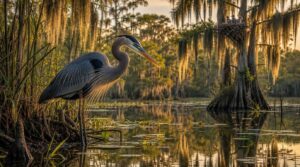
Watching a heron hunt is like seeing patience turned into a skill. These birds have fine-tuned everything — how they eat, what they eat, and how they raise their young — to fit Florida’s wetlands perfectly. Here’s a closer look at the behaviors that make them such effective hunters and nesters.
Fish and Amphibian Hunting
Most Florida herons are built around one core strategy: get close, stay still, then strike before the fish knows what happened. This silent strike technique takes less than 0.15 seconds — faster than a blink.
Prey preference shifts by species. Great Blue and Great Egrets target larger fish like sunfish, while Little Blue and Green Herons hunt minnows and tadpoles along marsh edges.
Crabs, Shrimp, and Insects
Fish aren’t the only thing on the menu. When tides shift and crustaceans become abundant, herons quickly adapt. Their diet consists mainly of whatever the wetland offers — and that includes crabs, shrimp, and insects.
Here’s what they target beyond fish:
- Fiddler and ghost crabs along mangrove shores
- Juvenile shrimp in tidal creeks and seagrass beds
- Aquatic beetles and dragonfly larvae near marsh edges
- Grasshoppers during dry-season foraging inland
Ambush Feeding Strategies
Herons are patient, calculated ambush predators — not chasers. They crouch low, lean forward, and go completely still, sometimes for several seconds, waiting until prey is perfectly positioned.
Motionless waiting isn’t laziness; it’s precision. A sudden neck lunge covers the distance before the fish even registers the threat.
Green Heron Tool Use
The Green Heron is one of the few birds in the world that use tools to hunt.
The Green Heron is one of the rare birds that uses tools to lure fish within striking range
It drops small objects — insects, feathers, leaves, even tiny sticks — onto the water’s surface to lure curious fish within striking range. Once a fish rises to investigate, the heron strikes fast.
Adults use this technique most often; juveniles tend to learn by watching.
Colony Nesting Season
Watching a colony nesting season unfold is something else entirely. Starting in late winter, herons and egrets gather at traditional sites called heronries or rookeries, often mixing species in the same trees.
Nest building wraps up within weeks, egg laying follows in a narrow two-to-three-week window, and fledglings leave roughly six to eight weeks after hatching.
Best Florida Heron Watching Spots
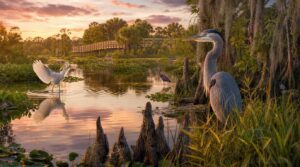
Florida makes it easy to find herons — you just need to know where to look. Certain parks and refuges across the state consistently put you within a few feet of multiple species at once. These five spots are worth putting at the top of your list.
Everglades National Park
If there’s one place in Florida that genuinely earns its reputation, it’s Everglades National Park.
Spanning 1.5 million acres of sawgrass prairies, mangrove forests, and coastal marine waters, it’s a stronghold for wetland habitats that support a vast range of species of herons, egrets, and bitterns in Florida — making it a must-visit for any serious birdwatching enthusiast.
Merritt Island NWR
If the Everglades feel wild and untamed, Merritt Island NWR offers something different — a 140,000-acre refuge where rocket launch pads share the skyline with Great Blue Herons gliding over marsh. That NASA integration makes this one of the most unusual birding hotspots in Florida.
Drive the Black Point Wildlife Drive and you’ll move through freshwater impoundments packed with wading birds, especially during winter.
Lake Okeechobee
From Merritt Island’s rocket-shadowed marshes, head inland to Lake Okeechobee — Florida’s largest freshwater lake at 730 square miles. Its shallow wetlands and littoral zones draw Great Blue Heron and Great Egret year-round. Here’s what makes it worth the stop:
- Lake shoreline foraging zones host wading birds daily
- A rich fish community — bass, bluegill, crappie — keeps herons well-fed
- Wetland restoration efforts have improved habitat quality substantially
- Algal dynamics shift seasonally, so winter visits offer clearer water and better sightings
St. Marks NWR
From Lake Okeechobee, shift your gaze north to St. Marks National Wildlife Refuge, established in 1931 across more than 86,000 acres in Florida’s panhandle. Its 43 miles of Gulf coastline, saltwater marshes, tidal creeks, and freshwater wetlands create layered habitat that draws herons, egrets, Winter Waterfowl, and Saltmarsh Birds all year.
| Feature | Detail | Why It Matters |
|---|---|---|
| Size | 86,000+ acres | Room for multiple species zones |
| Wilderness Area | 17,350 acres designated | Undisturbed nesting and foraging |
| Visitor Facilities | Boardwalks, trails, lighthouse | Easy access for bird watching |
| Best Season | Winter | Peak wading bird activity |
| Annual Visitors | ~350,000 | Well-maintained, accessible refuge |
Conservation Management here — including managed water control impoundments and fire restoration — actively bolsters breeding colonies and stable wetland health. Walk Lighthouse Road at dawn, and you’ll likely spot Great Blue Heron and Tricolored Heron within minutes.
Lake Apopka Area
Tucked into Orange County, Lake Apopka’s North Shore spans nearly 20,000 restored acres — and wading birds have clearly noticed. Decades of phosphorus reduction and wetland rebuilding have brought back freshwater marshes thick with herons.
Drive the free Wildlife Drive loop, log your sightings on eBird, and you’ll likely spot Great Blue Herons, Little Blue Herons, and Tricolored Herons foraging the shoreline.
Frequently Asked Questions (FAQs)
Did I see a crane or a heron?
That large bird standing still at the water’s edge — was it a crane or a heron? The easiest clue: neck shape in flight. Herons fold theirs into an S-curve; cranes fly with necks fully extended.
What birds are mistaken for herons?
The most common mix-ups involve Great Egret, Snowy Egret, and Sandhill Crane. Their similar size, white plumage, or wading posture trips up even seasoned observers in the field.
Is it rare to see a heron?
No, seeing a heron isn’t rare. In Florida, Great Blue Herons and Great Egrets appear on nearly a third of all eBird checklists year-round, making them reliably easy to spot near shallow water.
Is the heron native to Florida?
Yes — all five common species are native Florida residents. Great Blue Heron, Great Egret, Little Blue Heron, Green Heron, and Tricolored Heron all breed, nest, and live here year-round.
Can herons recognize individual human faces?
Some raptors and corvids can recognize individual human faces, remembering people who posed threats or offered food. Herons show similar habituation — repeated calm encounters near Florida’s wetlands make them noticeably more tolerant of familiar visitors.
How do herons react to extreme weather events?
Extreme weather hits hard. Hurricane nest damage can scatter entire colonies overnight. Storm foraging shifts push birds toward calmer inland waters when flooding reduces fish access along coastal flats.
What are herons’ primary predators in Florida?
Florida herons face threats from alligator ambush predation near waterways, raccoon nest raids, eagle aerial threats, snake tree climbing to reach eggs, and owl night predation targeting chicks after dark.
How do herons interact with other bird species?
Herons rarely fly solo in the social sense. They share wetlands with egrets, anhingas, and coots — competing for fish, borrowing alarm calls, and nesting in mixed rookeries where dozens of species raise chicks side by side.
Do herons migrate in groups or individually?
Most migrate individually or in small groups. Some stay year-round through partial migration, while cold fronts push others south temporarily. Loose mixed flocks may share stopovers, but solitary travel dominates outside the breeding season.
How do herons build and maintain their nests?
Nest Construction starts before the eggs arrive. Males gather sticks; females weave them into a sturdy platform. Colonies reuse and expand these colony rookery structures each season, reinforcing them with grasses and softer lining materials.
Conclusion
heron you almost walked past—still as driftwood, blending into the reeds—was already watching you.
what makes herons in Florida so worth learning: reward patience and attention with moments most visitors never notice.
Whether you’re scanning a canal edge or a mangrove flat, knowing each species sharpens your eye and deepens every encounter.
Florida’s wetlands don’t hide their wonders—they simply ask you to slow down long enough to see them.
- https://cruisecocoa.com/blog/herons
- https://www.birdsandblooms.com/birding/birding-basics/bird-species-profile-little-blue-heron
- https://www.allaboutbirds.org/guide/Tricolored_Heron/id
- https://myfwc.com/wildlifehabitats/profiles/birds/waterbirds/little-blue-heron
- https://www.audubon.org/field-guide/bird/green-heron