This site is supported by our readers. We may earn a commission, at no cost to you, if you purchase through links.
You spot a flash of red at your feeder and wonder whether it’s a cardinal, a house finch, or something else entirely. Identifying birds accurately depends on understanding the subtle differences that separate one type from another, from beak shape and plumage patterns to behavior and habitat preferences.
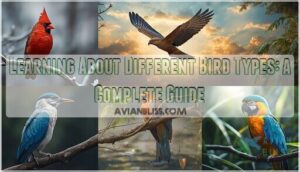
Learning about different bird types opens up a world where every backyard visitor, forest dweller, and wetland resident tells a story about adaptation and survival. The avian world divides into distinct groups—songbirds that fill morning air with melodies, raptors that hunt with precision, waterbirds built for aquatic life, and exotic species that challenge our assumptions about what birds can do and where they can thrive.
Table Of Contents
- Key Takeaways
- What Defines a Bird?
- Major Bird Groups and Orders
- Songbirds and Backyard Visitors
- Birds of Prey: Raptors Explained
- Waterbirds and Wetland Species
- Unique and Exotic Bird Types
- Bird Habitats and Global Distribution
- Bird Behavior and Social Structures
- Bird Migration and Seasonal Movements
- Conservation Status and Human Impact
- Frequently Asked Questions (FAQs)
- Conclusion
Key Takeaways
- Birds are defined by a unique combination of keratin feathers, lightweight hollow bones, specialized beaks, four-chambered hearts, and quadchromatic vision that includes ultraviolet wavelengths—traits that enable their remarkable diversity across every habitat on Earth.
- Passerines (songbirds) represent nearly two-thirds of all bird species with over 6,500 types worldwide, while non-passerines include specialized groups like raptors, waterfowl, and flightless birds, each demonstrating distinct evolutionary adaptations for their ecological niches.
- Migration patterns vary dramatically by species, with some shorebirds traveling over 11,000 miles between breeding and wintering grounds using multimodal navigation that combines geomagnetic detection, celestial cues, and learned routes—though climate change is causing spring arrivals to occur nearly a day earlier per decade.
- Currently 1,256 of 11,185 bird species face endangered status with 61% showing declining populations due to habitat loss, agricultural expansion, and human impact, but conservation efforts like native plantings, reducing pesticides, and preventing window collisions can directly support local bird populations and breeding success.
What Defines a Bird?
Before you can truly appreciate the remarkable diversity of bird species, you need to understand what actually makes a bird a bird. It’s not just about flight—plenty of birds can’t fly at all, and plenty of other animals can.
Let’s break down the defining features that set these feathered creatures apart from every other animal on Earth.
Key Physical Characteristics
If you’ve ever watched a bird at your feeder and wondered what makes it tick, you’re already on the right path to understanding avian anatomy. These creatures share defining traits that set them apart from every other animal on Earth.
- Feathers made of keratin insulate, waterproof, and enable flight through contour, flight, and down types
- Lightweight, hollow bones reinforced internally reduce mass while maintaining strength for aerial maneuvers
- Beaks instead of teeth lower head weight and vary dramatically in shape based on diet
- Four-chambered hearts separate oxygenated blood completely, powering sustained high-energy activities
- Quadchromatic vision with specialized cone cells detects ultraviolet wavelengths invisible to humans
Birds exhibit unique characteristics, such as having endothermic vertebrate traits that enable them to regulate their body temperature.
Unique Adaptations
Beyond those fundamental traits, birds evolved strategies that let them flourish in extremes you’d never expect. Feather insulation and thermoregulation keep some species warm at high altitude, where oxygen thins and temperatures plunge. Beak specialization drives ecological balance—filter-feeders, crushers, and nectar-sippers each carved out a niche. Visual acuity, often extending into ultraviolet ranges, sharpens foraging and mate choice.
These species adaptation mechanisms fuel the avian diversity you see today, shaping bird characteristics across every habitat and climate. The ability to perceive uv light signals plays a vital role in their behavior and survival.
Avian Anatomy Overview
All those adaptations come together in an anatomy engineered for flight. You’ll find skeletal systems averaging around 11% of body mass, air-filled bones connected to respiratory mechanics that deliver oxygen through crosscurrent exchange.
Feather structure, layered with precision, combines insulation and lift. Avian musculature concentrates on the chest, lowering the center of mass.
Circulatory efficiency pumps oxygen-rich blood to power wings, while beaks and lightweight frames define bird characteristics from tip to tail.
Major Bird Groups and Orders
Birds fall into dozens of distinct orders, but you can start making sense of them by focusing on a few major groups. These groups divide the avian world based on physical traits, behaviors, and evolutionary history.
Understanding these broad categories will help you recognize patterns across the thousands of species you might encounter.
Passerines Vs. Non-Passerines
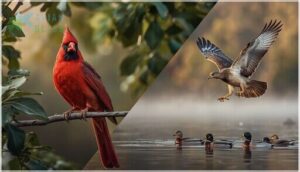
When you’re starting with bird identification, understanding the split between passerines and non-passerines unlocks species diversity at a glance. Passerines—songbirds with that signature three-toes-forward, one-back perching foot—make up nearly two-thirds of all bird types worldwide, roughly 6,500 species.
Non-passerines include everything else: raptors, waterfowl, and flightless birds, each showcasing distinct avian adaptations and beak variations shaped by passerine evolution across vastly different ecological niches.
Birds of Prey

Raptors—hawks, eagles, owls, falcons, and vultures—hunt with precision, using sharp talons and hooked beaks adapted for prey hunting. You’ll spot their dramatic flight patterns overhead, from the Red-tailed Hawk‘s soaring circles to the Peregrine Falcon’s vertical dives.
Bird identification gets easier once you learn their silhouettes and nesting habits. Despite their charisma among birdwatching circles, 37% of raptor species face extinction risk, making raptor conservation urgent across migratory flyways and breeding territories worldwide.
Waterfowl and Shorebirds
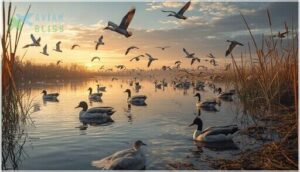
Wetlands pulse with life when waterfowl—ducks, geese, and swans gather by the millions along migratory flyways. You’ll find shorebirds probing mudflats at critical stopover sites, though 93% of North American species are declining. Wetland conservation directly impacts their survival:
Wetlands pulse with millions of waterfowl along migratory flyways, yet 93% of North American shorebird species are declining
- Northern pintails dropped 41% below long-term averages
- Over half of assessed shorebird species lost 50% of populations
- Asia faces the steepest declines in water birds
- Ramsar wetlands protect international flyway management sites
- May pond counts dropped 20% below average in 2025
Flightless Birds

You’ll encounter flightless birds across surprising habitats—from New Zealand’s forests harboring kiwis to Antarctic ice where penguins thrive. Island endemics like moa once dominated landscapes, but flightless bird evolution came with a cost: over 70% of documented species have vanished.
Ground-dwelling birds including ratites (ostriches, emus, cassowaries) showcase ratite characteristics like reduced keels and sturdy legs. Bird classification reveals flightless non-passerines evolved independently across 40 orders, making kiwi conservation and habitat protection urgent.
Songbirds and Backyard Visitors
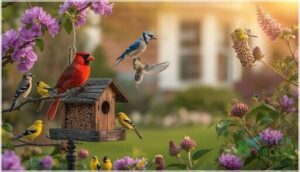
If you’re starting to notice the birds in your own neighborhood, chances are you’re already watching songbirds without even realizing it. These backyard visitors make up the largest group of birds you’ll encounter day to day, and many of them have adapted surprisingly well to life alongside humans.
Let’s look at some of the most common species you’re likely to spot at your feeder or in your garden.
Cardinals, Blue Jays, and Robins
If you’re wondering which birds you’ll spot most often in your backyard, Cardinals, Blue Jays, and American Robins top the list—these adaptable songbirds thrive in suburban landscapes across eastern North America.
Here’s what makes each special:
- Northern Cardinals display vibrant red plumage and rank among the most commonly captured species in long-term banding programs, reflecting their abundance at feeders year-round.
- Blue Jays exhibit exceptional intelligence and complex social structures, forming monogamous pairs that cooperatively feed nestlings for weeks after fledging.
- American Robins migrate seasonally, shifting from territorial breeding behavior to winter flocking behavior focused on berry foraging.
Understanding their nesting habits, feather care routines, and distinctive bird songs enhances your birdwatching experience. Cardinals defend territories with sharp chips and whistles, while Blue Jays produce varied calls that mimic hawks. Robins deliver cheerful caroling at dawn. Each species demonstrates unique beak functions—Cardinals crack seeds, Blue Jays store acorns, and Robins probe for earthworms.
Their flocking behavior varies dramatically: Cardinals form loose winter groups, Blue Jays travel in family units, and Robins gather in massive frugivorous flocks. These backyard birds adapt remarkably well to human presence, making them perfect ambassadors for connecting you with the natural world just outside your window.
Sparrows and Finches
Among the most diverse backyard birds, sparrows and finches showcase striking adaptations. House sparrows alone exceed 1.4 billion individuals globally, while finches span roughly 210 species across multiple continents. Their seed dispersal roles and the dietary flexibility of sparrows make them essential passerines for birdwatching enthusiasts tracking bird behavior amid urbanization pressures and conservation challenges affecting these resilient bird types.
| Feature | Sparrows (Passeridae) | Finches (Fringillidae) |
|---|---|---|
| Global Species | ~43 species | ~210 species |
| Primary Diet | Seeds, insects (breeding) | Seeds, some fruit/insects |
| Conservation Status | Declining regionally | 42 species threatened/near-threatened |
Understanding finch migration patterns—like projected eastern house finch shifts—and sparrows’ year-round residency helps you anticipate seasonal backyard visits. This knowledge supports these granivorous guilds through habitat-conscious gardening.
Hummingbirds and Their Habits
Hummingbirds power the highest metabolic rates among all bird types, beating wings 50 to 80 times per second while hovering at nectar sources. Their beak function, feather structure, and wing movement enable precision feeding on floral resources and tiny insects, which together comprise their hummingbird diet.
Understanding this extraordinary bird behavior enriches birdwatching and bolsters wildlife conservation through ornithology-informed backyard habitat management.
Birds of Prey: Raptors Explained

Raptors sit at the top of the avian food chain, equipped with sharp talons, hooked beaks, and vision that puts our own to shame. These birds of prey have shaped ecosystems across the planet, from open grasslands to dense forests.
You’ll find raptors divided into several distinct groups, each with hunting strategies and physical traits suited to their specific niche.
Eagles and Hawks
Eagles and Hawks showcase the full spectrum of raptor migration and hunting prowess. You’ll find these birds of prey mastering diverse flight patterns, from the bald eagle’s powerful soaring to the red-tailed hawk’s strategic perch-hunting.
Why eagle nesting and hawk behavior matter for wildlife conservation:
- Bald eagles quadrupled since 2009—a triumph of bird conservation
- Hawks achieve 71% hunting success from perches
- Female eagles outweigh males by 25%
- Red-tailed hawks span nearly all North America
Owls and Their Adaptations
Owls reshape nocturnal hunting with adaptations you won’t find in other bird types. Their eyes occupy roughly 75% of skull space, maximizing light-gathering capacity in darkness. Silent flight emerges from specialized feather structure—serrated leading edges and velvety surfaces muffle sound. Head rotation reaches 270 degrees, compensating for fixed tubular eyes. These hunting tactics, refined through wildlife ecology, make owls supremely efficient backyard birds after sunset.
| Adaptation | Function |
|---|---|
| Tubular eyes (75% skull volume) | Enhanced nocturnal vision |
| Asymmetric ear openings | Vertical sound localization |
| Serrated wing feathers | Silent flight mechanics |
| 14 cervical vertebrae | 270-degree head rotation |
Falcons and Vultures
While owls rule the night, falcons and vultures dominate daylight skies through contrasting strategies. Falcons exemplify aerial hunting—peregrine stoops hit 242 mph, making them the fastest bird types. Their pointed wings and feather adaptation enable precision bird predation.
Vultures, by contrast, soar for hours on thermals, cleaning ecosystems through scavenging. Vulture conservation faces urgent challenges: India’s populations crashed 98% from livestock drug exposure, disrupting wildlife ecology across continents.
Waterbirds and Wetland Species
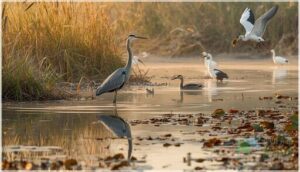
Wetlands and waterways are home to some of the most recognizable and graceful bird species on the planet. From the dabblers and divers that glide across open water to the long-legged waders that stalk shallow marshes, these birds have evolved exceptional adaptations for aquatic life.
You’ll find that waterbirds fall into several distinct groups, each with its own feeding style, habitat preference, and behavioral quirks.
Ducks, Geese, and Swans
Ducks, geese, and swans—collectively called waterfowl—dominate wetland landscapes worldwide, with about 180 species in the order Anseriformes. You’ll recognize them by their webbed feet and waterproof feather adaptation that facilitates aquatic life.
Their populations tell fascinating stories:
- North American breeding ducks number around 34 million individuals
- Canada geese have rebounded to over 5 million after near-extirpation
- Mallard populations fluctuate dramatically, ranging between 5 and 19 million
- Swan conservation efforts focus on managing clutch sizes and survival rates
Waterfowl migration patterns shift with seasons, connecting Arctic breeding grounds to temperate wintering sites.
Herons, Egrets, and Cranes
Stalking through shallow marshes, herons, egrets, and cranes represent wetland ecology at its finest, with over 70 heron species and 15 crane species globally. You’ll spot these water birds in freshwater and coastal zones, where bird watching and identification becomes rewarding—especially when observing wildlife conservation efforts protecting vulnerable populations.
In South Korea alone, 19 Ardeidae species demonstrate exceptional bird diversity, though crane conservation remains critical as 11 of 15 species face threats.
Shorebirds and Waders
Along tidal flats and muddy estuaries, you’ll encounter shorebirds—the long-legged specialists of wetland ecology. These waders probe soft sediment with sensitive bills, demonstrating striking coastal conservation needs as populations decline sharply.
Waterfowl and seabirds share these water birds’ habitats, where shorebird migration routes connect continents.
- Over 235 species exist worldwide
- Bills vary by feeding depth
- Many face accelerating declines
- Habitat loss drives population drops
Unique and Exotic Bird Types

Beyond the familiar songbirds and raptors you might see in your backyard, the avian world includes some truly exceptional specialists that defy expectations. From birds with cognitive abilities rivaling primates to species that traded flight for other survival strategies, these groups showcase evolution’s creativity.
Let’s explore three categories of birds that stand out for their intelligence, unique adaptations, and ecological roles.
Parrots and Corvids
You’ll find that parrots and corvids—crows, ravens, jays, and magpies—rival primates in avian cognition, with brain structures packed with neurons that enable impressive problem-solving. Parrots demonstrate vocal learning through unique ‘core and shell’ neural pathways, while corvid behavior includes spontaneous tool use in about 30% of species.
These bird types showcase exceptional intelligence, making them fascinating subjects for birdwatching tips and bird behavior studies in backyard birds and beyond.
Penguins and Flightless Birds
Flightless birds like penguins reveal how evolution traded wings for flippers, transforming Antarctic colonies into thriving water birds. Their compact bird skeletons—denser than flying species—support underwater propulsion, while scale-like feather adaptations insulate against subzero temperatures.
These ground-dwelling birds, from ratites to island rails, show that losing flight isn’t a disadvantage when your habitat demands swimming, running, or simply surviving without aerial predators.
Tropical and Rare Species
Tropical habitats shelter over 11,000 bird species worldwide, yet rare species face mounting threats. Wet forests alone host 500–600 types per region, where parrots and toucans navigate island ecosystems increasingly vulnerable to habitat loss.
27% of Panama’s forest birds have vanished since 1950, underlining how avian extinction accelerates without conservation efforts.
Flamingos and other colorful residents highlight the ecological importance of birds while demanding urgent protection for endangered species and avian diversity.
Bird Habitats and Global Distribution

Birds have carved out homes in nearly every environment on Earth, from dense forests to arid deserts and bustling city centers. Where a bird lives shapes everything about it—its diet, behavior, and even the sounds it makes.
Let’s explore how different species have adapted to thrive in forests, grasslands, and urban areas.
Forest and Woodland Birds
Forests act as living nurseries for roughly half of the world’s bird types, sheltering between 5,000 and 6,000 species in their layered canopies. You’ll boost avian diversity and support forest conservation by creating woodland habitats in your own yard:
- Plant native trees to increase tree species richness
- Set up a bird feeder for cardinals and blue jays
- Preserve dense understory vegetation
- Limit lawn areas to encourage forest ecology
- Monitor backyard birds to track bird migration patterns
Grassland and Desert Birds
Open grasslands and arid desert habitats challenge birds in ways dense forests don’t. Ground-dwelling birds like meadowlarks and sparrows thrive where grassland ecology sustains seed-rich diets, yet grassland bird populations have declined over 40% in recent decades.
Desert habitats push avian adaptations to their limits—species there persist near physiological thresholds, making conservation efforts critical as climate shifts reshape bird migration patterns and habitat distribution across these vulnerable landscapes.
Urban and Suburban Birds
While grasslands stretch for miles and cities pack millions of people into dense blocks, suburban habitats support surprisingly high bird abundances, often exceeding both urban cores and rural areas.
Your backyard birding tips matter: large green spaces in bird-friendly cities boost species diversity dramatically, making urban birdwatching rewarding if you know where feeders and intact vegetation attract city wildlife best.
Bird Behavior and Social Structures
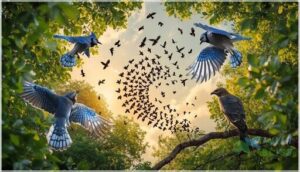
Birds aren’t just flying around aimlessly—they’re living complex social lives shaped by survival instincts, communication needs, and reproductive drives. From the way they hunt and forage to how they attract mates and defend territory, their behaviors reveal intelligence and adaptability you mightn’t expect.
Let’s look at three essential aspects of bird behavior that define how these creatures interact with their world and each other.
Feeding Strategies
You’ll find that birds have evolved remarkably diverse feeding strategies to thrive across every habitat. Whether you’re bird watching or tracking species through Project Feederwatch, observing avian diets reveals nature’s ingenuity:
- Nectar consumption – Hummingbirds drink roughly their body weight daily, meeting remarkable energy intake demands
- Seed dispersal – Frugivores transport seeds over 100 meters, shaping entire ecosystems
- Cooperative hunting – Harris’s Hawks succeed 25% more often when working together
- Specialized foraging tactics – From hovering to diving, each strategy matches the bird feeder or natural food source perfectly
Mating and Courtship Displays
Beyond foraging, you’ll witness some of nature’s most enchanting performances in avian courtship displays. Lekking behavior showcases how male grouse and manakins compete at shared arenas, where just 10–20% of males secure most matings through elaborate visual ornaments and acoustic signals.
These rituals—from colorful plumage to synchronized dances—reveal the intricate mate selection pressures shaping bird behavior and ecology, offering unforgettable moments for bird watching enthusiasts.
Communication and Vocalizations
You’ll discover that bird songs—lasting 3 to 5 seconds with 2 to 20 syllables—are powerful acoustic signals for bird identification. Vocal learning allows over 4,000 songbird species to culturally transmit complex repertoires, with some skylarks mastering 300+ syllables.
Beyond syrinx function, feather sounds from aeroelastic flutter add non-vocal dimensions to bird behavior, enriching avian research studies and your bird ID skills.
Bird Migration and Seasonal Movements

Migration is one of the most extraordinary behaviors you’ll witness in the bird world, where entire populations move thousands of miles between breeding and wintering grounds. Understanding how different species navigate these journeys, and what triggers them to move, reveals the intricate relationship between birds and their environment.
Let’s explore the patterns, navigation methods, and environmental factors that shape these seasonal movements.
Migration Patterns by Species
Bird migration isn’t one-size-fits-all—different species follow distinct flyway dynamics shaped by their unique needs. Shorebirds like Semipalmated Sandpipers travel over 11,000 miles between Arctic breeding grounds and South American coasts, while raptors ride thermals along mountain corridors.
Species tracking reveals that waterfowl use four North American flyways, with migration routes reflecting habitat connectivity and species-specific wintering destinations that define avian diversity.
Navigation and Orientation
When you watch migrants cross thousands of miles, you’re witnessing Multimodal Integration at work—geomagnetic navigation, celestial cues, and terrain recognition combine to guide their journey. Avian magnetoreception allows birds to detect Earth’s magnetic field, while stars and sun locations adjust their compass.
First-time migrants rely on innate programs, yet experienced travelers weave learned routes into their avian ecology toolkit, maintaining ecological balance and biodiversity through precise bird migration and patterns.
Effects of Climate and Geography
Climate shift and geographic barriers are reshaping migration patterns in ways you can measure. Habitat loss and ecological disruption threaten the ecological balance and biodiversity that keeps avian ecology functioning:
- Spring arrivals now occur nearly a day earlier per decade across North America
- Major barriers like the Mediterranean and Sahara channel birds through narrow corridors
- Phenological mismatches reduce breeding success when timing falls out of sync
Understanding these environmental science and conservation challenges helps you grasp how habitat and distribution changes affect bird migration and patterns.
Conservation Status and Human Impact

Birds face mounting pressures from human activities, and understanding their conservation status helps you recognize where your actions matter most. Many species are now threatened or endangered, but targeted initiatives and individual efforts can shift the balance toward recovery.
Let’s look at the current state of bird populations, the programs working to protect them, and the practical steps you can take to make a difference.
Threatened and Endangered Species
You’re witnessing a crisis that threatens avian diversity worldwide. Currently, 1,256 of 11,185 bird species are on endangered lists, with 61% showing declining populations. Human impact on bird populations—from habitat loss affecting 70% of species to agricultural expansion—drives these declines.
In North America alone, grassland birds have dropped 53% since 1970, while forest species lost a billion individuals, making wildlife protection and habitat preservation urgent priorities for endangered species survival.
| Region | Primary Threat | Most Affected Groups |
|---|---|---|
| North America | Agricultural expansion | Grassland birds (-53%) |
| Global islands | Habitat destruction | 95% of extinctions since 1500 |
| Wetlands | Deforestation | Shorebirds (-33%) |
| Tropical zones | Wildlife trade | 36.7% of threatened species |
Major Conservation Initiatives
Conservation efforts spanning continents now protect your feathered neighbors through coordinated action. BirdLife International’s network safeguards over 13,000 Important Bird and Biodiversity Areas across 200+ countries, while flyway programs coordinate habitat restoration along entire migration routes.
You’ll find these bird conservation initiatives working at multiple scales:
- American Bird Conservancy secured 30,000+ acres for endangered species in 2023
- The Migratory Bird Treaty Act protects 1,106 species through environmental policies
- Flyway partnerships address wetland loss threatening waterbird populations
- Colombia’s projects added 7,000+ acres for the Critically Endangered Gorgeted Puffleg
These wildlife management and conservation programs demonstrate how species protection and wildlife preservation unite avian diversity and endangered species recovery with practical habitat restoration.
How to Support Bird Populations
You can transform your yard into a refuge through native plantings and sustainable landscaping. Research shows that keeping non-native plants below 30% of biomass fosters successful breeding, while a single native oak hosts 530+ caterpillar species—critical food for nestlings. These bird-friendly gardens exemplify habitat restoration that directly advances wildlife conservation.
| Action | Impact | Implementation |
|---|---|---|
| Plant native vegetation | Increases bird abundance and diversity | Replace lawn with regional native species |
| Keep cats indoors | Prevents 1.3–4.0 billion annual bird deaths | Use enclosed catios for outdoor access |
| Reduce pesticide use | Protects grassland and insectivorous populations | Eliminate neonicotinoids; support insects naturally |
| Prevent window collisions | Lowers fatal strikes on glass | Place feeders within 1 meter or beyond 10 meters of windows |
Your habitat preservation strategies matter because wildlife management and conservation require coordinated environmental conservation at every scale, from individual yards to regional landscapes.
Frequently Asked Questions (FAQs)
How do birds choose nesting sites and materials?
Location is everything—birds don’t choose nesting sites randomly. They evaluate predation risk, habitat structure, material availability, and past breeding success, balancing concealment with accessibility while selecting antimicrobial plants and protective locations.
What colors can birds see that humans cannot?
Birds possess tetrachromatic vision spanning ultraviolet to red wavelengths—approximately 320 to 700 nanometers—allowing them to perceive nonspectral hues and ultraviolet plumage patterns completely invisible to trichromatic human eyes.
How long do different bird species typically live?
Lifespan varies dramatically across species—small songbirds like American Robins average just two years, while large parrots and Birds of Prey can reach 50 to 80 years.
This reflects distinct Avian Longevity patterns shaped by ecology and body size.
Can birds recognize individual human faces and voices?
You might think avian biology limits such recognition, but corvids and pigeons demonstrate impressive facial recognition and voice identification abilities.
Through human interaction, these species master auditory cues, showcasing advanced bird intelligence and intricate animal behavior patterns.
What role do birds play in seed dispersal?
You’ll find that avian frugivores move seeds across impressive distances—sometimes exceeding 100 kilometers during migration—connecting plant populations and driving forest regeneration through their fruit consumption habits and ecological network interactions.
Conclusion
The next time a mystery bird lands outside your window, you’ll notice details you once overlooked—the curve of its beak, the pattern of its flight, the habitat it chooses. Learning about different bird types transforms casual observation into meaningful connection, turning your backyard into a living classroom.
Every species you identify deepens your understanding of ecosystems, migration, and survival. You’re not just watching birds anymore; you’re reading the language of adaptation written across feathers and flight.
- https://bigbird.alibaba.com/question/how-many-bird-species-are-in-the-world
- https://pmc.ncbi.nlm.nih.gov/articles/PMC8166167/
- https://www.theearthandi.org/post/state-of-the-world-s-birds-2024-update
- https://www.sciencedirect.com/science/article/pii/S2950138524000044
- https://birdcast.info/migration-tools/migration-dashboard/