This site is supported by our readers. We may earn a commission, at no cost to you, if you purchase through links.

Most bird owners obsess over seed blends and feeder placement, but the bath sitting three feet away quietly matters just as much. The material your bird bath is made from directly affects water quality, footing safety, and how long the basin holds up through a Minnesota January or an Arizona August.
A cracked plastic basin leaching UV stabilizers into standing water isn’t a minor inconvenience—it’s a slow hazard for birds drinking and preening daily.
Choosing safe bird bath materials for birds means weighing thermal behavior, surface texture, chemical stability, and freeze resistance together, not just picking whatever looks nice on a garden center shelf.
Table Of Contents
- Key Takeaways
- Safest Bird Bath Material Options
- Bird-Friendly Safety Features
- Durability in Sun and Frost
- Temperature Effects on Water
- Top 9 Bird Bath Products
- 1. Bleuhome Green Heavy Duty Bird Bath Bowl
- 2. Copper Bird Bath Purification Disk
- 3. Mellbree Copper Bird Bath Disk
- 4. Ulycon Pure Copper Bird Bath Disk
- 5. Pure Copper Bird Bath Disc
- 6. CARGEN Hanging Bird Bath Feeder
- 7. Layafiter Pure Copper Bird Bath Disk
- 8. Pure Copper Bird Bath Purification Disk
- 9. Pure Copper Bird Bath Disk
- Choosing and Caring for Baths
- Frequently Asked Questions (FAQs)
- What bird baths are safe for birds?
- What is the best material to make a bird bath out of?
- Does copper in birdbath harm birds?
- Can I paint my bird bath safely?
- Do birds prefer certain colors or materials?
- How often should I replace my bird bath?
- Are recycled materials safe for bird baths?
- Whats the best location for a bird bath?
- Can bird baths attract mosquitoes or other pests?
- Do bird baths need a water filtration system?
- Conclusion
Key Takeaways
- Concrete, granite, and lead-free ceramic are the safest bird bath materials because they stay chemically inert, provide natural grip, and hold up through freeze-thaw cycles without leaching anything harmful into the water.
- Plastic and resin baths carry real risks — UV degradation causes microcracks that harbor bacteria, and cheaper resins can leach stabilizers into the water that birds drink and bathe in daily.
- Design details matter just as much as material — a basin depth of 1 to 2 inches, sloped edges between 5 and 15 degrees, and a matte or textured surface are what actually make a bath safe and usable for small birds.
- Your climate should drive your material choice — granite and sealed concrete handle harsh winters best, stainless steel resists coastal salt air, and light-colored concrete stays cooler in high-heat climates where water temperature directly affects bird health.
Safest Bird Bath Material Options
The material your bird bath is made from affects more than just how it looks — it directly influences bird safety, water quality, and how long the bath holds up. Some materials are genuinely better suited for backyard birds than others, and the differences come down to grip, toxicity, durability, and temperature control.
If you’re weighing your options, this guide on choosing the right bird bath materials for safety and bird visits breaks down exactly what to look for.
Here’s a closer look at the most common options and what each one actually offers.
Concrete and Cast Stone Bird Baths
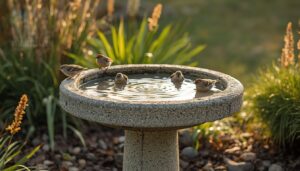
Concrete and cast stone bird baths are among the most dependable choices you can make.
Their thermal mass benefits keep water temperature stable, and their rough mold texture options give birds reliable footing.
Pedestal stability reduces tipping risk.
proper sealant longevity helps prevent freeze cracks across seasons.
They’re heavy — a real installation safety consideration — but that weight and stability make them a low environmental footprint, long-term investment.
The material also offers long term durability benefits.
Natural Stone and Granite Choices
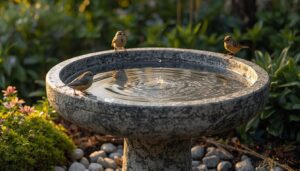
If concrete is your reliable workhorse, granite is the quiet overachiever. Natural stone and granite bird baths are made from non‑toxic materials that require no chemical coatings to be safe for birds. Their rich vein patterns and broad color palette mean each bath looks genuinely one of a kind.
Here’s what makes granite stand out:
- Weather-resistant by nature — granite endures freeze‑thaw cycles without cracking
- Eco-friendly materials — no synthetic resins, just solid stone from responsible stone sourcing
- Natural purification — stone’s mineral surface doesn’t leach harmful compounds into water
- Low sealing frequency — granite usually needs resealing only every 2–3 years
- Minimal environmental impact — locally sourced slabs cut transportation emissions greatly
Ceramic Bird Bath Options
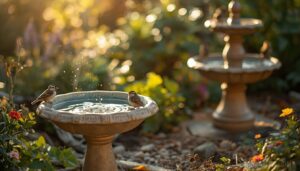
Ceramic and pottery bird baths come in three main styles — pedestal height designs, hanging installation models, and multi-tier levels — each built from nontoxic materials fired to create a dense, non-porous surface. Look for lead-free glazes and a basin depth between 0.5 and 1.5 inches for bird safety. Integrated drainage channels help prevent standing water.
| Feature | What to Look For | Why It Matters |
|---|---|---|
| Glaze Colors | Lead-free, UV-stable finishes | Prevents chemical leaching, resists fading |
| Surface Texture | Matte or embossed rim | Improves grip, reduces slipping |
| Maintenance Frequency | Weekly rinse, mild soap | Controls algae and mineral buildup |
| Weather Durability | Fully vitrified, frost-resistant walls | Survives freeze-thaw cycles without cracking |
Copper, Stainless Steel, and Aluminum Baths
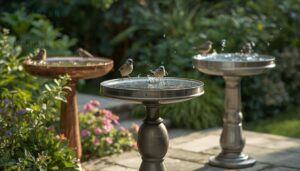
Metal baths — copper, stainless steel, and aluminum — each bring real trade-offs for bird safety.
Passivated copper offers antimicrobial benefits and a natural patina evolution, but it heats quickly in the sun.
Rust-resistant steel stays nonporous and easy to clean.
Aluminum costs less, though protective coatings and installation anchoring matter for stability.
Always confirm non-toxic materials and weather-resistant finishes before buying.
Plastic and Resin Safety Tradeoffs
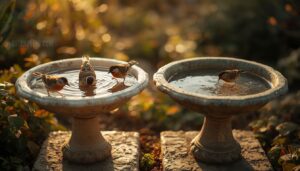
Resin and plastic baths are affordable, but the safety tradeoffs are real.
- Additive migration — UV stabilizer leaching from cheaper resins can introduce low-level contaminants into drinking water.
- Microcrack formation — freeze-thaw cycles weaken thin walls, creating hidden bacterial harbors.
- Impact shard risk — brittle, sun-degraded plastic can fracture into sharp fragments near birds.
- Recycled plastic consistency — variable recycled content may not meet leaching safety standards.
- UV exposure resistance — non-toxic ABS and non-toxic PVC with anti-algae coating outlast standard resin by several seasons.
Choose HDPE or polypropylene with verified low-migration UV stabilizers for the safest option.
Bird-Friendly Safety Features
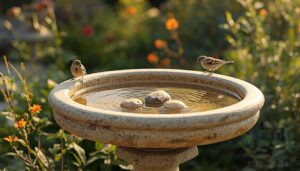
Even the safest material won’t protect birds if the bath itself is poorly designed. A few specific features make the difference between a bath that birds actually use and one they avoid.
Here’s what to look for.
Non-toxic, Lead-free Materials
Every material touching your birdbath water matters more than most people realize. Certified lead-free ceramics use food-safe glazes that won’t leach chemicals, while concrete and granite stay inert without eco-friendly coatings or non-toxic sealants.
Metals like copper and stainless steel are recyclable materials with clean safety profiles.
Even nontoxic ABS and nontoxic PVC plastics support bird safety when properly certified, keeping chemical-free water purification methods effective longer.
Rough or Matte Surfaces for Grip
A slippery bath is quietly dangerous for small birds. Surface texture directly affects how confidently birds land, grip, and drink. Here’s what actually matters for bird traction on surfaces:
A slippery bird bath is quietly dangerous — surface texture determines whether small birds land, grip, and drink with confidence
- Micro-roughness benefits small feet by increasing the friction coefficient optimization across wet and dry conditions
- Matte edge design reduces visual glare and improves perching stability
- Texture wear resistance keeps antislip base integrity through repeated cleaning
- Seasonal grip consistency on weather-resistant, nonporous surfaces outperforms smooth durable plastic bowl finishes year-round
Shallow Water Depth for Small Birds
Too deep means too dangerous — small birds drown in just a few inches. Keep shallow water at 1 to 2 inches, checking daily as part of your bird hygiene routine.
Depth Adjustment Guidelines suggest reducing by quarter-inch increments if birds hesitate. Add stones to create Microhabitat Zones.
Water Clarity Monitoring helps birds gauge depth, while Seasonal Depth Variation and a nonporous surface maintain safe, consistent conditions year‑round.
Sloped Edges and Landing Areas
A well-designed edge slope angle — generally 5 to 15 degrees — gives birds a smooth, controlled descent rather than a sudden drop onto a slippery rim. Curved radius design rounds the corner where slope meets platform, protecting toes.
Contrast color markings help birds spot safe zones at dusk. Anti-slip grit coating and drainage groove integration maintain traction and safety for birds on various materials, keeping landings predictable.
Chemical-free Finishes and Glazes
The finish on a ceramic bird bath matters more than most people realize. Mineral-based glazes made from feldspar and silica create an inert, food-safe surface after eco-friendly firing — no leaching, no off-gassing.
Look for zero VOC glazes and VOC-free sealers to keep the water a chemical-free solution for visiting birds.
Copper’s natural patina also offers genuine antimicrobial properties, supporting natural water purification without additives.
Durability in Sun and Frost

bird bath that looks great in spring can crack, fade, or rust by the following year if the material isn’t built for your climate. Sun, frost, and wind don’t give anything a free pass.
most common materials hold up over time.
Freeze-thaw Resistance by Material
Winter is where material choices really matter. When water freezes inside a porous bath, it expands and cracks the structure from within — that’s freeze‑crack prevention in action, or the lack thereof. Here’s how common materials hold up:
- Concrete uses Air Entrapement Design with Microvoid Distribution to absorb expansion stress, surviving 100+ freeze‑thaw cycles.
- Granite absorbs under 0.4% water by weight, making it a naturally freeze‑proof material with proven 150‑cycle durability.
- Ceramic depends on Thermal Expansion Matching between glaze and body — without it, crazing appears fast.
Sealant Compatibility and Joint Water Management keep stone and concrete weather‑resistant long‑term.
UV Resistance and Fading Concerns
Freeze damage isn’t the only threat sunlight brings. UV exposure quietly degrades materials over time, especially plastic, where UV Degradation Issues with Plastic Bird Baths are serious — surfaces yellow, crack, and leach chemicals.
UV Stabilizer Coatings and Fade-Resistant Pigments like titanium dioxide extend color life considerably.
UV-Blocking Varnish and Protective Wax Layers help too.
Concrete and stone simply don’t fade.
Rust, Oxidation, and Corrosion Risks
UV isn’t the only silent threat — rust and corrosion quietly compromise metal birdbaths too.
Watch for these common risks:
- Galvanic coupling between copper and steel fasteners accelerates pitting corrosion
- Chloride ingress from road salt eats through concrete coatings, exposing rust-resistant steel components
- Sealant degradation allows moisture trapping near metal fastener compatibility points
Choose weatherproof, rust-free components and inspect seals annually.
Weight and Wind Stability
Weight and stability considerations for bird baths matter more than most people expect. A tipped bath wastes water and can injure visiting birds.
Concrete and cast stone—often 20 to 60 pounds—use base mass distribution and footprint width to resist gusts.
Low center of gravity designs keep things grounded, and wind baffle integration with nearby planters, plus simple anchoring techniques like ground stakes, add reliable tipping prevention.
Long-term Maintenance Needs
Each material has its own maintenance rhythm. Concrete needs sealing every two to three years—your joint repointing schedule and moss removal protocol keep surfaces safe for landing birds.
Metal baths require mounting hardware checks quarterly.
A consistent drainage system maintenance routine prevents stagnant water.
Durable materials for bird baths still reward seasonal maintenance guidelines; cleaning and maintenance tools for bird baths make that routine straightforward.
Temperature Effects on Water
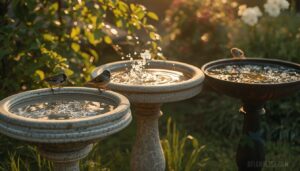
The material your bird bath is made from doesn’t just affect how long it lasts — it directly shapes the water temperature your birds drink and bathe in.
Some materials keep water stable and comfortable, while others can turn a bath into something closer to a warm puddle on a July afternoon.
Here’s how each material regulates heat, cold, and everything in between.
Thermal Mass Benefits of Concrete
Concrete’s high heat storage capacity acts like a slow cooker for water temperature — absorbing warmth gradually and releasing it through nighttime heat release rather than spiking or dropping sharply. That thermal inertia keeps visiting birds comfortable throughout the day.
- Buffers morning cold without shocking small birds
- Slows afternoon heat buildup in direct sun
- Facilitates temperature stabilization across seasonal shifts
- Reduces energy load reduction needs when paired with a heater
- Thermal mass benefits of concrete bird baths extend into winter, delaying ice formation
Metal Surfaces and Rapid Heating
Unlike concrete, metal birdbaths heat quickly — sometimes dangerously so. Copper and aluminum have high thermal conductivity, meaning water can warm quickly under direct sun.
That rapid heating uniformity may seem efficient, but it raises heat stress risks for small birds.
Shade placement matters here.
| Metal | Heating Speed |
|---|---|
| Copper | Very fast |
| Aluminum | Fast |
| Stainless Steel | Moderate |
Plastic and Resin Temperature Swings
Plastic and resin bird baths can swing 20–30°F within minutes in direct sun — thermal cycling effects that stress both the material and your visiting birds. Low heat resistance accelerates evaporation rate control issues, and microcracking in thin walls.
Use an insulation mat underneath to buffer temperature resistance swings. UV resistance in the formulation and expansion joint design prevent loosening hardware and premature cracking over time.
Light Versus Dark Basin Colors
Basin color quietly shapes water temperature more than most people expect. Light-colored bowls reduce surface heat by up to 25%, slowing Algae Growth and improving Bird Visibility against garden backgrounds. Dark-colored metal absorbs more solar radiation, demonstrating real solar heating benefits for metal bird baths, though shade offsets this.
Consider these practical differences:
- Light basins lower Heat Retention, keeping water fresher longer in summer heat
- Dark bowls support temperature regulation for birds on cool mornings through heat retention in metal bird baths
- Matte finishes aid Contrast Perception and provide Glare Reduction, reducing eye strain for visiting birds
Winter Ice Prevention Methods
Winter doesn’t have to shut down your bird bath entirely. A brine pre-treatment applied 1–6 hours before a freeze reduces ice bonding without harming birds.
Pair that with heated mats beneath the basin and an insulating skirt to cut heat loss.
Add non-slip grit for safe landings, and a recirculating pump delays freezing further — smart winter bird bath considerations that keep water accessible all season.
Top 9 Bird Bath Products
Knowing what materials work best is one thing — finding a product that actually delivers on those qualities is another. The nine options below cover a range of materials, designs, and price points worth considering.
Here’s what’s available right now.
1. Bleuhome Green Heavy Duty Bird Bath Bowl
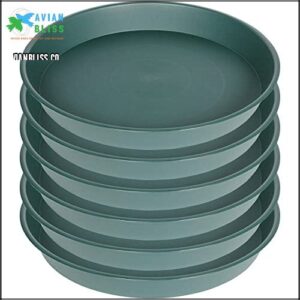
If budget and practicality matter to you, this six-pack of 8-inch polypropylene bowls at $9.99 is hard to overlook.
Each bowl sits at roughly 1.3 inches deep — right in the safe range for small songbirds. The BPA-free plastic won’t leach chemicals into the water, which matters clinically.
That said, prolonged UV exposure will eventually cause brittleness, so rotating bowls seasonally and inspecting for cracks before each refill keeps your birds safe.
| Best For | Backyard birders and families who want an affordable, no-fuss way to attract small songbirds without spending a lot. |
|---|---|
| Material | Polypropylene (PP) plastic |
| Weight | 10.8 oz per bowl |
| Outdoor Compatible | Yes |
| Chemical-Free | Yes, no additives |
| Pack Quantity | 6 bowls |
| Bird Safe | Yes |
| Additional Features |
|
- Six bowls for $9.99 is genuinely great value — you can spread them around the yard or keep extras on hand
- Thick PP plastic holds up well to bird traffic and won’t crack under normal use
- Works as both a birdbath and a seed tray, so it pulls double duty
- The 1.3-inch depth is too shallow for larger birds, so don’t expect doves or jays to stick around long
- UV exposure will eventually make the plastic brittle, meaning you’ll need to swap bowls out over time
- No mounting hardware included, so you’ll need to sort out hooks or a stand on your own
2. Copper Bird Bath Purification Disk
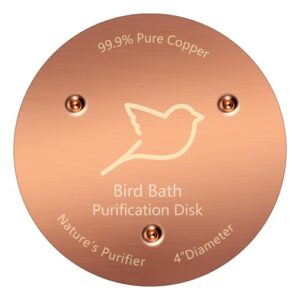
If you want something that works quietly in the background, this disk is worth considering. Made from 99.9% pure copper at 0.6 mm thick, it releases natural antimicrobial ions that reduce bacterial growth and slow algae buildup — no chemicals needed.
The triple-point feet keep it stable and fully exposed to water.
It won’t replace regular cleaning, but it meaningfully extends intervals between scrubs. Just note it performs best in ceramic or stone baths, not plastic.
| Best For | Bird lovers who want cleaner water in their ceramic or stone birdbath without messing with chemicals or constant scrubbing. |
|---|---|
| Material | 99.9% pure copper |
| Weight | 2.39 oz |
| Outdoor Compatible | Yes |
| Chemical-Free | Yes, no chemicals |
| Pack Quantity | 1 disc |
| Bird Safe | Yes |
| Additional Features |
|
- Pure copper construction naturally fights bacteria and slows algae — no additives required
- Triple-point feet keep it stable and in solid contact with the water surface
- Works year-round, even alongside heaters or fountains
- Noticeably less effective in plastic birdbaths
- Won’t fully stop algae if the water is heavily stagnant or nutrient-rich
- Smaller than some people expect, so placement matters more than you’d think
3. Mellbree Copper Bird Bath Disk
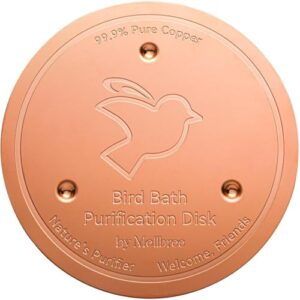
The Mellbree takes that same copper-ion concept and refines it a bit. At 99.99% purity and 0.6 mm thick, it’s built to release ions steadily without breaking down too quickly.
The three-point support keeps it stable and fully submerged, which matters for consistent water contact.
It fits stone, plastic, and composite basins well, but skip it if your basin has any damaged metal coating.
It won’t eliminate cleaning, though it can stretch your intervals out to about 14 days.
| Best For | Bird bath owners who want a low-maintenance, chemical-free way to keep water cleaner longer, especially those using stone, plastic, or composite basins. |
|---|---|
| Material | 99.99% pure copper |
| Weight | 1.76 oz |
| Outdoor Compatible | Yes |
| Chemical-Free | Yes, no chemicals |
| Pack Quantity | 1 disc |
| Bird Safe | Yes |
| Additional Features |
|
- 99.99% pure copper means steady ion release without degrading fast
- Three-point design keeps it stable and in solid contact with the water
- Can push cleaning intervals out to around 14 days, saving real time and money
- Won’t work safely if your basin has any cracked or exposed metal coating
- Doesn’t replace water changes or clearing out leaves and debris
- Aggressive cleaners like vinegar can cloud the surface and hurt its performance
4. Ulycon Pure Copper Bird Bath Disk
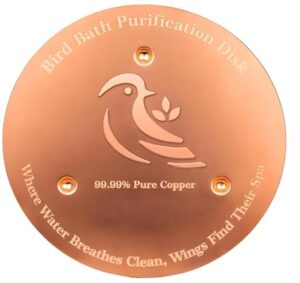
The Ulycon takes a similarly precise approach. It’s made from 99.99% pure copper — no coatings, no additives — so there’s nothing to peel or leach into the water your birds drink from.
At 0.6 mm thick and roughly 4 × 4 inches, it drops into most standard bowls without adjustment. The triple-point base keeps it stable and in full water contact.
One honest note: the protective film can be tricky to remove without scratching the surface, so take your time with that first step.
| Best For | Bird bath owners who want a no-fuss, chemical-free way to keep their water cleaner without constant scrubbing. |
|---|---|
| Material | 99.99% pure copper |
| Weight | 1.76 oz |
| Outdoor Compatible | Yes |
| Chemical-Free | Yes, no chemicals |
| Pack Quantity | 1 disc |
| Bird Safe | Yes |
| Additional Features |
|
- 99.99% pure copper means nothing harmful is leaching into the water your birds drink
- Drops right into most standard bowls — no tools, no setup headaches
- The triple-point base keeps it flat and in solid contact with the water
- Will turn brown or green over time as it oxidizes — totally normal, but not everyone loves the look
- The protective film can be a pain to peel off and may scratch the disc if you rush it
- Only treats the water directly around it, so bigger baths might need more than one disc to stay clear
5. Pure Copper Bird Bath Disc
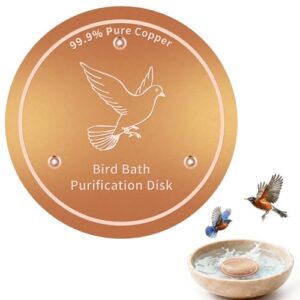
Here’s another straightforward option worth considering. This disc is made from 99.9% pure copper — no coatings, no glazes — so nothing’s chipping or breaking down into your birds’ water.
At 1 mm thick, it holds up well through freezes and thaws without warping.
The triple-point base keeps it flat on the bowl floor, maintaining steady water contact for consistent ion diffusion.
It won’t replace regular cleaning, but it genuinely slows algae between sessions, which means fewer harsh interventions overall.
| Best For | Bird bath owners who want a low-effort way to cut down on algae buildup between cleanings. |
|---|---|
| Material | 99.9% pure copper |
| Weight | 1.76 oz |
| Outdoor Compatible | Yes |
| Chemical-Free | Yes, no chemicals |
| Pack Quantity | 1 disc |
| Bird Safe | Yes |
| Additional Features |
|
- 99.9% pure copper means no coatings to chip or degrade into the water
- Triple-point base keeps it stable and in consistent contact with the bowl floor
- Works year-round, even in heated baths or through winter freezes
- Won’t replace cleaning — you’ll still need to scrub it when it oxidizes and refresh the water regularly
- May not do much in larger or fast-moving water features where the disc size limits its reach
- Antibacterial effect is mild, so heavily contaminated water will likely need more than just this
6. CARGEN Hanging Bird Bath Feeder
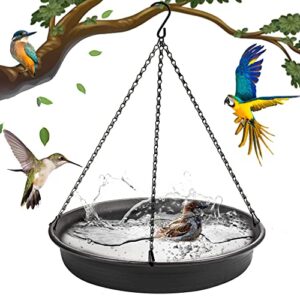
Versatility is this feeder’s strongest card.
polypropylene bowl with resin coating hangs via three stainless-steel chains, keeping it off the ground and away from predators — a genuine safety win.
At roughly 30 cm wide, it fits several small birds at once. The shallow tray works well for finches and sparrows.
Just know that prolonged sun exposure can soften the plastic over time, so positioning it in partial shade helps it last longer.
| Best For | Backyard birders who want a simple, affordable way to offer small birds like finches and sparrows a place to drink and eat without dealing with complicated setup. |
|---|---|
| Material | Polypropylene (PP) with resin coating |
| Weight | 0.77 lb (total) |
| Outdoor Compatible | Yes |
| Chemical-Free | Yes, no additives |
| Pack Quantity | 1 bowl with chains |
| Bird Safe | Yes |
| Additional Features |
|
- Hangs easily with no tools — just hook it to a branch or wrought-iron hanger and you’re done.
- Works as both a water bath and seed tray, so you’re getting two functions out of one lightweight piece.
- Held up through winter freezes in real-world use, which is more than you’d expect from a budget plastic bowl.
- Larger birds can tip it around, sending water everywhere and emptying it faster than you’d like.
- Plastic can go soft and lose its shape after long stretches in direct sun.
- It’s small enough that some birds simply ignore it, and water evaporates quickly on windy days.
7. Layafiter Pure Copper Bird Bath Disk
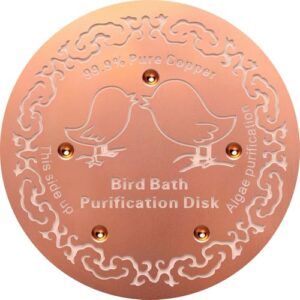
The Layafiter disk is built from 99.9% pure copper — no coatings, no fillers — which matters more than it sounds. Copper ions release steadily into the water, slowing algae and bacterial growth without any chemical additives.
At 4 inches wide and just 1.44 oz, it fits most standard basins and won’t disrupt a dripper or heater. The five-point support lifts it off the basin floor, maximizing water contact.
It won’t replace regular cleaning, but it does meaningfully stretch your intervals to around 10–15 days.
| Best For | Bird bath owners who want to cut down on how often they’re scrubbing and refilling without switching to chemical treatments. |
|---|---|
| Material | 99.9% pure copper |
| Weight | 1.44 oz |
| Outdoor Compatible | Yes |
| Chemical-Free | Yes, no chemicals |
| Pack Quantity | 1 disc |
| Bird Safe | Yes |
| Additional Features |
|
- Solid 99.9% pure copper means it actually works — coated versions don’t hold up the same way
- Stretches cleaning intervals to around 10–15 days, so you’re not out there every few days with a brush
- Tiny and light enough to drop in and forget about, no tools or setup needed
- Won’t wipe out algae completely — you still need to do real cleanings and water changes
- The 4-inch size could be a problem if your basin is small or has an odd shape
- Results vary depending on how much organic buildup or runoff your bath gets, so some people see algae come back within a month
8. Pure Copper Bird Bath Purification Disk
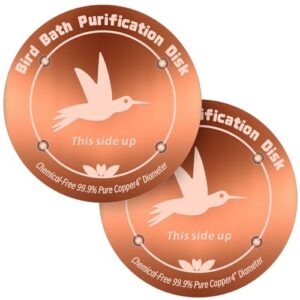
This one comes from a well-established source — Erva’s disk is made in the USA from 99.9% pure American copper, sourced directly from Revere Copper in Rome, New York.
Three small raised feet lift it off the basin floor, keeping the full 4-inch surface in contact with the water for consistent antimicrobial action.
Tarnish won’t weaken its effect, so don’t worry when the copper darkens.
That said, it doesn’t replace scrubbing — birds bring in fresh contaminants daily, and your cleaning routine still matters.
| Best For | Backyard bird enthusiasts who want to cut down on frequent birdbath scrubbing without using chemicals or additives. |
|---|---|
| Material | 99.99% pure copper |
| Weight | 1.58 oz per disc |
| Outdoor Compatible | Yes |
| Chemical-Free | Yes, no chemicals |
| Pack Quantity | 2 discs |
| Bird Safe | Yes |
| Additional Features |
|
- Keeps water cleaner longer — stretches your cleaning schedule out to around 20 days instead of every few days.
- No chemicals needed; the copper does the work naturally and even looks good sitting in the bath.
- Works with most common birdbath materials like cement, ceramic, and plastic, so it fits right into your existing setup.
- Loses its effectiveness after about 30 days, so you’ll need to clean or replace it regularly to keep it working.
- Shaded birdbaths don’t get the same results — if your bath sits under heavy tree cover, don’t expect much algae control.
- One disc might not cut it for larger baths over 50 gallons, which means buying more discs and adding to the cost.
9. Pure Copper Bird Bath Disk
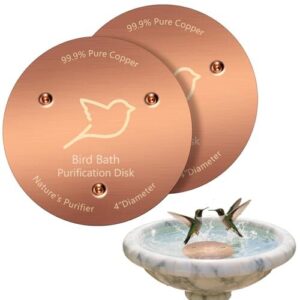
This listing is basically the same disk you saw in entry 8 — 99.9% pure copper, 4-inch diameter, three small feet, no chemicals. The difference is where you buy it.
It shows up across multiple retailers, from specialty birding shops to larger online marketplaces, sometimes priced around $12–$14.
If you’ve already considered the previous options and want a straightforward, no-frills version, this fits. Just keep your cleaning schedule in place — copper slows bacterial growth, but it can’t undo what a dozen birds track daily.
| Best For | Bird lovers who want a simple, chemical-free way to keep their birdbath cleaner longer without spending a lot of money. |
|---|---|
| Material | 99.9% pure copper |
| Weight | 5.3 oz per pair |
| Outdoor Compatible | Yes |
| Chemical-Free | Yes, no chemicals |
| Pack Quantity | 2 discs |
| Bird Safe | Yes |
| Additional Features |
|
- 99.9% pure copper naturally slows algae and bacterial growth — no chemicals needed
- Triple-point feet keep the disk flat and stable so it actually stays put
- Works with heaters, fountains, and standard bowls year-round
- Has to stay submerged or it can corrode and lose effectiveness
- Won’t save you from cleaning — heavy bird traffic still means regular maintenance
- Too big for birdbaths smaller than about 8 inches across
Choosing and Caring for Baths
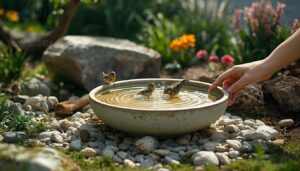
Picking the right bird bath is only half the job — keeping it safe and functional takes some ongoing attention. practical decisions about material, placement, and cleaning can make a real difference in how well birds use it.
what you need to know to get those details right.
Best Material for Your Climate
Your climate is the deciding factor.
Granite and sealed concrete offer Mountain Chill Resistance and Thermal Insulation for Winter Bird Baths, acting as freeze‑proof material in harsh winters.
Stainless steel provides Coastal Corrosion Guard against salt air.
Light-colored concrete delivers Desert Heat Tolerance and Shade Friendly Materials benefits.
Urban Pollution Tolerance and Eco‑friendly Bird Bath Options favor recycled concrete.
Weather‑resistant material durability protects your investment year‑round.
Placement for Safety and Visibility
Once your material suits the climate, placement seals the deal. Set the bath at Eye Level — between 4–6 feet — with Clear Sightlines from multiple directions.
Open Area Placement keeps predators visible. Predator Deterrence Elevation discourages cats.
Maintain a Wind Buffer Zone away from funneling gaps to improve bird bath stability in wind, preventing tipping and water loss.
Cleaning and Algae Control
Once placement is locked in, keeping that water clean becomes your next responsibility.
Scrub weekly using a bird bath cleaning brush with plastic bristles — Brush Cleaning Techniques like this protect textured surfaces. Try Vinegar Scale Removal (1:3 ratio) as a chemical‑free solution.
Solar Fountain Integration reduces stagnant buildup, while Mesh Debris Screens block leaf nutrients.
Beneficial Bacteria Use and a bird bath purification disk offer natural purification without antialgae coating chemicals.
Crack and Damage Inspections
Clean water matters, but a cracked basin quietly undoes all that effort.
Run a quick Tap Test Evaluation monthly — hollow sounds signal hidden damage. Visual Crack Mapping catches hairline fractures before they widen. For deeper concerns, Dye Penetrant Inspection or Ultrasonic Thickness Testing reveals internal stress.
Thermal Expansion Monitoring and freeze crack prevention checks support the weather resistance and longevity of bird bath materials, honoring your durability and maintenance requirements for outdoor bird baths.
Seasonal Care and Water Changes
Once cracks are addressed, your next focus shifts to keeping water safe through every season. Water Change Frequency and Evaporation Management matter most in summer — replace water every one to two days.
In winter, reduce volume but maintain pH Stability and Mineral Balance. Seasonal Aeration maintains oxygen levels year-round.
- Treat tap water before every refill
- Increase water purification steps in summer heat
- Follow seasonal maintenance guidelines for outdoor bird baths
- Store cleaning tools dry in winter
- Log seasonal water replacement dates for consistency
Frequently Asked Questions (FAQs)
What bird baths are safe for birds?
Concrete, natural stone, lead-free ceramic, and BPA-free plastic are your safest options.
Each promotes bird health indicators like hydration and clean feathers while minimizing safety and toxicity considerations for bird bath materials.
What is the best material to make a bird bath out of?
Concrete wins on most counts — weight stability, thermal mass, and grip — but your best choice depends on climate, budget, and how permanent you want the setup to be.
Does copper in birdbath harm birds?
Copper leaching is real but low-risk at normal pH levels. Patina formation creates a natural, chemical-free barrier that limits copper ion toxicity.
water pH impact regularly, and your birds stay safe.
Can I paint my bird bath safely?
Yes, you can — but only with low‑VOC paint, proper primer selection, a food‑safe sealant, and a full cure duration of 48 hours before refilling. Skip anything oil‑based.
Do birds prefer certain colors or materials?
Picture a flash of red catching a bird’s eye across a green yard.
Birds do favor bright color cues and high contrast rims for visual edge detection, with species hue preferences varying by type.
How often should I replace my bird bath?
Most bird baths last 1 to 3 years, though your replacement timeline depends on material wear, usage frequency, and visible wear indicators like cracks, persistent staining, or mold that won’t clean off.
Are recycled materials safe for bird baths?
Recycling something old doesn’t always make it safe — but with the right certification standards and lead-free glazes, recycled materials can actually be among the most reliable, weather-resilient materials you’ll find for a bird bath.
Whats the best location for a bird bath?
Place your bird bath in partial shade with open sightlines, near perches, away from windows, and shielded from wind — ideally 6–10 feet from shrubs for safe, predator-aware access.
Can bird baths attract mosquitoes or other pests?
Yes, stagnant water invites mosquito breeding and algae growth. Water circulation and daily changes break that cycle.
Good drainage design and clean water maintenance tips keep pest attraction low and your bath safe.
Do bird baths need a water filtration system?
Filtration necessity is low for most backyard setups.
Regular water changes and natural flow benefit from a dripper control water stagnation risks, better than costly filters, making maintenance vs filtration a clear win for simplicity.
Conclusion
Every bath you set out this season quietly shapes what happens next—which birds return, how often they drink, and whether they stay healthy through the harder months ahead. Choosing safe bird bath materials for birds isn’t a one-time decision; it’s something you’ll revisit each time you notice a crack, a chemical smell, or water warming too fast.
Get the material right, and the bath practically takes care of the rest.