This site is supported by our readers. We may earn a commission, at no cost to you, if you purchase through links.
Bluebirds don’t build the way most people expect. They’re remarkably selective—rejecting perfectly good materials while zeroing in on specific textures, lengths, and weights that match their instincts to the millimeter.
A nest that looks like a casual pile of grass is actually a layered structure engineered for insulation, drainage, and chick survival.
What goes into that cup matters more than most backyard birders realize, especially as synthetic debris increasingly shows up woven into wild nests. The right natural nesting materials for bluebirds aren’t hard to provide once you know what they’re actually looking for.
Table Of Contents
- Key Takeaways
- Essential Natural Nesting Materials for Bluebirds
- How Bluebirds Use Natural Materials to Build Nests
- Safe Vs. Harmful Nesting Materials for Bluebirds
- Tips for Offering Nesting Materials in Your Yard
- Conservation Benefits of Supplying Natural Nesting Materials
- Frequently Asked Questions (FAQs)
- Where do bluebird parents sleep at night?
- Do bluebirds reuse old nest materials each year?
- Can bluebirds distinguish between natural and synthetic fibers?
- How does weather affect nest material selection?
- Are bluebirds territorial about their nesting material sources?
- What time of day do bluebirds gather nesting materials?
- Do bluebirds reuse nests from previous seasons?
- How many broods do bluebirds raise per year?
- Can bluebirds compete with other cavity-nesting birds?
- What predators most threaten bluebird nesting boxes?
- Conclusion
Key Takeaways
- Bluebirds build with surprising precision — layering pine needles, fine dry grasses, plant down, and small twigs into a structured cup engineered for warmth, drainage, and chick survival.
- Synthetic materials like dryer lint — yarn, and plastic fibers aren’t just poor substitutes — they actively harm nestlings through entanglement, microplastic ingestion, and chemical leaching.
- Timing and placement of natural materials matter as much as the materials themselves — offering them near native plants, elevated off the ground, and stocked by early morning, fits how bluebirds actually forage.
- Supporting bluebird nesting goes beyond the box — planting natives, avoiding pesticides, and logging nest contents for programs like NestWatch connect your backyard to broader conservation efforts.
Essential Natural Nesting Materials for Bluebirds
Bluebirds aren’t picky builders, but they do have preferences — and knowing what they actually use makes it easier to help them out. The good news is most of these materials are things you can find in your own yard or pick up without much effort.
If you want to take it a step further, this guide on building the right bird houses for bluebirds walks you through everything with materials you likely already have on hand.
what to look for and keep on hand.
Pine Needles
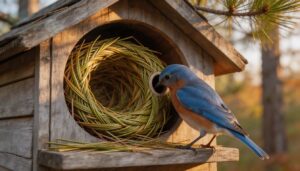
Pine needles are one of the most reliable nontoxic nesting materials you can offer for backyard bird habitat. Their needle longevity means they hold structure through an entire brooding cycle without breaking down.
Bluebirds favor them for moisture regulation — that waxy cuticle sheds dampness without trapping it.
Seasonal availability peaks in autumn, so collect from native plants like longleaf or loblolly pine while supplies are fresh.
Fine Dry Grasses and Sedges
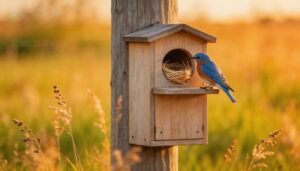
Fine dry grasses and sedges work a bit like nature’s yarn — flexible, lightweight, and surprisingly effective at insulation efficiency.
Bluebirds weave them into the cup’s outer layer, where their texture traps warm air while supporting moisture retention without getting waterlogged.
Seasonal availability peaks after late summer seed set, so gather from native plants using simple harvesting techniques: pull dried seed heads from chemical-free areas and keep them sheltered until birds discover them.
Many of these grasses, such as cocksfoot, possess a deep rooting system that helps stabilize soil.
Straw
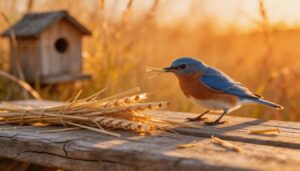
If grasses are nature’s yarn, straw is the scaffolding — hollow stems that hold shape and trap warmth at the same time.
Its low moisture content matters for Straw Moisture Management; wet straw molds fast, so Straw Storage Techniques mean keeping small pieces of straw dry until birds need them.
Straw Seasonal Availability peaks post-harvest, making it one of the easiest organic options for nest building and creating bird-friendly habitats in residential areas.
Small Twigs and Bark Strips
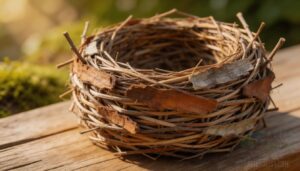
Straw holds the frame — but small twigs and bark strips are that lock everything in place.
Bluebirds favor:
- Twigs 1–3mm wide from native trees, dry and weathered
- Bark strips with natural curl for nest edge reinforcement
- air-dried seasonally, free of sap or soil
That rough bark strip texture gives the nest grip, turning loose natural materials into a tight, durable cup.
Plant Down (Cattails and Milkweed)
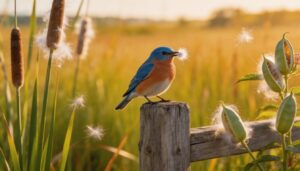
When cattail fluff drifts across a wetland in late summer, it’s doing double duty — scattering seeds and offering bluebirds some of the finest bird nesting material around. Both cattail and milkweed produce wind-carried fibers with impressive lightweight insulation and moisture-wicking capacity.
Harvesting timing matters: collect dry, fluffy heads before rain soaks them. These native plants are habitat-specific benefits you can grow right in your yard.
Moss and Spanish Moss (Regional)
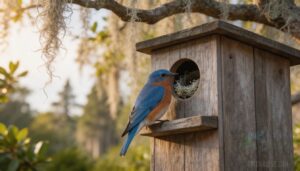
If you live anywhere along the Gulf Coast or Deep South, moss is one of the most adaptable natural nest materials bluebirds can find. Spanish moss — an epiphytic bromeliad, meaning it feeds on humid air rather than its host tree — excels at moss moisture capture, keeping nest cups stable in high-humidity zones. Its feathery filaments also harbor invertebrates that supplement nestling diets.
Support your local bird habitat with these moss-friendly wildlife gardening steps:
- Leave Spanish moss draped on live oaks and cypress trees undisturbed
- Position birdhouses near moisture-rich, shaded spots in coastal habitat areas
- Incorporate native plants like cattails nearby to complement moss availability
- Avoid removing mosses from branches during active nesting season
- Keep nesting zones free of synthetic debris so bluebirds weave in only clean, natural nest material
Leaves and Yard Debris
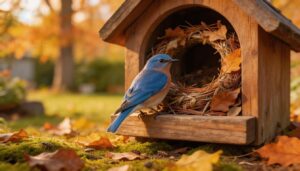
Don’t overlook what’s already underfoot — leaves and yard debris are some of the most overlooked nest materials around.
Dry leaves add coarse texture that stabilizes nest structure, while debris piles attract invertebrates, bluebirds rely on to feed chicks.
Leaf litter also facilitates Leaf Nutrient Cycling, boosting insect diversity nearby.
| Leaf Type | Nest Benefit | Seasonal Leaf Availability |
|---|---|---|
| Oak/Maple | Coarse lining, structure | Autumn peak |
| Pine Needles | Insulation, Leaf Moisture Management | Year-round |
| Yard Waste | Invertebrate Attraction, Predator Concealment | Spring–Summer |
How Bluebirds Use Natural Materials to Build Nests
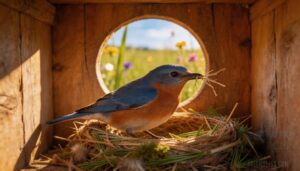
Knowing which materials bluebirds prefer is one thing — watching how they actually put a nest together is another. Bluebirds are more deliberate than you might expect, and their building process follows a pretty consistent pattern.
Here’s what’s going on inside that nest box.
Typical Bluebird Nest Structure
Think of a bluebird nest as a tiny, well-engineered cup — shallow, about 1 to 2 inches deep, built from dry leaves, grass clippings, and natural materials woven into smooth walls.
The entrance size is around 1.5 inches wide.
Wall smoothness prevents snags.
Ventilation placement near the top keeps air moving, while a drainage slope in the floor stops water from pooling under eggs.
Nest Construction Techniques
Bluebirds are quiet engineers — and their layering strategies are worth studying. They start coarse and finish fine, building from the outside in.
- Cup Geometry: walls taper to cradle eggs without rolling
- Material Binding: twigs or small sticks interweave for rigidity
- Wind Resistance: flexible outer fibers absorb gusts
- Thermal Insulation: plant down and grass clippings trap warmth inside
- Natural materials: leaves and other yard waste fill structural gaps
Material Preferences by Habitat and Region
Where a bluebird builds, shapes what it builds with.
Prairie birds lean on fine switchgrass and sedges for that snug inner cup.
Coastal nesters favor dry pine needles — they shed moisture and resist salt air.
In drier climates, desert straw use fills structural gaps.
Mountain moss selection adds insulation at elevation.
Urban yard debris, leaves and other yard waste, even grass clippings — cavity dwellers work with what’s there.
Safe Vs. Harmful Nesting Materials for Bluebirds
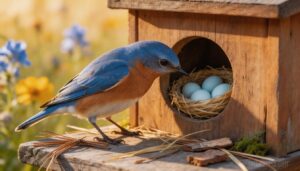
Not everything you find in your yard belongs in a bluebird nest — and the difference between helpful and harmful can really matter for the birds. Some materials support healthy chicks, while others pose serious risks you wouldn’t expect.
Here’s what to offer, what to skip, and why it matters.
Materials to Provide
A handful of well-chosen materials make a real difference for nesting bluebirds. Stick with what’s organic, dry, and chemical-free — twigs or small sticks, fine dry grasses, pine needles, and plant down from cattails or milkweed. Native plants are your best local source. Seasonal material rotation keeps supplies fresh and relevant.
| Material | Best Use | Key Tip |
|---|---|---|
| Fine dry grasses | Cup structure | Grass clippings from untreated lawns only |
| Pine needles (2–5 cm) | Lining and insulation | Collect from untreated trees |
| Small twigs or sticks | Outer framework | Keep under 1 cm diameter |
| Plant down (milkweed) | Soft inner cushion | Remove seeds before offering |
| Dried moss | Temperature regulation | Must be mold-free and dry |
Material moisture management matters more than most people realize — damp materials invite mold and parasites. Use material storage solutions like mesh bags or open bins to keep everything aired out. Microhabitat material placement near shrubs or perches helps birds find what they need fast.
Materials to Avoid
Just as important as what you keep out. Some materials look harmless but carry real risks — pressure‑treated wood releases arsenic, lead‑based paint dust settles into nests, and asbestos insulation fibers linger invisibly.
Pesticide‑contaminated debris, cigarette butts, shreds of plastic, and plastic micro‑fibers can injure or poison nestlings fast.
| Material | Why It’s Harmful | What to Do Instead |
|---|---|---|
| Pressure-treated wood shavings | Leaches arsenic and copper into the nest | Use untreated pine shavings |
| Lead-based paint chips | Impairs neurological development in chicks | Remove old painted debris from nest areas |
| Plastic micro-fibers & synthetic scraps | Cause entanglement and intestinal blockages | Offer plant down or dried grass |
| Pesticide-contaminated debris | Chemical residues transfer directly to nestlings | Source only from chemical-free yards |
| Cigarette butts & chemical components | Nicotine and toxins absorb into nest lining | Dispose of safely away from habitat |
Dangers of Synthetic and Human-Derived Materials
Synthetic materials bring a whole different category of risk. Microplastic Ingestion happens when nestlings eat fibers shed from yarn or dryer lint — and Chemical Leaching from treated fabrics disrupts hormone development.
Allergen Irritation, Pathogen Transmission, and bird entanglement add to the hazard pile.
| Synthetic Hazard | Real-World Impact |
|---|---|
| Microplastics | Ingested by nestlings, stunts growth |
| Chemical leaching | Disrupts bluebird reproduction |
| Pathogen transmission | Introduces avian disease to nest |
| Habitat litter | Persists, harms local invertebrates |
Tips for Offering Nesting Materials in Your Yard
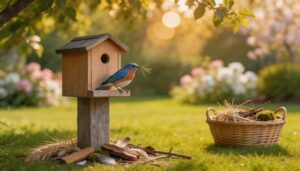
Knowing materials bluebirds need is only half the equation — the other half is making those materials easy to find. small changes to your yard can make a real difference during nesting season.
Here’s how to set things up so bluebirds actually use what you’re offering.
When and Where to Place Materials
Timing and placement matter more than most people realize. Morning Placement gives bluebirds a head start — they scout early, so having fresh materials out by dawn fits their rhythm. Keep stations at least 20 feet from active nest boxes to avoid disturbance, and use Shade Positioning to protect supplies from drying out or attracting predators.
- Practice Predator Camouflage by tucking stations near shrubs or brush piles
- Apply Seasonal Rotation — shift locations as nesting stages progress
- Follow best practices for reducing nest hazards by keeping materials elevated off the ground
- Support seasonal bird care with weekly replenishment checks
Using Native Plants as a Material Source
Your yard can do double duty when you grow native plants — they feed bluebirds and supply nesting material at the same time. Seed head harvesting from cattails or milkweed gives you ready-made plant down.
Native plant propagation and plant community diversity support seasonal material timing naturally, creating microhabitat placement opportunities that benefit avian nests and make habitat enhancement for birds part of everyday gardening.
Creating Safe and Accessible Material Stations
Set up stations between 24 and 30 inches high — that sweet spot works for both you and foraging bluebirds.
Use weatherproof containers made from untreated wood, label them with clear signage design, and keep hazardous nesting materials well away.
Place stations near native plants, since yard waste as nesting material works best when it’s already close by.
Accessibility features and volunteer training make the whole setup easier to sustain.
Maintaining and Replenishing Supplies Seasonally
Think of your material station like a garden — it needs tending, not just planting. Quarterly stock audits keep your supplies fresh and on track, while phenology-driven replenishment ties restocking to what’s actually blooming locally.
After storms, weather-driven restocking matters most.
Color-coded bins simplify inventory at a glance.
Community material swaps stretch your resources further, and skipping anything like cotton strings, soft pet hair, lichens, or seed bells keeps things safe.
Conservation Benefits of Supplying Natural Nesting Materials
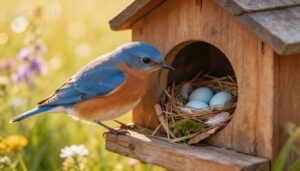
Helping bluebirds nest isn’t just a feel-good hobby — it actually moves the needle for local wildlife. When you offer the right materials, the ripple effects go further than you’d expect.
Here’s a look at what’s really at stake.
Supporting Bluebird Breeding Success
Every nest you stock with clean pine needles or dry grasses quietly tips the odds in a bluebird family’s favor. Stable nesting material means better insulation, fewer mite management crises, and stronger fledgling survival.
Pair that with predator control, water stations, and habitat connectivity between bird houses, and you’re following bird conservation guidelines that genuinely move the needle for cavity dwellers — native plant benefits included.
Reducing Reliance on Plastic and Synthetic Materials
Synthetic fibers don’t just fail bluebirds structurally — they introduce microplastics into the nest environment, where nestlings can ingest them. Swapping those out for natural alternatives is one of the simplest things you can do.
Synthetic fibers don’t just fail bluebirds — they poison nestlings from the inside out
- Avoid yarn, dryer lint, and fabric scraps — synthetic material hazards include entanglement and moisture collapse
- Join Community Material Swaps to share clean, chemical-free grasses and pine needles locally
- Build DIY Natural Kits using cattail fluff, dry sedges, and untreated straw
- Support Microplastic Monitoring programs that track nest contamination in your region
- Promote Educational Outreach and Policy Advocacy around Guidelines for safe bird nesting materials
Enhancing Local Ecosystems With Native Materials
When you plant natives, you’re not just tidying up the yard — you’re quietly rebuilding a whole food web. Native grasses and sedges act as native soil amendments, enriching the ground while offering ready-made nesting fibers.
Riparian buffer plantings stabilize stream edges and reduce erosion.
Pollinator habitat gardens boost microhabitat diversity that benefits birds well beyond the nest box.
| Native Material Benefit | Ecosystem Impact |
|---|---|
| Deep-rooted native grasses | Erosion control strategies for garden edges |
| Leaf litter decomposition | Enriches soil microbes and nutrient cycling |
| Seed-producing natives | Sustains seasonal food webs for birds |
| Riparian plantings | Filters runoff, improves water quality |
| Dense native sedge mats | Traps moisture for environmentally friendly, habitat-enhancing nesting sites |
Citizen Science and Monitoring Nest Composition
Your backyard observations can actually feed into something bigger. Programs like NestWatch let you log nest contents using standardized data sheets, tracking regional material trends and seasonal success metrics over time. Volunteer observation ethics keep disturbance minimal while the data stays meaningful.
- Record nest materials and egg counts per visit
- Note habitat type and surrounding vegetation
- Use the NestWatch mobile app for easy logging
- Compare your results against regional nesting benchmarks
Frequently Asked Questions (FAQs)
Where do bluebird parents sleep at night?
Funny enough, bluebirds don’t really "go home" — they roost in cavity dwellers’ spots like nest boxes or tree hollows, often sharing communal winter roosts when temperatures drop.
Do bluebirds reuse old nest materials each year?
Not exactly.
Bluebirds tend to build fresh nests each brood, though site fidelity influence means they’ll return to a proven box — sometimes incorporating leftover pine needles or grasses as a partial foundation.
Can bluebirds distinguish between natural and synthetic fibers?
Yes — bluebirds use tactile discrimination, visual color cues, and odor detection to assess fibers.
They favor flexible natural materials and actively avoid synthetic ones, which can pose serious avian health risks.
How does weather affect nest material selection?
Weather shapes every material choice.
Cold snaps drive temperature insulation needs up, humidity moisture control shifts with rainfall material shifts, and wind stability choices anchor the base — seasonal availability trends do the rest.
Are bluebirds territorial about their nesting material sources?
Bluebirds defend nest boxes fiercely, but material sources? Less so. Territorial defense timing peaks early in spring, mostly around the cavity itself — not scattered grasses nearby.
What time of day do bluebirds gather nesting materials?
Dawn gathering peaks between 7 and 10 a.m., when dew dries and materials are easiest to handle.
Evening collection bursts follow in late afternoon.
Midday material shifts are common on hot days.
Do bluebirds reuse nests from previous seasons?
Not exactly — they tend to "retire" old nests rather than move back in.
Seasonal fidelity keeps them returning to the same box, but parasite management drives them to rebuild fresh each time.
How many broods do bluebirds raise per year?
Most pairs raise two to three broods per season — sometimes four in warm southern regions.
Regional brood counts shift with weather, food availability, and pair stability, so no two seasons look quite the same.
Can bluebirds compete with other cavity-nesting birds?
Yes — bluebirds hold their own through territorial song, early seasonal timing, and entrance size strategy.
Spacing boxes 30+ feet apart reduces conflict with tree swallows and chickadees, keeping the species hierarchy in their favor.
What predators most threaten bluebird nesting boxes?
Squirrels, raccoons, house sparrows, cats, and raptors are the biggest threats. Predator guards on poles and proper entry-hole sizing go a long way toward keeping cavity dwellers safe.
Conclusion
Imagine a bluebird nest as a cozy, intricately woven cup—example of nature’s ingenuity. By providing the right natural nesting materials for bluebirds, such as pine needles and fine dry grasses, you’re supporting their impressive breeding success.
As you tend to your yard, remember that every twig and leaf counts. Your thoughtful offerings can make a tangible difference, helping these charming birds thrive in a world filled with synthetic debris and constant uncertainty.