This site is supported by our readers. We may earn a commission, at no cost to you, if you purchase through links.

Watch a bird feeder during a downpour and you’ll notice something strange—the birds vanish. One moment a dozen sparrows are competing for seeds, and the next the yard stands empty, as if the rain washed them clean away.
They didn’t fly south or find a different feeder. They went somewhere close, somewhere most people never think to look.
Understanding where birds go when it rains reveals a surprisingly complex set of survival strategies, from waterproof feather engineering to instinctive body postures that shed water like a sloped roof. What they do next, and how you can help, are worth knowing.
Table Of Contents
- Key Takeaways
- Why Rain Sends Birds Into Cover
- Birds Go to Nearby Shelter
- Trees and Shrubs as Rain Cover
- Cavities, Nest Boxes, and Brush Piles
- Buildings, Bridges, and Urban Overhangs
- How Birds Stay Dry
- Postures Birds Use in Rain
- Feeding Changes During Rain
- Which Birds Tolerate Rain Better
- How to Help Birds in Rain
- Frequently Asked Questions (FAQs)
- Where do birds live if it rains?
- What happens to birds when it rains?
- Where do birds hunk in a storm?
- Do birds eat in rain?
- Can birds fly in the rain?
- Where do birds hunk in the rain?
- Where do birds eat in the rain?
- How do birds survive in rain?
- Do birds get struck by lightning during storms?
- Can birds predict incoming rain and storm patterns?
- Conclusion
Key Takeaways
- When rain hits, birds don’t go far — they duck into dense foliage near tree trunks, thick hedges, natural cavities, or building eaves to stay warm and cut wind exposure.
- Wet feathers are a real danger, not just a discomfort, because soaked plumage loses its insulating air pockets fast and can push small birds toward hypothermia within minutes.
- Birds actively manage the rain through deliberate body postures — fluffing in light showers to trap warmth, sleeking tightly in heavy downpours to shed water quickly along feather shafts.
- You can make a real difference by planting dense native shrubs, mounting roost boxes away from prevailing winds, and using covered feeders to keep seed dry and mold-free.
Why Rain Sends Birds Into Cover
Rain isn’t just uncomfortable for birds — it’s a real threat to their survival. Wet feathers lose insulating power fast, and cold wind makes things worse, especially for smaller species.
Owls face some of the steepest odds in wet weather, since soaked feathers and scarce prey can quickly turn a rainstorm into a life-threatening challenge for owls and their chicks.
Here’s why birds don’t just tough it out and what actually drives them to find cover.
Heat Loss From Wet Feathers
When feathers get soaked, the thermal conductivity increase is immediate — water replaces the trapped air that normally keeps a bird warm. Feather water saturation collapses the down layer, stripping away thermal insulation fast.
Add the evaporative cooling effect on top of that, and the metabolic energy cost of staying warm climbs sharply. For small birds, that’s a short road to hypothermia.
This effect is explained by how rain fills feather air pockets leads to rapid heat loss.
Wind Exposure and Energy Drain
Rain isn’t the only threat — wind makes everything worse.
Convective heat loss spikes when gusts strip warm air from exposed feathers, and Wind Chill Amplification can push a small bird’s energy expenditure up dramatically.
That’s where Perch Wind Shielding and Huddling Energy Savings become critical rain shelter strategies, helping birds balance thermoregulation without burning through reserves they can’t afford to lose.
Birds also rely on feather water repellency to keep dry.
Why Small Birds Hide Fast
Small birds don’t have the luxury of waiting things out. Their high surface-area-to-volume ratio means hypothermia risk climbs fast once feathers start absorbing moisture.
That’s why Rapid Flight Initiation and Rain Detection are almost instinctive — every second of exposure costs energy they can’t spare.
Energy Conservation drives them straight into dense shrubs, where Social Huddling and Predator Avoidance both improve dramatically.
Why Shelter Matters More in Heavy Rain
Heavy rain changes everything. When a downpour hits, Thermal Insulation Loss accelerates rapidly — soaked plumage traps almost no air, and thermoregulation and hypothermia risk in birds spike within minutes.
Wind Shear Amplification drives that chill even deeper, while Rain-Induced Drag makes any movement costly.
That’s when bird shelters during rain — natural cavities, nest boxes, and dense cover — deliver a critical Microclimate Temperature Boost, cutting the Energy Expenditure Spike before it becomes irreversible.
Birds Go to Nearby Shelter
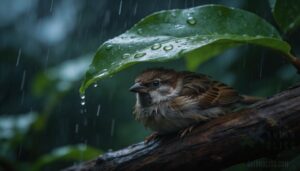
rain starts, birds don’t wander far — they move fast and stay close to whatever cover is nearby. Their choices are actually pretty predictable once you know what to look for.
main spots birds head to when the skies open up.
Dense Foliage Near The Trunk
When a storm rolls in, birds don’t wander far — the dense foliage nearest the trunk becomes an instant refuge. Branch lattice cushioning absorbs wind shaking, while needle water channeling diverts rain downward. Moss camouflage helps birds blend into the gray. Microclimate humidity stays warmer here, and insect concentration spikes along moist bark — convenient fuel during a wait.
- Overlapping leaves intercept drops before they reach resting birds
- Lichen and moss soften both rain impact and visibility to predators
- Dense canopy near the trunk keeps down feathers dry longer
Low Shrubs and Thick Hedges
When the sky opens up, thick shrubs and dense hedges become some of the most reliable bird shelters during rain. Hedgerow Connectivity matters — birds move quickly between linked corridors of cover. Microclimate Temperature inside stays noticeably warmer and drier, especially under shrubs and bushes with tight branching. Hedge Species Selection shapes how well that protection holds.
| Hedge Type | Rain Shelter Quality | Predator Visibility |
|---|---|---|
| Holly/Yew | High – year-round cover | Low |
| Hawthorn | Medium – dense stems | Medium |
| Privet | Medium – seasonal gaps | Medium-High |
Seasonal Hedge Maintenance keeps access points clear and canopy intact for rain shelter selection.
Tree Cavities and Natural Crevices
When branches break or decay carves out hollows, birds gain some of the most dependable rain refuges in any landscape.
Three things make these spots worth knowing:
- Cavity Microclimate – The interior stays warmer and drier than outside air.
- Predator Exclusion – A smaller Entrance Size limits who can follow.
- Decay Formation and Woodpecker Excavation – Both create natural cavities year‑round.
Eaves, Awnings, and Bridge Undersides
Not every rain shelter grows from a tree. When rain starts, pigeons, sparrows, and swallows move fast toward eaves of buildings, awnings, and bridge undersides — structures that offer immediate overhead cover without a long flight.
Eave depth variation matters here: deeper overhangs block more wind-driven rain.
Bridge undersides provide broad dry zones, though bridge vibration risks can make some nesting sites unstable.
Urban perch safety depends heavily on how exposed the structure really is.
Trees and Shrubs as Rain Cover

Trees and shrubs aren’t just scenery — for birds, they’re the first line of defense when the sky opens up.
Not all plants offer the same protection, though, and birds are surprisingly choosy about where they land.
Here’s a look at how different types of trees and shrubs actually hold up as rain cover.
Evergreens as Natural Umbrellas
Evergreen trees work like a living umbrella. Their canopy interception rate can reach 60–90%, meaning most rain never reaches the ground beneath. That windbreak effect slows gusts, reduces wind-driven rain, and creates microclimate cooling in the understory.
Needle mulch on the forest floor absorbs moisture, keeping things surprisingly dry. Birds rely on this seasonal shelter year‑round — here’s what makes it work:
- Dense foliage blocks a major portion of incoming rainfall before it hits perching birds
- Persistent needles guarantee bird shelters during rain stay functional even through winter storms
- Slowed wind beneath the canopy reduces heat loss, supporting bird shelter‑seeking behavior during rain
- The cooler, stable microclimate beneath discourages rapid temperature swings that stress small birds
Inner Canopy Vs. Outer Branches
Not all spots inside a tree offer the same protection. The inner canopy’s dense foliage acts as thermal insulation, trapping warmth and maintaining a humidity gradient that keeps bird shelters during rain, noticeably warmer than open air.
Outer branches, by contrast, provide better predation visibility and wind shielding, but leave birds more exposed. Rain-induced behavior often drives small birds deeper inward, balancing microclimate temperature against escape options.
Why Birds Perch Close to Trunks
Moving closer to the trunk isn’t random — it’s calculated.
Bark texture grips wet claws better, offering stability in wind that outer perches simply can’t match.
The trunk’s shadow provides Camouflage from Predators, breaking up a bird’s outline against rain-soaked bark.
Key advantages of trunk-side perching:
- Thermal Microclimate formed by still air near bark slows heat loss
- Quick Escape Routes open with minimal repositioning
- Proximity to Food — insects and invertebrates cluster in cracked bark
- Natural cavities and overhanging branches nearby extend shelter options
Best Plant Types for Rain Shelter
Once you understand why trunk-side perching works, choosing the right plants for your yard becomes just as deliberate. Viburnum thickets and holly thorn barriers block wind-driven rain at eye level, while dogwood canopy layers shelter what’s beneath.
Bamboo windbreaks reduce rain impact along exposed edges.
Tuck in mossy groundcovers under shrubs and bushes, and coniferous or evergreen trees complete a layered system that birds genuinely use.
Cavities, Nest Boxes, and Brush Piles
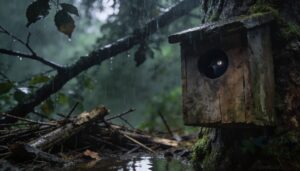
Sometimes open branches and thick foliage just aren’t enough — birds need something more enclosed to ride out a serious storm. That’s when cavities, nest boxes, and brush piles become the real difference between staying dry and getting soaked to the bone.
Here’s a closer look at the enclosed options birds turn to when the weather gets serious.
Tree Hollows and Rock Crevices
When rot fungi hollow out a mature oak or beech over decades, they’re quietly building one of nature’s most effective rain shelters. These natural cavities offer genuine microclimate buffering — warmer, calmer, and drier than the air outside. Species size limits matter here; narrow entrances favor small songbirds while keeping larger predators out.
Rot fungi hollowing ancient oaks for decades quietly build nature’s most effective rain shelters
- Mosses lining hollow walls absorb excess moisture, keeping interiors surprisingly dry.
- Rock crevices stay cool at depth, shielding birds from wind-driven rain.
- Crevice moisture retention stays low in granite fractures, making them reliable refuges.
- Hollow formation process can take decades, tied directly to conservation strategies for old trees.
- Darker hollow entrances reduce predator visibility, reinforcing bird shelter-seeking behavior in rain.
Roost Boxes During Storms
Where natural hollows are scarce, roost boxes step in as storm shelters. Unlike standard nest boxes, these are purpose‑built for cold, wet nights — thicker walls improve Thermal Insulation, while strategic Ventilation Management lets moisture escape without sacrificing warmth. Entrance Design matters too: a low entrance hole traps rising heat inside.
| Feature | Design Detail | Storm Benefit |
|---|---|---|
| Entrance Design | Bottom‑positioned, small hole | Retains warm air inside |
| Predator Guard Holes | Reinforced entrance surround | Blocks predator reach during storms |
| Mounting Placement | 6–15 feet high, wind‑facing back | Reduces direct rain and predator access |
| Thermal Insulation | Thick walls, optional cork lining | Maintains interior warmth during downpours |
| Ventilation Management | High‑placed vents, slanted base | Releases moisture without losing heat |
Bird‑friendly backyard design for rainy weather starts here. Mounting a box under existing eaves — a nod to Bird shelter‑seeking behavior during rain — combines natural and artificial shelter perfectly. Providing artificial shelters for birds doesn’t require much space, just thoughtful placement away from prevailing winds.
Brush Piles for Ground-Level Cover
A well-built brush pile gives ground-level birds exactly what dense shrubs can’t always offer — concealed, low cover right where they need it.
Follow basic Construction Guidelines: stack logs as a base, then layer branches down to smaller twigs. Leave six-to-eight-inch openings for quick entry.
Seasonal Material Choice matters too — pine boughs outlast deciduous leaves, supporting Airflow Optimization and Habitat Connectivity Planning through winter storms.
When Birds Choose Enclosed Shelter
When the storm really picks up, birds don’t just want cover — they want walls.
Cavity Selection kicks in hard during heavy or prolonged rain, pulling species toward tree hollows, nest boxes, and birdhouses where Microclimate Temperature stays noticeably warmer. Predator Avoidance also drives this choice; enclosed spaces offer fewer angles of attack.
Social Roosting happens too, with small birds squeezing into natural cavities, dense shrubs, and under shrubs and bushes together for shared warmth during Seasonal Shelter shifts.
Buildings, Bridges, and Urban Overhangs

City birds don’t need a forest to wait out the rain — they’ve learned to read the architecture around them. Pigeons, sparrows, and starlings are surprisingly good at finding dry spots in the most ordinary urban structures.
Here’s where they tend to go.
Why City Birds Use Structures
City birds don’t just tolerate human infrastructure — they’ve learned to exploit it. Bridges, parking garages, and billboard frames act as urban structures and avian refuges, offering thermal microclimate stability, predator avoidance from ground-level threats, and instant cover during downpours.
Where hollow trees are scarce, birdhouses and nest boxes fill that gap.
Buildings basically replaced the forest.
Eaves, Porches, and Window Ledges
Eaves, porches, and window ledges are some of the most reliable rain shelters birds find in cities.
The overhanging edge of a roofline gives edge perch stability and blocks direct rainfall, while painted sills offer surprising thermal retention — warm enough to function as a feather drying spot between gusts.
Railings improve predator visibility, and the extended shade duration under porches keeps birds calmer during longer downpours.
Dry Microhabitats in Urban Areas
Urban parks hold more bird refuges than you might expect. Mossy Bark Crevices in mature street trees stay surprisingly dry during light showers, and Leaf Litter Pockets beneath dense trees trap warm air close to the ground. Stone Wall Nooks, Gravel Bed Refuges, and Park Depression Patches all quietly fill with sheltering birds during downpours — alongside birdhouses, nest boxes, and under building eaves.
Three spots worth watching:
- Bark crevices — rough surfaces shed water fast, giving perched birds a dry rest
- Gravel garden beds — loose material drains quickly, keeping seeds and insects accessible
- Stone wall gaps — use of natural and artificial structures as bird refuges is surprisingly effective here
Limits of Man-Made Rain Shelter
Man-made shelters have real limits. Even a generous eave can’t block sideways rain, and Roof Pitch Limits mean driving storms still soak the opening.
Ventilation Blockage Risk builds up fast when nesting material plugs drain holes — Drainage Hole Size matters more than most people realize.
Predators exploit Predator Access Pathways near climbable poles, and Maintenance Frequency Needs often go unmet.
| Shelter Type | Key Weakness | What Helps |
|---|---|---|
| Building eave | Wind-driven rain penetrates | Deeper overhang, angled mount |
| Bridge ledge | Open to noise and disturbance | Limited — brief refuge only |
| Nest box | Drainage blocked by nesting debris | Regular clearing, small drain holes |
| Awning | No enclosed cavity for warmth | Pair with natural dense shrubs |
| Urban tree cavity | Competes with starlings, squirrels | Supplemental roost boxes nearby |
How Birds Stay Dry

Shelter helps, but birds don’t rely on it alone. Their feathers do a lot of the heavy lifting when rain starts falling. Here’s how that waterproofing system actually works.
Waterproof Feather Structure
What keeps a bird’s feathers dry isn’t luck — it’s engineering. Each feather works through several overlapping waterproofing mechanisms in avian feathers:
- Barbule Hook Interlock seals barbs tightly, closing gaps before rain penetrates
- Microtexture Roughness raises contact angles so water beads instantly
- Air Pocket Trapping preserves insulating down beneath the outer layer
- Layered Feather Redundancy creates backup barriers if one layer flexes
Together, these produce a hydrophobic feather structure that sheds water remarkably well.
Preen Oil and The Uropygial Gland
That feather structure works even better with the right coating. Tucked at the tail’s base, the uropygial gland produces preen oil that birds spread across their plumage during grooming. This oil’s antimicrobial properties protect feather keratin, while its chemical makeup shifts with season and diet.
| Feature | Function | Variation |
|---|---|---|
| Oil composition | Waterproofs outer feathers | Changes seasonally |
| Gland morphology | Regulates oil output | Larger in aquatic birds |
| Social signaling | Communicates health cues | Species-dependent |
Water Beading on Outer Feathers
That preen oil doesn’t just sit there — it actively drives water beading across outer feathers through microstructure hydrophobicity, where microscopic barbule ridges repel droplets before they can spread. Watch what happens when rain hits a well-preened bird:
- Droplets bead and roll off instantly, resisting droplet coalescence
- Temperature-dependent beading slows in cold, humid air
- Wind disruption effects can strip the oil renewal cycle, reducing water repellency
Waterproofing mechanisms in avian feathers depend on consistent feather oil preening to maintain that hydrophobic barrier.
Keeping The Insulating Down Layer Dry
Once water beads off the outer feathers, your real concern shifts inward — protecting the soft down beneath. That insulating layer of feathers is what actually keeps a bird warm.
Preen oil and feather alignment work together for moisture shedding alignment, maintaining air pocket retention so loft preservation stays intact.
| Down Layer Function | Rain Response |
|---|---|
| Thermal insulation maintenance | Fluffing up feathers traps air |
| Loft preservation | Feather alignment seals gaps |
| Waterproofing mechanisms in avian feathers | Preen oil repels penetration |
| Air pocket retention | Compact posture limits wind chill |
Postures Birds Use in Rain
When rain hits, birds don’t just sit there and take it — they shift their bodies in surprisingly deliberate ways. Each posture fulfills a purpose, whether it’s holding in warmth or shedding water fast.
Here’s how those adjustments actually work.
Hunched and Compact Storm Posture
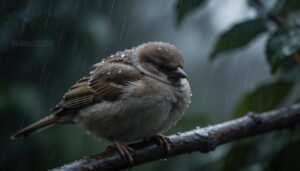
When a storm hits, birds don’t just hunker down randomly — every posture adjustment is deliberate. That hunched posture is a Thermal Insulation Strategy shaped by instinct.
- Compact Wing Tucking draws wings flush against the body
- Reduced Surface Area limits rain contact by up to 30%
- Wind Resistant Alignment keeps the breast forward, flanks sheltered
- Energy Saving Stance cuts unnecessary movement during downpours
- Storm shelter behavior holds until rain eases
Fluffing for Warmth in Light Rain
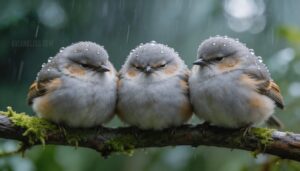
Fluffing up their feathers in light rain is one of the quietest survival strategies you’ll ever notice. Chest fluffing creates a microclimate — a warm, humid pocket beneath the outer plumage that slows heat loss dramatically.
Small songbirds use this for thermoregulation and thermal insulation, often synchronizing the behavior across a shared perch in what’s called social synchrony. It’s smart energy conservation, triggered partly by humidity itself.
Sleeking Feathers in Heavy Rain
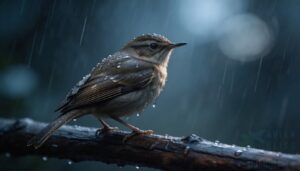
When heavy rain hits, birds switch strategies fast. Instead of fluffing, they sleek — tensing feather muscles to flatten plumage tightly against the body.
This barbule alignment channels water along the feather shafts, enabling rapid water shedding within seconds. Combined with feather oil preening and waterproofing from the uropygial gland, this sleek posture dynamics response keeps water-repellent plumage intact, supporting thermoregulation and reducing hypothermia risk through energy conservation seeking.
Tucking The Head to Reduce Exposure
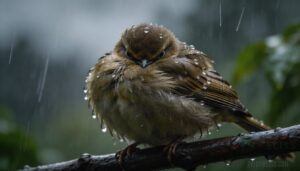
Tucking the head into the shoulder feathers is one of the most effective posture adjustments for rain protection that a bird can make.
It achieves Eye Shielding and Bill Protection simultaneously while creating a Compact Body Shape that helps Exposure Minimization.
This bird shelter-seeking behavior during rain also delivers real Metabolic Savings — the head loses heat quickly, so hiding it conserves core warmth without burning extra energy.
Feeding Changes During Rain
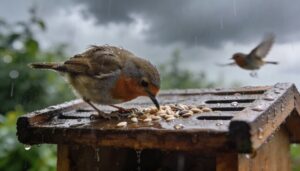
Rain doesn’t just change where birds go — it changes how and when they eat. Their feeding habits shift in some surprisingly practical ways once the clouds roll in.
Here’s what actually happens.
Foraging Less During Downpours
When a downpour hits, foraging almost stops. rain-induced flight limitation makes hunting genuinely costly — slower wingbeats and low‑altitude movement reduce hunting success.
Insect availability decline compounds the problem, since wet conditions push prey deeper into leaf litter. Prey visibility reduction and energy budget constraints together trigger a natural rain‑induced foraging pause, reshaping bird foraging patterns until conditions improve.
Quick Feeding Before Rain Starts
Before a storm arrives, birds don’t wait around. A barometric pressure drop, humidity spike, or sudden wind surge triggers something instinctive — a prestorm feeding rush.
You’ll notice quick-access feeders getting unusually busy as birds cram in energy-rich snacks while they can. These sensory cues in birds prompt rapid, efficient foraging before the rain-induced foraging pause forces them to stop entirely.
Seeds, Berries, and Other Easy Foods
Once that rain-induced foraging pause sets in, birds shift toward whatever’s easiest to grab. Wet conditions reshape foraging patterns fast, making reliable, sheltered food critical.
High energy seeds like black-oil sunflower, berry shrubs loaded with seasonal fruit, and suet feeders become go-to food sources. Insect supplements help too, since the rain’s impact on bird foraging patterns often means fewer live insects are accessible.
Returning to Feed After Rain Stops
Once that rain-induced foraging pause lifts, birds don’t waste a second. Food availability after rain spikes quickly, and the feeding peak timing is surprisingly tight.
Here’s what you’ll notice:
- Insect Surge draws birds to damp soil within minutes
- Ground Seed Access opens up as puddles drain
- Rapid Foraging Burst peaks in the first 30 minutes
- Post Rain Competition brings multiple species to the same patch
- Insects and worms surface quickly, triggering rain-induced changes in bird feeding habits
Which Birds Tolerate Rain Better
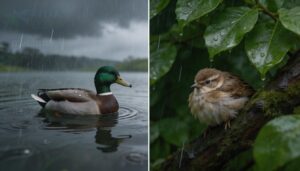
Not every bird manages a rainstorm the same way — and that gap in tolerance can mean the difference between staying put and scrambling for cover.
Body size, feather type, and natural habitat all shape how well a species weathers the wet.
Here’s how different birds stack up when the rain rolls in.
Small Songbirds and Hypothermia Risk
Small songbirds face the steepest hypothermia risk in wet weather, and body size is the core reason why.
Their higher surface-area-to-volume ratio means thermal conductivity works against them — heat escapes fast.
With limited energy stores and an elevated metabolic rate, even a short rain can tip the balance.
Behavioral thermoregulation, like retreating into brush piles or dense cover, becomes genuinely life‑saving.
Waterfowl That Stay Active
Waterfowl are built differently. Ducks, geese, and mergansers rely on dense feather oil from the uropygial gland to keep water beading off their plumage — making thermoregulation and hypothermia risk far less urgent than for songbirds.
Their water surface preference means rain barely disrupts normal life:
- Diving ducks forage deeper, unbothered by surface conditions
- Dabbling ducks feed along sheltered shorelines between showers
- Canada geese maintain flight readiness, moving short distances for calmer water
- Energy conservation kicks in through shoreline shelter and reduced unnecessary movement
- Molting timing adjusts seasonally, keeping waterproofing intact when it matters most
Larger Birds That Perch Openly
Hawks, eagles, and vultures handle wet weather differently than smaller birds. Their dense plumage creates a water‑shedding cape effect, while feather waterproofing and thermoregulation keep core temperatures stable. Sharp‑vision perching on wind‑resistant perches at forest edges lets them spot prey even mid‑shower.
| Behavior | Purpose |
|---|---|
| Territorial perch display | Keeps rivals away while waiting |
| Muscular grip adaptation | Maintains balance on slick, rain-wet bark |
| Brief perch duration | Conserves energy before switching to foraging |
Species Differences in Shelter Choice
No two species respond to rain the same way. Size-driven preferences shape where each bird lands — finches bolt under shrubs and bushes, woodpeckers retreat into natural holes in trees, and swallows vanish beneath eaves.
Migratory vs resident status matters too, since resident birds learn reliable local spots like brush piles or nest boxes over time. Habitat specialization and predator-driven selection further sharpen these species-specific responses to different rain intensities.
How to Help Birds in Rain
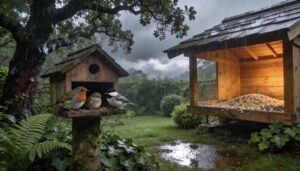
You don’t need a wildlife degree to make your yard a safer place for birds when the skies open up. A simple additions can go a long way toward giving them reliable cover, food, and shelter when they need it most.
Here’s what actually helps.
Plant Dense Native Shrubs
Dense native shrubs are some of the best rain shelters you can offer birds. Their multi‑stem architecture creates layered roost points, thorny predator deterrence keeps hunters at bay, and root system stability holds cover intact after heavy storms.
Plant a mix for native shrub diversity:
- Low sprawling species for under shrubs and bushes ground cover
- Mid‑height dense vegetation as refuges between feeding runs
- Evergreen types that stay intact when deciduous cover disappears
Seasonal insect support comes as a bonus.
Add Roost Boxes and Nest Boxes
A well-placed roost box can be a lifesaver during a downpour.
Mount nest boxes and birdhouses 6 to 15 feet up, with entrance holes around 1½ inches wide, a drainage hole in the floor, and a predator guard on the post. Face the entrance away from prevailing winds.
Cedar holds up best — durable, rot-resistant, and toxin-free.
Use Covered Feeders
Covered feeders solve a quiet problem most backyard birders miss. Seed Moisture Control matters more than you’d think — wet seed molds fast and birds won’t touch it.
A covered feeder with Ventilation Design keeps things dry and fresh. Smart Feeder Placement under eaves maximizes protection, while built-in Predator Deterrence features block squirrels.
Don’t skip Seasonal Maintenance — a quick wipe-down after heavy rain keeps it working.
Build Safe Brush Piles
brush pile is one of the most underrated bird rain hiding spots you can build.
Base Log Placement — large logs on the bottom, gaps between them for Open Pocket Design, so birds can slip inside.
Edge Spacing Guidelines by keeping piles 10 to 20 feet across, away from structures for Fire Hazard Mitigation.
Native Plant Integration around the pile adds food and cover.
Avoid Disturbing Sheltering Birds
Once you’ve built that brush pile, your job shifts — step back and let it work. Sheltering birds are fragile guests, and quiet observation matters more than you’d think.
Keep these habits in mind during any storm:
- Practice quiet observation and avoid sudden movements near dense cover
- Minimize shadows passing over shrubs where birds may be huddling
- Keep pets indoors so roosting spots stay undisturbed
- Use soft lighting if you’re outside after dark
- Don’t flush communal roosting groups by walking too close
Frequently Asked Questions (FAQs)
Where do birds live if it rains?
Rain doesn’t stop life — it redirects it.
Birds shift to natural cavities, nest boxes, dense foliage, and overhangs, settling into microclimate temperature zones that buffer wind, reduce predator exposure, and keep their insulating feathers dry.
What happens to birds when it rains?
When it rains, birds immediately shift into survival mode — seeking shelter, reducing activity, and conserving heat. Their feathers repel water, but heavy rain still raises hypothermia risk fast.
Where do birds hunk in a storm?
Birds tuck into dense cover fast — inner tree branches, thick shrubs, natural cavities, or building eaves.
Microclimate selection drives every choice, favoring thermal pockets and windward perch spots that block rain and hold warmth.
Do birds eat in rain?
You’ll notice birds adapt their feeding habits in wet weather—some take advantage of worm surfacing and invertebrate emergence.
But heavy rain often triggers a rain‑induced foraging pause, pushing them toward energy conservation strategies and food caching behavior.
Can birds fly in the rain?
Yes, birds can fly in the rain — but most choose not to. wet feathers increase drag and reduce lift, making flight costlier.
Most birds wait it out, taking short bursts only when necessary.
Where do birds hunk in the rain?
When rain hits, birds tuck into dense foliage, eaves, and brush piles — wherever a dry microclimate temperature pocket exists.
They go quiet quickly, trading Rain-Induced Vocal Silence for stillness and safety under overhangs.
Where do birds eat in the rain?
You’ll find birds eating at ground-level foraging spots, shrub edges, and sheltered feeders.
Rainfall impacts foraging activity, triggering insect emergence and microhabitat seed access, but heavy showers cause rain‑induced foraging pauses and delays until conditions improve.
How do birds survive in rain?
Birds survive rain through feather waterproofing, shelter-seeking behavior, and metabolic rate adjustment.
Fluffed plumage traps warmth, while group huddling for warmth and energy conservation strategies during rain prevent dangerous heat loss and hypothermia risk.
Do birds get struck by lightning during storms?
Lightning strike risk for birds is real, but rare.
Their instinctive storm avoidance behavior — seeking low, dense cover early — naturally reduces perch conductivity exposure, ground current danger, and storm side flashes before heavy storm conditions peak.
Can birds predict incoming rain and storm patterns?
Yes — birds are practically living weather stations.
Through Barometric Pressure Detection, Infrasound Sensing, and Humidity Cue Response, they sense storms hours ahead, triggering bird shelter-seeking behavior and storm avoidance behavior well before the first drop falls.
Conclusion
Imagine every bird vanishing mid‑flight—yet they’re closer than you think. Understanding where birds go when it rains reveals their resilience: dense evergreens, urban eaves, and brush piles become lifelines.
Their waterproof feathers and hunched postures defy downpours, but survival hinges on shelter.
You can help by planting native shrubs, installing roost boxes, and keeping feeders covered. These small acts bridge their wild strategies with your care, ensuring the next storm finds them ready, visible, and thriving.
A shared sky demands shared shelter.
- https://www.perchme.com/blogs/birdfeeders/where-do-the-birds-go-when-it-rains
- https://chirpforbirds.com/wild-bird-resources/how-weather-affects-birds/
- https://toughlittlebirds.com/2014/10/18/what-do-birds-do-when-it-rains/
- https://www.reallywildbirdfood.co.uk/news/post/2024/02/21/what-do-birds-do-when-it-rains
- https://conservationcatalyst.org/how-do-birds-survive-the-wet-and-cold/